Introduction
Most early-stage B2B SaaS founders invest months and thousands of dollars winning customers, only to watch them quietly cancel 6-12 months later. The painful truth: churn isn't usually about price — it's about a broken post-sales experience that leaves customers struggling to see value.
Research shows acquiring a new customer costs five to 25 times more than retaining one. Even a 5% improvement in customer retention produces more than a 25% increase in profit. Businesses that get retention right don't just grow faster — they spend less to do it.
This guide covers what churn really is and the root causes specific to B2B SaaS. More importantly, it gives CS teams and founders concrete practices to stop losing customers they worked hard to win.
TLDR
- Customer churn measures the percentage of customers who stop doing business with you; cutting churn by just 5% can boost profits by 25–95%
- Top B2B SaaS churn drivers are poor onboarding, low product adoption, weak relationships, and bad-fit customers — pricing rarely is
- Structured onboarding, health scoring, QBRs, and multi-threaded relationships beat reactive save attempts every time
- Early-stage startups can build effective CS without a full-time team by prioritizing high-value accounts and establishing repeatable playbooks from day one
What Is Churn in Customer Success — And Why It's So Costly
Customer churn is the percentage of customers who cancel or don't renew over a given period. The formula is simple: customers lost ÷ customers at period start × 100.
Two types of churn exist:
- Voluntary churn: Customer-initiated cancellations due to dissatisfaction, lack of value, or better alternatives
- Involuntary churn: Non-payment, expired credit cards, or account inactivity
For B2B SaaS specifically, churn is devastating because revenue compounds on retained accounts. A customer paying $5,000/month who stays three years generates $180,000 in lifetime value. Lose them after six months, and you've left $150,000 on the table.
Why Churn Matters Beyond Revenue Loss
Churn signals operational problems that affect your entire business:
- Raises CAC pressure — replacing lost revenue requires more new customers, driving up acquisition costs and burning budget faster
- Derails forecasting — unpredictable retention makes revenue projections unreliable, which limits growth planning and concerns investors
- Exposes onboarding gaps — when customers leave because expectations weren't met, it points to broken handoffs, unclear value delivery, or missing success milestones
BenchmarkIT's 2025 report shows median Gross Revenue Retention at 88%, down from 90% in 2022. The average B2B SaaS company is losing 12% of revenue annually from existing customer churn alone. Expansion revenue can offset some of that loss, but companies without it are falling behind.
The key insight from top-performing CS teams: Churn is usually an operational problem, not just a product one. Unclear ownership, invisible risk signals, and inconsistent follow-up are what let at-risk accounts slip away undetected. Address those gaps, and retention rates follow.
The Most Common Causes of B2B SaaS Churn
Poor Onboarding and Low Product Adoption
Customers who never reach a "first value moment" early in their lifecycle churn at significantly higher rates. Poor onboarding rarely shows up in exit surveys as the stated reason, but it correlates strongly with low engagement, high support ticket volume, and eventual attrition.
Bessemer Venture Partners reports that Procore reduced time to value from 60 days to 30 days through auto-provisioning, certificate programs, and drip email campaigns — directly improving retention. Tactics that drove this included:
- Auto-provisioning to reduce setup friction on day one
- Certificate programs that built product fluency early
- Drip email campaigns tied to usage milestones
The faster customers experience meaningful outcomes, the stickier they become.
Weak Post-Sales Relationships and Broken Sales-to-CS Handoffs
When customers feel passed off or have to re-explain their goals to a new contact after signing, trust erodes. The sales-to-CS handoff is one of the most consequential — and most neglected — moments in the customer lifecycle.
ChurnZero reports a 51% probability of churn within one year if a customer champion departs. If the champion is a senior executive, the risk rises to 65%. Single-threaded relationships are an existential risk: if your one contact leaves, so does the account.
Misaligned ICP and Poor-Fit Customers
Churn often has roots in the sales process itself. Customers sold on features or price — rather than genuine fit and expected outcomes — arrive predisposed to leave.
Bessemer's churn benchmarks by segment:
| Customer Segment | "Good" Annual Churn | "Best" Annual Churn |
|---|---|---|
| ICP / Upmarket | 10-15% | Below 5% |
| SMB | 15-20% | 5-10% |
| Non-ICP (early-stage) | 15-20% (expected) | N/A |
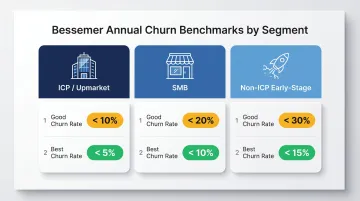
Shedding poor-fit customers isn't failure — it's a deliberate trade-off. Tightening your ICP early reduces noise in your retention metrics and lets your CS team focus where they can actually win.
Customer Success Best Practices That Actually Reduce Churn
Perfect the Sales-to-CS Handoff
A strong handoff includes the Account Executive or sales rep documenting customer goals, key stakeholders, pain points, and promises made — and passing this to the CSM before the first customer success call.
What a documented handoff looks like:
- CRM notes detailing buyer goals and success criteria
- A handoff form capturing key stakeholders and decision-making dynamics
- A short Loom video from the AE summarizing the customer's story
- A live meeting where the AE introduces the CSM to the customer
For startups using fractional sales professionals — like those sourced through Activated Scale — establishing this documented handoff process from day one ensures continuity and protects customer relationships won by the sales team. When fractional talent rotates or engagement models change, documentation prevents institutional knowledge from walking out the door.
Create a Structured, Goal-Oriented Onboarding Process
Onboarding should focus on getting customers to their first meaningful outcome as quickly as possible — not just "setting them up."
Key elements of effective onboarding:
- An intake call aligned to customer goals, not just product features
- A clear success milestone in the first 30-60 days
- Automated follow-up content for self-serve steps
- Personalized onboarding for enterprise or higher-ACV customers
TSIA research found that 22% of customers cancel because they don't perceive value or aren't willing to pay for the perceived value. Structured onboarding directly addresses this by making value tangible and measurable early.
Run Regular Check-Ins and Quarterly Business Reviews (QBRs)
QBRs aren't status updates — they're structured conversations that re-align on customer goals, review outcomes delivered, and surface new needs.
Research from Staircase AI found that customers who have regular QBRs are twice as likely to renew their contracts compared to those who don't receive QBRs.
A QBR agenda should include:
- Progress vs. original goals
- Product usage review with key metrics
- Roadmap preview relevant to the customer's use case
- Next steps and expansion opportunities
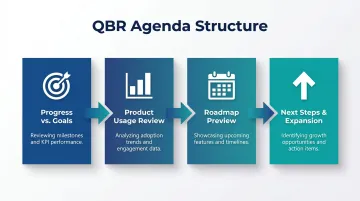
Even informal monthly check-ins for smaller accounts serve the same purpose at lower effort. Showing up on a predictable schedule — even briefly — signals to customers that their outcomes matter beyond the renewal date.
Invest in Customer Education and Enablement
Customers churn when they don't feel confident the product is delivering enough value for the effort it requires.
Types of education that reduce churn:
- Short walkthrough videos for common tasks
- In-app guidance and tooltips
- Webinars on advanced features or use cases
- Knowledge base with searchable how-to articles
Track which content customers consume. Drop-offs at a specific step often signal a retention leak worth addressing. According to McKinsey research on B2B tech, best-in-class value realization practices correlate with a +7 percentage point NRR lift compared to foundational maturity.
Build Multi-Threaded Account Relationships
If your only contact at an account leaves, changes roles, or goes on leave, the relationship — and the renewal — is at risk.
Growth Molecules recommends a minimum of 3-5 active relationships across different departments and seniority levels for enterprise or high-touch accounts to be considered safe from single-threading risk. This mirrors what strong AEs do during the sales process: involve multiple stakeholders to reduce deal risk.
How to multi-thread effectively:
- Invite multiple customer contacts to onboarding and QBRs
- Engage cross-functional teams (IT, operations, finance) based on product usage
- Connect executives on both sides for strategic alignment
- Document relationship maps in your CRM
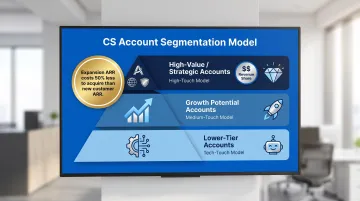
Segment Customers by Value and Prioritize Accordingly
Churn from a $200K account hits differently than losing a $5K contract — and your CS capacity should reflect that. Segment accounts by:
- Revenue contribution
- Expansion potential
- Strategic importance (for example, logo value or industry influence)
The Pareto principle applies: a small percentage of customers typically drive the majority of revenue. BenchmarkIT's 2025 report shows expansion ARR costs 50% less to acquire than new customer ARR ($1.00 Expansion CAC Ratio vs. $2.00 New Customer CAC Ratio). High-value and high-growth accounts warrant high-touch engagement; lower-tier accounts can be served with a lighter, tech-touch model. Getting this segmentation right means your best CSMs spend their hours where churn would hurt most.
How to Detect and Respond to Churn Risk Signals Early
Key Behavioral Warning Signs
These signals reliably precede churn:
- Significant drop in product usage or login frequency
- Unresolved support tickets sitting too long
- Non-responses to outreach attempts
- Missed QBRs or success milestones
- Stakeholder changes (champion departure, org restructuring)
- Late invoice payments
In practice, these signals typically surface several weeks before a customer formally raises concerns — enough lead time to act.
Build a Simple Risk-Monitoring Routine
Define 3-5 signals your team can track consistently. Assign one owner per at-risk account with one next action and one deadline.
Customer health scores combine usage data, NPS/CSAT, support sentiment, and CSM sentiment into a single view of account health. McKinsey case studies show analytics-driven interventions can reduce churn by up to 60% for priority customers when implemented with dedicated teams.
Proactive vs. Reactive Outreach
Proactive outreach reaches the customer the moment a risk signal appears — before they've made a decision. Waiting until they raise the issue is almost always too late.
TSIA's research found that companies with consistent monthly or quarterly customer contact have churn rates 6 percentage points lower than companies with no contact strategy.
Example proactive outreach: "I noticed you haven't reached [specific milestone] yet — want to schedule 30 minutes this week so I can help you get there?"
What to Do When a Customer Signals Intent to Churn
- Listen first — understand the root cause before proposing anything
- Diagnose fast: is this a product gap, a support failure, or a mismatch in expectations?
- Propose concrete next steps without overpromising
- Protect the relationship even if they leave — customers who cancel gracefully sometimes return
Treat cancellation conversations as high-value, high-stakes interactions — not admin work. Log outcomes to build a retention playbook over time.
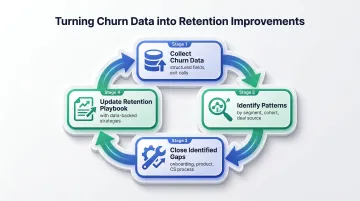
Analyze Past Churn to Improve Future Retention
Standardize churn reasons as structured data fields (not just open-ended notes). Look for patterns by customer segment, onboarding cohort, or deal source. Conduct exit calls when possible.
Done consistently, this analysis shifts your CS team from firefighting individual cancellations to systematically closing the gaps that cause them.
Scaling Customer Success Without a Full-Time CS Team
Early-stage B2B SaaS startups often operate with founders playing the CSM role in the earliest stages. The first dedicated CS hire is often one person covering dozens of accounts.
The risk: without clear processes and documented playbooks, CS becomes dependent on individuals, and quality drops with every new account added.
Build a Scalable CS Foundation Before Scaling Headcount
Document a success playbook:
- Onboarding sequence with timeline and milestones
- Check-in cadence by customer segment
- QBR template and agenda
- Churn risk escalation process
Create templated outreach for common scenarios. Use your CRM to track account status and ownership so retention doesn't depend on anyone's memory.
The book "Customer Success" by Mehta, Steinman, and Murphy recommends hiring the first dedicated CSM at $1M-$2M ARR, or earlier (closer to $500K ARR) if the product requires high-touch implementation.
Tech-Touch vs. High-Touch Segmentation
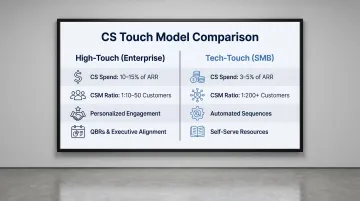
Automate routine touchpoints (onboarding email sequences, milestone check-ins, health score alerts) for lower-tier accounts, while reserving high-touch, personalized engagement for your most valuable accounts.
Touch model spending guidance:
| Touch Model | CS Spend (% of ARR) | Customer-to-CSM Ratio |
|---|---|---|
| High-Touch (Enterprise) | 10-15% of ARR | 1 CSM : 10-50 customers |
| Tech-Touch (SMB) | 3-5% of ARR | 1 CSM : 200+ customers |
Some early-stage startups bridge the gap with fractional CS or account management talent. It's a faster path to coverage than a full-time hire, with less risk while the process is still being proven. Activated Scale connects startups with fractional Customer Success professionals who can stabilize retention while founders build long-term CS infrastructure.
Why Strong CS Compounds Revenue Growth
Retaining existing customers directly lowers the revenue growth required from new customer acquisition. SaaS Capital's research shows that increasing NRR from 90-100% to 100-110% improves growth rate by 5 percentage points.
Startups that build retention infrastructure early grow more efficiently and predictably. In practical terms, a startup at $2M ARR with 110% NRR needs far less new logo revenue to hit its growth targets than one stuck at 90% — and that gap widens every year.
Frequently Asked Questions
What is churn in customer success?
Churn in customer success refers to the rate at which customers cancel, don't renew, or stop using a product over a given period. CS teams exist specifically to prevent voluntary churn by ensuring customers consistently achieve value.
What are the 5 pillars of customer success?
The five most widely cited pillars of customer success are proactive engagement, structured onboarding, value realization, relationship management, and retention/renewal focus. Together, these form the foundation of a CS motion that reduces churn and drives expansion.
What are some customer success strategies?
Key strategies include:
- Structured onboarding to drive early value
- Regular QBRs to stay aligned on customer goals
- Health scoring to identify at-risk accounts early
- Multi-threaded relationships to protect against champion departure
- Customer segmentation to prioritize resources effectively
How can you mitigate customer churn?
Mitigating churn comes down to three fundamentals: catching risk early through usage monitoring and outreach, getting customers to value fast during onboarding, and assigning clear ownership so every at-risk account has one person accountable for follow-up.
How do you know if a customer is about to churn?
Reliable early warning signals include declining product usage, unresolved support issues, non-responsiveness to outreach, missed milestones, and stakeholder changes. These signals typically appear several weeks before a customer formally raises the issue, giving you time to intervene.
What is a good churn rate for B2B SaaS?
For ICP/upmarket customers, annual churn below 5% is considered best-in-class, while 10-15% is acceptable. The more useful benchmark is whether your churn rate is trending downward and whether you can identify and address its root causes.