Introduction
Every CS leader recognizes the moment when the model breaks. Customer counts surge past 200, then 500, then 1,000, and headcount can't keep pace. CSMs who once proactively guided accounts through value milestones now spend their days firefighting escalations and scrambling to cover renewals at the eleventh hour.
Personalized engagement gives way to generic check-ins that fail to demonstrate expertise or partnership. Accounts fall silent for weeks, invisible in the CRM until a cancellation notice arrives.
When your customer base scales faster than your team, the 1:1 coverage model that worked at 50 accounts becomes mathematically impossible at 500. Throwing headcount at the problem doesn't fix it, either. NRR rates declined for 75% of software companies surveyed, even as nearly 60% increased customer success spending — more CSMs without strategic deployment doesn't solve retention.
This guide is for CS leaders and founders at B2B SaaS companies managing or anticipating rapid growth. In enterprise contexts, these challenges are structurally distinct: complex stakeholder networks, longer contract cycles, and expectations for consultative expertise make this a strategy problem, not just a staffing one.
We'll cover five core challenges that limit scaling CS teams: CSM-to-account ratio breakdowns, the personalization paradox, technology gaps and data silos, talent constraints, and budget justification difficulties. Name the right problem, and you'll know what to fix first.
TLDR
- Coverage collapses when CSM-to-account ratios break down, pushing teams into firefighting mode instead of proactive engagement
- Personalization fails without segmentation strategies and health score automation to direct CSM effort toward at-risk accounts
- Fragmented tooling and siloed data force CSMs to spend 12-15 hours per week gathering information instead of engaging customers
- CS ROI is hard to prove in real time, making budget and talent investment difficult to justify even as workload grows
- Solving these challenges requires scalable systems, tiered engagement models, and consolidated tech infrastructure, not just additional headcount
Why Scaling Customer Success Looks Different at Enterprise Scale
The traditional one-CSM-for-every-X-customers model works when your customer base sits below 100 accounts. Each CSM can maintain regular touchpoints, deliver personalized QBRs, and keep detailed notes on stakeholder preferences. But this model becomes mathematically unsustainable as customer counts reach the hundreds or thousands.
Enterprise CSMs typically manage 1:2-4 accounts when handling strategic named accounts worth $12M-$15M in ACV. Mid-market CSMs stretch across 1:100-250 accounts managing $2M-$5M in total ARR. The gap isn't just volume — the underlying mechanics of coverage are completely different.
At enterprise scale, accounts stop being "customers" and become complex organizations with procurement layers, multiple departments, and contract cycles spanning 12-18 months or longer. A single account can involve:
- A champion in IT driving adoption
- Budget authority sitting in finance
- End users spread across three or more departments
- Executive sponsors who appear only at renewal time
A uniform coverage model can't serve that range of stakeholders — and trying to apply one is where most scaling efforts break down.
Two Types of Scaling Challenges
Distinguish between scaling CS for volume versus scaling for complexity:
Scaling for volume shifts CSMs from 1:50 to 1:200 ratios through tech-touch automation, self-service resources, and tiered engagement. It works for SMB and lower mid-market segments where accounts share similar onboarding paths and usage patterns.
Scaling for complexity is a different problem entirely. Enterprise accounts bring multiple departments, power users, and deep integration requirements. The challenge isn't account quantity — it's stakeholder mapping, custom success plans, and coordinating across procurement, technical, and business teams. 58% of companies now expect CSMs to handle renewals directly, adding contract negotiation to an already demanding engagement model.
Confusing these two scaling problems leads to the wrong solutions. Adding headcount addresses volume but not complexity. Automation helps volume but can't replace the consultative expertise enterprise accounts demand.
The CSM-to-Account Ratio: When Coverage Breaks Down
When a CSM crosses their effective coverage threshold, the operational shift is immediate. Proactive outreach—monthly check-ins, usage reviews, feature adoption campaigns—gets replaced by reactive escalation management. QBRs get rescheduled repeatedly, then skipped entirely.
Renewals that should be handled 90 days out get addressed at 30 days, after the customer has already started evaluating alternatives. Coverage gaps emerge where accounts go weeks or months without meaningful contact, invisible in the CRM until a cancellation notice forces attention.
The business impact shows up in lagging indicators. 58% of B2B companies saw NRR decline over two years, with average performance dropping from 110.8% to 107.2%. Companies with declining NRR also missed overall growth targets 71% of the time. When CSMs can't proactively engage, churn becomes visible only after it's too late to recover the account.
The Segmentation Fix
Customer segmentation is the foundational solution to ratio breakdowns. A tiered model divides accounts into segments based on usage behavior, contract value, or strategic importance:
- No usage / At-risk accounts: CSMs focus on re-engagement campaigns and churn prevention
- Low usage accounts: Drive feature adoption through targeted playbooks and automated nudges
- General usage accounts: Maintain with quarterly check-ins and scaled engagement
- Super users / Strategic accounts: Receive high-touch support, custom success plans, and proactive relationship management
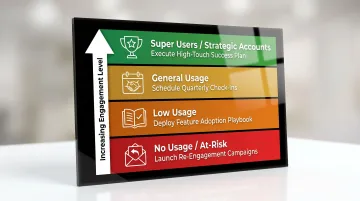
This framework lets CSMs focus effort where it drives movement—pushing customers up the usage ladder rather than uniformly touching everyone. Companies using guided digital journeys for lower tiers see a 30% increase in net revenue retention, proving that scaled engagement works when it's deliberate and data-driven.
Why "More CSMs" Isn't the Answer
The trap: assuming ratio problems are staffing problems. Adding headcount without fixing underlying processes just replicates the same breakdown at a higher account volume.
If your playbooks are manual, your health scores are subjective, and your engagement model is reactive, hiring three more CSMs delays the crisis by six months. It doesn't prevent it.
The ratio problem is a process problem disguised as a staffing problem. Companies that segment accounts, automate routine touchpoints, and deploy health scoring can extend CSM capacity from approximately 52 accounts to 95 accounts per rep. For a team of eight CSMs, that translates to avoiding $380,000+ in annual hiring costs.
Data-Driven Segmentation
A/B testing and analytics refine segmentation further. Track which outreach types and content formats drive the most customer movement—then do more of what works. Does a product usage email generate more engagement than a check-in call for mid-tier accounts? Does a self-service knowledge base reduce support volume for SMB customers? Answering these questions lets teams scale further by concentrating effort on high-impact activities.
Without this data layer, CSMs rely on instinct or the loudest accounts, leading to misallocated effort and missed churn risk. Automated health scores detect churn risk 63 days before cancellation versus 11 days for manual assessment—a 52-day improvement that increases the save rate of at-risk accounts from 18% to 44%.
Personalization at Scale: The Paradox Every CS Leader Faces
As customer bases grow, expectations for personalized, knowledgeable, and proactive engagement don't decrease—they increase. Enterprise accounts paying $50K, $100K, or $500K+ annually expect a true partner who understands their business context, anticipates needs, and delivers consultative guidance. They don't expect a support ticket handler who responds only when contacted.
Yet nearly two-thirds of software customers feel their post-sales needs are being addressed "only moderately or worse". The gap between expectation and delivery widens as CSMs stretch across more accounts.
The "Whoever You Are" Problem
When CSMs are stretched thin, outreach defaults to generic check-ins: "Just wanted to see how things are going." These messages fail to demonstrate product knowledge, business context, or expertise. At enterprise scale, this is particularly damaging.
There's a significant priority mismatch: technical implementation is ranked the #1 priority by software buyers but #6 by CS practitioners. Customers prefer a technical role as their primary contact, while vendors typically assign a non-technical CSM—deepening the perception of generic, surface-level engagement.
The result: customers feel like vendors are checking boxes rather than acting as strategic partners. Trust erodes, and when competitive alternatives surface, there's no relationship equity to protect the renewal.
Playbooks as Structural Solutions
The fix isn't more headcount—it's structure. Standardized playbooks and workflows ensure the right conversation happens at the right time, with the right context already loaded. A well-designed playbook covers:
- Day 7, 30, and 60 onboarding milestones with defined check-in goals
- Automated outreach triggers when usage drops or engagement goes dark
- Quarterly reviews for high-touch accounts, semi-annual for mid-tier
- Clear escalation paths: when to pull in product, support, or leadership
Implementing structured success plans leads to an 87% customer engagement rate, demonstrating that process doesn't reduce personalization—it enables it by freeing CSMs from manually deciding what to do next.
Health Scores Enable Purposeful Engagement
Customer health scores turn reactive outreach into purposeful engagement with a defined goal for every interaction. Instead of "checking in," CSMs know exactly who needs attention, why, and what kind:
- Red health score due to declining usage → Re-engagement campaign focused on feature adoption
- Yellow score due to support ticket volume → Proactive call to address friction points
- Green score with high engagement → Expansion conversation to introduce advanced features
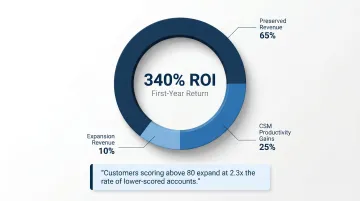
Automated health scoring delivers approximately 340% first-year ROI for the median SaaS company with $10M+ ARR, with 65% from preserved revenue, 25% from CSM productivity gains, and 10% from expansion revenue. Customers with health scores above 80 expand at 2.3x the rate of those with scores between 50-80—making health scoring one of the clearest revenue levers a CS team can pull.
Automation as Scaffolding, Not Replacement
How you deploy automation determines whether your CS strategy scales or collapses. Using automation as a replacement for human contact—canned sequences, chatbot-only support, removed touchpoints—feels impersonal and erodes trust, especially at enterprise scale.
Used as scaffolding, automation does the opposite: it frees CSMs to have higher-quality conversations with the accounts that need them most. Specifically:
- Automated onboarding emails handle routine milestone communication while CSMs focus on strategic planning sessions
- Self-service knowledge bases deflect common support questions, creating capacity for consultative calls
- Health score automation surfaces at-risk accounts so CSM attention goes where intervention matters most
Technology Gaps, Data Silos, and the Tooling Trap
Most CS teams at scaling companies work across disconnected tools: CRM holds account history, support platforms track tickets, billing systems manage subscriptions, and product analytics capture usage data. No single system provides a unified customer view.
The result is CSMs toggling between five dashboards to answer basic questions: Is this account healthy? When was the last engagement? What features are they using?
CSMs spend approximately 12-15 hours per week on manual data gathering: checking analytics (3.5 hours), reviewing CRM (2.8 hours), reading tickets (2.4 hours), updating spreadsheets (1.8 hours), synthesizing signals (2 hours), and preparing reviews (1.5 hours). At one company, CSMs were spending close to 80% of their time on internally facing activities, translating to minimal customer-facing capacity.
Fragmented Data Creates Misinformed Decisions
Without a consolidated health score or usage view, CSMs rely on instinct or the loudest accounts rather than objective signals. The result: missed churn risk, misallocated effort, and firefighting instead of prevention. Only 57% of companies have mapped the full customer journey, leaving 43% with significant engagement gaps across data silos.
Customer data typically lives in four departmental silos:
- Sales (CRM): Account history, contract details, stakeholder contacts
- Support (ticketing): Issue volume, resolution time, satisfaction scores
- Customer Success (engagement platforms): Success plans, QBR notes, relationship health
- Product (analytics): Feature usage, adoption rates, technical engagement
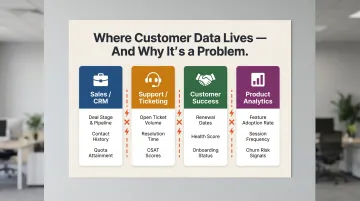
When these systems don't talk to each other, CSMs manually stitch together a customer picture — time-consuming, error-prone, and impossible to scale.
The Right CS Tech Stack at Scale
The fix is a customer success platform that centralizes health scoring, automates playbook triggers, tracks engagement, and surfaces at-risk accounts — eliminating manual report-pulling across five separate tools. Key capabilities to prioritize:
- Combines CRM, support, billing, and product data into a single customer dashboard
- Calculates health scores in real time using usage, engagement, support volume, and contract metrics
- Triggers automated workflows for onboarding, renewal prep, and re-engagement campaigns
- Sends proactive alerts when accounts show early churn signals
- Provides executive dashboards tracking NRR, churn, and expansion pipeline
With automation, data gathering time drops from approximately 14 hours/week to 1.5 hours/week per CSM. That time recovery lets existing teams cover significantly more accounts without sacrificing relationship quality.
The Cost of Waiting
Teams that don't invest in proper tooling early end up retrofitting solutions onto a broken process when the customer base is already large — far more disruptive and expensive than building the right stack during growth. Automated scoring achieves a 1.1-point reduction in quarterly gross churn on average, preserving approximately $400,000 in annual revenue per $10M ARR. The breakeven point for health score automation is just 2.8 months.
Delaying investment doesn't save money. It costs revenue through preventable churn and productivity loss that compounds every quarter.
Talent and Budget: The Two Levers That Break Under Pressure
Scaling CS teams requires finding CSMs who combine technical product knowledge, consultative communication skills, and strong portfolio management—a rare combination. Customer Success Manager is ranked the #1 most in-demand SaaS role for 2026. Companies protect CSM headcount because retaining revenue costs far less than acquiring new customers. Competition for qualified talent is intense, and hiring cycles stretch as companies search for candidates with the right mix of skills.
CSM salaries reflect this demand: $67,000 to $89,000 base in the US, with fully loaded costs (including benefits, tools, overhead) reaching approximately $115,000 per CSM.
The Budget Justification Problem
Unlike sales, where revenue attribution is direct, CS operates on lagging indicators: churn rates, renewal percentages, NPS scores, and expansion revenue. These metrics take months to move, making real-time ROI difficult to demonstrate to finance and leadership. Without clear KPIs tied to revenue impact, CS teams struggle to secure investment for headcount and tools, even as workload grows.
CS leaders face a "language gap" with the boardroom. Contributions like providing sales references, surfacing product feedback, and leading onboarding drive real revenue—but no one formally tracks them, so they don't count at budget time.
The fix is connecting CS work to metrics the C-suite already cares about:
- Track CS-influenced pipeline as a formal metric with RevOps tagging
- Document reference activity and attribute it to deal progression
- Record expansions tied to specific feature adoption milestones
- Report against NRR and expansion MRR in every leadership review
Breaking the Underfunding Cycle
Misalignment between CS and leadership expectations creates a self-reinforcing trap: underfunded CS teams can't hit targets, which reduces leadership confidence in the function, which makes further investment harder to justify. The cycle continues until churn becomes painful enough to force action—by which point, recovery is expensive and slow.
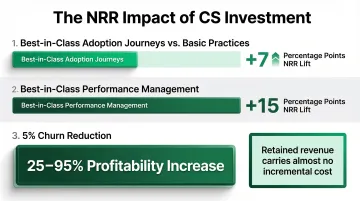
Breaking this cycle means making CS ROI visible in revenue terms. NRR is the primary metric connecting CS performance to business outcomes, and the numbers are hard to ignore:
- Best-in-class adoption and value realization journeys produce NRR ~7 percentage points higher than basic practices
- Best-in-class performance management pushes NRR 15 percentage points higher
- Reducing churn by just 5% increases SaaS profitability by 25–95%, since retained revenue carries almost no incremental cost
For companies that can't yet justify a full-time CS hire, Activated Scale's contract-to-hire model lets you bring on a vetted fractional CSM, prove the value over 30–90 days, and convert to full-time only when the numbers support it. It's a practical way to close coverage gaps without locking into headcount before the budget case is made.
Frequently Asked Questions
Frequently Asked Questions
What is the biggest challenge in customer success?
The biggest challenge is maintaining proactive, high-quality engagement as the customer base scales. Most CS teams default to reactive support as account numbers grow, which erodes trust and drives churn before the problem becomes visible in retention metrics.
What are the 4 pillars of scaling up?
The four pillars commonly cited in scaling frameworks are people, strategy, execution, and cash. For CS teams, these translate to right talent, clear playbooks, consistent execution, and budget alignment — each one dependent on the others to hold at scale.
What are the 7 C's of CRM?
The 7 C's are Customer, Consistency, Communication, Customization, Collaboration, Capability, and Continuity. These principles map directly to CS team challenges when scaling—particularly the tension between consistency (standardized playbooks and processes) and customization (personalized engagement that meets enterprise expectations).
How do you maintain personalization when scaling a customer success team?
Segmentation divides accounts into tiers by value and usage, health scoring routes CSM attention to accounts that need it, and automated playbooks trigger the right touchpoints at the right time. These three tools work together so CSMs deliver timely, context-aware outreach without manually tracking every account.
What is the right CSM-to-customer ratio for enterprise companies?
The right ratio varies by product complexity, account size, and support model. Strategic/named enterprise accounts typically require 1:2-4 CSMs, high-touch enterprise averages 1:8, and broader enterprise can range 1:10-50 depending on total ARR managed per CSM. Ratios alone don't matter without the right segmentation and tooling in place—companies can extend capacity through automation and tiered engagement models.