Introduction
Your pipeline is dry. You're staring at the same three lukewarm leads you've been nurturing for weeks. Hiring a full-time BDR feels too risky—you're barely past Seed funding, and one mis-hire could burn through two quarters of runway. Then you see it: BDR outsourcing. A team, a process, no headcount.
BDR outsourcing promises to solve the outbound problem for early-stage B2B SaaS companies. For most founders still finding product-market fit, it delivers something else entirely. The issue isn't just quality—it's control.
When you hand your outbound motion to an external agency, you lose the buyer intelligence that tells you why prospects say yes, why they say no, and what your actual ICP looks like. Most BDR agencies require 6–12 month minimums at $5,000–$15,000/month, locking you into a process that generates activity metrics instead of market insight.
This post examines whether BDR outsourcing delivers on its promise, especially for Seed to Series A SaaS companies. It also covers what to do instead: a fractional sales talent model that preserves the feedback loop between prospects and product, without the cost and commitment of full-time hiring.
Key Takeaways
- BDR outsourcing reduces hiring friction but undermines quality and brand fit at the Seed-to-Series A stage
- Outsourced agencies optimize for meeting volume, not the discovery conversations that matter at the Seed-to-Series A stage
- Outsourcing research and list-building is fine—handing off prospect conversations is where it breaks down
- Fractional sales talent is a stronger alternative: experienced reps who embed in your team without a full agency handoff
- Only 32% of companies would rehire their current outsourced BDR provider, signaling structural dissatisfaction
What Is a BDR and What Do They Actually Do?
A BDR (Business Development Representative) is an outbound-focused sales professional who identifies prospects, runs multi-channel outreach, qualifies leads, and books meetings for Account Executives. BDRs generate pipeline—they don't close deals. Their job is to fill the top of the funnel with qualified opportunities that AEs can convert into revenue.
The BDR function breaks down into two distinct parts:
Research-oriented tasks — no prospect interaction required:
- Building target account lists and mapping org hierarchies
- Identifying decision-makers and enriching contact data
- Maintaining data hygiene across the CRM
Prospect-facing tasks — require judgment, product knowledge, and adaptability:
- Cold outreach via email, phone, and LinkedIn
- Running qualification conversations and handling objections
- Booking meetings and handing off to Account Executives
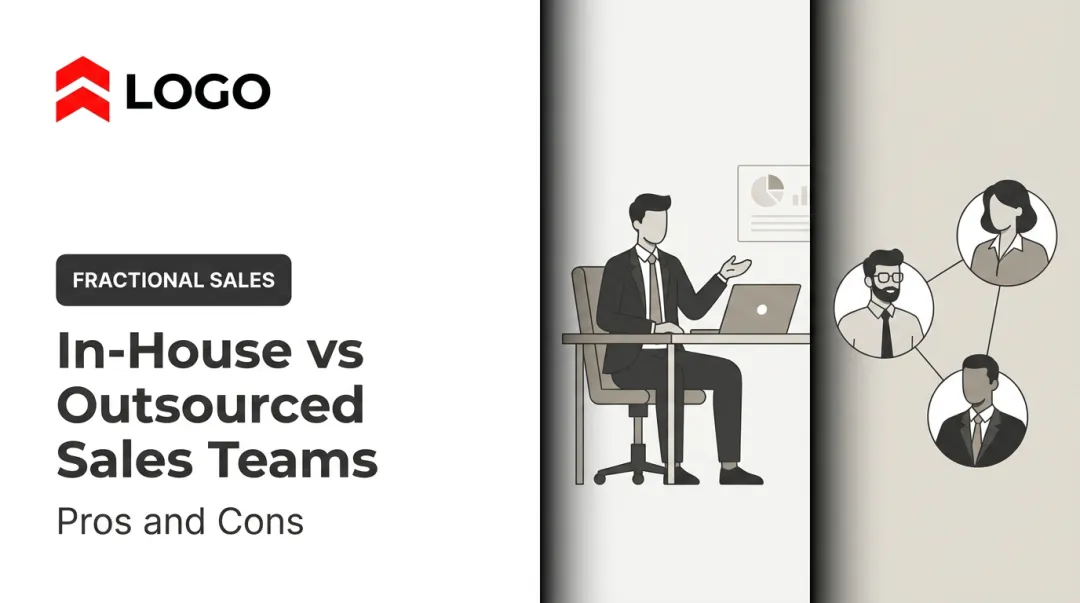
This distinction matters when evaluating what to outsource. Research tasks are commoditizable. Prospect-facing tasks are not—especially when your ICP, messaging, and positioning are still being validated.
Why BDR Outsourcing Seems Attractive
BDR outsourcing makes a strong first impression on paper. You skip the recruiting cycle, avoid onboarding ramp, eliminate benefits overhead, and get an entire team executing outbound from day one. Approximately 68% of B2B companies use third-party lead generation services, and the outsourced SDR market was valued at $2.29 billion in 2024, projected to reach $5.8 billion by 2035.
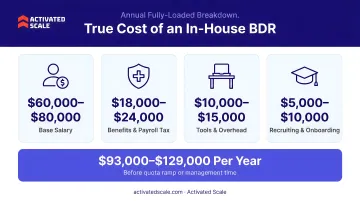
The cost argument strengthens the appeal. In-house BDR seats carry high fully-loaded costs:
- Base salary: $51K–$93K/year
- Total compensation: $65K–$95K/year OTE
- Fully loaded annual cost: $102K–$145K/seat, including:
- Employer taxes: $7.8K–$14.2K
- Benefits: $15K–$25K
- Recruiting fees: $8K–$15K
- Tools: $3K–$5K
- Lost productivity during ramp (3–6 months): $12K–$28K
Outsourcing converts this into a predictable monthly fee. Monthly retainer programs range from $3K–$8K/month, while pay-per-meeting models charge $150–$600 per booked meeting. For cash-strapped founders, that's an attractive trade.
Cost predictability isn't the only draw. Outsourced teams can theoretically ramp outreach up or down without the lag of hiring cycles—a real advantage for founders who don't yet know whether they need one BDR or five.
Why BDR Outsourcing Falls Short for Early-Stage B2B SaaS
The same distance that makes BDR outsourcing fast—separation from your product, team, and buyers—is exactly what makes it dangerous for companies still validating their ICP and messaging.
Disconnected from Product-Market Fit
Early-stage B2B SaaS companies are still learning why buyers say yes and, more importantly, why they say no. Every prospecting conversation is a data point. When those conversations happen through an external agency, founders lose direct access to buyer intelligence.
Product-market fit takes an average of 4 years to achieve, according to research by Lenny Rachitsky. During this phase, ICP definitions shift, positioning evolves, and messaging requires constant iteration.
Outsourcing outbound during this period means the agency is selling a positioning that's likely to change—creating wasted effort and a pipeline full of wrong-fit prospects. Worse, you won't hear the objections that tell you what to fix.
That loss of signal has a second consequence: it shows up directly in how your brand is perceived.
Generic Outreach That Damages Brand
Outsourced BDR teams manage multiple clients simultaneously and often apply templated sequences, generic value props, or off-target messaging. For a startup with no established brand equity, one wave of poorly personalized cold outreach can poison the well before your own team gets a chance to engage.
73% of B2B buyers actively avoid suppliers who send irrelevant outreach, according to Gartner's 2025 survey of 632 B2B buyers. Budget providers often use low-quality, AI-generated cold email templates at scale, flooding decision-makers who already receive 50+ sales emails daily.
The result: your domain gets flagged as spam, your brand gets associated with noise, and your ideal prospects form negative impressions before they ever see your product.
Shallow Product Knowledge Loses Qualified Prospects
Outsourced reps can't match the product depth your in-house team carries. When a prospect asks a pointed question about integrations, pricing models, or use-case fit, a BDR who can't answer confidently signals uncertainty at the exact moment trust is being formed.
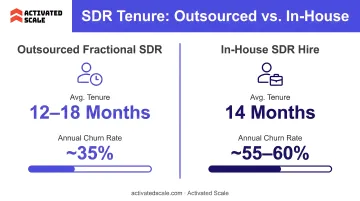
Turnover makes this worse. Average SDR tenure industry-wide has dropped to 14 months, but many outsourced providers see churn at the 6-9 month mark—just as a rep starts understanding your offering, they leave and the learning cycle resets. In-house SDRs hold a median tenure of 1.9 years, nearly double that of outsourced reps.
Limited Oversight Means Slow Course Correction
Founders rarely have real-time insight into what messages are going out, how prospects are responding, or whether outreach is aligned with current ICP targeting. By the time a misalignment is caught, weeks of pipeline damage may have already occurred.
Offshore or low-cost providers add time zone gaps that slow feedback further. You find out Tuesday morning that Friday's outreach targeted the wrong persona—but 300 prospects already received it.
Volume Metrics Mask Pipeline Quality
Most outsourced BDR agencies are incentivized on meetings booked, not on meetings that progress to opportunities. This misalignment pushes providers toward quantity over fit—producing "activity" that looks good on a dashboard but generates frustrated AEs and stalled pipeline.
Pay-per-meeting models charge $150-$600 per meeting, creating direct incentive to book anything that responds. Monthly retainer models deliver fixed effort regardless of outcomes. Only 32% of companies surveyed by Tenbound said they would rehire their current outsourced SDR provider—a structural dissatisfaction gap that early-stage founders should weigh heavily.
The meetings hit the calendar. The pipeline stays empty. That's the gap between activity metrics and actual revenue progress—and it's why the incentive structure matters more than the headcount.
What To Do Instead: The Fractional Sales Talent Model
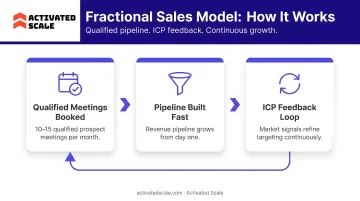
Instead of handing your outbound motion to an agency, embed an experienced, fractional sales professional directly into your team. Unlike an outsourced BDR from an agency, a fractional rep works as a de facto member of your sales organization, using your tools, learning your product, and having real conversations with prospects in your voice.
The key distinction: fractional reps are experienced sellers—not junior SDRs managed by an agency—who take ownership of your pipeline. Because they're embedded rather than siloed, they feed buyer intelligence back into your product and positioning in real time, preserving the feedback loop that outsourcing severs.
This matters most at the Seed to Series A stage, when every prospect conversation actively shapes your go-to-market strategy.
Risk Profile Advantage
Fractional sales talent sidesteps the biggest costs of full-time BDR hiring:
- No six-month ramp risk
- No churn replacement cost
- No recruiter fees ($8K-$15K per hire)
- No sunk cost in a mis-hire
It also avoids the brand dilution and quality gaps of outsourced agencies. Founders evaluate real performance before committing to a full-time hire — a lower-risk path than either outsourcing or a permanent headcount decision. Platforms like Activated Scale connect early-stage B2B SaaS companies with vetted, experienced fractional sales professionals in as little as 7 days, with the option to convert to full-time.
What Fractional Produces
The fractional model delivers:
- 10-15 qualified meetings per month with the right buyer profiles
- Messaging refined through real conversations, not templates
- Growing understanding of what ICP and sales motion actually work
- Direct feedback on product positioning, pricing objections, and competitive threats
All without the overhead of building an in-house team from scratch.
What to Still Outsource
Research-heavy tasks—building target lists, enriching contact data, identifying decision-makers—are worth outsourcing to specialized data vendors. The fractional rep then applies that data in direct prospect conversations. You keep control of every prospect relationship while still offloading the work that doesn't require a seasoned seller.
How to Decide What's Right for Your Stage
If your company is pre-Series A, still validating ICP, and needs the learning from prospect conversations as much as you need the meetings themselves—fractional sales talent is the right starting point over a full outsourced BDR program.
BDR outsourcing can work under narrow conditions:
- Mature companies with documented, proven ICP
- Stable, high-volume outbound playbooks that don't require iteration
- Internal bandwidth to manage the agency relationship tightly with defined SLAs and active feedback loops
This is rarely the situation for Seed to Series A SaaS founders. Jason Lemkin of SaaStr explicitly warns against outsourcing early sales: founders should close 10-20 customers personally before hiring anyone in sales. The first SDR/BDR shouldn't appear until $1M–$2M ARR, when AEs are already at capacity.
Early-stage sales is "product research"—you need to hear objections directly. Outsourcing severs the feedback loop between customer and product team.
Practical next step: Before committing to any model, map out which parts of the BDR function you need most right now—pipeline volume, message refinement, ICP validation, or all three—and match the engagement model to that specific need.
Frequently Asked Questions
What is a BDR in a company?
A BDR (Business Development Representative) is an outbound-focused sales role responsible for prospecting, qualifying leads, and booking meetings for Account Executives. They generate pipeline but don't close deals—their job is filling the top of the funnel with qualified opportunities.
Is outsourcing cheaper than hiring?
Outsourcing can lower upfront costs versus a fully loaded in-house BDR hire ($102K-$145K annually). However, for early-stage startups the hidden costs (lost buyer intelligence, pipeline quality issues, and brand damage) often outweigh the savings. A 68% dissatisfaction rate with outsourced providers is a strong signal that lower spend rarely translates to better revenue outcomes.
Is a BDR an entry level role?
BDR roles are often filled by early-career sales professionals in traditional models, but this is part of the problem with outsourcing. Experienced fractional sellers bring contextual judgment and product fluency that entry-level outsourced reps typically can't match.
What's better, SDR or BDR?
SDRs (Sales Development Representatives) and BDRs are similar roles—BDRs typically focus on outbound prospecting and new business, while SDRs may handle inbound qualification as well. For most early-stage B2B SaaS startups, the BDR function (outbound pipeline generation) is the more pressing need when inbound volume is low.
Is outsourcing illegal in the US?
Outsourcing sales functions, including BDR work, is legal in the US. The relevant considerations for B2B companies are contractual, data privacy, and compliance-related rather than legal prohibitions. Ensure contracts address data protection, confidentiality, and compliance with anti-spam regulations.
What are the four types of outsourcing?
The four common outsourcing categories are professional/services outsourcing, IT outsourcing, manufacturing outsourcing, and process outsourcing. BDR outsourcing falls under professional/services outsourcing—and is distinct from the fractional talent model where an experienced rep embeds directly into your team rather than operating through an external agency.