Introduction
The pipeline isn't building itself. For early-stage B2B SaaS founders, that's the uncomfortable reality hitting around month three of launching a product. You've shipped features, refined messaging, and maybe even landed your first few customers through your network. Then the referrals dry up.
Hiring a full-time SDR or BDR feels like the obvious next step. Then you realize it means 3-4 weeks of recruiting, a rep who's never sold your product, and 3.2 months to ramp to full productivity. That's a quarter of pipeline growth you can't afford to lose when runway is measured in months, not years.
Outsourcing is how growth-stage companies scale without adding full-time headcount. But choosing the wrong role to outsource first can cost you an entire quarter of pipeline.
If you outsource an SDR when you actually need a BDR to open new markets, you've spent 90 days booking meetings into accounts that were never ready to buy. If you outsource a BDR when you need raw meeting volume now, you've traded speed for relationship-building you don't yet need.
This guide covers what each role does, how they compare, and a decision framework for determining which to outsource based on your growth stage and pipeline bottleneck.
Key Takeaways
- SDRs run outbound prospecting to fill top-of-funnel; BDRs cover inbound leads, strategic accounts, and new market expansion
- Outsourcing eliminates the 90-day hiring and ramp cycle—external teams deploy in days with proven playbooks
- Seed-to-Series A SaaS companies with no pipeline should outsource an SDR first for the fastest path to qualified meetings
- Companies chasing enterprise buyers, cold inbound traffic, or new verticals to test should start with a BDR
- Fractional models like Activated Scale deploy vetted reps in 7 days without full-time risk
SDR vs BDR: Quick Comparison
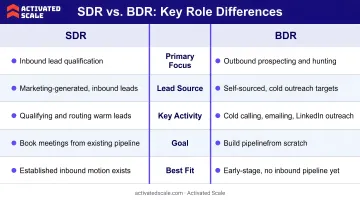
The roles overlap more than most job descriptions suggest. Here's where they actually differ:
| Dimension | SDR | BDR |
|---|---|---|
| Lead Source | Outbound: cold calls, cold emails, LinkedIn prospecting against defined ICP lists | Inbound, outbound, or hybrid: works MQLs, strategic accounts, or new market segments |
| Primary Goal | Book qualified discovery meetings for AEs; maximize top-of-funnel volume | Identify and develop new business opportunities; nurture leads through longer discovery cycles |
| Buyer Interaction | Brief qualifying conversations focused on gauging interest and confirming fit before handoff | Deeper, consultative conversations involving multiple stakeholders and extended relationship-building |
| Funnel Stage | Top of funnel; passes leads to AEs once qualified | Mid-to-top funnel; may nurture opportunities before AE involvement |
| Best Outsourcing Fit | Startups with a clear ICP and AEs ready to take meetings | Companies with unconverted inbound demand, enterprise deal cycles, or new verticals to test |
Knowing which role fits your stage is the first step—next is deciding whether to hire or outsource.
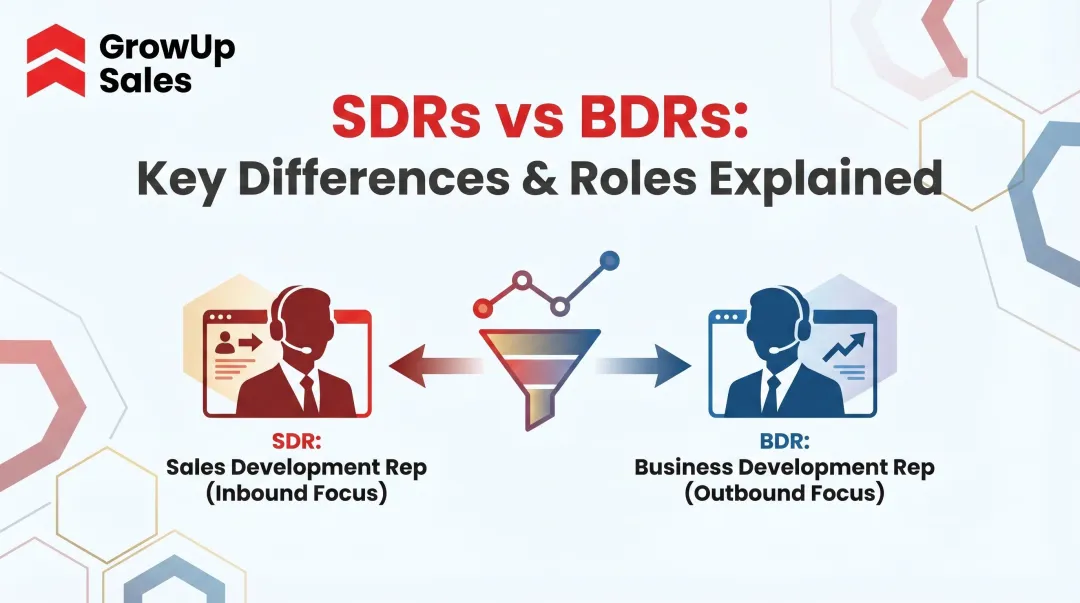
What is an SDR?
Sales Development Representatives own outbound prospecting. They build lists, run multi-touch cadences across calls, emails, and LinkedIn, and qualify leads against criteria like budget, authority, need, and timing before booking meetings for Account Executives.
SDRs are the first sales hire or outsource for most B2B SaaS companies because their work is repeatable, volume-driven, and directly measurable by pipeline output.
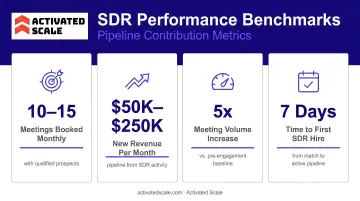
The Bridge Group's 2023 report analyzing 365 B2B companies found SDRs generate a monthly quota of 11-15 meetings or opportunities, with 63% of reps achieving quota. For outbound-focused teams, 15 meetings per month is a realistic target; accounting for a 20% dropout rate yields approximately 12 attained meetings.
Metrics That Define SDR Success
The leading indicators that matter before pipeline metrics show up:
- Meetings booked: the primary metric tracked across all SDR teams
- Qualified opportunities created: conversion from meeting to accepted opportunity
- Sequence reply rates: 2-8% is normal; high-performing industries hit 8-11%
- Show rate on booked meetings: industry standard sits at 75-85%
- Connect rates: 8-15% overall — SMB runs 12-18%, mid-market 8-12%, enterprise 5-10%
Pipeline contribution matters too. SDRs generate $3M in pipeline per year on average, with ranges from under $750K to over $10M depending on deal size and market. SAL-to-SQL conversion averages 52.7%. Those numbers only hold when SDRs are consistently fed the right targets — which is exactly where outsourcing decisions start to matter.
Use Cases of SDRs
SDR outsourcing works best when you have a clearly defined ICP, a repeatable outbound message, and Account Executives ready to run discovery calls but no one feeding them qualified leads.
Where SDRs fit:
- Seed-to-Series A SaaS companies with no dedicated sales team
- Founders currently doing all prospecting themselves
- Teams expanding into a new product line needing market validation through outbound
Outsourcing fits these scenarios because it skips the 60-90 day ramp time built into every in-house hire. External SDR teams arrive with tested cold outreach playbooks and start booking meetings within weeks, not months.
That speed matters more than most founders realize. It now takes 18+ dials to achieve a single prospect connect, and a team with existing cadence infrastructure closes that gap faster than any in-house ramp can. For companies still at the problem-market fit stage, an outsourced SDR also validates whether your ICP will take meetings before you commit to full-time headcount.
What is a BDR?
Business Development Representatives take a broader view of pipeline creation. They handle high-intent inbound leads requiring qualification, pursue strategic accounts needing multi-touch relationship approaches, or open doors in new market verticals where cold calling alone won't work.
What separates BDR work from SDR work: BDRs go deeper in early conversations and engage multiple stakeholders. The goal isn't just a booked meeting — it's arriving at that meeting with enough account context to move the deal forward.
Metrics That Define BDR Success
BDR metrics differ from SDR volume metrics:
- Strategic accounts and new logos engaged (penetration depth, not just volume)
- Pipeline value from strategic outreach (deal size matters more than meeting count)
- Partner opportunities initiated through channel development and co-selling
- Inbound MQL-to-opportunity conversion rate — high-intent leads convert at 75-80%; low-intent leads at just 5-10%
Only 27% of inbound leads fulfill all three ICP criteria (company level, geography, and job function/seniority), which is why BDRs who can engage prospects before they hit lead-scoring targets increase conversion by 27%.
Use Cases of BDRs
BDR outsourcing is most valuable when marketing generates interest—content downloads, demo requests, webinar signups—but no one follows up quickly enough to convert that interest into pipeline.
Where BDRs fit:
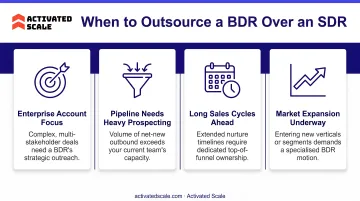
- Companies targeting mid-market or enterprise buyers with multi-stakeholder buying committees
- SaaS teams exploring new verticals where message-market fit is still being tested
- Organizations running ABM campaigns requiring personalized strategic outreach
Example scenario: Your marketing team runs a webinar that generates 50 registrants. Without a BDR, those leads sit in your CRM for days. Responding within 5 minutes makes you 100x more likely to make contact and 21x more likely to qualify the lead compared to a 30-minute response. Yet the average B2B response time is 47 hours, and fewer than 25% of companies respond within 5 minutes.
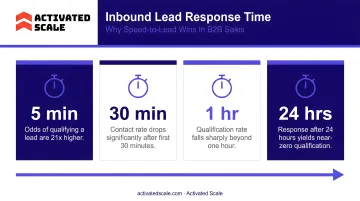
That speed gap is exactly where outsourced BDRs earn their keep. Why outsourcing BDRs adds value:
- Brings relationship-building expertise and market intelligence without a long-term HR commitment
- Lets you test new segments before committing full-time resources
- Handles the complexity of enterprise buying committees that now average 6-10 stakeholders, where buyers complete 60-70% of their journey before ever talking to sales
SDR vs BDR Outsourcing: Which is Right for Your Startup?
Four decision factors determine which role to outsource first:
- Current pipeline status - Zero pipeline vs. some inbound activity
- Average deal size and complexity - Transactional vs. enterprise
- AE capacity - Do AEs exist and need feeding, or are leads already coming in?
- ICP definition - Is your ideal customer profile clearly defined or still being validated?
Outsource an SDR When...
You have zero pipeline and need to create outbound demand immediately.
SDR outsourcing fills the top of funnel and generates meeting volume within weeks. Without an SDR, AEs either go dark or founders stay stuck in prospecting mode instead of closing deals. At companies under $5M revenue, 32% of SDR teams report directly to the CEO, eating into founder time that should go toward product and fundraising.
Your ICP is clearly defined and your sales motion is transactional or short-cycle.
SDRs thrive with a repeatable playbook, a known buyer persona, and a product that doesn't require extensive discovery before a meeting is worth taking. If your deals close in 1-3 months and average under $25K, an SDR can generate the volume you need to hit revenue targets.
The ramp time gap matters here. In-house SDRs take 3.2 months to reach full productivity, while outsourced SDRs can begin meaningful outreach in 2-8 weeks with qualified meetings flowing shortly after.
Outsource a BDR When...
You have inbound interest that's going cold.
If website visitors, MQLs, or demo requests sit uncontacted in your CRM for more than 24-48 hours, you're losing pipeline you already earned. Lead quality drops 80% after the first 5 minutes, and responding within 1 hour makes you 7x more likely to qualify versus waiting 2 hours. A BDR recaptures that lost opportunity.
Your buyers are enterprise, your deals are complex, or you're entering a new market.
BDRs handle the nuance required to start relationships at the right level, build a business case, and prepare buyers before the AE enters the picture. The average B2B tech sales cycle has expanded to 6.5 months, up from 4.9 months in 2019. Enterprise deals ($100K+) typically take 6-9+ months and involve up to 25 stakeholders.
At that scale, you need someone who can multi-thread relationships and navigate organizational complexity. Key signals that a BDR fits your motion:
- Deals regularly involve 5+ stakeholders or a formal buying committee
- Your AE is spending time educating prospects who aren't yet ready to buy
- You're entering a new vertical or market where relationships matter before demos
- Engaging 3+ contacts within a mid-market deal closes the sale 2.4x faster
Proposals sent within 24 hours of a demo also close 35% faster — a BDR who manages pre-sales nurturing creates the conditions for that speed.
Once you know which motion fits, execution speed matters. Activated Scale places vetted fractional SDRs and BDRs in as few as 7 days on a try-before-you-buy basis — so you can test the right motion before committing to a full-time hire.
Conclusion
The SDR vs BDR outsourcing decision depends entirely on where your pipeline breaks down. If demand doesn't exist yet, outsource an SDR. If demand exists but isn't converting, outsource a BDR. Knowing which bottleneck you're solving prevents wasted spend and wasted quarters.
For Seed-to-Series A SaaS founders, outsourcing delivers more than cost savings. It accelerates pipeline and removes the commitment risk of full-time hiring before you've validated your sales motion.
The cost difference is hard to ignore:
| Model | Annual Cost | Cost-per-Meeting Impact |
|---|---|---|
| In-house SDR (fully loaded) | $117K–$170K | Baseline |
| Outsourced SDR | $42K–$96K | 50–60% lower |
That gap covers OTE, employer taxes, benefits, sales tools, and management overhead on the in-house side — none of which apply to an outsourced model.
The right outsourced hire, deployed correctly, should pay for itself in qualified meetings within 30 days. If you're evaluating whether to outsource an SDR or BDR, start by auditing where your pipeline actually stalls. That single answer will tell you exactly which role to hire first.
Frequently Asked Questions
What is an SDR and BDR in sales?
SDRs (Sales Development Representatives) handle outbound prospecting and lead qualification. BDRs (Business Development Representatives) take a broader scope — inbound follow-up, strategic account development, and new market exploration — though many companies use the titles interchangeably or reverse the definitions.
What is better, SDR or BDR?
Neither is universally better — it depends on your motion. SDRs excel at building outbound pipeline with high meeting volume. BDRs are the stronger choice for converting inbound leads, pursuing enterprise accounts, or entering new market segments where relationships matter more than speed.
How much does it cost to outsource an SDR or BDR?
Outsourced SDR/BDR costs range from $42K-$96K annually depending on the model (monthly retainer, pay-per-meeting, or hybrid). Traditional retainers run $3K-$8K per month; pay-per-meeting models charge $150-$600 per meeting. Compare this to in-house fully-loaded costs of $117K-$170K per year including salary, benefits, tools, and management overhead.
Can I outsource both SDR and BDR roles at the same time?
Yes, but early-stage companies should typically start with one role, validate the playbook, then layer in the second. Running both before you know what works wastes budget and muddies what's actually driving results.
How quickly can an outsourced SDR or BDR start generating pipeline?
Outsourced reps typically come with existing playbooks and can begin outreach within 1-2 weeks of onboarding, with qualified meeting flow established by week 3-8. This is significantly faster than in-house hires who need 60-90 days to ramp.
What is the difference between outsourced SDR/BDR and fractional sales talent?
Traditional outsourcing typically involves an agency running campaigns on your behalf with shared resources. Fractional sales talent (like Activated Scale) means a dedicated, experienced rep works as part of your team on a part-time basis with the option to convert to full-time—offering more control, alignment, and cultural fit.