Introduction
Early-stage B2B SaaS founders face a real tension: they need qualified pipeline now, but can't afford the 3-4 months it takes to hire, onboard, and ramp a full-time SDR—let alone the $110,000 to $150,000 annual cost per rep.
With annual SDR turnover at 39% and 23% of new sales hires leaving within their first year, the traditional hiring path is both expensive and risky.
That's why outsourced BDR/SDR services combined with quality B2B data have become the go-to solution for resource-constrained teams. Instead of months of recruiting and ramp time, companies can deploy experienced reps with established playbooks in weeks. The catch: success depends entirely on knowing what separates high-performing programs from costly failures.
This guide covers the BDR vs. SDR distinction, why companies outsource, how data quality determines success, and the key best practices that will make or break your outsourced sales development program.
Key Takeaways
- Outsourced SDRs book meetings 2-4 weeks faster than in-house hires at 50-60% lower cost per qualified meeting
- B2B contact data decays at 3% monthly — poor data quality kills even the best SDR programs
- Multi-channel outreach (email + phone + LinkedIn) boosts engagement by 287% vs. single-channel
- Only 7% of companies say outsourced SDRs "really" worked — clear ICP, CRM integration, and weekly feedback loops are non-negotiable
- Programs most often fail due to compensation misalignment, poor oversight, or prioritizing cost over quality
BDR vs. SDR: Understanding the Difference Before You Outsource
What Each Role Actually Does
BDRs (Business Development Representatives) focus on outbound prospecting—identifying new accounts, cold outreach, and sourcing pipeline from scratch. They're hunters who create demand where none existed before.
SDRs (Sales Development Representatives) typically qualify inbound leads or conduct a mix of inbound and outbound activity, depending on the company's go-to-market motion. They respond to demo requests, content downloads, and webinar signups, then qualify prospects using structured frameworks.
The compensation reflects this difference:
- SDRs earn $60,000-$95,000 OTE with 2-3 month ramp time
- BDRs command $70,000-$110,000 OTE with 3-5 month ramp, justified by higher rejection rates and cold prospecting difficulty
Why the Distinction Matters for Outsourcing
Many B2B SaaS companies use these terms interchangeably—and job boards frequently blur the distinction—but understanding your intended function is critical when scoping an outsourcing engagement. The data, messaging, and KPIs required differ significantly between the two.
Each role demands a different infrastructure:
- Outbound BDR: verified contact data, technographic filters, cold outreach sequences
- Inbound SDR: lead routing automation, response-time SLAs, qualification frameworks
- Hybrid: both, plus clear handoff rules to avoid dropped leads
Define the role clearly before approaching any provider. A founder who asks for "an SDR" without specifying inbound vs. outbound often ends up with a rep optimized for the wrong motion—and a pipeline that reflects it.
Why B2B Companies Are Outsourcing Sales Development
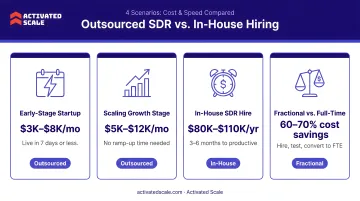
Building an in-house SDR team is expensive. The median SDR earns $80,000 OTE, but fully-loaded costs reach $110,000–$150,000 annually once you add benefits, tools, management overhead, and recruiting.
The time cost compounds that problem. Average time-to-hire runs 30–60 days, followed by a 3-month ramp to full productivity — meaning you're often 5+ months away from your first qualified meeting.
Outsourced providers deliver experienced reps with existing playbooks, tools, and muscle memory in weeks—not months. Early meetings typically appear within 2-4 weeks, with reliable volume by weeks 6-8.
When Outsourcing Makes Strategic Sense
Outsourcing works best in four situations:
- Founder-led outreach has plateaued — If you're personally prospecting and stuck below 10 meetings per month, outsourced capacity scales pipeline without pulling you off product.
- Validating a new market or ICP — Before committing to a full-time hire in an unproven segment, outsourced SDRs let you test demand and messaging at lower cost.
- Covering SDR turnover — When a rep leaves and you're facing a 3–6 month replacement cycle, outsourced talent keeps pipeline moving.
- Cutting cost-per-meeting — In-house cost-per-qualified-meeting runs $821–$1,150, while outsourced programs deliver the same meetings for $357–$500. Platforms like Activated Scale offer a try-before-you-buy model where startups work with vetted US-based fractional reps before converting to full-time hires.
About 38% of B2B SaaS companies now outsource part or all of their SDR operations, with the global outsourced sales services market projected to reach $4.21 billion by 2034.
How B2B Data Services Power Your BDR/SDR Outcomes
The Data Quality Imperative
Outsourced BDR/SDR programs are only as good as the data they run on. Poor contact data means low deliverability, wasted call time, and SDRs reaching irrelevant prospects—regardless of rep skill level.
The decay problem is real: B2B contact data decays at approximately 3% per month, meaning your database loses nearly 40% accuracy annually. 20-30% of contacts change jobs or titles within a single year, and 70% of CRM data is outdated or inaccurate.
The financial impact? Organizations lose an average of $12.9 million per year from poor data quality, with sales reps wasting approximately 500 hours annually on bad prospect data.
Three Data Types That Drive SDR Success
Each data type serves a different role in an outsourced SDR motion. Understanding which one does what prevents you from over-investing in the wrong layer.
| Data Type | What It Tells You | SDR Use Case |
|---|---|---|
| Firmographic | Industry, company size, revenue, location, ownership | Segmentation, territory assignment, ICP filtering |
| Technographic | Tech stack, software, cloud providers in use | Personalized messaging, replacement/integration plays |
| Intent | Keyword searches, content consumption, review site visits | Prioritizing active in-market buyers |
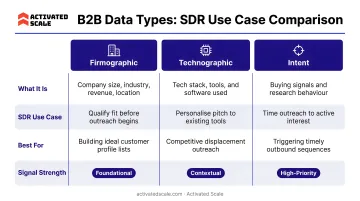
Signal-based outreach achieves 15-25% reply rates compared to 1-5% for generic cold email, and trigger-based outreach converts at 4x the rate. Intent data is what separates a prioritized pipeline from a spray-and-pray list.
Data Quality Standards You Should Demand
Premium B2B data providers achieve approximately 97% accuracy—the average provider delivers only 50%. In practice, keep hard bounce rates below 1% on verified contacts. Anything above 2% signals a list quality problem worth investigating before your SDRs burn more time.
Not all data sources are equal. Here's how the three main sourcing models compare:
- First-party data (collected from your own channels): highest quality, limited scale
- Third-party purchased lists: broader coverage, variable quality—vet providers carefully
- Intent data platforms: identifies active buyers, premium pricing, highest outreach ROI
- Data enrichment tools: layers firmographic/technographic data onto existing records
On the compliance side, US-based teams need to account for two key frameworks. GDPR permits B2B cold email under legitimate interest (Article 6(1)(f)), but requires a documented Legitimate Interest Assessment for each campaign. CCPA's B2B exemption expired in January 2023, meaning business contact data is now fully covered—"Do Not Sell" requests must be processed within 15 days.
Companies with accurate, targeted data see 66% higher conversion rates. That gap is the difference between a data vendor worth paying for and one that wastes your outsourced SDR's time from day one.
Best Practices for Outsourcing Your BDR/SDR Function
Define Success Criteria Before Signing
Agree on what a qualified meeting looks like, how leads are scored, what the handoff to an AE involves, and which KPIs will be tracked. Average monthly SDR quota is 12 meetings/opportunities, with approximately 65% of SDRs hitting quota.
Realistic benchmarks by performance tier:
- Elite (top 10%): 18+ meetings per month
- Top 25%: 12-15 meetings
- Median: 8-10 meetings
- Bottom 25%: 4-6 meetings
Track both activity metrics (calls made, emails sent, LinkedIn touches) and outcome metrics (response rate, meetings booked, show rate, pipeline created). Review weekly to identify whether underperformance stems from data problems, messaging issues, or activity levels.
Require CRM Integration and Reporting Transparency
Your outsourced SDR team should log every touch, outcome, and note in your CRM from day one. Lack of visibility into activity data is one of the most common reasons outsourced programs fail to improve over time.
Demand dashboard access showing:
- Daily activity volume by rep
- Email open and reply rates
- Call connect and conversation rates
- Meeting booking and show rates
- Pipeline created and stage progression
Invest in Onboarding and Knowledge Transfer
Even experienced SDRs need time to learn your product, personas, competitive landscape, and messaging. Share call recordings, customer case studies, objection handling guides, and sales content before the team starts dialing.
Create a messaging framework with:
- Value proposition statements
- Subject line options (A/B tested variants)
- Voicemail scripts
- LinkedIn connection request copy
- Objection responses for top 5 blockers
Reps who start with a complete messaging framework typically ramp 2-3 weeks faster than those handed a product deck and told to figure it out.
Build Weekly Feedback Loops
Weekly syncs are where outsourced programs either compound gains or quietly stall. Use them to surface what's working before scaling it, and cut what isn't before it costs you pipeline.
A productive weekly sync should cover:
- Which subject lines and call openers are getting responses
- Objections coming up repeatedly (and how to update messaging)
- Rep activity levels versus targets
- Data quality issues blocking outreach
- One messaging experiment to test next week
Only 7% of companies report outsourced SDRs "really" worked; most teams underestimate the oversight and enablement required.
Align Outreach Cadences with Data Quality
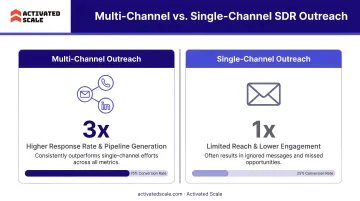
Multi-touch, multi-channel sequences (email + phone + LinkedIn) boost engagement by 287% compared to single-channel cold outreach. Combining cold email with LinkedIn generates 30-40% more replies than either channel alone.
None of that holds up when contact data is stale. Bounced emails, wrong titles, and disconnected numbers erode sequence performance before messaging even gets a fair test. The ideal cadence runs 16+ touchpoints per prospect, and generating a viable B2B lead requires 6-8 touches — which means every bad data point wastes a full sequence.
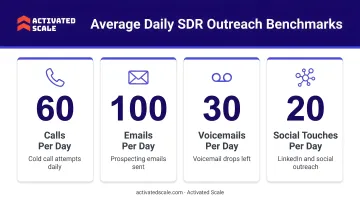
For context on what that volume looks like in practice, average daily SDR benchmarks run approximately:
- 35.9 calls
- 32.6 emails
- 15.3 voicemails
- 7 social touches
That's roughly 94 touches per rep per day — and accurate data is what makes each one count.
How to Set Up Your Outsourced SDR Program for Success
Define Your ICP with Specificity
Before launch, document your ideal customer profile: company size, industry, tech stack, pain points, and the persona who owns the problem your product solves. A vague ICP means your outsourced SDR is prospecting blind — wasting touches on companies that will never buy.
Targeted campaigns of 50 or fewer recipients produce a 5.8% response rate vs. 2.1% for large blasts. Include:
- Revenue range ($5M-$50M ARR)
- Employee count (50-500)
- Geographic focus (North America, EMEA)
- Tech stack indicators (uses Salesforce, doesn't use competitor X)
- Buyer persona title and seniority level
- Triggering events (fundraising, leadership changes, product launches)
Establish Realistic Ramp Timelines
Most outsourced SDR programs take 30-60 days to ramp before producing predictable results. In-house SDRs average 3.0 months; outsourced programs move faster but still need structure.
Plan quarterly pipeline expectations around this phased timeline:
- Weeks 1-2: Onboarding, training, and sequence setup
- Weeks 3-4: First meetings booked — volume is light but real
- Weeks 6-8: Consistent weekly output established
Set Up Dual-Track Metrics
Track both activity and outcomes weekly:
Activity metrics:
- Calls attempted and connected
- Emails sent and opened
- LinkedIn connection requests and acceptances
- Total touches per prospect
Outcome metrics:
- Response rate (% of prospects who reply)
- Meetings booked (qualified opportunities)
- Show rate (% of booked meetings that occur)
- Pipeline created (dollar value attributed to SDR sourcing)
Review both weekly to diagnose underperformance quickly. Low activity with strong outcomes is a green light to scale volume. High activity with poor outcomes points to a data or messaging problem — fix the inputs before adding more of them.
Common Mistakes to Avoid When Outsourcing Sales Development
Mistake 1: Outsourcing Before Validating ICP and Messaging
If you don't know who your best customers are and what resonates with them, no outsourced team can compensate. Most outsourced providers apply a "one-size-fits-all" strategy with no custom targeting—the primary structural reason programs fail.
Before handing off to any third party:
- Clarify your positioning internally
- Run a founder-led outreach pilot to surface what messaging resonates
- Document what works before handing anything off
Mistake 2: Treating the Provider as a Black Box
Companies that don't review calls, inspect email copy, or monitor CRM data forfeit the ability to course-correct. Lack of client oversight is one of five critical failure modes in outsourced programs.
Stay actively involved:
- Schedule weekly call reviews
- Read the actual email sequences being sent
- Check CRM logging quality regularly
- Request win/loss analysis on every booked meeting
Mistake 3: Optimizing Purely for Cost
Choosing the cheapest provider, particularly offshore teams with no domain expertise, often means sacrificing contact accuracy, cultural context, and brand representation in prospect conversations.
When outsourced SDRs are paid per meeting rather than per qualified opportunity, it incentivizes quantity over quality and results in unqualified meetings that waste AE time.
Focus on quality over volume. A US-based rep booking 12 qualified meetings per month at $500 per meeting delivers better ROI than an offshore team booking 25 unqualified meetings at $200 each.
Mistake 4: Relying on Single-Channel Outreach
Providers that rely only on email produce far lower results than multi-channel approaches. It now takes an average of 18+ outbound dials to connect with a single prospect.
Insist on phone + email + LinkedIn in every sequence. Multi-touch sequences achieve 4.0-7.0% conversion to booked meetings vs. 0.8-2.0% for cold email alone.
Mistake 5: Ignoring Data Quality and List Management
Providers using broad, unverified lists default to generic messaging and "spray and pray" volume that burns sender domains and erodes brand trust.
Before your provider sends a single email, confirm they meet these standards:
- Contact data with sub-2% bounce rates
- List refresh cadence of at least quarterly
- Segmentation by ICP fit before outreach begins
Frequently Asked Questions
What is SDR outsourcing?
SDR outsourcing means contracting with a third-party provider to supply trained sales development representatives. These reps handle prospecting, lead qualification, and meeting booking on your behalf—acting as an extension of your internal sales team.
What's an SDR vs BDR?
SDRs typically focus on qualifying inbound leads or mixed inbound/outbound activity, while BDRs are primarily focused on outbound prospecting and generating new pipeline from cold or untapped accounts. In practice, many B2B SaaS companies use the terms interchangeably.
Why do companies outsource their SDR function?
The primary drivers are speed and cost. In-house hiring takes 3–6 months and runs $110,000–$150,000 annually, while outsourced reps can be onboarded in 2–4 weeks. Companies also gain access to experienced reps with established playbooks and the flexibility to scale without long-term headcount commitments.
What are the benefits of outsourcing overseas?
Cost savings are the primary driver, with offshore SDRs often priced 50-70% below US-based equivalents. However, this comes with tradeoffs: time zone challenges, cultural and language fit issues, and potential negative impact on prospect experience—especially relevant for B2B SaaS selling into North American markets.
Want to grow pipeline without the cost and delay of full-time hiring? Activated Scale connects B2B SaaS startups with vetted, US-based fractional sales professionals—SDRs, BDRs, and Account Executives available on flexible engagements with the option to convert to full-time. Most clients are up and running within 7 days.