This guide gives CROs a practical playbook to extract maximum pipeline impact from outsourced SDR programs. You'll learn how to set up your engagement, enable outsourced reps to perform like embedded team members, measure what matters, and avoid the failure modes that tank most vendor relationships. The quality of your onboarding, enablement, and governance determines whether your outsourced SDR program delivers pipeline or disappointment — not just who the vendor is.
TLDR
- Outsourced SDRs succeed or fail based on how well the CRO structures the engagement
- Have a validated ICP, messaging playbook, and SDR-to-AE handoff protocol ready before outreach starts
- Track meeting quality and pipeline conversion — not raw activity volume
- Try-before-you-buy and contract-to-hire models let you validate SDR fit with low risk
Why CROs Are Turning to Outsourced SDRs
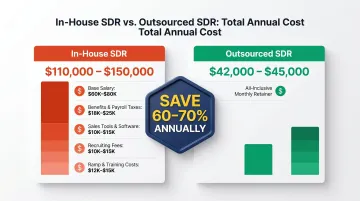
The math is straightforward. Fully loaded annual cost for one in-house SDR ranges from $110,000-$150,000 in Year 1, once you account for:
- Base salary ($45,000-$65,000)
- Benefits and payroll taxes
- Sales tools ($3,000-$5,000 per seat)
- Recruiting fees and management overhead
- Ramp costs during the productivity gap
Contrast that with outsourced SDRs at $42,000-$45,000 annually — a 60-70% reduction. Those hidden costs represent roughly 60% of your total investment, yet they rarely show up on the salary line item.
Speed matters as much as cost. In-house SDRs now take 5.7 months on average to reach full productivity in SaaS companies, up 32% from 4.3 months in 2020. Outsourced programs activate campaigns in 4-6 weeks and can launch 40% faster than building in-house. Time-to-first-meeting drops from 8-12 weeks to 4-6 weeks.
Growth-stage B2B SaaS CROs need surge capacity without headcount commitment. 82% of companies plan to outsource at least part of their lead generation, driven by the need to flex capacity without adding permanent headcount. For Seed-to-Series A companies, outsourced SDRs offer a practical way to test new ICPs, validate messaging in untapped verticals, and ramp outreach around product launches — without committing to a hire that costs $150K before they've booked a single meeting.
How to Set Up Your Outsourced SDR Program for Maximum Impact
Nail Your ICP and Target Account List Before Day One
The single biggest reason outsourced SDR programs underperform is a vague or untested ICP. The CRO must own ICP definition before the engagement starts:
- Firmographics: company size, revenue range, growth stage, funding status
- Technographics: tech stack, CRM platform, marketing automation tools
- Buying triggers: recent funding rounds, leadership changes, product launches, compliance deadlines
- Key personas: title, seniority level, department, typical pain points
Build a tight target account list before outreach begins. Segment by vertical, company size, and buying signal. Lock the list before day one rather than letting the SDR team prospect broadly on their own. A well-defined TAL of 200-500 accounts outperforms a loose list of 2,000.
Establish a Structured Onboarding Period
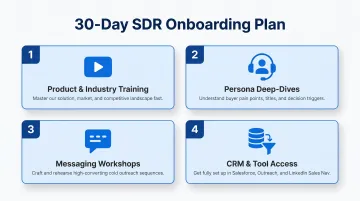
A 30-day onboarding plan covers:
- Product and industry training: 5-10 hours of recorded demos, competitive positioning, and use case walkthroughs
- Persona deep-dives: shadow calls with AEs and CSMs to hear objections, pain points, and buying motivations firsthand
- Messaging workshops: live sessions where SDRs practice cold call openers, email sequences, and objection handling
- CRM and tool access: full visibility into pipeline, closed-lost accounts, and open opportunities
Skipping this phase is the most common CRO mistake. Activated Scale can connect and activate vetted, US-based fractional SDRs in as little as 7 days — but fast-start timelines don't eliminate the need for structured knowledge transfer. Without it, SDRs default to generic messaging, and no volume of activity fixes a positioning problem.
SLAs give that investment structure. Once onboarding is underway, lock in the output expectations that hold both sides accountable.
Define Clear SLAs and Success Criteria Upfront
Set output-based SLAs before outreach starts:
- Outbound touchpoints: 40-60 calls and 30-50 emails per SDR daily
- Meetings booked per month: 12-15 qualified meetings for outbound SDRs; 20+ for top performers
- Meeting definition: What constitutes a "qualified" meeting in your context
Document what a Sales Accepted Lead (SAL) looks like. Agree on qualification criteria with both the outsourced SDR provider and your AE team:
- Role and title of attendee
- Company size and revenue band match ICP
- Identified pain point aligns with your solution
- Timeline for evaluation or purchase
- Budget authority or buying influence
Without this agreement in writing, AEs and SDRs will measure success differently — and you'll spend weekly syncs relitigating what counts as a meeting rather than improving the program.
Enabling Outsourced SDRs to Perform Like Part of Your Team
Build a Messaging Playbook They Can Actually Use
A complete SDR messaging playbook must contain:
- ICP-specific value propositions for each target persona
- Pain-point-led cold call openers (15-30 second hooks)
- Email sequence templates (5-7 touch cadence) for each persona
- Objection handling responses for the top 10 objections
- Competitor differentiation talk tracks (2-3 sentences per competitor)
Without this foundation, outsourced SDRs default to generic outreach — and generic outreach produces sub-1% reply rates. The first 60 days are when messaging patterns become visible, so test and iterate weekly during that window:
- Track reply rates by email template
- Monitor positive response rates vs. objection patterns
- Review call recordings weekly with the vendor
- Adjust messaging based on what the data surfaces
A/B test subject lines, openers, and CTAs. Let data drive iteration, not gut feel.
Create a Tight SDR-to-AE Handoff Protocol
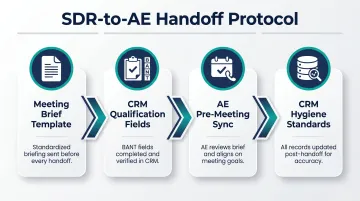
Because the SDR is external, there's higher risk of context loss when passing a qualified prospect to a closing rep. The CRO must define a documented handoff process:
- Meeting brief template: pre-call research, pain points discussed, next steps agreed
- Document required qualification fields in CRM: BANT (Budget, Authority, Need, Timeline) or MEDDIC
- AE briefing call norms: 5-minute pre-meeting sync between SDR and AE
- CRM hygiene standards: contact role, company notes, email thread history
Give outsourced SDRs visibility into open pipeline and closed-lost accounts so they can personalize outreach intelligently and avoid reaching out to existing customers or recently churned accounts.
Run Ongoing Feedback Loops Between SDRs, AEs, and the CRO
Most outsourced SDR programs stall not because of bad reps, but because feedback moves too slowly to fix problems before they compound. Build these touchpoints into your operating rhythm:
- Weekly SDR pipeline reviews: 30-minute call reviewing meetings booked, held rate, and AE feedback
- Bi-weekly messaging debrief calls with the vendor: review reply rates, objection patterns, and A/B test results
- Monthly AE feedback sessions: AEs rate meeting quality and share discovery call insights
When AEs consistently flag low meeting quality, that's a targeting problem. When reply rates drop, that's a messaging problem. Each feedback channel tells you exactly where to intervene — and when to do it.
The CRO's Measurement Framework for Outsourced SDRs
Track leading indicators weekly:
- Outbound touchpoints: calls dialed, emails sent, LinkedIn messages
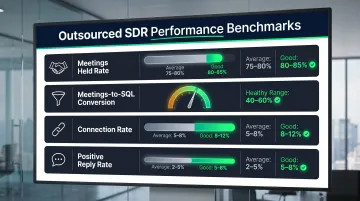
- Connection rates: 5-8% average; 8-12% good
- Positive reply rates: 2-5% average; 5-8% good
These tell you whether targeting and messaging work before waiting for meetings to materialize.
Own the core pipeline metrics:
- Meetings booked per month per SDR
- Meetings held rate: 75-80% average; 80-85% good (catches no-shows and ghosting)
- Meetings-to-SQL conversion rate: 40-60% is healthy
- Outsourced-SDR-sourced pipeline as % of total pipeline
The caveat matters: meetings only count when they convert. SDRs generate 46-73% of total pipeline depending on organization maturity — "meetings booked" is a vanity metric if those meetings don't move downstream.
Calculate ROI:
(Pipeline Revenue Generated – Total Program Cost) ÷ Total Program Cost
Include indirect benefits — founding team time saved, faster market feedback, reduced hiring risk. 70% of SMBs plan to increase outsourcing because ROI here goes beyond cost-per-meeting.
Knowing your numbers is only useful if you act on them at the right time. Outsourced SDR programs typically need 60-90 days to reach steady-state metrics. Red flag signals in weeks 4-8 include:
- Zero positive replies after 200+ emails sent
- AEs rejecting >50% of meetings as unqualified
- No-show rates exceeding 30%
- No repeat meetings with target accounts
Expect normal variance during ramp: 1-2 weeks with no meetings booked, reply rate fluctuations of ±2%, and early objection patterns that help refine messaging.
Common Mistakes CROs Make That Kill Outsourced SDR Performance
Three mistakes show up repeatedly in underperforming outsourced SDR programs:
1. Treating It Like a Hands-Off Vendor Relationship
CROs who disengage after signing a contract consistently see weaker results. Regular involvement in messaging refinement, ICP calibration, and AE feedback is non-negotiable. High-performing programs run weekly CRO touchpoints for the first 60 days, then shift to bi-weekly.
2. Measuring Activity Instead of Outcomes
Holding outsourced SDRs accountable for call and email volume creates the wrong incentives. The result: meetings AEs reject and pipeline that never converts. Track outcome-based metrics instead — cost-per-qualified-opportunity, meeting-to-SQL conversion rate, and total revenue influenced.
3. Choosing on Price Alone
Going with the cheapest option — particularly offshore-only providers without US-based talent — often leads to brand damage, shallow persona-level conversations, and weak pipeline quality. The price gap looks obvious upfront: US-based outsourced SDRs run $5,000–$8,000/month vs. offshore at $1,500–$3,000/month. But the real savings gap narrows to 40–50% once you factor in training overhead, churn, and conversion quality.
Try-before-you-buy models — like Activated Scale's contract-to-hire approach — let CROs validate SDR fit before committing long-term, cutting selection risk without sacrificing speed to pipeline.
Frequently Asked Questions
What is SDR outsourcing?
SDR outsourcing means partnering with an external provider whose reps handle outbound prospecting, outreach, and lead qualification on behalf of your company. They integrate into your CRM and GTM motion rather than acting as a detached call center.
What is an offshore SDR?
An offshore SDR is a sales development rep based outside the hiring company's home country, often in lower-cost regions. The cost savings are real, but language gaps, cultural mismatches, and time zone friction can limit effectiveness — especially for North American B2B outreach.
What does CRO stand for in business?
CRO stands for Chief Revenue Officer — the executive responsible for all revenue-generating functions including sales, marketing alignment, and pipeline strategy. Note: in pharma, CRO refers to Contract Research Organization — a different role entirely.
How do you measure the ROI of outsourced SDRs?
Use the formula: (Pipeline Revenue Generated – Total Program Cost) ÷ Total Program Cost. Factor in indirect ROI like time saved, market learnings, and faster ramp compared to building in-house.
How quickly can outsourced SDRs start generating pipeline?
While fast-start providers can activate SDRs in days, expect a 60-90 day ramp to reach consistent pipeline output. Early weeks focus on messaging testing and ICP refinement, with first meetings typically appearing at 4-6 weeks.
What's the difference between outsourced SDRs and fractional sales reps?
Outsourced SDRs typically work as part of a vendor team focused on top-of-funnel outreach. Fractional sales reps are individual experienced sellers embedded part-time directly into your company, often covering the full sales cycle or acting as a VP of Sales equivalent at an early-stage company.