Introduction
B2B buyers in 2026 are more informed and harder to reach than ever. According to Forrester's 2025 Buyers' Journey Survey, an average of 22 people now influence each B2B purchase decision—13 internal and 9 external stakeholders. Meanwhile, buyers receive 120+ sales emails per week, and Gartner reports that 67% of buyers prefer a rep-free experience. Generic outreach gets filtered out before it's even read.
The old playbook—blast 500 cold emails and hope for replies—is dead. Average cold email reply rates have collapsed to 3.43%, and that number drops even further when sellers prioritize volume over personalization. Prospecting in this environment is a precision sport, not a numbers game. The 8 strategies below show exactly how to build a pipeline that converts in 2026.
Key Takeaways
- Define your Ideal Customer Profile using closed-won data, not assumptions
- Multi-channel cadences (email + calls + LinkedIn) outperform single-channel by 287%
- Use AI to research and draft outreach, but keep humans in the loop for editing and final decisions
- ABM, referrals, and intent data consistently deliver the highest conversion rates
- Founders can scale prospecting without a full-time hire by bringing on fractional sales talent
What Makes B2B Sales Prospecting Harder in 2026
Today's buying committees are massive. Forrester research shows that 73% of B2B purchases involve three or more departments, with an average of 13 internal stakeholders plus 9 external advisors influencing every decision. Single-threaded outreach—targeting just one contact per account—is no longer sufficient. If you're only reaching the VP of Sales when Finance, Legal, IT, and Operations all have veto power, your deal will stall.
Buyers also complete most of their journey before engaging sales. Gartner's March 2026 survey found that 67% prefer a rep-free experience, and 45% already used AI during their most recent purchase. By the time prospects raise their hand, they've researched alternatives, read reviews, and often formed a preference. Outbound sellers must lead with insight and value, not product pitches.
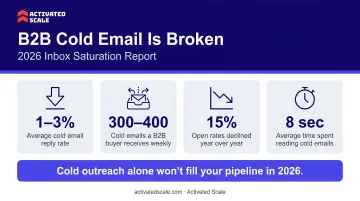
Inbox saturation and AI-driven spam filters have made breaking through harder than ever. The numbers tell the story:
- Cold email reply rates have dropped to 3.43%, with even top-performing campaigns topping out at 10.7%
- Open rates fell 23% year-over-year
- 95% of cold emails generate zero response
- GDPR and CAN-SPAM violations can cost up to $51,744 per violation
Relevance and timing are no longer differentiators — they're the baseline requirement for any response at all.
8 B2B Sales Prospecting Strategies for 2026
These strategies are chosen for environments where teams are lean, budgets are tight, and every prospecting hour must count—especially relevant for early-stage B2B SaaS companies.
Strategy 1: Define Your ICP with Evidence, Not Assumptions
Most prospecting failures stem from targeting the wrong accounts. Start by analyzing your existing closed-won customers for patterns:
- Industry verticals that convert fastest
- Company size and headcount ranges
- Tech stack signals (e.g., using Salesforce, HubSpot, or specific integrations)
- Job titles of champions and decision-makers
- Trigger events that triggered the purchase (funding round, leadership change, new regulation)
Build an evidence-based ICP by reviewing your CRM data, win/loss analysis, and customer interviews. Look for commonalities among your best customers—those who closed quickly, paid full price, and stayed long-term.
Equally important: define your anti-ICP. These are accounts that look right on paper but consistently don't close or churn early. Common anti-ICP signals include:
- Companies in adjacent industries that seem similar but have different pain points
- Organizations below a certain size that lack budget or authority
- Prospects who request features you don't offer
- Accounts with long sales cycles that drain resources without closing
Documenting your anti-ICP prevents wasted pipeline capacity and lets your team disqualify bad-fit leads faster.
Strategy 2: Build a Multi-Channel Outreach Cadence
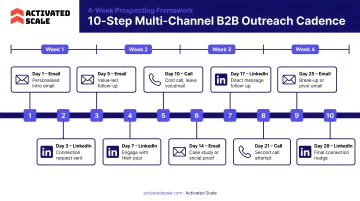
Coordinated multi-channel sequences consistently outperform isolated touches. Research shows that campaigns using 3+ channels achieve 287% higher purchase rates than single-channel efforts, and multi-channel meeting conversions are 30%+ higher.
A well-structured 3–4 week cadence looks like this:
Week 1:
- Cold email with specific insight (Day 1)
- LinkedIn connection request with context (Day 3)
- Phone call referencing the email (Day 5)
Week 2: 4. Follow-up email with new value (Day 8) 5. LinkedIn engagement on their content (Day 10) 6. Second phone attempt (Day 12)
Week 3: 7. Case study or resource share via email (Day 15) 8. LinkedIn InMail if not yet connected (Day 17)
Week 4: 9. Final breakup email with clear next step (Day 22) 10. Phone call as last touchpoint (Day 24)
Each touchpoint must advance the conversation rather than repeat the same message. The phone call should reference the email hypothesis, and LinkedIn engagement should warm the relationship before the pitch arrives. RAIN Group research shows it takes an average of 8 touchpoints to get an initial meeting, yet 44% of reps stop after one attempt.
Strategy 3: Use AI for Research and Personalization at Scale
The "AI drafts, humans decide" workflow works like this:
- AI pulls relevant signals per prospect (funding news, tech stack from BuiltWith, recent hires on LinkedIn, product launches, job changes)
- AI proposes a first draft that references those signals
- The rep spends 60–90 seconds tightening the message, adding a real point of view, and verifying accuracy
McKinsey's 2025 B2B Pulse Survey shows that 19% of B2B leaders are implementing generative AI for buying and selling, with early adopters seeing 30-40% higher conversion rates. But speed isn't everything.
Warning: Full automation of outreach risks spam complaints, domain reputation damage, and lost credibility. Research shows that 88% of recipients ignore emails they suspect are AI-generated, and 80% of people would switch brands if a company relies too heavily on AI communication.
Two more risks worth knowing: AI hallucinations occur approximately 15% of the time, and most AI "personalization" is just template field swaps—not the genuine relevance buyers expect.
Use AI for research and drafting—but keep human review in the loop. The hybrid approach achieves 30-50% time savings while maintaining response rates and brand trust.
Strategy 4: Account-Based Marketing (ABM) for High-Value Targets
ABM means concentrating resources on a defined set of high-fit accounts rather than casting wide. Identify 20–50 target accounts and coordinate personalized, multi-stakeholder campaigns that align sales and marketing messaging.
How to identify ABM-worthy accounts:
- Match your best closed-won profile (industry, size, tech stack)
- Show intent signals (website visits, content downloads, event attendance)
- Have deal sizes large enough to justify higher per-account investment
ITSMA reports that 87% of marketers say ABM delivers higher ROI than other strategies. Forrester/SiriusDecisions found that 89% of organizations able to measure ABM ROI confirmed it outperformed control groups, with 171% increases in average deal size.
ABM execution includes:
- Personalized landing pages for target accounts
- Custom content (case studies, ROI calculators, comparison guides)
- Coordinated outreach across multiple stakeholders
- Account-specific ad campaigns on LinkedIn
- Executive engagement (CEO to CEO, CFO to CFO)
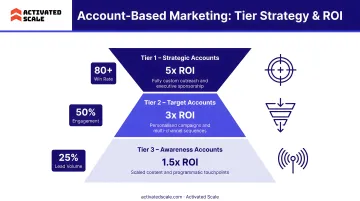
Even startups can apply ABM principles by tiering accounts into Tier 1 (strategic, 1:1 customization), Tier 2 (mid-priority, strong ICP-fit), and Tier 3 (1:many scaled outreach).
Strategy 5: Social Selling and LinkedIn Prospecting
LinkedIn prospecting in 2026 means building credibility before asking for meetings. Three practices that move the needle:
- Post before you pitch. Share insights relevant to your buyer's world—industry trends, customer wins, sharp takes on common problems. Credibility compounds over time.
- Engage before you connect. Like and comment on prospects' posts before sending a request. Reference their content in your message so it's clear you've paid attention.
- Write connection requests with context. Skip "I'd like to add you to my network." Try: "Saw your post on API security challenges—we've helped three fintech companies solve similar problems. Worth a quick conversation?"
LinkedIn data shows that sellers with 4+ connections at a target account are 16% more likely to close, and personalized InMails increase acceptance rates by 40%. The platform hosts 130 million+ decision-makers, and 98% of Fortune 500 CEOs use it as their primary social channel.
Use tools like LinkedIn Sales Navigator to identify buying signals—job changes, company growth, new funding rounds—that indicate a prospect is in-market before they raise their hand.
Strategy 6: Activate Referrals and Warm Introductions
Referral leads convert at far higher rates than cold outreach. First Page Sage data shows client referrals deliver 56% lead-to-MQL conversion rates—the highest of any source. Referral deals reportedly close 69% faster than any other channel.
A simple referral process:
Ask at peak satisfaction moments:
- Right after a successful outcome (product launch, first ROI milestone)
- Following a renewal or upsell
- After a positive quarterly business review
Make it easy with a templated ask: "We're looking to help 3-5 more companies like yours solve [specific problem]. Do you know anyone at [target company type] who's facing similar challenges?"
Consider lightweight incentives:
- Amazon gift cards for introductions that turn into meetings
- Partner program credits for closed deals
- Public recognition (customer spotlight, case study feature)
The key is making referrals part of your regular customer engagement rhythm rather than a one-off request.
Strategy 7: Prioritize Buying Signals and Intent Data
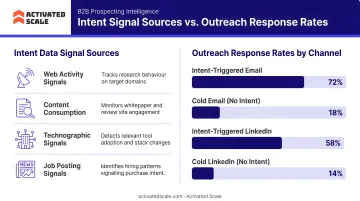
Intent data reveals which accounts are actively researching solutions like yours. Sources include:
- Website visitor tracking (repeat visits, pricing page views, demo requests)
- Content downloads (whitepapers, case studies, comparison guides)
- Review site activity (G2, Capterra, TrustRadius)
- Social engagement (LinkedIn post interactions, webinar attendance)
- Job postings (hiring for roles that indicate need for your solution)
Unify/Emblaze data shows intent-triggered outreach produces 8-15% positive reply rates versus 1-3% for cold lists, and signal-initiated deals win at 33-41% versus 18-25% for reactive deals.
Act on intent signals quickly. Prospects showing active interest have a short engagement window. Same-day or next-day follow-up with a highly relevant message dramatically increases response rates. Harvard Business Review research found that firms responding within 1 hour are 7x more likely to qualify a lead.
Strategy 8: Build Prospecting Capacity with Fractional Sales Talent
Many early-stage B2B SaaS founders hit a critical bottleneck: they have a validated ICP and solid outreach playbook, but no dedicated person to execute prospecting consistently while they focus on closing deals and building product.
Fractional sales professionals solve this problem. Experienced SDRs and AEs can own prospecting execution on a part-time or contract basis, enabling startups to:
- Test channels and messaging before committing to full-time hires
- Build pipeline without the 6-month hiring cycle
- Access talent with experience selling to your exact buyer persona
- Scale capacity up or down based on results
Activated Scale connects B2B SaaS startups with vetted, US-based fractional sales talent through a try-before-you-buy model. Companies can hire experienced SDRs or Account Executives in 7 days or less, with zero termination fees and the option to convert to full-time.
The model reduces hiring risk by letting founders evaluate talent in a real working environment before making permanent commitments.
How to Prioritize These Strategies for Your Stage
Not every strategy should be pursued simultaneously. Early-stage companies (pre-product-market fit or with one SDR) should start with:
- ICP definition (Strategy 1)
- Cold email + cold calling (Strategy 2)
- Basic LinkedIn engagement (Strategy 5)
Once you have consistent meeting flow, layer in:
- AI-assisted research (Strategy 3)
- Referral process (Strategy 6)
- Intent data monitoring (Strategy 7)
Finally, add ABM and fractional talent when:
- Average deal size exceeds $25,000-$50,000 (ABM becomes ROI-positive)
- Sales cycle involves multiple stakeholders (ABM coordination pays off)
- Founder is spending 20+ hours/week on prospecting (fractional talent frees capacity)
Simple decision framework:
- Deal size above $50K? Prioritize ABM and multi-stakeholder outreach
- Sales cycle under 30 days? Referrals and intent data will move faster than ABM
- Solo founder-seller? Adding fractional talent generates more pipeline than piling on another tactic
Test one new strategy per quarter, tracking metrics like reply rate, meeting set rate, and pipeline created. Spreading across all 8 at once dilutes focus and makes it nearly impossible to know what's working.
Conclusion
B2B prospecting in 2026 rewards teams that are disciplined and targeted. The teams consistently filling pipeline aren't necessarily the best-resourced — they're the most focused, treating every outreach as a reason to start a real conversation rather than push a message.
If you need to build or scale your outbound pipeline without the risk of a full-time hire, explore Activated Scale's fractional sales talent network—where experienced B2B sales professionals can be onboarded in 7 days or less to start booking qualified meetings.
Frequently Asked Questions
What are the 5 P's of prospecting?
The 5 P's of prospecting are: Preparation (research your ICP), Persistence (follow up across touchpoints), Personalization (tailor each message), Product knowledge (know your solution's value), and Process (run a repeatable, measurable system).
What is the best strategy for sales in 2025?
The most effective sales strategy combines a tight ICP with multi-channel outreach (email, phone, LinkedIn) and AI-assisted personalization. Quality of engagement beats volume of activity—targeted campaigns to 100 well-researched accounts outperform spray-and-pray to 1,000 cold contacts.
What is B2B sales prospecting?
B2B sales prospecting is the process of identifying, researching, and initiating contact with potential business buyers who fit your ideal customer profile and are likely to convert. It's the top-of-funnel activity that generates qualified meetings and pipeline for the sales team.
How do you qualify a B2B prospect?
Use these four criteria to qualify a prospect:
- Authority — can they sign the contract?
- Budget — do they have funds allocated?
- Need — does your solution address their problem?
- Timing — are they actively evaluating, or just browsing?
BANT and MEDDIC are two structured frameworks that codify this process.
What tools are commonly used for B2B sales prospecting?
Common categories include CRM systems (Salesforce, HubSpot), intent data platforms (6sense, Bombora), LinkedIn Sales Navigator, email sequencing tools (Outreach, SalesLoft), and AI personalization tools (Clay, Lavender). The right stack depends on your ICP, deal size, and team size.
How long does B2B prospecting take to generate results?
Most outbound prospecting motions take 4–8 weeks to show consistent pipeline results, depending on outreach volume, ICP tightness, and follow-up cadence discipline. RAIN Group data shows 75% of outbound leads require long-term nurture, and the average B2B customer journey spans 211 days. For most early-stage teams, plan for at least 90 days before meeting flow becomes consistent.