
Introduction
Most B2B founders face the same trap: spend 4-6 months hiring and ramping an SDR — who may quit within 18 months — while competitors capture the pipeline you're missing. The numbers back this up: 60% of sales leaders cite talent recruitment as their biggest obstacle, and 83% of SDRs miss quota.
The traditional hiring playbook is broken.
This guide covers what B2B sales outsourcing actually is, when it works, the five most common engagement models, how costs compare to in-house hiring, and what to look for in a partner.
TLDR:
- B2B sales outsourcing means hiring external teams for top-of-funnel activities like prospecting, outreach, and appointment setting
- Retainers run $2,500-$15,000/month vs. $110,000-$150,000/year for in-house SDRs
- Outsourced teams launch in 2-4 weeks vs. 3-6 months to hire and ramp internally
- Best for: Companies with defined ICPs who need pipeline now but can't afford full-time hiring risk
- Watch for: Specialization over generalism, transparent pricing, and real-time CRM integration
What Is B2B Sales Outsourcing?
B2B sales outsourcing is hiring an external team or individual to handle specific sales functions—typically prospecting, cold outreach, or appointment setting—instead of building everything in-house. The goal isn't to replace your sales operation, but to extend its reach into the activities that slow internal teams down most.
B2B sales development focuses specifically on top-of-funnel pipeline building (SDR/BDR activity). Sales outsourcing is broader — it can cover any part of the process from lead generation through deal support, though most successful implementations stop before the close.
Where Outsourcing Works (and Where It Doesn't)
Outsourcing excels at high-volume, process-driven tasks at the top of the funnel:
- Lead research and list building – Identifies target accounts and contacts matching your ICP
- Runs email sequences, LinkedIn messaging, and cold calling at volume
- Appointment setting – Qualifies prospects and books demos directly onto your AEs' calendars
- Manages the full prospecting-to-qualified-meeting workflow (SDR/BDR functions)
- Pipeline qualification – Runs initial discovery calls to validate fit before handoff
- Keeps contact and account data clean and current
These activities are repeatable, measurable, and don't require deep internal product knowledge.
What should stay in-house:
- Closing deals – Requires pricing authority and product depth no external rep will have
- Long-term relationship management with key accounts
- Technical product demos – Deep functionality walkthroughs that need engineering-level insight
- Revenue forecasting tied to internal strategy and business intelligence
- Customer success – Post-sale retention and expansion where continuity matters
External teams can run repeatable plays at scale. The moment a conversation requires negotiating a custom contract, defending your roadmap, or managing a relationship that took two years to build — that work stays with you.
Key Benefits of B2B Sales Outsourcing
Speed to Pipeline
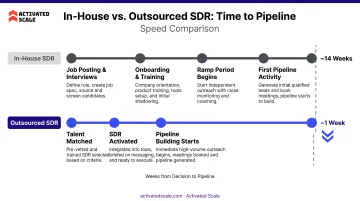
The hiring math is brutal. Median time-to-fill for an SDR role is 42 days. Then add 3.2 months for the new hire to reach full productivity. That's 5+ months from job posting to consistent pipeline generation.
Outsourced teams launch campaigns and start delivering qualified meetings within 2-4 weeks. When your AEs are sitting idle or your founder is burning 20 hours a week on cold outreach, those 3-4 months of lost time translate directly to missed revenue.
Cost Efficiency
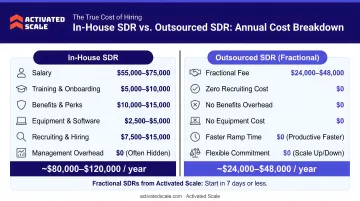
The all-in cost of a US-based SDR isn't just salary:
Full-Time SDR (Annual):
- Base salary: $45,000-$55,000
- OTE (on-target earnings): $55,000-$90,000
- Benefits and taxes: 20-30% of salary
- Sales tech stack: $5,100-$11,100
- Management overhead: ~$18,000
- Recruiting fees: $4,000-$13,000
- Total: $110,000-$150,000
Outsourced SDR (Annual):
- Monthly retainer model: $30,000-$96,000
- Pay-per-appointment model: $18,000-$72,000 (assuming 150-300 meetings/year)
Turnover makes the gap worse. Average SDR tenure is 14-18 months, with 40-50% attrition annually. Each departure costs $115,000-$195,000 in recruiting, ramp time, and lost pipeline.
Specialized Expertise, No Ramp-Up Required
Outsourced sales partners bring established playbooks, industry-specific messaging, and proven processes refined across dozens of client campaigns. Your first in-house SDR hire is learning on your dime — an outsourced team already knows what works for companies like yours.
That gap shows up in quota attainment: 83% of SDRs fail to hit quota, largely because they're still figuring out the fundamentals that experienced external teams have long since solved.
Scalability and Flexibility
Launch a new product line? Scale up. Market contracts? Scale down. With outsourced teams, you adjust capacity without the emotional and financial toll of layoffs or frantic rehiring.
This flexibility is critical for early-stage startups managing runway. You can test messaging, validate ICPs, and prove out pipeline economics before committing to permanent headcount.
Founder and Internal Team Focus
Sales reps spend 70% of their time on non-selling tasks—admin, data entry, meeting prep. For founders wearing multiple hats, that percentage is even higher.
Outsourcing top-of-funnel activity frees founding teams to focus on product development, customer success, and closing deals instead of grinding through cold email campaigns. When your time is the bottleneck, handing off prospecting and reclaiming 15-20 hours a week is one of the highest-ROI moves available to early-stage founders.
B2B Sales Outsourcing Models: Which Works Best for Your Business?
SDR/BDR Outsourcing
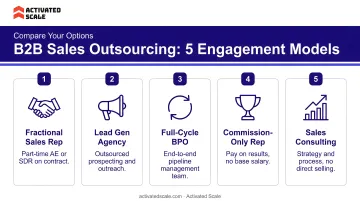
The external team handles prospecting, cold outreach, and appointment setting. Internal AEs close deals. This is the most common model for growth-stage B2B companies.
At a glance:
- Best for: Companies with established AE teams who need consistent top-of-funnel pipeline but don't want to manage SDR hiring and ramp
- Typical output: 8–15 qualified meetings per SDR per month, generating $50,000–$150,000 in monthly pipeline depending on deal size
- Ramp time: 30–60 days from contract signature to first qualified meetings
Fractional Sales Talent
Experienced sales professionals — AEs, SDRs, or sales managers — work part-time or on contract, embedded within your team rather than operating from an agency. This model suits early-stage B2B SaaS startups that need real sales execution but aren't ready for full-time hires.
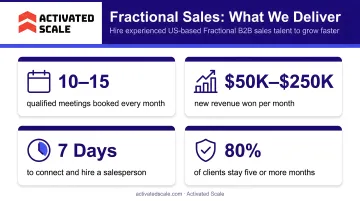
One example of this in practice: Activated Scale matches vetted US-based fractional sales talent to startups on a try-before-you-buy basis. Companies connect with experienced professionals in 7 days or less, evaluate fit over a contract period, and convert to full-time if results align.
Best for: Startups without sales leadership who need someone to own the entire prospecting-to-close motion while minimizing hiring risk.
Typical engagement: 10–20 hours per week on a monthly retainer, with option to convert to full-time after 3–6 months.
Full-Cycle Outsourcing (End-to-End Pipeline)
The vendor handles everything from list building to booked meetings. Best for companies that need to move fast and have a simple, repeatable sales motion.
Important limitation: Full-cycle outsourcing rarely extends through closing. Most reputable providers stop at qualified appointment handoff. Vendors promising to "own the entire sales cycle" often lack the product depth and strategic context required to close complex B2B deals.
Best for: Companies with well-defined ICPs, clear messaging, and AEs ready to take qualified handoffs immediately.
Cold Email or Outbound Channel Outsourcing
Vendors specialize in a specific outreach channel — email, LinkedIn, or cold calling. Best used when you have a defined ICP and want to test a channel before building it in-house.
There's an important distinction here:
- A cold email agency runs campaigns and delivers meetings
- A full SDR program covers multi-channel outreach, qualification, meeting coordination, and CRM management
This model works well for testing a new channel or scaling a proven one without hiring specialized talent first.
Hybrid Model (Outsourced Prospecting + In-House Closing)
Outsourced SDRs generate pipeline. Internal AEs close. For complex B2B sales requiring real product depth, this is typically the strongest setup.
Critical success factor: Strong handoff protocols and ICP alignment between both teams. If your outsourced SDRs book meetings that your AEs reject as unqualified, the model breaks down fast.
Best for: Mid-market and enterprise sales with deal cycles of 30+ days and multiple stakeholders.
B2B Sales Outsourcing vs. Hiring In-House
| Dimension | In-House SDR | Outsourced SDR |
|---|---|---|
| Cost (Annual) | $110,000-$150,000 (salary, benefits, tools, management) | $30,000-$96,000 (retainer or per-meeting fee) |
| Time to First Meeting | 4-6 months (hiring + ramp) | 2-4 weeks |
| Financial Risk if It Fails | $115,000-$195,000 (replacement cost + lost pipeline) | Month-to-month contract with 30-day exit |
| Flexibility to Scale | Fixed cost; layoffs required to scale down | Variable cost; adjust capacity monthly |
Speed and Productivity Comparison
In-house SDRs take 3-6 months to reach full productivity. Outsourced teams typically start producing qualified meetings within 30-60 days because they're not learning your market from scratch—they're applying proven frameworks.
The gap widens when you factor in hiring time. If you're starting from zero (no posted job, no pipeline of candidates), you're realistically looking at 5-7 months before an in-house SDR is delivering consistent pipeline. For companies with urgent growth targets or limited runway, that delay simply isn't viable.
When In-House Makes More Sense
In-house is the right long-term play for scaling companies with:
- Established product-market fit
- Repeatable sales process, documented and tested
- Budget for full-time headcount (including management layer)
- 12+ month timeline to build sustainable sales infrastructure
For most early-stage companies, outsourcing is the path to get there. Start with outsourced SDRs, prove your pipeline economics, then bring the function in-house once you have the budget and processes to support full-time hires.
When Is the Right Time to Outsource B2B Sales?
Timing matters more than budget when it comes to outsourcing sales. Go too early and you'll burn spend on a process that isn't ready to scale. Wait too long and your AEs will keep doing work that shouldn't be theirs. Here's how to know where you stand.
You're Ready When:
- You have a defined ICP – You can describe your ideal customer in 1-2 sentences, including company size, industry, and buyer role
- Your AEs are prospecting instead of closing – If your closers are spending 10+ hours a week on cold outreach, you're leaving money on the table
- You've struggled with SDR retention or ramp time – Repeated failed hires signal process or market timing issues, not just bad luck
- You're entering a new market or testing a new segment – Outsourcing lets you validate demand before committing to full-time headcount
- Your pipeline is inconsistent – Revenue swings month-to-month because you don't have a predictable lead generation engine
You're NOT Ready When:
- You haven't defined your ICP – Outsourcing a broken or undefined process amplifies the problem
- There's no internal alignment on what a qualified meeting looks like – When AEs and marketing disagree on "qualified," outsourced SDRs fill your calendar with meetings no one wants
- Your AEs can't handle inbound meetings – If your team is already underwater, adding more pipeline just creates bottlenecks
- You're still iterating core messaging – Outsourced teams need tested messaging; sending them in with unproven copy wastes time and budget
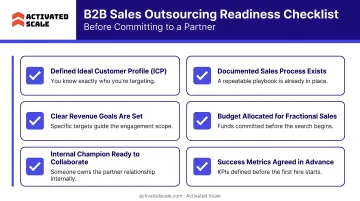
Readiness Checklist
Before committing to outsourcing, validate that you have:
- A written ICP that specifies firmographics, buyer role, and the pain points you solve
- Documented qualification criteria (BANT, MEDDIC, or equivalent) used consistently across your team
- AE capacity to absorb 8-15 new qualified meetings per month per SDR
- $3,000–$10,000/month budgeted for a 3+ month pilot engagement
- A 30–60 day pilot window to test, measure, and refine before scaling
- A CRM (Salesforce, HubSpot, or equivalent) to track activity and outcomes
How to Choose the Right B2B Sales Outsourcing Partner
Evaluate Specialization Over Generalism
The best partners are specialists. Ask:
- What industries or buyer personas do you focus on?
- Can you share case studies with companies like ours (stage, deal size, sales motion)?
- What's your average client engagement length, and why do clients leave?
Request quantified outcomes: meetings booked, pipeline generated, meeting-to-opportunity conversion rate.
Be cautious of agencies that claim to do everything—B2B SaaS, healthcare, manufacturing, enterprise, SMB. Deep expertise in one vertical or sales motion consistently outperforms shallow coverage across many.
Pricing Model Transparency and Contract Terms
Three primary models exist:
Monthly retainer: $2,500–$15,000+ per month depending on team size and scope. Predictable cost, but you pay regardless of output.
Pay-per-appointment: $150–$500 per qualified meeting. You only pay for results, but watch for incentive misalignment (quantity over quality).
Hybrid: Base retainer + per-meeting bonus above a threshold. Balances predictability with performance incentives.
Red flags:
- Rigid 12+ month contracts with no performance clauses
- Hidden tool fees (email automation, data providers) not disclosed upfront
- Vague definitions of what constitutes a "qualified" meeting
- No monthly minimum or cap on meetings (uncapped risk)
For startups, look for partners offering try-before-you-buy or 30–60 day pilot options. Activated Scale's model is a strong example: connect with vetted fractional sales talent, evaluate performance over a contract period, then decide whether to convert to full-time. This structure minimizes financial risk while proving out ROI before long-term commitment.
Integration, Reporting, and Communication Standards
Pricing and contract terms matter upfront—but how a partner operates day-to-day determines whether the engagement actually delivers. Your outsourced team should:
- Integrate with your CRM: Log all activity in Salesforce, HubSpot, or your system of record
- Provide real-time reporting: Weekly dashboards showing qualified meetings, pipeline value, and conversion rates — not just emails sent or calls made
- Participate in regular syncs: At minimum, weekly check-ins to review messaging, ICP fit, and qualification criteria
Avoid vendors that operate as a black box. If they won't share call recordings, email templates, or meeting notes, you can't validate quality or learn what's working. The right partner should give you enough visibility to coach, iterate, and improve—not just receive a weekly meeting invite and hope for results.
Frequently Asked Questions
What is B2B sales outsourcing?
B2B sales outsourcing means hiring an external team or individual to handle specific parts of the sales process—typically top-of-funnel activities like prospecting, outreach, and appointment setting—rather than managing everything in-house. The goal is to augment your existing team, not replace it entirely.
What is B2B sales development?
B2B sales development focuses on building and qualifying pipeline at the top of the funnel, typically performed by SDRs or BDRs. It's one of the most commonly outsourced functions because it's high-volume, process-driven, and doesn't require deep product knowledge to execute well.
How much does B2B sales outsourcing cost?
Monthly retainers typically run $2,500-$15,000+ depending on scope and team size. Pay-per-appointment models range $150-$500 per qualified meeting. Costs vary based on geography (US-based talent costs more), vendor specialization, and whether you're outsourcing just one channel or a full SDR program.
What sales functions can be outsourced in B2B?
The most commonly outsourced functions are lead research and list building, cold outreach (email, phone, LinkedIn), appointment setting, SDR/BDR activity, and pipeline qualification. Closing deals and strategic account management typically stay in-house because they require deep product knowledge and decision-making authority.
When should a B2B startup outsource its sales?
Consider outsourcing when the founding team is losing time to outreach over product or customer work, pipeline is inconsistent, or a full-time hire feels too risky for your current runway. One hard prerequisite: you need a defined ICP and proven messaging before an external team can produce results.
What's the difference between outsourced sales and hiring a full-time sales rep?
Outsourcing deploys in 2-4 weeks versus 4-6 months for a full-time hire, with monthly contracts instead of $115,000+ replacement costs if the hire fails. A full-time rep brings deeper company integration and institutional knowledge over time, but carries higher fixed costs and a longer ramp to productivity.