Introduction
Your B2B SaaS startup needs a steady flow of qualified prospects to hit growth targets. But building an internal sales development team eats cash and time — especially at the seed to Series A stage when every dollar and week counts.
Hiring an SDR means 3 months of ramp time before they book their first qualified meeting. Add recruiting costs, tech stack licenses, and management overhead, and you're $100,000+ deep before seeing results. Your pipeline stays empty while revenue stalls.
This guide covers how outsourced sales teams generate qualified meetings faster than in-house hiring, what makes the fractional model different from traditional agencies, and what to watch for when choosing a partner.
TLDR
- Outsourced sales teams handle prospecting, outreach, and qualification so your team focuses on closing deals
- Expect first qualified meetings within 2-4 weeks versus 3+ months for a new in-house SDR hire
- Fractional models give early-stage startups senior sales talent without full-time costs
- Success depends on a clear ICP, tight handoff processes, and the right partner
Why B2B Startups Struggle to Build Qualified Pipeline In-House
Early-stage B2B SaaS founders wear too many hats. Product roadmap, fundraising, customer support — prospecting gets deprioritized until the pipeline runs dry. This creates feast-or-famine revenue cycles that kill predictability.
When founders finally decide to hire an SDR, hiring an SDR triggers its own set of delays. According to The Bridge Group's 2025 Sales Development Metrics report, based on data from 351 B2B companies, average SDR ramp time is 3.0 months — the lowest reading since 2010, but still a quarter wasted before a single qualified meeting gets booked. For full-cycle account executives, that number jumps to 5.7 months.
The Real Cost of In-House Sales Development
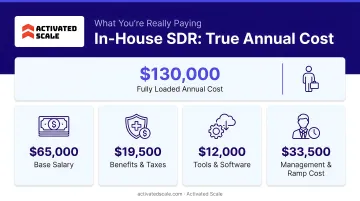
Here's what that SDR actually costs you:
- Base salary: $55,000 (Bridge Group 2025 benchmark)
- On-target earnings (OTE): $80,000 with variable compensation
- Benefits and payroll taxes: 25-30% of base (~$14,000-$17,000)
- Recruiting fees: $7,000-$15,000
- Sales tech stack: $5,000-$12,000 annually (CRM, sequencing tools, data providers)
- Management overhead: Pro-rated share of manager salary and time
Total fully loaded cost: $92,000 to $130,000+ per year for a single SDR who won't be fully productive for three months.
That's a painful burn rate for early-stage companies trying to stretch runway.
The ICP Clarity Problem
Many seed-stage startups haven't nailed their ideal customer profile yet. An in-house hire spends expensive ramp time chasing the wrong prospects — burning salary dollars and opportunity cost while you figure out who actually converts.
The alternative — founders doing the selling themselves — creates a different bottleneck. The founder becomes the single point of failure. Growth stalls when attention shifts to product development, fundraising, or operations.
The pipeline pressure is real across the board. Salesloft's 2025 State of Pipeline Generation survey found that generating new pipeline is the #1 challenge facing sales leaders, with 86.1% of sellers reporting higher pipeline quotas than last year.
The hiring timeline trap extends beyond ramp time. Bridge Group data shows average SDR tenure has fallen to 1.4 years, down from 1.8 years in 2021. Factor in the 3-month ramp and you get roughly 14 months of full productivity before turnover forces you to restart. With 20% of new sales hires leaving within the first 90 days, the true cost of in-house sales development compounds fast — which is exactly the problem outsourced sales models are built to solve.
How Outsourced Sales Teams Build Qualified Pipeline Faster
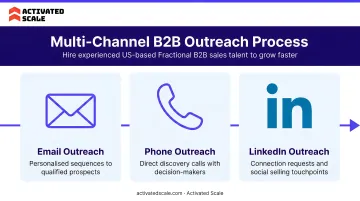
Outsourced sales teams follow a systematic process that covers the full top-of-funnel motion: ICP definition, prospect list building, multi-channel outreach (email, phone, LinkedIn), lead qualification, and appointment setting. Your internal team receives meeting-ready leads.
Prospect Identification and Targeting
Experienced outsourced professionals don't rely on generic databases. They use market intelligence and buying signals to build targeted prospect lists:
- Funding announcements indicating budget availability
- Headcount growth signaling expansion and new hiring
- Technology adoption showing tool stack changes
- Leadership changes creating new decision-making dynamics
Bombora's 2025 case study with Box demonstrated the power of intent-driven targeting. Using Company Surge intent data and visitor identity resolution, Box achieved a 75% increase in conversion rate and a 338% increase in Sales Qualified Leads in Life Sciences prospects compared to the control group. Before implementation, 90% of Box's website traffic was anonymous.
That's the difference between chasing volume and targeting accounts that are actively in-market.
Lead Qualification and Handoff
Before any prospect reaches your calendar, outsourced teams screen for budget, authority, need, and timeline (BANT). This qualification layer ensures your closers spend time on real opportunities, not tire-kickers.
A well-defined Sales Qualified Appointment (SQA) criteria in your service level agreement enforces this quality standard. Without it, you get high meeting counts but low conversion rates.
A clean handoff includes:
- CRM integration (HubSpot, Salesforce, Pipedrive)
- Documented qualification notes explaining why the prospect qualified
- Structured handoff protocol preventing leads from going cold between outreach and your first call
Harvard Business Review research from 2011 found that companies contacting leads within one hour were nearly 7x more likely to qualify the lead than those waiting just one hour longer.
The InsideSales.com 2021 Lead Response Study, analyzing 5.7 million inbound leads, found conversion rates are 8x greater when leads are contacted within five minutes versus 5 minutes to 24 hours.
Speed matters. A structured handoff protocol keeps that window from closing — which brings the execution layer into focus: how outsourced teams run outreach across multiple channels without consuming internal bandwidth.
Multi-Channel Outreach Without Overloading Internal Teams
Relying on one channel — email only, or cold calls only — leaves most of your addressable market untouched. Martal Group's analysis of 100,000+ qualified leads found that multi-channel campaigns combining email, phone, and LinkedIn generate 40% higher response rates and 31% lower cost-per-lead compared to single-channel outreach.
Outsourced teams execute this at scale without pulling founders or sales managers into daily prospecting work. They handle:
- Personalized email sequences (4-7 touches)
- Direct phone outreach and voicemail drops
- LinkedIn connection requests and engagement
- Follow-up cadences across all three channels
Outsourced vs. In-House Sales: What the Numbers Actually Show
Let's compare real costs and timelines.
Cost Comparison
In-House SDR (Annual Fully Loaded Cost):
- Base salary: $55,000
- Benefits and payroll taxes: $14,000–$17,000
- Recruiting: $7,000–$15,000
- Tech stack: $5,000–$12,000
- Management overhead: $11,000–$16,000
- Total: $92,000–$130,000+
Outsourced SDR Program (Annual Cost):
- Fixed retainer model: $42,000–$120,000 annually ($3,500–$10,000/month per SDR equivalent)
- Pay-per-appointment model: $48,000–$180,000+ annually ($100–$600 per meeting × 10–30 meetings/month)
- Hybrid model: $30,000–$96,000 annually ($2,500–$8,000/month base + performance fees)
According to GigaBPO's 2026 analysis, most B2B companies pay between $2,500 and $15,000 per month for outsourced sales services.
Speed to Pipeline
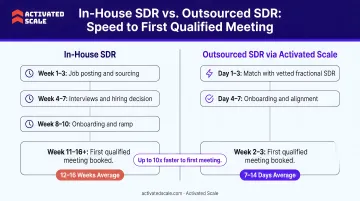
In-House SDR:
- Recruiting and interviewing: 4–8 weeks
- Onboarding and training: 2–4 weeks
- Ramp to full productivity: 3.0 months (Bridge Group 2025)
- First qualified meetings: 3–4+ months
Outsourced SDR:
- Program setup and ICP alignment: 1–2 weeks
- Initial outreach launch: Week 2–3
- First qualified meetings: 2–8 weeks
That 2–3 month gap matters most for startups trying to hit quarterly targets — and it has a direct dollar value, which the ROI framework below quantifies.
ROI Framework
(Pipeline Value Generated – Program Cost) ÷ Program Cost
Example Scenario (Month 3 of outsourced program):
- Meetings booked: 12 qualified meetings
- Estimated pipeline value per meeting: $15,000 (based on your average deal size and close rate)
- Total pipeline value: $180,000
- Monthly outsourcing cost: $6,000
- Monthly ROI: ($180,000 – $6,000) ÷ $6,000 = 29x
Set realistic expectations for Year 1: cost-per-meeting starts high and drops as you refine messaging and targeting. Track improvement trends across months 1–3 rather than judging the model on its first few weeks of output.
The Fractional Sales Model: Purpose-Built for Early-Stage SaaS
The fractional sales model differs from traditional outsourced sales agencies in one critical way: integration. Instead of handing pipeline generation to a third-party firm operating independently, fractional sales professionals embed directly into your team.
They learn your product deeply, participate in team meetings, and function as an extension of your sales organization — on a part-time or contract basis.
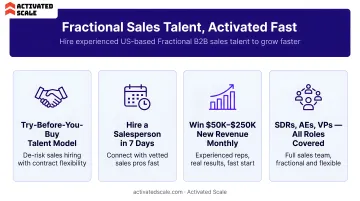
Try-Before-You-Buy Reduces Hiring Risk
Fractional models let you evaluate a sales professional's performance and culture fit during an initial contract period before deciding whether to convert to full-time. Activated Scale's model is built on this principle: connecting startups with vetted, US-based sales professionals from companies like Salesforce, Oracle, IBM, Zendesk, and Yelp, with the option to convert to permanent employees.
The broader market reflects this shift. The fractional executive market reached $5.7 billion in 2024, growing at 14% annually. Fractional job listings have grown by more than 50% since 2020. Today, 25% of US businesses use fractional hiring — a number projected to reach 35% by 2026.
Speed and Cost Advantage for Seed to Series A
A fractional rep can begin outreach within days, not months. They book 10-15 qualified meetings per month at a fraction of a full-time hire's cost — the right fit for early-stage companies that need to prove out their sales process before locking in full-time headcount.
Activated Scale connects startups with experienced sales professionals in as little as 7 days, sometimes on the same day. The numbers bear this out:
- Fractional CRO monthly retainers typically range from $10,000–$20,000
- Companies engaging fractional CROs saw an average 63% pipeline lift within six months
- Activated Scale clients can hire and onboard in 7 days or less — sometimes the same day
Common Mistakes That Kill Outsourced Pipeline Programs
Vague ICP Definitions Undermine Everything
When your ideal customer profile is too broad, outsourced teams cast a wide net with low conversion rates. A strong ICP definition includes:
- Firmographic criteria: Industry, company size, revenue range, geography
- Decision-maker titles: Specific roles with budget authority
- Pain points: Problems your product solves
- Buying triggers: Events that create urgency (funding, leadership changes, regulatory shifts)
Defining "Sales Qualified Appointment" criteria in your SLA is non-negotiable. Without it, you'll get quantity without quality.
The Broken Handoff Problem
Qualified leads go cold fast when there's no structured handoff process. Research consistently shows lead conversion rates drop by over 80% when response time exceeds five minutes — yet most companies take hours. Fix the transition before it costs you the pipeline. You need:
- Direct CRM integration with automated lead routing
- Response time SLAs (ideally under 1 hour, maximum 24 hours)
- Pre-agreed follow-up protocol documenting next steps
Volume Over Quality Trap
Chasing high lead counts instead of qualified meetings overwhelms sales teams with unfit prospects and burns out closers. Belkins' 2024 analysis of 16.5 million cold emails found that targeting 1 contact per company yields a 7.8% reply rate, while targeting 10+ contacts per company drops to 3.8% — a 51% decline demonstrating the spray-and-pray penalty.
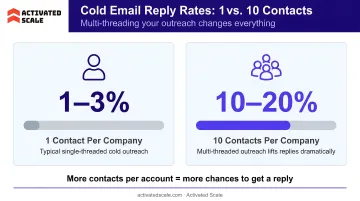
For early-stage teams especially, five well-qualified meetings beat fifty cold leads every time. Closers stay focused, conversion rates hold, and your outsourced team's effort maps directly to revenue.
How to Choose the Right B2B Sales Outsourcing Partner
The wrong outsourcing partner wastes months of runway. Before signing anything, vet candidates on these criteria:
- Ask whether they've sold to your specific buyer personas in your industry — generic B2B experience doesn't transfer cleanly
- Require them to walk through their data sources, outreach sequencing, and qualification framework before the contract
- Insist on weekly pipeline metrics, not monthly activity summaries
- Avoid 12-month commitments on first engagements — flexibility matters when you're still validating fit
- Confirm in writing that you retain all prospect data and CRM records when the engagement ends
Red Flags to Avoid
- Promising high meeting volumes in the first 30 days (ramp takes time — this signals they're selling, not setting expectations)
- Defining qualification as "booked meeting" with no ICP criteria — that fills your calendar, not your pipeline
- Offshore-only delivery with no US-based team members, which creates time zone gaps and cultural misalignment with your buyers
- Pay-per-lead pricing structures that reward volume over quality, flooding your pipeline with prospects that never convert
Start With a Structured Pilot
Once you've screened for these red flags, don't start full-scale. Run a defined 60-90 day pilot with agreed-upon success metrics:
- Cost per qualified meeting
- Lead-to-opportunity conversion rate
- Sales cycle length for outsourced leads versus other sources
A pilot structure keeps spend controlled. If a partner can't hit reasonable benchmarks in 90 days, you have a clean exit — not a 12-month contract to unwind.
Frequently Asked Questions
What is the 95/5 rule in B2B?
Only 5% of B2B buyers are actively in-market at any given time, while 95% are future buyers not yet ready to purchase. This makes consistent pipeline-building and lead nurturing critical, since most prospects need engagement well before they reach active buying mode. (LinkedIn B2B Institute and Ehrenberg-Bass Institute research)
How long is the average B2B sales cycle?
Gartner research from 2025 found the average B2B buying cycle spans 4.6 months across up to seven channels. Cycle length varies by deal size: deals under $25,000 typically close in 90 days, while $100,000+ deals take 3-9 months. This lengthy cycle reinforces the case for outsourcing top-of-funnel activities early so pipeline stays full while current deals progress.
How much can outsourcing reduce sales costs?
Outsourced SDR programs eliminate management overhead, technology procurement, and recruiting costs — with savings of 30-55% compared to in-house teams. The efficiency gain also comes from freeing founder time for strategic selling and product development rather than SDR management.
What is the difference between outsourced sales and fractional sales?
Outsourced sales typically refers to an external agency running pipeline activities independently, while fractional sales involves a part-time professional who embeds directly into your team. The fractional model offers deeper product knowledge and cultural alignment, making it better suited for early-stage startups that need integrated support rather than arms-length vendor relationships.
How quickly can an outsourced sales team start generating qualified meetings?
Most outsourced teams complete onboarding and begin outreach within 1-2 weeks, with first qualified meetings arriving within 30-60 days. Fractional models with experienced reps can compress this timeline to the first week when ICP alignment and prospect lists are well-defined upfront.
Is B2B sales outsourcing a good fit for early-stage startups?
Outsourcing fits well for Seed to Series A companies that have initial product-market fit but lack the bandwidth or budget to build a full internal sales team. The try-before-you-buy fractional model de-risks this stage, providing experienced talent without permanent headcount commitments or long ramp periods.