Introduction
For B2B SaaS founders navigating the seed-to-Series A stage, generating a consistent pipeline is usually the first critical growth bottleneck. Only 59.9% of organizations are currently on track to hit revenue targets, and 22% of startups fail due to marketing strategy failure—frequently because they struggle to build predictable demand generation before capital runs out.
Building a full in-house SDR team is slow, expensive, and risky to execute. The average SDR takes 3.2 months to reach full productivity, and the fully-loaded first-year cost runs $95,000–$135,000 once you factor in salary, benefits, tools, and recruiting.
This guide explains what lead generation outsourcing is, when it makes strategic sense, how the end-to-end process works, what it costs across different models, and how to evaluate the right partner—so founders and sales leaders can make a confident, informed decision.
TL;DR
- Lead generation outsourcing delegates prospecting, outreach, and qualification to an external team rather than building in-house.
- Best suited for B2B SaaS startups with validated ICP and messaging who lack the bandwidth to execute consistent outbound at scale.
- Models range from full-service agencies ($2K–$20K/month) to fractional reps who plug directly into your CRM.
- Not an emergency fix—outsourcing amplifies what's already working, not what's broken.
- Track CPL, lead-to-meeting rate, meetings per month, and CAC to measure ROI.
What Is Lead Generation Outsourcing?
Lead generation outsourcing is the practice of delegating top-of-funnel sales activities—including prospect research, list building, outbound outreach, and lead qualification—to an external provider rather than building an in-house team.
The outcome this model delivers is simple: a predictable flow of qualified sales meetings handed off to your internal closing team, without requiring you to add SDR headcount, invest in prospecting tools, or manage day-to-day outreach execution.
How It Differs From In-House Lead Generation
Instead of adding permanent headcount, you access specialized talent or a dedicated external team. This approach is:
- Activates in weeks, not months — no recruiting pipeline to build
- Eliminates fixed overhead: no benefits, payroll taxes, or HR coordination
- Scales up or down as pipeline demand shifts
Why B2B SaaS Startups Should Outsource Lead Generation
Outsourcing makes strategic sense when a startup has a defined ICP and proven messaging but lacks the team capacity to execute outbound consistently. It does not work when the pipeline is empty and the go-to-market strategy is still unclear—outsourcing will amplify broken fundamentals, not fix them.
Speed to Pipeline
The average SDR ramp time is 3.2 months, and many organizations report actual ramp periods of 5-6 months before hitting quota. Outsourced teams or fractional reps can be activated in days to weeks—not months.
For early-stage companies, the compounding cost of delay is significant. Every month without consistent pipeline activity is a month of missed meetings, stalled sales cycles, and lost momentum.
The Financial Argument
The true monthly cost of maintaining an in-house two-SDR function includes:
Fully-Loaded Year 1 Cost Per SDR:
- Base salary + OTE: $65,000-$85,000
- Benefits (health, dental, 401k): +20-30% of base
- Payroll taxes: +7.65%
- Software/tools (CRM, dialer, data): $8,000-$15,000/year
- Equipment: $2,000-$4,000 one-time
- Recruiting fees: $8,000-$15,000
- Ramp-period productivity drag: ~$16,000
- Total: $95,000-$135,000 per SDR
Outsourced SDR services cost $48,000-$96,000/year—a Year 1 savings of $40,000-$90,000 per rep.
What Goes Wrong Without Structured Lead Generation Support
- Founder-led outreach becomes a bottleneck—founders split attention between building product and running manual prospecting
- Pipeline activity is inconsistent—no systematic follow-up or multi-touch cadences
- Sales cycles stall—without dedicated SDR capacity, qualified leads go cold
Why Outsourcing Works for B2B SaaS
B2B buyers expect personalized, multi-touch engagement across channels. Clients using a full multi-channel approach (email + LinkedIn + phone) see 30%+ higher meeting conversion rates compared to single-channel methods.
Hitting those conversion rates requires enriched prospect data, sequenced outreach across three channels, and reps who already know the motion. That's exactly what experienced fractional SDRs bring from day one—without a 5-month ramp.
How Outsourced Lead Generation Works
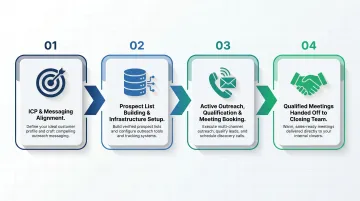
The process moves through four stages, each dependent on the quality of the one before it:
- ICP and messaging alignment
- Prospect list building and infrastructure setup
- Active outreach, qualification, and meeting booking
- Qualified meetings handed off to internal closing team
Define ICP and Outreach Messaging
The outsourced team works directly with the client to document:
- Target titles, company size, industry, pain points, and buying triggers (the ICP)
- Channel-specific messaging: email templates, LinkedIn scripts, call talking points
Skipping or rushing this alignment stage is the most common reason outsourced campaigns underperform. 70% of outsourcing agreements fail to meet expected objectives, often because of lack of context, misaligned BANT criteria, or voice and tone mismatches.
Build Prospect Lists and Set Up Outreach Infrastructure
During this stage:
- Lead research specialists build verified, enriched contact lists matched to the ICP
- Sending domains are configured and warmed for email deliverability
- CRM integrations and tracking are set up so all activity is visible from day one
Execute Outreach, Qualify, and Book Meetings
SDRs or fractional reps run multichannel outreach:
- Cold email (average response rate: 1-5%)
- LinkedIn outreach (average reply rate: 85%—3x higher than email)
- Cold calling (average success rate: 2.3-2.5%, or ~1 meeting per 40-45 dials)
SDRs follow up systematically, qualify prospects against agreed-upon criteria, and book confirmed meetings directly onto the client team's calendar.
That covers the standard agency model. A separate approach — fractional sales talent — works differently and suits certain startups better.
The Fractional Sales Talent Model: A Distinct Alternative
Rather than engaging a full-service agency that manages everything at arm's length, some B2B SaaS startups hire vetted fractional SDRs or BDRs who integrate directly into their team and CRM.
Activated Scale, for example, places experienced, US-based fractional sales professionals within 7 days using a try-before-you-buy model — letting startups validate fit before committing to a full-time hire. Key details:
- Engagement: 15-20 hours per week
- Visibility: Direct CRM access, so nothing is a black box
- Cost: $3,000-$4,000/month plus commission — well below a full-time SDR's fully loaded cost
- Speed: Reps placed in 7 days or less
What Does It Cost to Outsource Lead Generation?
Pricing models vary significantly based on scope, channel mix, and provider type.
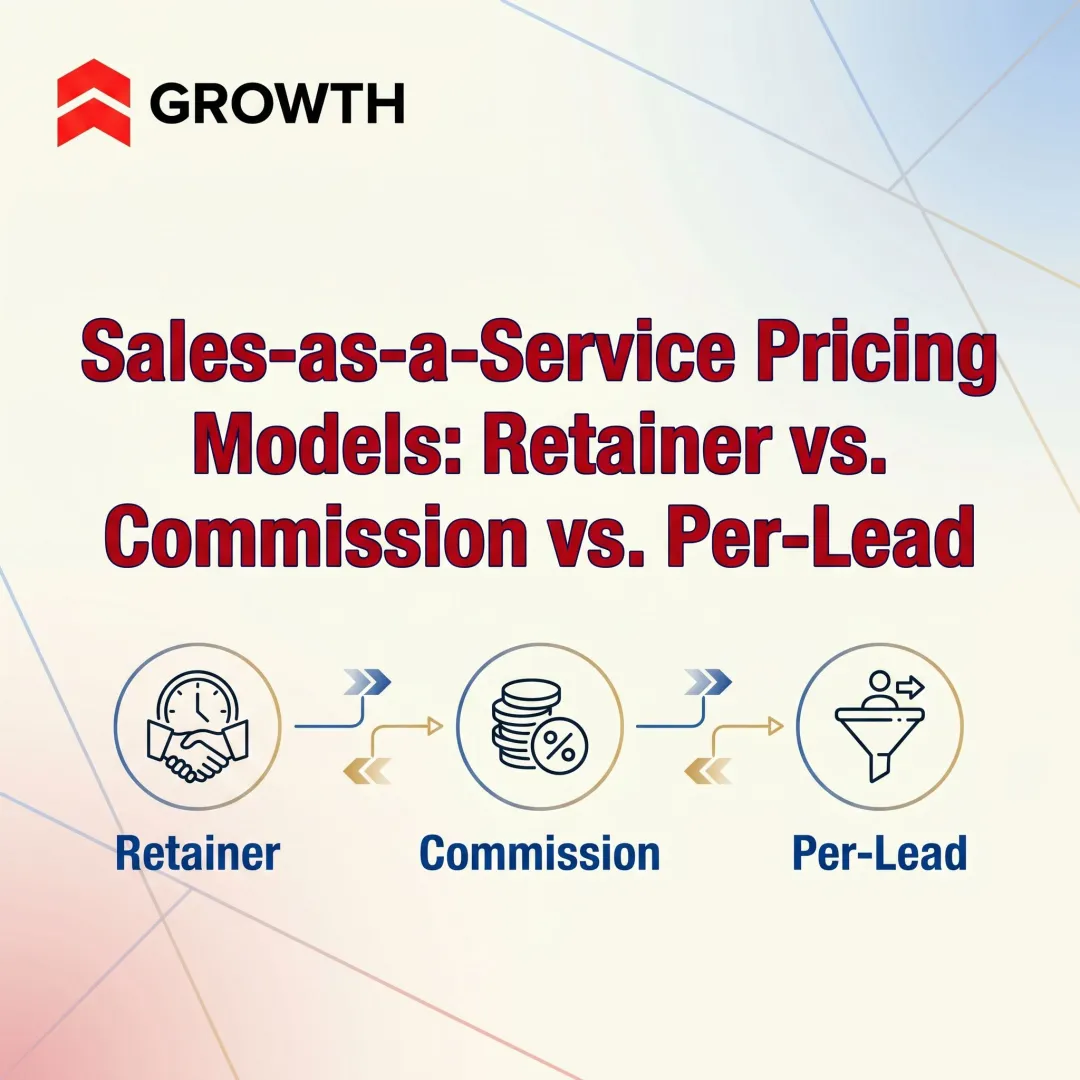
Monthly Retainer (Most Common with Agencies)
- SME agency: $2,000–$5,000/month
- Mid-sized agency: $5,000–$10,000/month
- Large/enterprise agency: $10,000+/month
Retainer models prioritize lead quality — the right fit for companies with longer, complex sales cycles.
Pay-Per-Lead
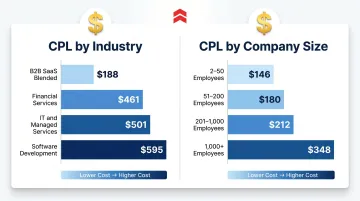
Cost per lead (CPL) varies by industry and targeting complexity:
- B2B SaaS blended CPL: $188
- Software Development: $595
- IT & Managed Services: $501
- Financial Services: $461
CPL also varies by company size:
- 1,000+ employees: $348
- 201–1,000 employees: $212
- 51–200 employees: $180
- 2–50 employees: $146
Pay-per-lead models can push providers to hit lead counts rather than deliver prospects who actually convert — worth weighing carefully before committing.
Performance or Commission-Based
Some agencies offer pay-per-appointment pricing, typically $50–$500 per appointment. Costs track directly with output, but providers may book low-quality appointments just to hit targets.
Hourly or Part-Time (Fractional Individual Reps)
Fractional SDRs or BDRs typically cost $3,000–$4,000/month for 15–20 hours per week, plus commission. This model is faster to activate, lower overhead, and well suited to early-stage B2B SaaS startups.
Why In-House Costs Are Higher Than They Appear
Before choosing a model, it helps to see the full in-house cost picture. Founders often undercount these expense categories:
- Base salaries
- Employer taxes and benefits
- CRM and prospecting software subscriptions
- Prospect data services
- Onboarding and ramp-up time
- Ongoing management overhead
The true cost gap is often two to three times the base salary number.
Factors That Cause Significant Cost Variation
- Industry complexity: Competitive verticals like financial services or enterprise IT drive CPL significantly higher
- Geographic scope: Tightly targeted regions cost more per lead than broad national campaigns
- Channel mix: Multi-channel outreach (email + LinkedIn + calling) carries a higher price than single-channel
- Qualification depth: Providers who pre-qualify leads before booking meetings charge more, but deliver better conversion rates
- Data sourcing: Manual list enrichment costs more upfront than automated databases, but typically produces cleaner contacts
How to Choose the Right Lead Generation Partner (and Avoid Common Pitfalls)
Criteria That Matter Most
Before signing with any partner, verify these five factors:
- Industry-specific experience with companies at your stage — not just "B2B" generalists
- Documented process: which channels they use, how they qualify leads, and what the outreach cadence looks like
- Proof of results through case studies, client references, and conversion rates — not just lead volume claims
- Contract terms that include defined deliverables, exit clauses, and a trial period option
- Compliance with GDPR, CAN-SPAM, and any other regional data privacy regulations relevant to your market
Most Common Outsourcing Mistakes
Even strong partnerships fail when these mistakes happen at the start:
- Going to market before your ICP and messaging are validated. No partner can fix a broken value proposition — and 25-50% of outsourced projects fall short of expectations for exactly this reason.
- Selecting a vendor based on lead volume promises instead of qualified meeting conversion rates. High volume with low quality burns your team's time and damages prospect relationships.
- Locking into a long-term contract without a trial run first. Most outbound programs require 3-6 month minimums, so validate fit on targeting, messaging, and process before committing to that length.
When Outsourcing Is Not the Right Fit
Even if you've found a strong partner, outsourcing may be the wrong move entirely. It won't work if:
- Your product-market fit is still unclear and your ICP shifts frequently
- Your sales process requires deep relationship-building that only a senior internal rep can credibly own
- Your team lacks capacity to respond to, nurture, and close the meetings an outsourced function generates
In these cases, building internal clarity first will produce better results than outsourcing early.
Frequently Asked Questions
How to outsource lead generation?
Start by documenting your ICP and desired meeting outcomes, then choose between a full-service agency and a fractional rep model based on your stage and budget. Vet shortlisted partners by process transparency and relevant track record, and launch with a clear trial period and defined KPIs.
How much is the salary of a lead generation specialist?
In-house SDRs in the U.S. earn an average base salary of $62,000 (range $54K-$72K), with total compensation including commission averaging $102,463. This represents only part of the true in-house cost when tools, data, benefits, and ramp-up time are added. That's why outsourcing is often more cost-efficient for early-stage companies.
Is outsourcing illegal in the US?
Outsourcing is entirely legal in the US. However, companies using outsourced teams for outbound prospecting must comply with CAN-SPAM for email outreach and GDPR when targeting contacts in Europe. Reputable providers will have compliance protocols and data handling practices in place.
What are the four types of outsourcing?
The four commonly referenced categories are professional services outsourcing (such as sales, legal, and HR), IT and technology outsourcing, business process outsourcing (BPO), and project-based or manufacturing outsourcing. Lead generation outsourcing falls within the professional services and business process categories.
What is the difference between outsourcing lead generation to an agency and hiring a fractional sales rep?
A full-service agency manages strategy, tooling, and execution under a monthly retainer. A fractional sales rep integrates directly into your team, works within your existing CRM and workflows, and typically offers faster ramp-up at lower overhead — making it a strong fit for early-stage B2B SaaS startups.
How do you measure the success of outsourced lead generation?
Focus on these five metrics:
- Cost per lead (CPL)
- Lead-to-meeting conversion rate
- Qualified meetings booked per month
- Pipeline value generated
- Customer acquisition cost (CAC) vs. equivalent in-house cost