Introduction
Picture this: It's Friday afternoon, and you've just wrapped a product demo that went nowhere. Again. Before that, you spent two hours building a prospect list from LinkedIn, three hours the day before writing cold email sequences, and most of Monday manually uploading contacts into your CRM. Your pipeline review is in 20 minutes, and you already know what you'll see—four lukewarm leads, two stalled conversations, and a big empty space where next quarter's revenue should be.
This isn't a failure of ambition. It's the predictable outcome when founders and early-stage account executives try to juggle product development, customer success, and lead generation simultaneously. According to Salesforce's State of Sales report, sales reps spend 60% of their time on non-selling tasks: searching for collateral, managing data entry, chasing approvals. That leaves barely two days of actual selling time a week.
For founders wearing the sales hat, that number drops even lower.
The real tension: in-house lead generation feels like control, but it's actually a tax on your team's most valuable hours. The question isn't whether you can build pipeline yourself — it's whether you should. What follows covers when outsourcing makes sense, what strong partners actually deliver, and how to evaluate providers on fit and results rather than just cost.
Key Takeaways
- Outsourcing removes prospecting overhead so closers focus on revenue-generating activities
- Specialized partners deliver proven systems, tools, and expertise that early teams can't replicate in-house
- Consider outsourcing when pipeline quality drops, bandwidth shrinks, or growth targets outpace hiring timelines
- Evaluate partners on industry experience, qualification rigor, transparent reporting, and ramp speed
- Success requires shared KPIs, structured handoffs, and ongoing feedback loops
Why In-House Lead Generation Breaks Down for B2B SaaS Startups
Lead generation isn't one task. It's a chain: ICP research, list building, sequencing, outreach, follow-up, objection handling, CRM hygiene, and reporting. Each step demands time, and each competes with higher-value work.
Most early-stage B2B SaaS companies don't have a dedicated SDR or BDR. That means founders or account executives absorb prospecting duties. The math is brutal. Reps already spend only 28-30% of their time actively selling, with administrative work consuming nearly half the week. High-performing teams manage to push selling time to 34%, but that's still a minority of working hours.
When closers prospect, two problems compound:
- Pipeline volatility from inconsistent execution. Generic messaging, sporadic follow-up, and weak qualification criteria fill the funnel with low-intent contacts. These leads stall deals and waste closing capacity. Only 2.9% of marketing-qualified leads convert to revenue, underscoring how critical rigorous qualification is before handoff.
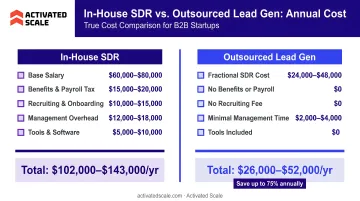
- Massive upfront investment to scale. Hiring an SDR means recruiting fees, base salary, benefits, tooling licenses, management overhead, and ramp time. The fully-loaded annual cost ranges from $125,000 to $150,000, reaching $200,000 with premium tech stacks. That's a fixed cost structure misaligned with the financial reality of most seed-to-Series A companies.
Then there's turnover. The median SDR attrition rate is 40% annually, with a historical mean closer to 50%.
Replacing each SDR (factoring recruiting, onboarding, and lost productivity) runs approximately $100,000 per departure. If five SDRs leave in a year, you're looking at $750,000 in lost pipeline.
Key Benefits of Outsourcing Lead Generation
Immediate Access to Expertise and Proven Systems
Outsourced partners bring specialists who run lead generation full-time across multiple clients and industries. These aren't generalists learning on your dime. They've already tested messaging frameworks, ICP targeting criteria, and outreach cadences—and refined them based on thousands of conversations.
Contrast that with hiring an in-house SDR, who faces a steep learning curve even with prior experience. They need to understand your product, buyer persona, competitive landscape, objection patterns, and internal handoff process before generating consistent results. Outsourced teams skip much of that ramp by applying proven systems from day one.
Faster Time to Pipeline
Building an in-house SDR function takes months. The average time to fill an SDR role is 25-30 days. Add 3 months of ramp time before they hit quota, and you're looking at 4-5 months from job posting to full productivity.
Outsourced programs move faster:
- Launch campaigns in 4-6 weeks with pre-built infrastructure and trained reps
- Deploy 40% faster than in-house teams
- Report up to 70% faster pipeline acceleration in the first three months
For early-stage companies, that 4-month head start can determine whether you hit your next growth target or stall waiting on a rep who's still learning your product.
Cost Efficiency Without Sacrificing Quality
The true cost of a full-time SDR includes base salary ($55,000-$60,000), benefits (roughly 30% of base), commissions, recruiter fees (15-30% of annual salary), CRM and sequencing tools ($3,600-$12,000+ per year), and management overhead (~$15,000 annually). Total: $125,000-$150,000 per year.
Outsourced models run approximately $42,000-$45,000 annually: a 25-30% cost reduction that converts a large fixed expense into a variable cost aligned with results.
The savings extend further than the sticker price:
- In-house SDRs average 47 days of PTO annually, during which outbound activity stops entirely
- Turnover replacement (common in SDR roles) adds another recruiter fee and ramp cycle
- No recruiting drag, no onboarding overhead, no management bandwidth lost
Scalability Without the Hiring Lag
Outsourcing lets you adjust lead generation intensity quickly—ramping up before a product launch, pulling back during a strategic pivot—without the HR friction of headcount changes. You don't post jobs, interview candidates, negotiate offers, or manage onboarding.
An in-house team is a fixed cost that's hard to reverse. An outsourced team scales up or down in weeks, which matters when market conditions shift faster than a hiring cycle can respond.
Better Lead Quality Through Dedicated Focus
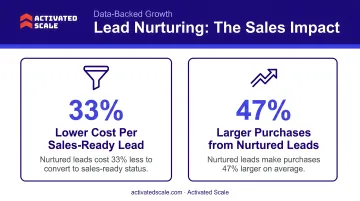
External teams focused exclusively on prospecting and qualification produce leads with more context, stronger fit, and clearer intent signals. Companies that excel at lead nurturing generate 50% more sales-ready leads at 33% lower cost, and nurtured leads make 47% larger purchases than non-nurtured ones.
When a partner focuses solely on qualification, they catch weak signals early. They disqualify poor fits before wasting AE time. They document objections and context so your closers walk into informed conversations.
Your Internal Team Closes More
The opportunity cost of distracted closers is enormous. When AEs spend time prospecting, they lose selling time—the hours spent on demos, negotiations, and relationship-building that directly drive revenue.
Outsourcing restores that focus. Companies using fractional sales talent through Activated Scale report booking 10-15 qualified meetings per month and winning $50,000-$250,000 in new revenue monthly—results that come from closers doing what they're best at, not building prospect lists.
4 Signs It's Time to Outsource Lead Generation
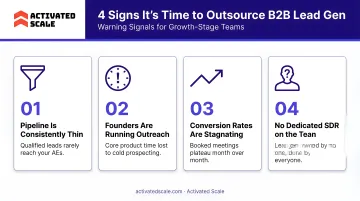
Signal 1: Pipeline inconsistency. Some months deliver strong flow, others run dry. There's no reliable system driving inbound interest or consistent outbound volume. You're reacting to gaps instead of preventing them.
Signal 2: Your closers are sourcing their own leads. Founders and AEs spend hours on LinkedIn, building lists, writing sequences, and managing follow-ups instead of running demos and negotiating contracts. Less than 25% of leads come from marketing at most companies, meaning sales is self-sourcing the majority of prospects.
Signal 3: Lead quality is debated in every pipeline review. Sales can't trust marketing leads. Qualification criteria aren't shared across the team. Deals stall because no one verified budget, authority, need, and timeline before passing the contact to a closer.
Signal 4: Growth demands exceed internal capacity. You've raised a round, entered a new market, or launched a new product line—and internal bandwidth simply can't keep pace with the demand for qualified pipeline.
For B2B SaaS startups without a dedicated sales team, Signal 4 often hits all at once. Activated Scale's fractional sales model is built for this moment: founders can bring in experienced sales professionals within days, removing the prospecting burden without the delay of a full-time hire.
What to Look for in a Lead Generation Partner
Industry and ICP Fit
A partner who has generated leads in your vertical understands buyer language, common objections, decision-making timelines, and the competitive landscape. Ask for case studies or client references in your industry before signing anything.
Qualification and Handoff Process
The best partners operate with a clear SQL definition, documented disqualification criteria, and a structured handoff that gives your sales team context—not just a name and email. Ask to see sample lead notes or handoff documentation during evaluation.
Technology and Data Practices
Evaluate what tools the partner uses for prospecting, enrichment, sequencing, and CRM integration. Ask about data handling practices and compliance with privacy regulations. A partner using outdated lists or untargeted mass outreach will damage your sender reputation and brand.
Non-compliance penalties are severe:
- Up to $53,088 per CAN-SPAM violation
- €20 million or 4% of annual turnover under GDPR
- $7,500 per intentional CCPA violation
Transparency and Reporting Standards
Insist on weekly or bi-weekly performance visibility. Not vanity metrics like emails sent or dials made, but outcome metrics—lead acceptance rate, meetings held, pipeline influenced. A partner unwilling to show granular data is a red flag.
Ramp Model and Flexibility
Evaluate how quickly the partner can launch, what onboarding looks like, and whether they offer a pilot before a long-term commitment. Early-stage startups benefit most from try-before-you-buy models—they limit the risk of locking into a relationship that doesn't fit. Activated Scale takes this approach with fractional sales talent, offering contract-to-hire arrangements so companies can evaluate real-world results before making longer-term commitments.
Measuring Success: KPIs to Track with Your Outsourced Partner
Track six core metrics consistently:
- Lead acceptance rate — Do your AEs actually want to follow up on these leads?
- Meetings held rate — Booked meetings mean nothing if prospects don't show
- Reply rate by outreach segment — Which messaging and targeting combinations work? (Industry benchmarks: 5-6% average reply rate, top performers hit 10%+)
- SQL-to-opportunity conversion — How many qualified leads turn into real pipeline? (Benchmark: 38% SQL-to-opportunity conversion)
- Pipeline value influenced — What dollar amount can you attribute to the partner's efforts?
- Time to first follow-up — Speed matters; delays kill deals
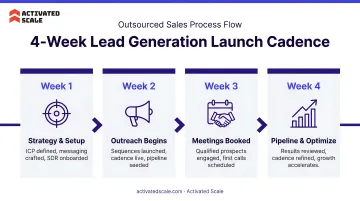
A structured launch rhythm prevents drift. Follow this four-week cadence to stay on track:
- Week 1: ICP and offer alignment — confirm you're targeting the right people with the right message
- Week 2: Messaging review and initial outreach — test your sequences before scaling volume
- Week 3: Daily monitoring and rapid iteration — catch underperforming segments early
- Week 4: Pipeline retrospective and scaling decisions — double down on what's working
Once past launch, monthly performance reviews keep momentum going. Shift effort toward what's working, cut underperforming segments early, and keep iterating on messaging. The partnerships that generate compounding pipeline treat this cadence as a standing priority — not a quarterly afterthought.
Frequently Asked Questions
How much does outsourced lead generation typically cost for a B2B startup?
Costs typically range from $3,000–$14,000 per month depending on model (retainer, performance-based, or fractional talent). Compare that against a fully-loaded in-house SDR at $125,000–$150,000 annually—not just the agency fee.
What's the difference between outsourcing lead generation and hiring a full-time SDR?
A full-time SDR takes months to hire, onboard, and ramp—and carries fixed cost and turnover risk. Outsourcing offers faster deployment (4-6 weeks vs. 4-5 months), variable cost structures, and access to experienced specialists without management overhead.
How quickly can an outsourced lead generation partner start producing results?
Reputable partners begin outreach within 1-2 weeks of onboarding, with initial meetings appearing in the first 30 days. Pipeline impact compounds over 60-90 days as messaging and targeting are refined through real feedback.
What metrics should I track to evaluate an outsourced lead gen partner?
Focus on lead acceptance rate, meetings held rate, SQL-to-opportunity conversion, and pipeline value influenced. A strong partner shares these proactively—you shouldn't have to chase them down for performance data.
Can outsourcing lead generation work for very early-stage companies with small budgets?
Yes. Early-stage companies often benefit most because they lack the infrastructure, time, and capital to build a proper in-house function. Models like fractional sales talent or pilot-first engagements make outsourcing accessible without large upfront commitments.
What are the biggest risks of outsourcing lead generation and how do I avoid them?
The main risks are brand misrepresentation, poor lead quality, and limited visibility into performance. Avoid them by defining SQLs upfront, reviewing outreach samples before launch, and requiring a trial period with weekly reporting before committing fully.