Introduction
Most founders building their first sales team face the same confusing choice: SDR or BDR? These titles get used interchangeably across job boards and company org charts, but treating them as the same role leads to expensive mis-hires — ranging from $150,000 to $750,000 in wasted spend depending on your sales cycle length.
For early-stage B2B SaaS companies, this distinction matters even more. Your first sales development hire sets the entire tone for your go-to-market motion.
Hire an inbound-focused SDR when you need outbound pipeline generation, and you'll watch qualified leads go cold while your new hire waits for form fills that never come. Bring on an outbound-focused BDR when you're already drowning in demo requests, and you'll burn budget on cold outreach while warm leads slip through the cracks.
What follows is a clear breakdown of both roles — their daily responsibilities, KPIs, and the signal that tells you which one your startup should hire first.
Key Takeaways
- SDRs qualify inbound leads from prospects already interested in your product
- BDRs generate outbound pipeline by reaching cold accounts proactively
- Both feed qualified opportunities to Account Executives but don't close deals
- Hire an SDR first if inbound demand exists; hire a BDR first if pipeline is thin
- Most early-stage startups start with one hybrid SDR/BDR role until deal flow warrants splitting the two
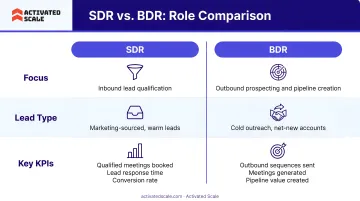
SDR vs BDR: Quick Comparison
| Dimension | SDR (Sales Development Rep) | BDR (Business Development Rep) |
|---|---|---|
| Primary Focus | Qualifying inbound leads | Generating outbound pipeline |
| Lead Source | Marketing-generated (content, SEO, paid ads, webinars) | Self-sourced (cold outreach, account research) |
| Lead Type | Warm (already expressed interest) | Cold (no prior engagement) |
| Key Daily Activities | Discovery calls, CRM logging, booking AE meetings | Cold emailing/calling, LinkedIn outreach, building prospect lists |
| Funnel Position | Between marketing and sales | Top of sales funnel (demand creation) |
| Works Closely With | Marketing teams, AEs | AEs, sales leadership |
| Primary KPIs | Qualified meetings booked, meeting quality | Pipeline generated from cold outreach, completed meetings |
Naming conventions vary significantly across companies. Salesforce uses these titles interchangeably, and some organizations reverse the definitions entirely (SDR = outbound, BDR = inbound). This article follows the most widely adopted convention: SDR = inbound and BDR = outbound.
What is an SDR?
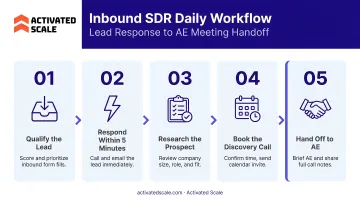
An SDR (Sales Development Representative) handles inbound leads generated by marketing activities. They respond to form fills, demo requests, content downloads, and webinar registrations, qualify these prospects against your Ideal Customer Profile, and pass sales-ready opportunities to Account Executives. SDRs do not close deals.
The SDR sits between marketing and sales, acting on leads from content, SEO, paid media, and events. Because of this positioning, 50% of inbound-focused SDR teams report to Marketing rather than Sales at B2B SaaS companies.
When to Hire an SDR
Hire an SDR when you face these challenges:
- High inbound lead volume with no one responding quickly
- AEs wasting time on unqualified prospects who don't fit your ICP
- Slow response times causing interested leads to go cold
- Marketing-generated leads falling through the cracks after content downloads
The SDR's day-to-day includes:
- Responding to inbound inquiries within minutes (speed matters: companies responding within 30 minutes are 21x more likely to qualify a lead)
- Running structured discovery calls to assess budget, authority, need, and timing
- Logging activity in CRM and maintaining data hygiene
- Scheduling qualified meetings for Account Executives
According to a Blossom Street Ventures survey of 351 B2B SaaS companies, inbound SDRs average 21 meetings per month with typical daily activity of 44 dials, 41 emails, and 4.1 quality conversations.
Key skills needed:
- Fast, structured qualification using frameworks like BANT or MEDDIC
- Strong listening and discovery question techniques
- Consistent follow-up discipline across multiple touchpoints
- Ability to manage high lead volume (approximately 15 leads per day) without sacrificing quality
What is a BDR?
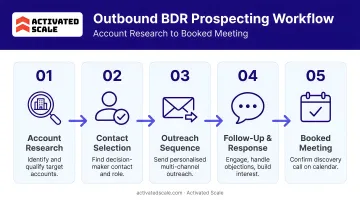
A BDR (Business Development Representative) focuses entirely on outbound prospecting. They identify target accounts, research decision-makers, and initiate cold conversations through email, phone, and LinkedIn to create pipeline from scratch where none previously existed.
Unlike SDRs reacting to inbound signals, BDRs generate demand from scratch. No warm leads, no intent data — just cold outreach, which requires deeper account research, highly personalized messaging, and far higher rejection tolerance.
Use Cases of a BDR
Hire a BDR when you face these scenarios:
- Low or inconsistent inbound lead volume
- Entering new markets, verticals, or ICP segments
- Targeting enterprise accounts that won't discover you organically
- AEs don't have enough top-of-funnel pipeline to work
A typical BDR day involves:
- Building and researching prospect lists with ideal-fit accounts
- Crafting personalized multi-touch sequences across email, phone, and LinkedIn
- Identifying trigger events (funding rounds, hiring spikes, expansion signals)
- Booking qualified meetings with prospects who've never heard of your company
Bridge Group research shows that outbound prospecting typically requires 9-12 touchpoints per prospect, with BDRs averaging 40-50 calls and 10-40 emails daily. That volume is necessary because the math is brutal.
Average cold email reply rates sit at 5.8%, and it takes 1 out of 59 cold calls to book a meeting. Outbound BDRs typically target 12-15 qualified meetings per month — roughly 40% fewer than inbound SDRs working warm leads.
To succeed in this role, BDRs need:
- Deep account research to identify relevant pain points and value angles
- Rejection resilience (most outreach gets ignored or rejected)
- Creative, personalized messaging that breaks through inbox noise
- Multi-channel prospecting ability (phone, email, LinkedIn, video)
- Clear value articulation for prospects who've never heard of your company
SDR vs BDR: Which Role Does Your Startup Need?
Start with a simple pipeline audit: where are your opportunities actually coming from?
If inbound demand exists but isn't being worked efficiently, hire an SDR first. You're already generating interest through marketing — you just need someone to qualify and convert it before prospects go cold or choose a competitor.
If pipeline is thin and prospects won't find you organically, hire a BDR first. You need proactive outreach to create conversations and build pipeline from scratch.
Situational Recommendations
Hire an SDR when:
- Marketing is generating leads but response times are slow (only 7% of companies respond within 5 minutes)
- AEs are spending time qualifying prospects who don't fit your ICP
- Good inbound leads are going cold with no structured follow-up process
Hire a BDR when:
- Inbound volume is low or inconsistent month-to-month
- You're entering a new market segment or ICP where you lack brand awareness
- You're targeting accounts that require proactive multi-touch outreach to engage (typically $25,000+ ACV deals)
The startup reality: Most seed-to-Series A SaaS companies don't yet have volume to justify two separate roles. 36% of companies use hybrid SDR/BDR roles that handle both inbound qualification and outbound prospecting.
Bridge Group's research points to a useful threshold for making that split: separate inbound and outbound only when inbound flow is strong enough to sustain at least 2 full-time SDRs. Until that threshold, one hybrid hire who toggles between warm leads and cold pipeline often makes the most sense.
For early-stage startups that need to test their SDR or BDR motion without committing to a full-time hire, fractional sales professionals are a practical option. Activated Scale connects you with an experienced SDR or BDR within days on a contract-to-hire basis.
You validate the role against real pipeline activity, then convert to full-time once you've confirmed the fit.
Conclusion
SDRs and BDRs serve distinct but complementary pipeline functions: one captures existing demand, the other creates it from scratch. Neither is inherently more valuable — the right choice depends entirely on where your pipeline gaps actually exist.
Getting this hire right early means faster meeting volume, cleaner handoffs to Account Executives, and a more predictable revenue engine. Getting it wrong costs more than budget — it costs momentum you can't easily recover at an early stage.
If you're not ready to commit to a full-time hire, Activated Scale's fractional SDR and BDR professionals let you test the fit before locking in — so you can validate the role against your pipeline reality, not just a job description.
Frequently Asked Questions
How is SDR different from BDR?
SDRs work leads that have already shown interest through form fills, demo requests, or content downloads. BDRs proactively create conversations with cold prospects who haven't engaged with your company yet, using research-driven outreach across email, phone, and LinkedIn.
What's higher, BDR or SDR?
Neither is inherently senior — they're typically parallel roles at the same level. However, at some companies (notably Salesforce), SDR is the entry role and BDR is a more senior outbound function. Seniority depends entirely on company structure and definitions.
Is a BDR an entry level role?
Yes. Both BDR and SDR are typically entry-to-mid-level roles that serve as launchpads for Account Executive positions. Average tenure is 1-2 years before advancement, with median SDR tenure at 1.9 years.
Do SDRs make good money?
SDR compensation varies by market and company stage. Median SDR base salary is $55,000 with total OTE of $80,000 (68% base, 32% variable), though actual earnings vary by region and company size.
Which is better, sales or business development?
This isn't an either/or choice. BDRs (business development) feed pipeline to AEs (sales closers). Both functions are necessary: business development creates the opportunities that sales converts into revenue. They're complementary roles, not competing ones.
Is SDR the hardest sales job?
SDR work is demanding: high volume, repetitive outreach, and frequent rejection. That said, inbound qualification is more predictable than outbound BDR work. BDR roles typically face higher rejection rates and require more creativity to build pipeline from scratch.