

Introduction
Your startup just closed a Series A round. Sales are growing, but your founding team is stretched dangerously thin. You know you need senior leadership, but committing $200K+ annually to a full-time CRO feels like betting the farm when you're still finding product-market fit. Should you hire a fractional executive who can start next week for a third of the cost, or hold out for a permanent hire who'll be fully invested in your company's future?
This isn't just a budget question. The wrong hiring model at the wrong stage can stall your growth, burn through runway faster than a bad product pivot, or saddle you with an expensive executive who doesn't match your actual needs. Both models work well in the right context — and both can hurt you in the wrong one.
This guide cuts through the confusion to help you make the call that fits your company's stage, resources, and day-to-day requirements.
Key Takeaways
- Fractional executives work 10-20 hours/week across multiple companies, delivering strategic outcomes at 30-70% lower cost than full-time equivalents
- Full-time executives are fully embedded with daily availability — ideal when workload demands 40+ hours and cultural continuity matters
- Go fractional when the role isn't full-scope yet, speed matters, or budget is tight — and you want to test before committing
- Go full-time when the role demands 40+ hours weekly, the team needs daily hands-on management, or cultural integration is the priority
- Hybrid models — fractional paired with a full-time manager, or contract-to-hire — often make the most sense for early-stage companies
Fractional vs. Full-Time Executives: At a Glance
| Factor | Fractional Executive | Full-Time Executive |
|---|---|---|
| Annual Cost | $36K-$180K (retainer) | $200K-$500K+ (base + equity + benefits) |
| Time to Hire | Days to weeks | 3-6 months |
| Weekly Availability | 10-25 hours | 40+ hours |
| Commitment Type | Contract, often ongoing | Permanent employment |
| Best For | Pre-Series B, defined outcomes, 12-18 month timelines | Series B+, managing managers, 2-5 year strategic initiatives |
| Risk Level | Low (test-and-exit flexibility) | High (recruiting fees, severance, equity) |
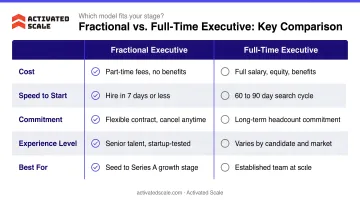
- Series A full-time executives cost $183K-$218K in base salary alone — 25-35% more when benefits and taxes are factored in
- Fractional executives typically run 30-40% of the full-time equivalent cost, with no equity dilution or severance exposure
What Is a Fractional Executive?
A fractional executive is a senior leader who works part-time across multiple companies simultaneously, owning a specific function with full accountability for outcomes. This isn't consulting—consultants deliver reports and recommendations, then leave. Fractional executives embed directly into your leadership team, make decisions within defined authority, and remain accountable for measurable results week after week.
Key benefits for B2B SaaS startups include:
- Deliver executive-level expertise at roughly 40% of full-time cost, with some estimates showing 50–80% savings depending on role and scope
- No equity dilution, no severance liability, and contract terms that let you adjust as needs change
- Contributing within days or weeks, compared to 3–6 months for a traditional executive search
- Working across multiple organizations means they arrive with proven playbooks from companies at your exact growth stage
Most Common Fractional Roles
The fractional model spans nearly every C-suite function. CFOs represent the most common fractional role at approximately 18% of all fractional executives, followed by CMOs, CTOs, CROs, and COOs.
For early-stage B2B SaaS companies, fractional sales leadership roles—including VP of Sales and CRO—are now standard. They allow startups to access senior sales expertise and build scalable processes before they have enough pipeline or team depth to justify a $200K+ full-time hire.
Use Cases of a Fractional Executive
Fractional leadership fits best when you need strategic direction but the function doesn't yet demand full-time attention. Common scenarios include:
- Pre-PMF or early post-PMF stages where you need to establish foundational processes, validate market approach, or build initial sales infrastructure
- Gap-filling between full-time hires when an executive departs and you need continuity while conducting a search
- Validating role requirements before committing to a permanent hire—testing what the position actually needs versus what you assumed
The numbers back this up. Global demand for fractional executives surged 46% in 2024, with total fractional roles doubling from roughly 60,000 in 2022 to 120,000 in 2024. Executive job postings mentioning fractional or part-time leadership have tripled since 2018.
Private equity firms have particularly embraced it. PE-backed companies routinely staff fractional CFOs and CROs across portfolio companies, filling senior roles within 1–2 weeks without full-time overhead. In lower and middle market deals where margins are tight, that speed and cost control matters.
What Is a Full-Time Executive?
A full-time executive dedicates 40+ hours per week exclusively to your company—fully embedded in operations, accountable for both strategy and day-to-day execution. They build institutional knowledge over years that part-time engagement genuinely cannot replicate.
Core benefits of full-time executives:
- Always available for urgent decisions, real-time problem-solving, and team communication
- Builds genuine team trust through daily presence — mentoring, culture-building, and consistent interaction over time
- Owns long-horizon initiatives — projects with 18-24+ month ROI timelines need someone who'll still be there at the finish line
- Handles operational scale — multiple direct reports, cross-functional coordination, and constant stakeholder demands require sustained, full-time attention
Use Cases of a Full-Time Executive
Full-time executives become necessary when scope and complexity exceed what fractional engagement can support:
- Post-Series B scaling where the company has sufficient runway and needs someone who can manage 5-10+ direct reports across multiple functions
- Managing managers — When your team has grown to include middle management layers, a full-time executive provides the coaching and coordination required
- Long-horizon strategic initiatives — Projects with 18-24+ month ROI timelines (enterprise sales cycles, international expansion, platform rebuilds) benefit from dedicated ownership
- Functions genuinely requiring 40+ hours weekly — When the role involves daily team management, constant stakeholder communication, and operational firefighting, part-time won't cut it
These scenarios tend to cluster around a specific revenue threshold. Full-time CFOs are typically justified once a company reaches approximately $25M in revenue, while full-time sales leadership becomes standard above $20M. At those scales, the volume and complexity of work demands full-time attention — fractional simply doesn't stretch far enough.
The cost commitment is substantial. A Series A CRO commands $200K-$325K in base salary. Add on-target earnings and equity, and total compensation reaches $350K-$600K. Factor in 25-35% for benefits and taxes, and total employer cost easily exceeds $400K-$700K annually.
When to Hire Fractional vs. When to Hire Full-Time
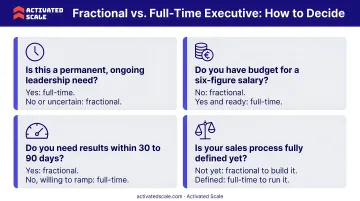
The hiring decision comes down to four practical questions that cut through the noise:
- How many hours does this role actually require per week?
- Can I define 2-3 specific, measurable outcomes?
- What's the ROI timeline — 3-12 months or 2+ years?
- Does my team need daily management or strategic direction?
Answer these honestly, and the right model becomes clear.
Hire Fractional When:
- Weekly workload is 10-25 hours — The role requires strategic planning, process design, or periodic oversight, but doesn't fill a 40-hour week
- Outcomes are clearly defined — You can articulate exactly what success looks like (build a sales playbook, implement a CRM, design a go-to-market strategy)
- Timeline is compressed — You need results in 6-18 months, not 3-5 years
- Your team can execute independently — Employees need weekly strategic guidance but don't require constant real-time direction or daily check-ins
- Budget constraints make full-time premature — You have limited runway and need to preserve capital while still accessing senior expertise
Speed matters here. The average executive cost-per-hire has spiked 113% since 2017, with traditional recruitment fees alone running 20-30% of annual salary ($24K-$60K for exec roles). Fractional engagements bypass these costs entirely while delivering faster time-to-impact.
Hire Full-Time When:
- Workload consistently demands 40+ hours — The role involves managing multiple direct reports, handling constant operational issues, and coordinating cross-functional initiatives
- Team is junior and needs daily coaching — Your employees require real-time feedback, frequent approvals, and hands-on management to perform effectively
- Cultural integration is a primary requirement — The executive must shape organizational culture, build deep relationships, and provide visible leadership presence
- Role involves sensitive or confidential information — Working with a multi-company fractional creates risk when dealing with proprietary strategy, M&A activity, or competitive intelligence
- ROI requires 3-5 year investment horizon — Initiatives like building an enterprise sales motion or entering new markets demand sustained commitment
The Hybrid Model: Fractional + Full-Time Manager
Pairing a fractional executive with a strong full-time manager who reports to them delivers both strategic direction and operational coverage — typically at a lower cost than a single full-time executive.
For example, a fractional CRO works 15 hours/week ($10K-$12K/month) setting sales strategy, refining process, and coaching leadership. Meanwhile, a full-time account executive team led by a Sales Director ($120K-$150K base) handles daily execution. Total cost runs $250K-$300K annually compared to $400K-$700K for a full-time CRO — while still providing comprehensive sales leadership.
A Note for B2B SaaS Founders on Sales Roles
That hybrid dynamic plays out often in early-stage SaaS. Most Seed-to-Series A companies don't have the pipeline volume or team depth to justify a $200K+ full-time VP of Sales or CRO — but they absolutely need experienced sales leadership to build process, close early deals, and prove the model.
A fractional sales leader covers exactly that gap. They can build your sales playbook, stand up CRM infrastructure, and validate your sales motion — all before you're ready to commit to a full-time hire.
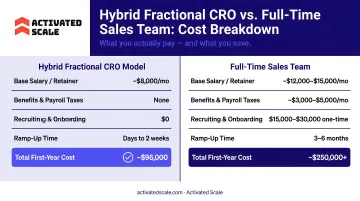
Activated Scale connects B2B SaaS startups with experienced fractional sales professionals who can start in as little as 7 days. The try-before-you-buy model lets you begin fractional and convert to full-time once the role justifies it — no long recruiting cycles, no premature salary commitments.
Real-World Scenario: How a B2B SaaS Startup Made the Call
A Series A B2B SaaS company faced a common inflection point. The founders—both engineers with limited sales background—had reached approximately $1M ARR through founder-led selling. Board pressure to build a scalable pipeline was mounting, but the company lacked budget and certainty to justify a $180K+ full-time VP of Sales.
The Challenge
Sales cycles were inconsistent, with no repeatable process. The CRM was a mess, providing no visibility into pipeline health. Marketing and sales operated in silos with unreliable handoffs. A prior 12-week engagement with a top-tier consulting firm had produced a data-heavy report but zero implementation. The company needed someone who could actually execute, not just advise.
The Fractional Engagement
The company brought in a fractional CRO through a structured engagement. The scope covered four priorities:
- Auditing the existing sales organization
- Rebuilding CRM infrastructure into a reliable system of record
- Unifying reporting across marketing and sales
- Establishing repeatable processes for deal handoffs and pipeline tracking
The fractional executive worked approximately 20 hours per week over a 3-month initial period. Within 3 weeks—compared to the 4-6 months a traditional consulting engagement would require—the entire sales organization had been restructured.
The Results
Deal conversion improved immediately. The CRM rebuild gave leadership real-time pipeline visibility for the first time. Marketing and sales alignment eliminated the handoff friction that had been slowing deals down. The team, previously operating without a clear process, had a defined playbook they could actually use.
Total engagement cost: $25K. A comparable traditional consulting project would have run $450K–$600K—and taken months longer to show results.
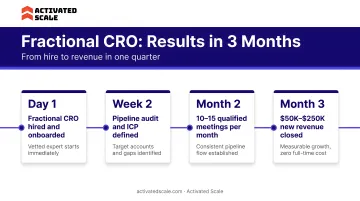
Key Takeaway: Fractional works when outcomes are specific, timelines are 6–18 months, and the role doesn't yet require full-time scope. Activated Scale connects B2B SaaS founders with pre-vetted fractional sales professionals—with the option to convert to full-time once the fit is proven.
Conclusion
Neither fractional nor full-time is universally better. The right answer depends on actual workload scope, team maturity, budget constraints, and how clearly you can define success. Founders who define what success looks like before they hire — not after — consistently make smarter decisions.
For early-stage B2B SaaS companies, fractional executives offer a practical path to access senior leadership, de-risk hiring, and move fast without committing overhead you can't yet justify. As your company scales and functions genuinely become full-time in scope, the transition to permanent hires follows naturally — typically when a role consistently demands 30+ hours per week and the scope has stabilized.
The question was never which model is better. It's whether the model fits where your company stands right now — and whether you're honest enough about that to act on it.
Frequently Asked Questions
What does it mean to be a fractional executive?
A fractional executive is a senior leader who works part-time across multiple companies, owning a specific function with full accountability for measurable outcomes. Unlike consultants who deliver projects and leave, or part-time employees who simply work reduced hours, fractional executives embed directly into leadership teams with defined decision rights and executive authority.
How much does a fractional executive cost?
Fractional executive costs vary by role and scope. Fractional CFOs typically run $2K-$15K/month, CMOs $5K-$25K/month, and CTOs $2K-$25K/month. Fractional sales leaders range from $6K-$15K/month. This represents 30-70% savings compared to the fully-loaded cost of full-time equivalents, which can exceed $400K-$700K annually when base salary, benefits, and equity are included.
What is the difference between a fractional executive and an interim executive?
Fractional executives work part-time across multiple companies (10-25 hours/week), focused on building capabilities and driving ongoing strategic outcomes. Interim executives are full-time, temporary replacements — brought in during transitions or crises for 3-12 months until a permanent hire is made.
Can a fractional executive transition to a full-time role?
Yes. Many fractional engagements evolve into full-time hires as scope expands. Building a buyout clause or conversion fee structure into the initial contract reduces risk for both parties and creates a clear path to permanent employment.
Is a fractional executive the right choice for an early-stage startup?
Early-stage startups are often ideal fits for fractional leadership. Outcomes tend to be well-defined, timelines compressed (6-18 months), and most functions don't yet warrant full-time attention. Fractional executives deliver senior expertise without the overhead or equity dilution of a permanent hire.
How do I know if my team is ready for fractional leadership?
The clearest signal: can your team execute with weekly strategic direction rather than daily supervision? If employees need constant approvals or real-time coaching, a full-time manager may be the right first hire. Fractional leaders work best with teams mature enough to act on direction between scheduled touch points.