
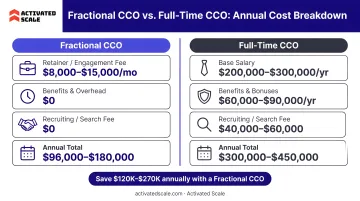
The challenge is clear: hiring a full-time Chief Customer Officer (CCO) to fix broken customer experience requires $300,000-$450,000 in cash compensation plus equity. Most early-stage companies simply don't have that budget. Yet leaving CX leadership to chance costs even more when churn compounds and expansion stalls.
Fractional CCO engagements solve this dilemma. They deliver executive-level customer experience leadership at a fraction of full-time cost—typically $12,000-$25,000 per month for 1-3 days weekly. This post covers what a fractional CCO does, why it's worth the investment, and exactly when to pull the trigger.
Key Takeaways
- A fractional CCO manages your full post-sale journey (implementation, renewal, and advocacy) working 1-3 days per week
- They deliver strategic systems and cross-functional alignment, not just day-to-day CS management
- Growing companies choose this model to access senior expertise without six-figure salary commitments
- Hire when churn rises, NRR drops below 105%, or CS teams operate in silos — most common at $1M–$10M ARR
- Success requires clear ownership, full data access, and a defined 90-day mandate
What Is a Fractional Chief Customer Officer?
A fractional CCO is a senior executive who works part-time—typically 1-3 days per week—to own your company's customer experience strategy, retention outcomes, and post-sale lifecycle. You get C-suite-level leadership without full-time overhead.
The distinction between a CCO and other CX roles matters. A Head of Customer Success manages reactive support and renewals post-sale. A CCO holds a broader strategic mandate spanning the entire customer journey—from acquisition through advocacy. The "C" in Chief Customer Officer reflects genuine C-suite scope: cross-functional influence, board-level accountability, and direct revenue ownership. The role carries real organizational authority, not just a title upgrade for a support function.
How the fractional model works:
Most fractional CCOs engage on monthly retainer contracts and may serve 2-4 companies simultaneously. According to Umbrex's Fractional CCO Playbook, typical retainers land at $12,000-$25,000 per month—representing 20-40% of the total cash outlay for a full-time hire. Time commitment typically spans 32-48 hours monthly (1-3 days weekly).
Full-time CCO compensation puts the cost difference in sharp relief. Glassdoor reports median total pay of $472,591 annually (including base, bonus, and equity), with ranges from $355,000-$645,000. Base salary alone runs $179,000-$317,000.
For growth-stage companies managing tight burn rates, the fractional model frees up $200,000-$400,000 annually — capital that goes toward product development, sales hiring, or other growth levers instead.
The global fractional executive market has topped $5.7 billion and is growing 14% annually, with fractional professionals doubling from 60,000 in 2022 to 120,000 in 2024. The model took root among businesses under $10M in revenue that needed executive-level expertise without committing to full C-suite salaries. That's still the core use case for most scaling B2B SaaS companies today.
What Does a Fractional CCO Actually Do?
Lifecycle Architecture
The fractional CCO maps every post-sale touchpoint—implementation, onboarding, adoption, renewal, expansion, and advocacy. They define clear stage transitions, ownership, and success criteria so no account gets lost in the handoff between teams.
This includes:
- Documenting handoff protocols between Sales, Implementation, and Account Management
- Creating stage-gate criteria (when does a customer move from onboarding to steady-state?)
- Assigning clear ownership for each lifecycle stage
- Building playbooks for critical moments (first login, 30-day check-in, renewal conversations)
Health Scoring and Churn Prevention
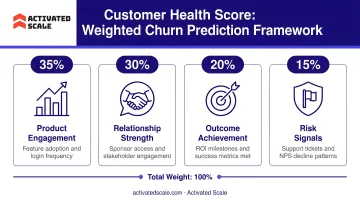
Health-score frameworks are one of the first things a fractional CCO builds—using leading indicators that predict churn, not lagging satisfaction surveys. Gainsight's health scoring research identifies key categories weighted by churn predictiveness:
Leading indicator categories:
- Product usage depth, feature adoption, and login frequency (40% weight — highest predictive value)
- Ticket volume, resolution time, and escalation frequency (25% weight)
- NPS, CSAT, and CSM qualitative notes (20% weight)
- Executive sponsor engagement, QBR cadence, and contact depth across the account (15% weight)
The CCO pairs these scores with remediation playbooks. When an account hits "at-risk" status (typically scores of 31-70 on a 100-point scale), specific actions trigger automatically—executive outreach, ROI review sessions, or product training—so intervention happens before the churn notice arrives.
Cross-Functional Alignment
Bridging silos between Sales, Product, Support, and Marketing is where the CCO role pays for itself:
- Product feedback loops: Customer insights reach engineering through structured channels, not ad-hoc Slack messages
- Sales handoff excellence: Eliminates "whiplash" experiences where sales promises don't match delivery reality
- Unified customer view: Every team sees the same health scores, timeline, and account history
McKinsey found that CX leaders achieved more than double the revenue growth of CX laggards between 2016-2021. Cross-sell rates increased 15-25% and share of wallet grew 5-10% when companies prioritized CX alignment.
Expansion and Revenue Ownership
The most impactful fractional CCOs treat expansion as a growth function, not an afterthought. They build expansion pipelines by embedding upsell and cross-sell discovery into every QBR (quarterly business review). Rather than walking through product usage screenshots, QBRs become outcome-focused conversations that surface new use cases and buying triggers.
They tie customer success metrics directly to ARR outcomes like Net Revenue Retention (NRR). High Alpha's SaaS Benchmarks show that companies with NRR ≥100% grow at 48% year-over-year—double the rate of those below 100%. Past $50M ARR, roughly 60% of net new ARR comes from existing customers—which means a weak expansion motion is a direct revenue ceiling.
Core KPIs a fractional CCO owns:
| Metric | What It Measures | Why It Matters |
|---|---|---|
| Net Revenue Retention (NRR) | Revenue retained + expanded from existing customers | Best-in-class is 110-120%; below 105% signals expansion problems |
| Gross Logo Retention (GLR) | Percentage of customers renewed (excluding expansion) | Median is 90%; below this indicates fundamental value issues |
| Customer Lifetime Value (CLV) | Total revenue from average customer over relationship | Determines sustainable CAC and growth efficiency |
| Time-to-First-Value (TTFV) | Days until customer sees measurable ROI | Above 45 days (mid-market) kills momentum and increases early churn |
| Net Promoter Score (NPS) | Likelihood customers recommend you | Leading indicator of organic growth and referrals |
Why Growing Companies Choose Fractional Over Full-Time CCO
Cost and Capital Efficiency
Full-time CCO cash compensation runs $300,000–$450,000 annually, while fractional retainers cost $144,000–$300,000 annualized ($12,000–$25,000 monthly). That $150,000–$200,000 difference doesn't just sit on the balance sheet — it funds:
- 2–3 additional sales hires
- Critical product features
- 6–9 months of extended runway
For Seed to Series A companies managing burn rates, this matters. The fractional model delivers executive expertise without the permanent overhead that impacts unit economics and fundraising metrics.
Immediate Impact, No Ramp Lag
Seasoned fractional CCOs bring cross-portfolio pattern recognition from serving multiple companies. They've diagnosed churn scenarios across industries, rebuilt broken onboarding flows, and developed expansion playbooks for wildly different customer bases.
Contrast this with full-time executive onboarding: Forbes reports that 27–46% of senior executives fail or leave within two years, and only 2% of companies offer accelerated integration programs. Most new hires are left to figure it out alone.
A fractional CCO arrives with proven frameworks ready to deploy immediately — measured in weeks, not a six-month onboarding arc.
Flexibility and Scalability
Fractional engagements scale up or down as business needs evolve. Companies in retention crisis can increase hours temporarily (bumping from 2 days to 3 days weekly). During stable periods, oversight may mean nothing more than advisory participation in monthly business reviews.
Startup growth is unpredictable by nature — your leadership costs should match that reality. You're not locked into a $450,000 annual commitment when needs fluctuate quarter-to-quarter.
Objective, Outsider Perspective
Unlike an internal hire navigating company politics, a fractional CCO brings unbiased diagnosis. They surface uncomfortable truths—broken sales-to-CS handoffs, underperforming team members, product-CX misalignment—without hesitation. They're not protecting their position or worried about offending colleagues.
Issues that internal executives might spend months tiptoeing around get tackled in the first 30 days. No political calculus required.
Beyond CX: The Fractional Talent Model
For growing B2B SaaS companies, the fractional model extends beyond CX leadership. Platforms like Activated Scale connect startups with vetted fractional professionals across go-to-market functions—sales, marketing, and revenue operations. A founder managing burn rate carefully can staff senior-level expertise across sales, CS, and RevOps — without committing to a single full-time salary in any of them.
When Is the Right Time to Hire a Fractional CCO?
Quantitative Warning Signals
Hire when you hit these thresholds:
- ✅ Gross Logo Retention drops below 90% or falls 2+ points quarter-over-quarter
- ✅ Net Revenue Retention slides under 105% or drops 2+ points in consecutive quarters
- ✅ Time-to-First-Value exceeds 45 days for mid-market accounts or 90 days for enterprise
- ✅ Expansion pipeline falls below 20% of installed ARR for two consecutive quarters
- ✅ Monthly churn exceeds 2.5% (mid-market) or 1.5% (enterprise)
SaaS benchmarks from Rockingweb show median NRR at 101-102% for private SaaS companies, with best-in-class at 120%+. If you're below 105% and trending down, you need executive CX intervention.
Qualitative Red Flags
Watch for these organizational symptoms:
- Sales reps pull CS into late-stage deals as "proof of value" because referenceable customers are scarce
- QBR decks show feature usage screenshots instead of ROI narratives and business outcome tracking
- Customers complain about "handoff chaos" between sales, onboarding, and account management
- Support tickets increase while product usage decreases (disengagement signal)
- Your team can't answer "which 10 accounts are most at risk and why?" without days of data digging
These warning signs show up in the day-to-day before they show up in your metrics. The ARR stage you're at determines whether a fractional CCO is the right response.
Growth Stage Mapping
The right CX leadership model shifts with ARR:
| ARR Stage | Right CX Model | Reasoning |
|---|---|---|
| Pre-seed / Seed (<$1M) | Founder is the CCO | Direct customer contact builds product-market fit insights |
| $1M-$10M ARR | Fractional CCO | Need executive strategy without full-time salary; highest ROI stage |
| $10M-$50M ARR | Fractional or Full-Time | Customer complexity and renewal concentration determine the right call |
| $50M+ ARR | Full-Time CCO | Customer complexity, team size, and board expectations require dedicated leadership |
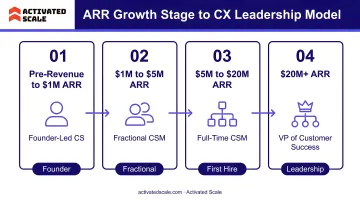
At $1M-$10M ARR, you've proven product-market fit but don't yet have the budget or organizational complexity to justify a full-time CCO. That's the fractional window.
The Cost of Waiting Too Long
Small reductions in monthly churn create disproportionately large valuation impacts through ARR compounding. Tomasz Tunguz's analysis shows how this plays out:
For a SaaS company with 3,000 customers and $3M ARR ($1,000/customer):
- 2% monthly churn = 22% annual churn = 646 customers lost = $800,000 in CAC spend just to stay flat
- 3% monthly churn = 31% annual churn = 918 customers lost = $1.2M to stay flat
- 5% monthly churn = 46% annual churn = 1,379 customers lost = $1.7M to stay flat (60% of revenues)
At 5% monthly churn, a company at $2.5M ARR raising a $5M Series A would need $5.45M just to sustain and double revenue—exceeding the entire raise. At 1% churn, the cost drops to $4.55M, fitting within the capital raised.
A fractional CCO engagement that moves monthly churn from 3% to 2% frees up $400,000 in CAC annually—capital that compounds into growth instead of replacement. The longer that fix waits, the more expensive the hole becomes.
How to Set Your Fractional CCO Up for Success
Define the Mandate Before Day One
The most common reason fractional CCO engagements underdeliver is vague scope. Before the engagement starts:
Define the top 3 outcomes for the first 90 days:
- Cut Time-to-First-Value by 30% (from 60 days to 42 days)
- Lift Net Revenue Retention from 98% to 105%
- Build referenceable customer base from 5 to 20 accounts
Grant full access to critical systems:
- CRM (Salesforce, HubSpot)
- Customer Success platform (Gainsight, ChurnZero, Catalyst)
- Product usage analytics (Mixpanel, Amplitude, Pendo)
- Support ticketing (Zendesk, Intercom)
Co-sign a decision-rights charter: Document what the CCO owns (lifecycle design, health-score formulas, expansion strategy) versus what internal teams own (daily customer communication, QBR execution, support tickets).
Structure the First 30-60-90 Days
Days 1-30: Listen and Diagnose
- Conduct 15-20 customer interviews across healthy, at-risk, and churned segments
- Review 6 months of retention, expansion, and usage data
- Map stakeholder landscape (who owns what, where are the gaps?)
- Deliver "Flash Findings" memo with top 3 issues and one quick win
Days 31-60: Strategy and Quick Wins
- Publish Lifecycle Charter defining stage transitions and ownership
- Launch health-score v1.0 with leading indicators
- Implement weekly renewal forecast calls with sales and CS leadership
- Execute first quick win (for example, pre-mortem analysis for top 10 at-risk accounts)
Days 61-90: Execution and Metric Establishment
- Roll out expansion discovery playbooks embedded in QBR process
- Build multi-threading maps (identify 2+ senior contacts + 1 economic sponsor per key account)
- Launch board-ready dashboard tracking NRR, GLR, TTFV, and pipeline
- Train internal CS team on new systems and playbooks
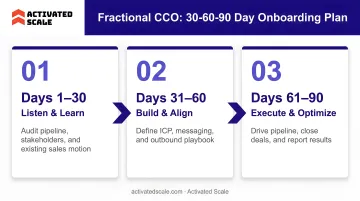
That 90-day arc only works if internal CS teams know exactly where their responsibilities begin. Without that clarity, execution stalls.
Maintain Internal Alignment
Internal alignment determines whether a fractional CCO delivers results or spins wheels. Communicate clearly:
CCO's role (strategic layer):
- Lifecycle architecture and stage gates
- Health-score formulas and thresholds
- Expansion discovery frameworks
- Strategic account planning templates
CSM's role (execution layer):
- Daily customer communication
- QBR preparation and delivery
- Onboarding execution
- Support coordination
When this division is unclear, fractional executives get pulled into escalations and day-to-day firefighting — burning hours on tasks CSMs should own. The engagement succeeds when the CCO is building systems, not running them.
Frequently Asked Questions
What is a fractional chief customer officer?
A fractional CCO is a senior executive who works part-time (typically 1-3 days weekly) to own your customer experience strategy, retention outcomes, and post-sale lifecycle. You get C-suite-level strategic leadership without the $300,000-$450,000 annual cost of a full-time hire.
What is the salary of a chief customer officer?
Full-time Chief Customer Officers earn total compensation of $355,000-$645,000 annually (median $473,000), including base salary, bonus, and equity, according to Glassdoor. Fractional CCOs work on monthly retainers of $12,000-$25,000—roughly 20-40% of full-time cash compensation.
Is CCO chief customer officer?
Yes, CCO stands for Chief Customer Officer—a C-suite role responsible for the end-to-end customer journey, retention, expansion, and advocacy. This is distinct from Chief Commercial Officer (also abbreviated CCO), which oversees pre-sale and post-sale revenue strategy across sales, marketing, and partnerships.
When should a startup hire a fractional CCO?
Most B2B SaaS companies hit the inflection point between $1M and $10M ARR, when churn starts rising, NRR slides below 105%, or founders spend excessive time on customer escalations. A fractional CCO is the right move when you need executive CX strategy but can't yet justify a full-time salary.
How is a fractional CCO different from a Head of Customer Success?
A Head of Customer Success manages post-sale retention for a single team, focused on execution. A CCO owns the entire customer lifecycle—driving cross-functional alignment across Sales, Product, and Support while tying CX directly to NRR and expansion ARR.
How do I measure the ROI of a fractional CCO?
Track NRR improvement, churn reduction, Time-to-First-Value, and expansion ARR—agreed as North Star metrics before the engagement starts. The math is straightforward: reducing monthly churn from 3% to 2% in a $3M ARR business saves $400,000 in CAC annually, which covers a $20,000/month retainer several times over.