
The fractional revenue team model resolves this tension. It gives early-stage companies access to senior sales, marketing, and customer success expertise without the $300,000+ all-in cost of a full-time executive or the 68-day hiring cycle that traditional recruiting requires. This guide explains what fractional revenue teams are, who belongs on one, when the model makes sense, and how to build and measure one effectively.
Key Takeaways
- Fractional revenue teams deliver senior sales, marketing, and customer success talent on a flexible contract basis—without full-time overhead
- Best fit: Seed-to-Series A B2B SaaS companies ($0–$5M ARR) proving repeatable revenue before committing to full-time hires
- Core roles span Fractional CRO, VP of Sales, SDRs/AEs, VP of Marketing, and VP of Customer Success
- Success depends on clear KPIs, workflow integration, and knowing when to convert top performers to full-time
What Is a Fractional Revenue Team?
A fractional revenue team is a group of experienced sales, marketing, and customer success professionals who work with a company on a part-time or contract basis. They provide executive-level strategy and hands-on execution without requiring full-time employment. Crucially, these are not consultants who deliver recommendations and leave. Fractional executives own targets, manage pipelines, run outbound campaigns, and stay accountable for revenue results—just like a full-time hire, but on a flexible engagement.
How Fractional Differs from Outsourced Sales
Fractional revenue teams embed within your company. They use your tools, adopt your brand voice, attend leadership meetings, and operate as a true extension of the internal team. Outsourced sales agencies and lead generation vendors, by contrast, hand off leads at a distance — they don't sit in your strategy meetings or carry accountability for your revenue numbers.
Fractional vs. Full-Time Revenue Teams: Quick Comparison
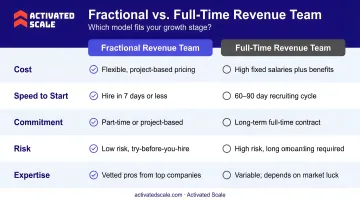
| Factor | Fractional Team | Full-Time Team |
|---|---|---|
| Cost Structure | $8K–$25K/month retainer per role | $150K–$450K+ total comp per role (salary + equity + benefits) |
| Speed to Start | 7–30 days (sometimes same-day for vetted talent) | 68 days average hiring cycle for leadership roles |
| Scalability | Scale up or down by adjusting hours/scope | Requires hiring or layoffs—slow and expensive |
| Commitment | 3+ month contracts, often convert to full-time | Permanent employment with severance risk |
| Expertise Depth | Senior professionals with 10-20 years experience | Variable; often need 3-6 months ramp time |
Why B2B SaaS Has Embraced Fractional Talent
B2B SaaS hiring has gotten slower and more expensive. Ramp times for new sales hires have risen to 5.7 months on average — up 32% since 2020, according to SaleSso's 2025 benchmarks — while investors continue pressing for ARR milestones on tight timelines. That gap is exactly where fractional talent fits.
You get senior professionals who've already built the playbook at companies like Salesforce, Oracle, and Zendesk, and who can apply it on day one. Demand for fractional and temporary executive roles has surged 57% since 2020 — as experienced leaders increasingly prefer portfolio careers, and founders realize a six-month hiring cycle is a competitive liability they can avoid.
Key Roles Within a Fractional Revenue Team
Fractional Chief Revenue Officer (CRO)
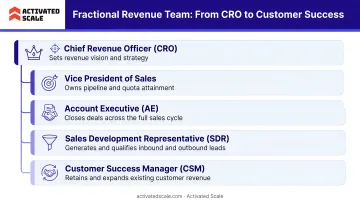
The Fractional CRO is the strategic anchor. This role sets the unified revenue strategy, aligns sales, marketing, and customer success around shared goals, owns forecasting, and reports directly to the CEO. A Fractional CRO becomes critical when a company needs cross-functional alignment but isn't ready to commit to a $300,000–$450,000+ full-time CRO salary.
Fractional CRO pricing runs $10,000 to $22,000 per month: a 60-80% cost reduction versus full-time total compensation.
Fractional VP of Sales / Sales Leader
This role manages the day-to-day sales motion: builds the sales playbook, runs weekly pipeline reviews, coaches reps, and closes strategic deals. For many early-stage startups, a Fractional VP of Sales serves as the first structured sales leader, creating repeatable processes from scratch. Where a full-time VP of Sales commands $150,000–$300,000 in base salary plus equity, a fractional engagement runs $6,000–$15,000 per month—giving founders 3-6 months to validate the hire before committing to a full-time hire.
Fractional SDRs and Account Executives
SDRs handle outbound prospecting and lead qualification; AEs run discovery calls, build business cases, and close deals. These are the execution layer.
Experienced fractional SDRs and AEs — sourced from curated networks like Activated Scale, which draws professionals from top-tier sales organizations — can start generating pipeline within days, not months. Top-quartile SDRs book 12-15 qualified meetings per month, and fractional talent with existing playbooks hits these benchmarks faster than new hires still learning your product.
Fractional VP of Marketing
A Fractional VP of Marketing owns demand generation, content strategy, and brand positioning to keep the top of funnel full. Many early-stage SaaS companies treat marketing as secondary to sales—a mistake that creates feast-or-famine pipeline swings. A fractional VP of Marketing helps maintain consistent lead flow and aligns marketing spend with revenue targets, typically for $8,000–$22,000 per month versus $150,000+ for a full-time VP.
Fractional VP of Customer Success
Companies with Net Revenue Retention above 110% report growth rates 83% higher than median — making customer success one of the fastest paths to ARR growth. This role drives that outcome by ensuring customers achieve results, converting them into renewals, upsells, and expansion revenue.
Bringing in a Fractional VP of Customer Success from the start — not as an afterthought at $2M ARR — materially improves lifetime value and compounds revenue over time.
Why B2B SaaS Startups Choose Fractional Revenue Teams
Cost Savings and Budget Flexibility
A failed sales hire costs 2-4x the annual salary when factoring in lost pipeline, founder time, and morale damage. That adds up to $500,000 or more over 12 months. A full-time VP of Sales at $160,000 base salary, with 31% benefits loading and equity, runs $250,000–$450,000 annually.
A fractional VP of Sales at $10,000/month for six months costs $60,000. If the engagement doesn't work out, you've preserved $190,000+ in runway with no severance complications.
Speed to Impact
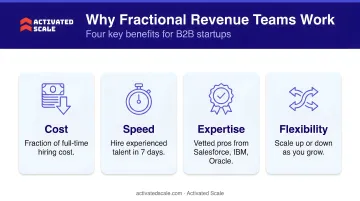
The average time to fill a senior sales leadership role is 68 days, yet most companies plan for 30 days or fewer. That seat sits vacant twice as long as expected. Fractional professionals eliminate this gap: platforms like Activated Scale connect companies with vetted talent within 7 days, and top performers often start contributing to pipeline in their first week.
Access to Specialized Expertise and Networks
Fractional revenue professionals bring deep, role-specific experience in your exact ACV range, deal cycle length, and ICP vertical. A fractional AE who's closed 50 deals in your category brings practical advantages a new hire can't match on day one:
- Knows which objections to address and which to sidestep
- Brings warm industry relationships that shorten prospecting cycles
- Has already built and refined the playbooks for your deal type
- Contributes to pipeline in weeks, not months
Scalability and Flexibility
Fractional teams scale up during product launches or fundraising pushes and scale back without layoffs. For a founder whose revenue targets shift quarter to quarter, that adaptability has real dollar value. Add fractional SDR capacity for a three-month outbound sprint, then reduce hours once pipeline fills. With full-time employees, that same adjustment means a hiring freeze or a layoff.
Risk Reduction: Try Before You Buy
Many fractional engagements offer contract-to-hire pathways. You evaluate a sales professional's performance and cultural fit over 3-6 months before committing to a full-time salary. This directly addresses one of the top founder fears: making a senior sales hire who looks great on paper but can't execute in your specific context. CRO tenure averages just 25 months — the shortest of any C-suite role — so validating fit before committing to equity and long-term comp makes strategic sense.
When Does a Fractional Revenue Team Make the Most Sense?
Early-Stage Startups: Pre-Product-Market Fit to $5M ARR
At this stage, building a full revenue team is premature. The cost and organizational distraction drain resources better spent on product development and customer discovery.
A fractional team helps you validate the fundamentals before scaling headcount:
- ICP fit — confirm you're targeting the right customer profile
- Messaging — test positioning with real prospects before committing to it
- Sales motion — identify what closing looks like at your price point
Jason Lemkin recommends hiring your first VP of Sales at $1M-$2M ARR once two reps consistently hit quota. Fractional talent bridges the gap from $0 to that milestone.
Sales Leadership Gaps and Transitions
When your VP of Sales departs, when you're stepping back from founder-led sales, or when preparing for a Series A that requires a credible revenue function in place quickly, fractional talent provides immediate continuity.
You don't need to leave the sales seat vacant for two months while recruiting. Engage a fractional leader within a week and keep pipeline moving.
New Market Entry or Product Launches
Fractional professionals bring fresh market perspective and can test go-to-market strategies with less risk than a permanent team commitment. If your SaaS product is expanding from SMB to mid-market, a fractional AE who's sold to that segment at three prior companies can validate the motion in 90 days, so you only commit to a full-time hire after proving the model works.
How to Build and Manage a Fractional Revenue Team
Start with the Right Source
Look for fractional talent with stage relevance (have they scaled companies from your current ARR to your target?), ICP match, and verifiable results. When evaluating candidates or platforms, prioritize these three factors:
- Stage relevance – Have they scaled companies at your current ARR to your target?
- ICP match – Do they have direct experience selling to your buyer type and deal size?
- Verifiable results – Can they show pipeline created, revenue closed, or ramp time at similar companies?
Platforms like Activated Scale vet and match B2B SaaS founders with US-based fractional sales professionals, often connecting companies with qualified talent within 7 days. Professionals in these networks bring experience from companies like Salesforce, Oracle, IBM, and Zendesk, along with proven playbooks and immediate credibility.
Set Clear Expectations Before Day One
The most common failure point with fractional engagements is ambiguity. Before the engagement starts, define:
- Roles and responsibilities – Who owns pipeline creation vs. deal closing vs. reporting?
- Weekly time commitments – How many hours per week, and which core meetings are mandatory?
- Communication cadence – Daily Slack check-ins? Weekly pipeline reviews?
- Success metrics – Pipeline dollar value created, meetings booked, revenue closed, win rate
Clear expectations upfront are the difference between a fractional hire who ramps in two weeks and one who never fully gets traction—regardless of how strong their background is.
Integrate Fractional Talent Like Full Team Members, Not Vendors
Onboard fractional hires the same way you would permanent employees:
- Share internal context – company mission, product roadmap, customer pain points
- Include them in relevant team meetings – all-hands, pipeline reviews, product demos
- Give them the tools and access they need – CRM, email sequences, Slack channels, customer data
The more embedded fractional professionals are, the faster they generate results. Treating them like external consultants creates friction and slows ramp time.
Measuring the Success of Your Fractional Revenue Team
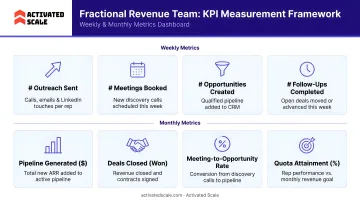
Core Sales Activity Metrics (Track Weekly)
For early-stage companies, leading indicators matter more than lagging ones in the first 60-90 days:
- Qualified meetings booked – Top-quartile SDRs generate 12-15 per month; track weekly progress toward this benchmark
- Outbound sequences launched – Are fractional SDRs executing cadences consistently, or are there gaps?
- Pipeline dollar value created – New opportunities added to CRM each week
- Deal stage progression – Are opportunities moving through stages, or stalling?
These metrics reveal whether fractional talent is executing the fundamentals before revenue results materialize.
Revenue Outcome Metrics (Review Monthly)
- New ARR closed – The ultimate measure of sales success
- Win rate – Average B2B win rate is 21% across all opportunities, 29% for qualified-only opportunities; track your fractional team against these benchmarks
- Average deal size – Is your fractional AE closing deals at the target ACV, or skewing smaller?
- Sales cycle length – Median B2B SaaS sales cycle is 84 days; compare your fractional team's cycles to this baseline
Establish these benchmarks at the start of the engagement so you can measure impact clearly. Establish these benchmarks at the start of the engagement so you can measure impact clearly. Once you're consistently hitting them, that's your signal to consider making the role permanent.
Knowing When to Convert Fractional to Full-Time
The signals that indicate a fractional role has proven its value and the business is ready for a permanent hire:
- 3+ months of quota attainment – Hitting or exceeding targets consistently, not just once
- Pipeline volume that requires full-time focus – Deal flow dense enough that part-time capacity is becoming the bottleneck
- Demonstrated cultural fit – Work style, communication, and values align with your team's long-term direction
At that point, you've already seen this person close deals in your environment. Converting to full-time is a straightforward decision — not a leap of faith.
Frequently Asked Questions
What is a fractional CRO?
A fractional CRO is a senior revenue executive who works with a company on a part-time or contract basis, owning the full revenue strategy—including sales and marketing alignment, forecasting, and go-to-market execution—without the cost or long-term commitment of a full-time hire.
How much does a fractional CRO charge?
Fractional CRO fees typically range from $10,000 to $22,000 per month depending on scope, company stage, and hours required. This represents 60-80% savings versus the $300,000–$450,000+ total cost of a full-time CRO when salary, benefits, and equity are included.
How much does a fractional CFO charge per hour?
Fractional CFOs typically charge $200–$400 per hour, or $8,000–$18,000 per month on retainer, depending on experience and company complexity.
How much does a fractional CEO cost?
Fractional CEO engagements typically range from $250–$500 per hour or $15,000–$35,000 per month on retainer. This makes them accessible to early-stage companies that need executive guidance without full-time compensation overhead.
Is a 5% increase in revenue good?
Revenue growth benchmarks depend heavily on company stage and market. For early-stage SaaS startups, median annual growth is 35-45%—so 5% annual growth signals stagnation. A fractional revenue team that's properly deployed should move pipeline and ARR into double-digit monthly growth within the first quarter through structured outbound and consistent sales execution.