Introduction
Most SaaS founders face the same tension: customer success is critical for retention and growth, but building a full in-house CS team is expensive and slow. The median B2B SaaS CSM salary in the US now sits at $114,026, with total compensation reaching $140,203 when you include bonuses and equity. Recruiting and onboarding a single CSM typically takes 35-60 days under favorable conditions. For cash-strapped seed and pre-Series A companies already stretched thin, outsourcing customer success starts to look tempting.
But the decision isn't simple. Customer success isn't just a cost center to optimize—it's the function that drives retention, expansion, and customer lifetime value. Get it wrong, and you risk losing the relationships that fund your growth.
This post covers the honest pros and cons of outsourcing CS, the specific scenarios where it works, and a practical middle-ground approach that many early-stage SaaS companies are using to bridge the gap.
Customer Success vs. Customer Support: Why the Distinction Matters for SaaS
Customer support is reactive. It resolves tickets, answers questions, and handles issues as they arise. Customer success is proactive. It drives adoption, reduces churn risk, expands accounts, and builds long-term relationships tied to the customer's business goals. A support rep helps a customer fix a broken integration; a CSM ensures that customer is getting ROI from your product and identifies opportunities to expand the relationship.
This distinction matters because outsourcing reactive support is straightforward—it's transactional, scriptable, and measurable by response time and ticket volume. Outsourcing a proactive, consultative CS function requires much deeper product knowledge, relationship continuity, and strategic judgment.
A CSM needs to understand not just what your product does, but why a customer bought it, how it fits into their workflows, and what business outcomes they're trying to achieve.
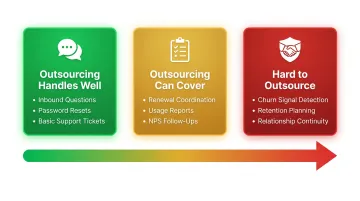
Many vendors marketed as "outsourced customer success" are actually delivering enhanced support—coordinating renewals, running usage reports, and responding to inbound questions. Founders need to recognize this gap before making a decision. The difference shows up clearly in practice:
- Answering inbound questions ("How do I reset my password?") — outsourcing handles this well
- Coordinating renewals and running usage reports — outsourcing can cover this with the right vendor
- Spotting early churn signals and intervening with a retention plan — this requires embedded product knowledge and relationship continuity that most outsourced teams can't replicate
Why Some SaaS Companies Consider Outsourcing Customer Success
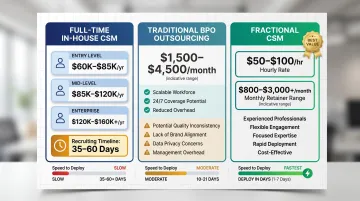
Cost and speed are the primary drivers. Hiring a full-time CSM in the US is expensive — according to 2025 salary data aggregated by CS Insider, base salaries range from $77,617 to $140,203 depending on experience:
- Entry-level CSMs: $60K–$85K
- Mid-level CSMs: $85K–$120K
- Enterprise CSMs: $120K–$160K or more
On top of salary, recruiting takes time. HackerEarth's 2026 benchmarks put average time-to-fill for technology roles at 35–60 days. For a founder racing to cut churn before the next board meeting, outsourcing offers faster deployment and lower upfront cost.
Resource constraints hit hardest at early stages. Seed and pre-Series A companies often lack the budget or bandwidth to build out a CS team. Between product development, fundraising, and closing deals, customer success falls to whoever has time — usually the founder or a part-time contractor. Outsourcing can fill this gap while the product and process stabilize.
Structured CS playbooks are another draw. Some outsourced providers bring pre-built onboarding frameworks, health scoring models, and churn intervention plays that early-stage companies would have to build from scratch. For founders without CS experience, this can meaningfully accelerate time to value.
The Real Risks of Outsourcing Customer Success in SaaS
Relationship Depth Is Hard to Replicate Externally
CSMs who are deeply embedded in a customer's workflows, team dynamics, and evolving goals are far more effective at reducing churn and driving expansion. Outsourced agents managing multiple clients at multiple vendors struggle to build this. Customer success is relationship-driven, and relationship equity takes time and consistent presence to accumulate.
When a customer calls with a problem, they want to talk to someone who knows their account history, understands their business context, and has been there from day one. Outsourced teams, often rotating through large client portfolios, rarely offer that continuity.
Research cited by Harvard Business Review shows that acquiring a new customer is 5 to 25 times more expensive than retaining an existing one, and that increasing retention rates by just 5% can boost profits by 25% to 95%. Those numbers depend entirely on a CSM who knows the account well enough to act on it.
Product Knowledge Gaps Create Credibility Problems
CSMs need to understand not just features and benefits, but implementation nuance, common failure modes, and how different customer segments get value. Outsourced teams onboarded quickly will have surface-level knowledge that customers notice in high-stakes conversations.
When a customer asks, "Why isn't this working the way we expected?" or "Can we customize this workflow for our team?" they need answers from someone who understands the product deeply. An outsourced CSM who doesn't know the answer and has to escalate every technical question erodes trust fast.
Decision-Making Authority Is Harder to Delegate Externally
Effective CSMs often need to make real-time calls—offering renewal concessions, escalating to product teams, committing to timelines. Delegating this authority to an outside team adds friction and slows response time, which erodes customer trust.
A customer facing an urgent issue needs a CSM who can say, "Yes, we'll get this fixed by Friday," not "Let me check with the internal team and get back to you." According to MarketStar's 2021 analysis, approximately 80% of consumers will leave a product after one bad interaction. When your outsourced CSM lacks decision-making power, you're gambling with those interactions.
Cultural Misalignment With Both Your Company and Your Customers
CSMs act as an extension of both the vendor and the client. An outsourced team that doesn't internalize your company's values, voice, or the industry context of your customers will struggle to operate in a genuinely consultative capacity.
Consider a SaaS product serving healthcare providers: the CSM needs to understand HIPAA compliance, EHR workflows, and the day-to-day pressures of clinical operations. An outsourced team splitting attention across a dozen different industries won't have that depth. Custify's February 2026 analysis notes that cultural misalignment is one of the primary reasons outsourced CS fails in SaaS, even with nearshore providers.
LTV Risk: Outsourcing the Driver of Your Business Model
Customer success exists to maximize customer lifetime value. Placing this function outside the business creates a misalignment of incentives. Outsourced teams are typically measured on activity metrics, not outcomes:
- Number of QBRs held and NPS surveys completed
- Renewal emails sent and check-in calls logged
- Ticket response times and onboarding completions
None of those proxy metrics capture what actually matters: long-term retention and expansion revenue.
The average B2B SaaS churn rate is 3.5% according to Recurly's 2025 churn report, with anything below 5% considered solid. For high-ACV enterprise SaaS companies, even a single churned account is painful. Trusting an external team with the primary driver of your revenue growth is a hard position to justify without exceptionally tight internal oversight.
Scenarios Where Outsourcing Customer Success Can Work
High-Volume, Low-Touch Segment
If your product serves hundreds or thousands of SMB customers with lower ACV—typically under $5,000 according to Prospeo's 2026 ACV benchmarks—and the CS motion is largely automated or playbook-driven (onboarding sequences, usage nudges, renewal outreach), outsourcing the execution layer can work.
In these segments, the CSM-to-customer ratio is typically 100:1 or higher, and the focus is on digital-first engagement rather than high-touch relationship management.
Key characteristics of successful low-touch outsourcing:
- Automated billing and renewals
- Standardized onboarding playbooks
- Digital engagement primarily through email sequences and in-app messaging
- Limited customization or consulting required
- Your internal team retains strategic oversight and handles escalations
Bridge While Building Your Internal Team
Early-stage companies that have just closed a round and need CS coverage while recruiting full-time CSMs can use outsourced or fractional talent to prevent churn during the transition. This works when there's a clear handoff plan and timeline.
For example, if you're targeting a Q2 hire for a full-time Head of Customer Success but need coverage now, a 3-6 month outsourced or fractional engagement can keep customers engaged and reduce immediate churn risk while you recruit properly.
Bounded CS Functions Can Be Outsourced Selectively
Temporary coverage isn't the only play. You can also outsource specific, transactional functions without handing over the full CS motion:
- Renewal coordination: Tracking renewal dates, sending reminders, processing paperwork
- NPS survey follow-ups: Collecting feedback and routing responses to the right team
- QBR scheduling: Coordinating calendars and preparing presentation decks
- Basic onboarding support: Guiding new users through initial setup steps
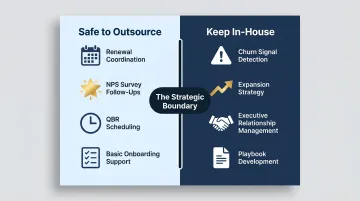
These tasks are administrative rather than strategic, and outsourcing them frees up your internal CSMs to focus on high-value relationship work.
Strong Internal CS Leadership Provides Guardrails
If you have an internal Head of CS who owns the strategy, playbooks, and key relationships, outsourcing the execution layer (junior CS work, administrative CS tasks) becomes lower risk. The outsourced team extends your capacity without owning the relationship.
The internal leader holds account ownership and strategic direction — outsourced CSMs handle execution within clearly defined boundaries.
The Middle-Ground Option: Fractional Customer Success Talent
What Is Fractional CS Talent?
Fractional CS talent refers to experienced CS professionals who work with a company part-time or on a contract basis, embedded in the company's tools, processes, and team—not as a remote BPO agent, but as a genuine team member with fewer hours. Unlike traditional outsourcing, where agents juggle multiple unrelated clients at once, a fractional CSM dedicates their engagement entirely to your accounts.
This model sits between full-time hiring and traditional outsourcing. You get an experienced professional who operates inside your CRM, uses your CS platform (Gainsight, ChurnZero, etc.), joins your Slack channels, and builds real relationships with your accounts—but you're not paying for 40 hours per week.
Why Fractional CS Fits the Early-Stage SaaS Context
Seed to Series A companies often need a seasoned CSM who can build the function from scratch, but can't justify a full-time $120K+ hire. A fractional CSM delivers experienced execution for significantly less. That typically means:
- Defining the onboarding playbook before it becomes a bottleneck
- Setting up health scoring so churn risks surface early
- Identifying expansion signals your team doesn't yet have a system to catch
According to Forbes' April 2026 analysis of fractional leadership trends, leadership roles are increasingly becoming fractional, with organizations accessing expertise on demand rather than embedding it permanently. This approach is particularly effective during "high-value moments" such as strategic pivots and implementation phases—exactly where early-stage SaaS companies find themselves.
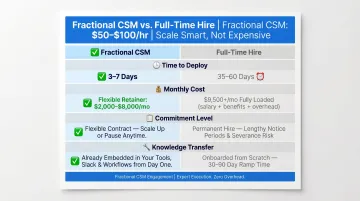
For comparison, fractional CMOs charge $8K-$18K per month and fractional CFOs typically cost $3K-$15K per month according to industry benchmarks. Fractional CSMs typically operate in a similar range, often charging based on hours (commonly $50-$100 per hour for experienced SaaS specialists) or monthly retainers tied to part-time schedules.
Relationship Continuity: The Key Differentiator
When a customer emails your fractional CSM at 3pm on a Wednesday, they're talking to the same person who onboarded them, knows their account history, and has been present at every QBR. That continuity drives trust and retention in ways that rotating BPO agents can't replicate.
And if the role grows, a fractional CSM can convert to full-time—carrying the institutional knowledge they've already built.
Activated Scale's Fractional CS Model
Activated Scale connects B2B SaaS startups with vetted, US-based fractional sales and customer success talent—professionals from companies like Salesforce, Zendesk, and Oracle—on a try-before-you-buy model. Founders can hire in days, not months, and convert to full-time if the fit is right.
The company's model is designed specifically for early-stage companies that need experienced CS execution without the commitment and overhead of full-time hiring. If you're evaluating whether fractional CS is the right move, Activated Scale's trial-based structure means you can test the model before making a long-term commitment.
How to Decide: A Decision Framework for Early-Stage SaaS Founders
Walk through these three questions to assess whether outsourcing, fractional, or in-house CS is right for your company:
1. What Is Your Average Contract Value?
If ACV is above $25,000, losing even one account is painful. According to Optifai's 2026 NRR benchmarks, mid-market companies (ACV $25K-$100K) achieve median NRR of 108%, while enterprise companies (ACV >$100K) achieve 118%. These economics depend on high-touch CS, which is harder to outsource.
If ACV is below $5,000, you're operating in a high-volume, low-touch segment where digital-first CS and selective outsourcing make more sense.
2. Do You Have an Internal CS Leader Who Can Own Strategy and Relationships?
If the answer is yes, outsourcing execution tasks or hiring fractional CSMs to extend capacity becomes viable. Your internal leader maintains ownership of customer relationships and strategic direction while delegating specific work.
If the answer is no, build this capability internally first. Outsourcing CS without internal leadership creates a dangerous vacuum—no one owns the function, relationships drift, and churn risk increases.
3. Are You Validating or Scaling Your CS Motion?
The answer changes significantly depending on where you are in building the function:
- Still validating (figuring out adoption drivers, churn signals, expansion triggers): Keep CS close to the business. Use a fractional expert who can embed with your team, learn your product deeply, and iterate on the playbook.
- Motion is documented and repeatable (onboarding defined, health scores set, expansion triggers identified): Selective outsourcing of execution tasks starts to make sense.
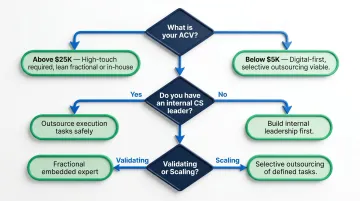
Validation requires embedded learning. Once you're scaling a proven motion, you have room to delegate.
Frequently Asked Questions
Can you outsource customer success?
Yes, but it comes with real trade-offs for SaaS businesses, particularly around relationship depth, product knowledge, and decision-making authority. For early-stage companies, fractional or embedded CS talent is typically more effective than traditional BPO outsourcing — it preserves relationship continuity while keeping costs manageable.
How much does outsourced customer service cost?
Costs vary widely by model. BPO-style outsourced CS can range from a few hundred to several thousand dollars per month per agent depending on scope, geographic model (onshore vs. nearshore), and account volume. Fractional CSMs typically charge $50-$100 per hour or work on monthly retainers (often $4,000-$8,000 per month for part-time engagements).
Are customer success managers in high demand?
Yes, CSMs remain in high demand in SaaS. That said, 2025 data from Custify shows 53.5% of CSMs have not seen salary increases and 44.2% of companies reported CSM layoffs — signs of real market volatility that make fractional and contract models an appealing entry point for early-stage companies.
What are the 4 pillars of customer success?
The four commonly cited pillars are adoption (ensuring customers onboard effectively), retention (keeping customers engaged and reducing churn), expansion (growing accounts through upsells and cross-sells), and advocacy (turning customers into brand ambassadors). These pillars require deep product and customer knowledge, reinforcing why the CS function is harder to outsource than transactional support.
What are the four types of outsourcing?
The four main models are:
- Onshore — same country, highest cost, best cultural alignment
- Nearshore — neighboring country, balanced cost and collaboration
- Offshore — distant country, lowest labor cost but time zone and cultural barriers
- Fractional/project-based — part-time specialists on retainer, flexible scope
For SaaS CS functions, fractional is the most aligned model due to the relationship-heavy nature of customer success.