This guide explains what customer success means for service-based businesses, how the lifecycle works, what to measure, and how to build a CS function even with limited resources.
TLDR:
- Customer success is proactive and outcome-focused—not reactive support or contract-driven account management
- Service companies need a CS model adapted to project and relationship dynamics, not software usage patterns
- Key lifecycle phases: expectation-setting onboarding, value delivery with regular check-ins, QBRs to demonstrate ROI, expansion signals, and renewal prep
- Track retention rate, NPS (median +45 for professional services), and net revenue retention (top firms achieve 105-120%)
- Start lean with a designated CS owner, health scoring, and structured touchpoints—fractional CSMs can establish the function before committing to full-time hires
What Is Customer Success for Service-Based Companies?
Customer success is a proactive, outcome-focused approach to ensuring clients consistently get measurable value from your service throughout the entire relationship. It's distinct from customer support (reactive problem-solving) and account management (contract renewals). The Customer Success Association defines CS as "a long-term, scientifically engineered business strategy for maximizing customer and company sustainable profitability."
In service contexts, this means managing client relationships as strategic assets with no defined end date.
The Service Company Distinction
Unlike SaaS, where customer success tracks product usage signals—login frequency, feature adoption, workflow completion—service-based CS centers on relationship quality and perceived value. Your "product" is your people and process, not a platform. TSIA's framework for managed services positions CS as a "trusted advisor" focused on long-term value, anticipating issues before they become complaints.
Customer success is ongoing and value-based. Professional services — onboarding, implementation, project delivery — are project-based with defined start and finish dates. Both matter, but conflating them leads to clients feeling abandoned post-project. CS picks up where delivery leaves off, ensuring clients continue to see value quarter after quarter.
Who Needs Formal CS?
Service-based companies that benefit most from a structured CS function include:
- Marketing agencies
- Consulting firms
- Managed service providers (MSPs)
- Outsourced staffing companies
- Legal and financial services
- B2B service startups
These businesses rely on renewals, retainers, and referrals—making CS directly tied to revenue. Over 90% of organizations now have dedicated customer success roles, up from 50-70% just a few years ago, and 72% of businesses name improving customer experience their top priority.
Core CS Principles for Service Companies
Whether you're running an agency or a consulting practice, the same CS principles apply. The core four:
- Proactive engagement — reach out before clients raise concerns
- Outcome alignment — tie every touchpoint to client goals, not just deliverables
- Regular check-ins — structured cadences that surface issues early
- Feedback loops — systematic ways to capture and act on client sentiment
The difference from SaaS CS is execution. Instead of monitoring dashboard logins, you're tracking meeting attendance, deliverable satisfaction, response times, and stakeholder sentiment.
Why Customer Success Looks Different for Service Companies
SaaS CS teams rely on product data to trigger interventions: a user stops logging in, adoption drops, a feature goes unused. Service companies don't have these signals. CS must be built around relationship signals instead—responsiveness, meeting engagement, deliverable approvals, and qualitative feedback captured through structured touchpoints.
The Invisible Churn Problem
Research shows that 96% of unhappy customers never complain—they just leave. For every complaint you receive, 26 other clients are unhappy but silent. This is "invisible churn," and service companies are especially vulnerable. Without proactive check-ins and health monitoring, dissatisfaction festers quietly until it becomes a non-renewal decision.
Jason Lemkin of SaaStr described losing an eight-year customer paying $60,000 annually, roughly $500,000 in lifetime value. Usage declined 50% over 12 months, but the vendor only reached out to pitch upsells. The customer didn't complain. They simply chose not to renew. Lemkin identifies "Year 3" as a critical danger zone where larger customers are frequently lost if engagement drops.
Success Metrics Are Outcomes, Not Outputs
For a SaaS company, success might mean daily logins and completed workflows. For a service company, success means the client hit a business goal your service contributed to: increased pipeline, improved compliance, faster operations. TSIA warns that meeting SLA metrics doesn't guarantee satisfaction or renewal—clients judge you on business impact, not just deliverable completion. Documenting and demonstrating those outcomes is a core CS responsibility.
Relationship Intensity and Loyalty Risk
Service delivery teams (account managers, project leads, delivery staff) often double as de facto CS touchpoints. This creates risk: delivery teams focus on execution, not proactive value demonstration. HBR research on 18,000 client decisions found that after 3.5 years with a specific individual, the probability of a client following that person to a new firm doubles. Each additional team member serving the account decreases defection risk by about 2.5%.
Teams of specialists anchor clients to the firm better than generalists do. True CS requires someone whose role is specifically to ensure the client sees and feels ongoing value, not just someone who manages delivery.
Retention Benchmarks: Service vs. SaaS
That loyalty risk is real—yet service companies still outperform SaaS on retention, even without formal CS infrastructure:
| Industry | Avg. Annual Retention | vs. B2B SaaS (74%) |
|---|---|---|
| Business Consulting | 85% | +11 pts |
| IT & Managed Services | 83% | +9 pts |
| Professional Services | 84% | +10 pts |
| Legal Services | 75% | +1 pt |

Source: First Page Sage, 2025 study of 10,214 firms
The paradox: service firms retain better but invest less in CS. Formalizing CS gives these companies a clear path to push already-strong retention into the 90%+ range.
The Customer Success Lifecycle for Service Companies
Service-based CS operates across five phases. Each phase has specific responsibilities, typical failure points, and measurable outcomes.
Phase 1: Onboarding and Expectation Setting
Strong onboarding means aligning on outcomes, timelines, and communication norms from day one. Create a shared success plan with the client documenting:
- Their business goals and how success will be measured
- Key stakeholders and decision-makers
- Communication cadence and preferred channels
- What "done well" looks like at 30, 60, and 90 days
Over 20% of voluntary B2B churn links to poor onboarding. The first 60 days are the highest-risk window. High-performing firms bring consultants to full productivity in 54 days versus 65.5 days for average firms.
Common Mistake: Only 52% of companies set onboarding expectations during the sales cycle. The handoff from sales to delivery often loses critical context about what the client actually needs.
Phase 2: Value Delivery and Ongoing Engagement
Once onboarding wraps, CS owns making sure clients see consistent, measurable progress. Responsibilities include:
- Regular check-ins (not just delivery updates)—monthly for smaller accounts, bi-weekly for strategic ones
- Proactively sharing progress tied to client goals
- Flagging risks before they become complaints
- Tracking engagement signals: meeting attendance, response times, stakeholder sentiment
When cadence slips, clients notice before you do. 70% of buying experiences are based on how customers feel they're being treated, not just technical quality.
Phase 3: Value Demonstration and Business Reviews
Results alone don't drive renewals. Clients need to be reminded, repeatedly, how those results connect to their goals. Quarterly or semi-annual business reviews (QBRs) are the CS mechanism for:
- Reviewing outcomes against agreed benchmarks
- Revisiting evolving client goals and reprioritizing accordingly
- Quantifying ROI so it's visible, not assumed
- Bringing unaddressed concerns to the surface before they fester
- Setting clear priorities for the next period
Running QBRs with a formal agenda increases retention by approximately 11%. B2B customers with strong executive engagement are 2.5x more likely to renew. Start formal renewal conversations 90 days before contract end. Waiting until the final weeks turns a routine renewal into a high-stakes negotiation.
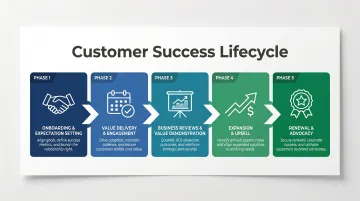
Phase 4: Expansion and Upsell Signals
Expansion is the organic outcome of a client who sees clear value. The probability of upselling an existing client is 60-70% versus 5-20% for a cold prospect. Watch for these signals:
- Increasing scope requests
- Introductions to new stakeholders or departments
- Questions about adjacent services
- Growth in the client's own business
That upsell window closes fast if the conversation feels transactional. Position expansion in the context of client goals, not your revenue targets. CSMs should raise it naturally during QBRs or check-ins: "Given your Q3 goals around X, have you thought about extending our work into Y?"
Phase 5: Renewal and Advocacy
Renewal should be the result of months of demonstrated value, not a last-minute scramble. CS responsibilities here:
- Engage the economic decision-maker early (90 days out minimum)
- Prepare a clear ROI summary with quantified outcomes
- Address any outstanding concerns proactively
- Secure commitment before the contract lapses
Clients who renew with confidence are most likely to provide referrals, testimonials, or case studies. Loyal clients refer an average of 3-5 new clients per year. A well-managed renewal doesn't just protect existing revenue — it opens the door to referrals, case studies, and introductions you can't buy with outbound.
Key Metrics to Track Customer Success in Service Companies
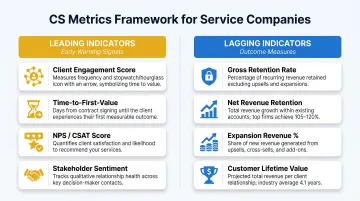
Service CS requires a mix of leading indicators (early warning signs) and lagging indicators (outcome measures). Without product telemetry, you need to build these signals from deliberate client touchpoints rather than passive data collection.
Leading Indicators
These predict churn before it happens:
- Client engagement score: Meeting attendance, response rate, deliverable approval speed, active stakeholder participation
- Time-to-first-value: How quickly did the client see a meaningful result after onboarding?
- NPS or CSAT scores: Collected at regular intervals (quarterly or post-milestone)
- Stakeholder sentiment during QBRs: Are they enthusiastic, neutral, or defensive?
Agencies using formal health scoring systems report up to 30% higher retention.
Lagging Indicators
These measure actual outcomes:
- Gross retention rate: Percentage of clients who renew annually
- Net revenue retention (NRR): Accounts for expansion and contraction; top professional services firms achieve 105-120% NRR
- Expansion revenue as % of total revenue: 74% of CS survey participants report majority of revenue comes from existing customers
- Customer lifetime value (CLV): Average client lifetime in service businesses is 4.1 years
NPS Benchmarks for Professional Services
| Segment | NPS Score |
|---|---|
| Professional Services (median) | +45 |
| Management Consultancy | 36 |
| IT Services | 42 |
| Architecture | 64 |
| Digital Marketing Agency | 30 |
Source: Sopact NPS Benchmarks, 2024; Clearly Rated, 2021
A "good" NPS range for professional services is +40 to +60; "excellent" is +70. Track trend over time—internal progress matters more than external benchmarks.
Simple Health Scoring for Early-Stage Firms
If you don't have a CS platform yet, use a spreadsheet-based health tracker. Assign red/yellow/green status to each account based on 3-5 signals:
- Recent engagement quality (meeting attendance, responsiveness)
- Last check-in outcome (positive, neutral, concerning)
- Deliverable satisfaction (formal or informal feedback)
- Renewal timeline and likelihood
- Expansion opportunity (none, possible, active discussion)
Target health distribution: 70%+ green, <20% amber, <10% red. If you're consistently above 10% red, that's a signal to audit your onboarding process or account coverage model — not just individual accounts.
Building Your Customer Success Function: Team and Tools
Most service companies don't need a full CS platform on day one. Start with the basics: clear ownership, a repeatable process, and consistent follow-through.
Starting Lean: Designate a CS Owner
At early stage, CS starts with designating someone—even if it's a founder or account lead—as the responsible party for proactive client outcomes. As the company grows, this role should be separated from delivery and sales to avoid conflicting priorities.
Key responsibilities of a Customer Success Manager (CSM) in service contexts:
- Regular proactive outreach to clients
- Tracking client goals and progress toward them
- Facilitating QBRs and renewal conversations
- Surfacing expansion opportunities
- Acting as the client's internal advocate
Fractional CS Before Full-Time Commitment
Early-stage service companies don't need to hire a full-time CSM immediately. Fractional or part-time CS professionals can provide the structure and senior expertise needed to establish the function without full-time overhead. The logic mirrors what Activated Scale does for B2B sales: try fractional talent first, validate the model, then commit to a full-time hire.
A fractional CSM engagement typically runs 15-20 hours per week for 3-6 months, giving you time to validate the CS model and ROI before scaling. 60% of fractional engagements convert to full-time hires.
CSM Book of Business Benchmarks
How many accounts can one CSM manage?
| Segment | Accounts per CSM | ACV Threshold |
|---|---|---|
| High-touch | ~22 accounts | >$100K ACV |
| Mid-touch | ~49 accounts | $10K-$100K ACV |
| Low-touch | ~144 accounts | <$10K ACV |
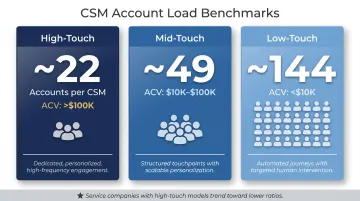
Source: Gainsight CSM Ratio Benchmarks, 2022
Service companies with high-touch delivery models should expect ratios toward the lower end—fewer accounts per CSM than SaaS firms.
Minimal Tool Stack for Service CS
You don't need expensive software to start. The essentials:
- CRM: Track account health, touchpoints, renewal dates, and stakeholder contacts
- Simple health scorecard: Spreadsheet or lightweight tool to monitor red/yellow/green status
- Survey tool: For NPS/CSAT collection (quarterly or post-milestone)
- Shared success plan template: Document client goals, metrics, and milestones for every engagement
Companies with Customer Success Platforms achieve ~100% NRR versus 94% without, but process and discipline matter more than platform sophistication at the early stage.
Common Mistakes Service Companies Make with Customer Success
Mistake 1: Confusing Delivery with Success
Many service companies assume that doing the work well is enough. But clients don't always connect deliverables to outcomes. CS requires active value narration—regularly translating what was done into business impact the client cares about.
Example: Instead of "We ran five campaigns this quarter," say "The five campaigns we ran generated 143 qualified leads, contributing to your 22% pipeline growth versus last quarter."
Mistake 2: Waiting for Clients to Raise Concerns
Service companies that only engage when something goes wrong are practicing customer support, not customer success. 91% of unhappy customers leave without complaining. By the time a client voices dissatisfaction, the churn decision is often already made.
Proactive check-ins, health scoring, and structured QBRs catch dissatisfaction before it becomes a decision to leave.
Mistake 3: Treating All Clients the Same
Not every account has the same strategic value or complexity. High-value, high-risk clients need high-touch CS: dedicated CSMs, frequent reviews, executive engagement. Smaller accounts can be served efficiently through:
- Templated check-in emails
- Automated NPS surveys
- Group webinars or office hours
- Self-service resource libraries
Segmentation combined with highly personalized offerings correlates with achieving >80% annual retention. The data is clear: matching your CS engagement model to account tier protects retention without burning resources on the wrong accounts.
Frequently Asked Questions
Frequently Asked Questions
What is a customer success service?
A customer success service is a proactive function that ensures clients achieve their desired outcomes from a product or service. Unlike reactive support, it guides clients through onboarding, adoption, and sustained value delivery—with retention and expansion as the primary goals.
What are customer success examples?
Practical examples for service companies include a marketing agency conducting quarterly business reviews to tie campaign results to client revenue goals; a consulting firm assigning a CSM to check in monthly and flag scope risks; a managed services company using NPS surveys to surface dissatisfaction before renewal.
What does an enterprise customer success manager do?
An enterprise CSM manages high-value, complex accounts with a high-touch model—running executive business reviews, managing multi-stakeholder relationships, coordinating renewals and expansions, and acting as the client's internal advocate to drive long-term value and retention.
What is SMB in customer success?
SMB in customer success refers to the small and midsize business segment, which typically receives a low-touch or scaled CS model—using automated check-ins, templated onboarding, and group training rather than dedicated CSMs—because the account value doesn't justify high-touch investment.
What are the 5 C's of customer service?
While frameworks vary, commonly cited 5 C's include Communication, Consistency, Commitment, Competency, and Customer Focus—principles that underpin both reactive customer service and proactive customer success strategies.
What is the 10/5/3 rule in customer service?
The 10/5/3 rule is a customer engagement guideline from hospitality: acknowledge a customer at 10 feet, make eye contact at 5 feet, and greet them verbally at 3 feet. It's since been adopted more broadly as a model for proactive engagement—reaching customers before they have to ask for help.
Service-based companies already have the relationship foundation that SaaS firms struggle to build. The opportunity isn't to become more like SaaS—it's to formalize what you already do well. Structure your touchpoints, measure what matters, and invest in someone whose job is to make sure clients never forget why they chose you.
A 5% improvement in client retention increases profits by 25-95%. That's the compounding effect of treating retention as a revenue strategy, not an afterthought.