
This guide provides a clear framework for measuring outsourced SDR performance before problems compound. You'll learn which metrics to track, how to interpret results at each program stage, and how to spot issues early—before they cost you revenue and time.
Key Takeaways
- Define success metrics before the first outreach begins, not after 90 days of activity
- Three measurement layers matter: activity metrics (volume), pipeline metrics (quality), and ROI metrics (business outcomes)
- Qualified meetings that convert to opportunities matter more than total meeting volume — cost-per-qualified-opportunity is your north star metric
- Benchmark results against your program's stage: week 4 data looks different from month 3 performance
- Measuring volume while ignoring conversion rates and lead quality is the most common way outsourced SDR programs fail
What You Need Before You Can Measure SDR Success
Measurement without context is noise. Before your outsourced SDR team sends a single email, establish three foundations: your definition of a qualified meeting, your ICP criteria (company size, industry, role, pain points), and your expected deal size. These baselines determine whether a booked meeting represents progress or wasted calendar space.
Without these definitions in writing, your SDR team will optimize for what they can control—meeting volume—rather than what you need: meetings that convert.
Tools and Access Points Required
Three elements must be in place on day one:
- CRM integration with full activity logging — Every call, email, and meeting note must flow into your CRM (Salesforce, HubSpot, Pipedrive), not just the vendor's dashboard
- Shared qualification scorecard — A written document defining exactly what makes a lead meeting-ready (role, authority, pain point, timeline, budget fit)
- KPI targets in writing — Monthly targets for meetings booked, meetings held, qualified meetings, and cost-per-opportunity, reviewed and signed by both parties
If your vendor can't provide live CRM access or insists on proprietary reporting, you have a transparency problem before the program begins.
Preconditions for Accurate Measurement
SDR programs require a ramp period—typically 30-45 days—where messaging, targeting, and qualification criteria are calibrated. During this window, activity volume is lower and conversion rates aren't representative of steady-state performance.
Set this timeline upfront — if you evaluate the program after three weeks using full-production benchmarks, you're comparing ramp data to mature-program expectations. That always looks like underperformance, even when the program is on track.
The Key Metrics for Outsourced SDR Performance
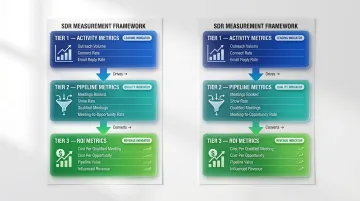
Effective measurement operates across three layers: Activity Metrics (leading indicators of effort), Pipeline Metrics (quality indicators of engagement), and ROI Metrics (business outcome indicators of revenue impact). Each layer reveals different failure modes and different fixes.
Activity Metrics
Activity metrics are your earliest warning system. They surface whether your targeting and data quality are holding up.
Track these three:
- Outreach volume — Emails sent and calls attempted per week
- Connect rate — Percentage of dials that reach a live person (benchmark: 3-10% for B2B outbound)
- Email reply rate — Percentage of emails that generate any response, positive or negative (benchmark: 5-7% on first email)
Low connect rates below 3% signal poor contact data quality. Low reply rates below 3% point to targeting problems (wrong prospects) or messaging problems (wrong value proposition). High activity with low replies means the SDRs are working, but they're reaching the wrong people or saying the wrong things.
Analysis of 16.5 million cold emails found average reply rates dropped from 6.8% in 2023 to 5.8% in 2024. Adjust your benchmarks accordingly.
Pipeline Metrics
Pipeline metrics measure quality at each funnel stage. They reveal whether booked meetings are actually the right prospects.
Track these four:
- Meetings booked — Total meetings scheduled
- Meeting show rate — Percentage of booked meetings where the prospect attends (benchmark: 70-80% for outbound programs)
- Meetings qualified — Meetings where the prospect met your scorecard criteria (role, authority, pain point, ICP fit)
- Meeting-to-opportunity rate — Percentage of qualified meetings that advance to a formal sales opportunity
A high meeting volume with a low show rate signals a qualification problem — SDRs are booking anyone who says yes, regardless of fit. If your show rate looks healthy but qualification is low, the issue is upstream: your scorecard doesn't match what the sales team actually needs.
Research shows 52.7% SAL-to-SQL conversion as a baseline, with tight ICP programs achieving 70%+ qualified meeting rates.
ROI Metrics
Once your pipeline quality holds up, the final question is whether the program justifies its cost. ROI metrics connect activity to revenue — and answer that question directly.
Track these:
- Cost per qualified meeting — Monthly retainer ÷ qualified meetings held
- Cost per opportunity — Monthly retainer ÷ opportunities created
- Pipeline value generated — Total dollar value of opportunities in play
- Influenced revenue — Closed deals sourced from the SDR program (measurable after 90+ days)
To calculate cost per qualified meeting, divide your monthly retainer by meetings that advanced past the first call. At $5,000/month with 10 qualified meetings, that's $500 per meeting — and $1,000 per opportunity if half convert.
Activated Scale clients targeting 10-15 qualified meetings per month provide a concrete benchmark: a well-run fractional SDR program at a $4,000-$5,000 monthly retainer produces a cost-per-qualified-meeting of approximately $267-$500.
How to Interpret Your SDR Performance Results
Reading metrics in isolation produces wrong conclusions. Results must be interpreted against three factors: program stage (ramp vs. steady-state), ICP definition quality, and where conversion drops off in the funnel.
Strong Performance
Healthy programs show consistent patterns:
- Activity metrics at or above benchmark (5%+ reply rate, 3%+ connect rate)
- Meeting show rate above 70%
- Meeting-to-opportunity conversion of 20-40% (28-40% is typical for B2B outbound)
Strong performance means your SDR inputs—targeting, messaging, and qualification criteria—align with what your sales team needs. The prospects showing up to meetings match your ICP, and they're experiencing the pain points your product solves.
If you're hitting these benchmarks consistently after 60 days, your program is working.
Warning Signs That Need Attention
Certain patterns indicate fixable problems, not program failure:
High meeting volume but low show rates (below 60%): SDRs are booking meetings with prospects who don't understand why they're taking the call. Tighten qualification criteria and require SDRs to confirm pain points before booking.
Meetings held but low conversion to opportunities (below 20%): The prospects attending meetings don't match what your AEs can close. Audit a sample of meeting recordings against your ICP, then revise targeting or adjust your scorecard.
Strong activity but low reply rates (below 3%): The outreach is reaching inboxes, but it's not resonating. Test new subject lines, revise value propositions, or narrow your target persona.
None of these require canceling the engagement — they're calibration problems, and each one has a clear path to resolution.
Out-of-Spec Results That Require Intervention
Some results indicate structural problems that demand immediate action:
- Zero qualified meetings after 60 days of full execution — The targeting, messaging, or qualification criteria are completely misaligned
- No CRM activity data appearing in your systems — Transparency failure; you can't manage what you can't measure
- 100% of meetings failing your qualification scorecard — The SDR team and your sales team are operating with conflicting definitions of "qualified"
If you see any of these, pause outreach immediately. Audit a sample of calls and emails to identify the breakdown. Revisit qualification criteria and ICP definition together with the vendor. Relaunch only after alignment is confirmed in writing.
Setting Up Your Reporting and Review Cadence
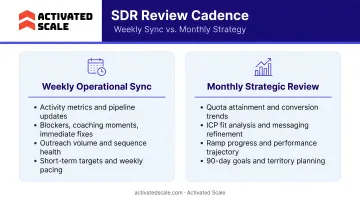
Measurement only drives improvement if it produces decisions. Establish a two-tier review cadence:
| Review Type | Frequency | Duration | Focus Areas | End With |
|---|---|---|---|---|
| Operational Sync | Weekly | 30 min | Activity volume, blockers, quick adjustments | One specific change to test (subject line, persona, qualification criterion) |
| Strategic Review | Monthly | 60 min | Pipeline trends, cost-per-opportunity, qualification accuracy, messaging | Written summary of what changed and why — so you can catch ICP drift before it costs pipeline |
The source of that data matters as much as the cadence itself. All reporting should originate from your CRM, not the vendor's platform. A vendor who can only provide PDF summaries instead of live CRM data makes accurate measurement nearly impossible.
Run the cadence consistently for at least 90 days. The written summaries compound: each one gives you a clearer picture of what's working and, more importantly, what to cut.
Common Measurement Mistakes That Distort Results
Four mistakes account for the majority of outsourced SDR disappointment:
Meeting volume, not quality. A provider incentivized on meeting count optimizes for bookings, not qualified opportunities. Track meetings that advance to a second conversation — not total meetings booked. Only 7% of B2B companies say outsourced SDRs have "truly worked", often because they were measuring the wrong thing.
Judging performance before ramp completes. Most programs need 45–60 days before messaging and targeting are calibrated. Teams that evaluate after three weeks are comparing ramp data to full-production expectations — which will always look like failure.
No written qualification criteria before day one. Without a qualification scorecard shared with the vendor upfront, SDRs optimize for meetings booked rather than meetings that convert. Activated Scale requires ICP alignment and qualification criteria to be locked in before outreach begins, so this gap doesn't emerge mid-program.
Measuring cost per meeting instead of cost per qualified opportunity. A cheaper provider with a 10% qualification rate costs more per real opportunity than a higher-priced provider hitting 50% accuracy. Always calculate cost at the opportunity layer, not the meeting layer.
Frequently Asked Questions
How to measure SDR performance?
SDR performance is measured across three layers: activity metrics (call and email volume), pipeline metrics (meetings booked, show rate, qualification rate), and ROI metrics (cost per qualified opportunity, pipeline generated). The single most important metric is meeting-to-opportunity conversion rate, which reveals whether booked meetings are actually advancing your sales process.
How do you measure and judge the positive effectiveness of the outsourcing vendor?
Judge vendor effectiveness across three areas:
- Qualified meetings consistently advance through your sales funnel
- CRM data is fully transparent and accessible in your own systems
- Cost-per-qualified-opportunity decreases over the first 90 days as messaging and targeting improve
What is a good meeting-to-opportunity conversion rate for outsourced SDRs?
Industry benchmarks range from 20-40% for B2B outbound programs, depending on deal size, ICP tightness, and qualification rigor. Tightly defined ICP programs with clear qualification scorecards consistently produce higher conversion than broad-based targeting, often reaching 50%+ meeting-to-opportunity rates.
How often should I review outsourced SDR performance?
Use a two-tier cadence: weekly operational syncs for quick adjustments (subject lines, persona refinements, qualification tweaks) and monthly strategic reviews for trend analysis, ICP refinement, and messaging iteration. Skipping reviews lets misalignment compound quietly until it's too late for easy fixes.
What should I do if my outsourced SDR program isn't hitting targets?
Underperformance usually traces to one of three root causes: targeting (wrong prospects), messaging (wrong value proposition), or qualification definition (wrong criteria). The fix is auditing a sample of outreach and meetings against your qualification scorecard before adding more volume. More activity doesn't fix a targeting or messaging problem—it amplifies it.
How do I define a "qualified meeting" for my outsourced SDR team?
Define a qualified meeting using observable criteria documented before outreach begins: role, decision-making authority, an acknowledged pain point, ICP fit (size, industry, tech stack), and an expected timeline for addressing the problem. Capture these in a shared scorecard and revisit it monthly as your ICP understanding sharpens.