Introduction
Building an in-house SDR team sounds straightforward until you face the reality: 3-6 month hiring cycles, another 3-6 months of ramp time, and annual turnover rates hitting 34-40%. For B2B SaaS founders, that's potentially six months of salary with zero pipeline.
Add recruiting fees ($8K-$15K per hire), benefits, tech stack costs, and management overhead, and your $65K base salary balloons to $95K-$135K in Year 1. When that SDR churns after 1.9 years on average, replacement costs run $115K-$195K.
This expensive, slow-moving cycle is pushing more startups to consider outsourcing SDR services. Launch in 2-4 weeks instead of months, pay $3K-$8K monthly instead of six figures, and skip the hiring headaches entirely.
This post delivers a balanced breakdown of outsourcing SDR services, backed by current data — including a cost comparison and a practical framework to decide what's right for your stage and go-to-market motion.
TLDR
- Outsourcing typically costs 40-60% less than in-house when factoring in fully loaded expenses, launching in weeks instead of months
- Core advantages: specialized expertise, faster ramp-up, flexibility without headcount commitment, and freeing internal teams to close deals
- Core risks: poor ICP alignment, communication gaps, inconsistent brand voice, and highly variable provider quality
- Only 7% of companies say outsourced SDRs "really" work — success demands clear ICP definition and active management
What Is SDR Outsourcing?
SDR outsourcing means hiring a third-party provider to handle top-of-funnel sales activities: prospecting, cold outreach (email, calls, LinkedIn), lead qualification, and meeting booking. Your internal team focuses on running demos and closing deals while the outsourced team fills the pipeline.
It's not a budget line you set and forget. Effective outsourcing requires clear direction, a tight ICP definition, and ongoing management from your side. There's also a meaningful distinction between a managed SDR agency — which delivers systems, playbooks, and reporting — and simply renting headcount, which gives you bodies without infrastructure.
The numbers tell an interesting story. The outsourced sales services market is projected at $3.37B in 2026, growing to $4.89B by 2035 at 4.2% CAGR. Yet a SaaStr survey of 1,200+ companies found only 7% reported outsourced SDRs "really" working, with another 26% saying it "sort of worked." The market keeps growing while satisfaction stays low — which means most companies are still figuring out how to make it work.
Advantages of Outsourcing SDR Services
Significant Cost Savings Over In-House Hiring
A fully loaded in-house SDR costs $95K-$135K in Year 1 when you account for:
- Base salary: $50K-$65K
- Benefits and payroll taxes: +20-30%
- Recruiting fees: $8K-$15K
- Equipment: $2K-$4K
- Software/tools: $8K-$15K annually
- Ramp productivity drag: ~$16K
- Management time
Outsourced SDR retainers run $3K-$8K monthly—$36K-$96K annually. That's a 40-60% cost reduction on paper.
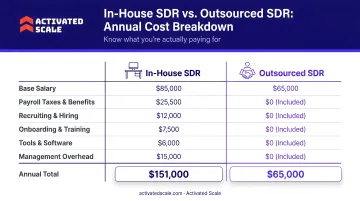
That gap widens for early-stage startups without a dedicated SDR manager or HR infrastructure. No sales leader to onboard, coach, and track performance means hidden costs pile up fast.
Access to Specialized Sales Expertise
Outsourced SDR providers bring:
- Pre-built outbound playbooks tested across dozens of clients
- Trained reps who've executed multi-channel campaigns before
- Refined prospecting systems you'd otherwise spend months developing
Top providers staff reps with experience across multiple industries and ICP types, enabling faster iteration on messaging and targeting. Instead of hiring your first SDR and hoping they figure it out, you're accessing expertise that's already worked through the common failure modes.
Faster Ramp-Up and Scalability
In-house SDRs take 3-6 months to reach full productivity. Outsourced programs launch outreach in 2-4 weeks.
Ramp timeline comparison:
- In-house: Month 1 at 25% quota, Month 2 at 50%, Month 3 at 75%, Month 4 at 100%
- Outsourced: Week 2-4 launch, immediate activity volume
For a Seed-stage startup burning cash, three months of unproductive salary is a meaningful drain. Outsourcing compresses time-to-pipeline.
The same logic applies to scaling. Need to test a new market segment or double outreach for a product launch? Outsourced programs adjust volume without repeating the hiring cycle—useful for seasonal pipeline needs or market experiments.
Flexibility Without Headcount Commitment
Outsourced SDR services typically operate on monthly retainers or project contracts. You can:
- Engage for a 3-6 month test period
- Pause during slow quarters
- Exit without severance, unemployment insurance, or legal risk
Contrast this with full-time employees, who require benefits, equity, and termination processes. The flexibility matters most when you're validating a new ICP or don't yet have product-market fit nailed down.
Frees Internal Team to Focus on Revenue-Generating Activities
Prospecting is time-intensive by design. The numbers show why:
- 44 dials per day yield roughly 4.1 quality conversations and ~15 meetings per month
- 10-11 touchpoints across channels required per converted prospect
- 70% of sales rep time consumed by non-selling tasks—admin work, meeting prep, CRM hygiene
Outsourcing top-of-funnel prospecting hands that time back to AEs and founders. More hours for demos, deal negotiation, and closes—where the actual revenue gets made.
Disadvantages of Outsourcing SDR Services
Risk of Poor ICP Alignment and Weak Lead Quality
If your Ideal Customer Profile isn't clearly defined and communicated, outsourced reps will default to broad targeting and generic messaging. The result: low-quality meetings that frustrate AEs and waste budget.
This is the most commonly cited reason outsourced SDR programs fail. Jason Lemkin notes that outsourcing fails when companies try to delegate something they don't already understand themselves. His core insight: "It is just hard in practice to outsource something you don't already know well yourself."
ICP misalignment creates a negative feedback loop:
- Reps book meetings with unqualified prospects
- AEs waste time on demos that don't convert
- Sales leadership blames the provider
- The provider blames unclear targeting
- Budget is burned with nothing to show
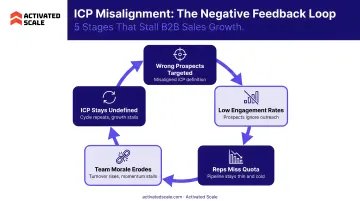
Without a validated ICP, tight qualification criteria, and documented messaging, outsourcing makes the underlying problem worse — not better.
Communication and Visibility Gaps
Outsourced SDRs aren't sitting in your office. Critical context gets lost:
- Objections prospects raise in discovery calls
- Product updates that change messaging
- Competitive insights gathered during outreach
- Nuanced feedback about positioning
When communication relies solely on scheduled check-ins and written reports, important details slip through. An in-house SDR overhears the AE's demo, absorbs product updates in all-hands meetings, and asks the support team about common customer questions. An outsourced rep doesn't have that ambient context.
This risk is manageable with structured weekly standups, shared Slack channels, and transparent reporting dashboards—but it requires intentional process-building that many teams underestimate.
Inconsistent Brand Voice
Every cold email and call represents your brand. Without thorough onboarding on tone, values, and messaging nuances, outreach can sound:
- Generic and template-driven
- Misaligned with your company's personality
- Tone-deaf to your audience
For early-stage companies working a small pool of high-value prospects, a poorly executed cold call can close doors permanently. Outsourced reps make hundreds of first impressions on your behalf. Getting the voice wrong with even a handful of those prospects can set back your pipeline for months.
Variable Quality Across Providers
The outsourced SDR market spans a wide quality spectrum. Providers differ dramatically on:
- ICP specialization and vertical expertise
- Multi-channel capabilities (some only do email)
- Reporting transparency and data ownership
- QA practices and rep training
- Compensation models (activity-based vs. outcome-based)
Choosing based on price alone often yields high activity volume with poor revenue impact. A $3K/month provider might deliver 50 cold emails daily but zero qualified meetings. A $7K/month provider might deliver 12 qualified meetings monthly with clear conversion data.
Vet providers on references within your specific market segment, not aggregate case studies. Insist on data ownership, clear SLAs, and transparent reporting before signing.
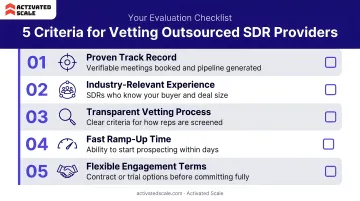
Outsourced SDR vs. In-House: Cost and Performance Comparison
| Metric | In-House SDR | Outsourced SDR |
|---|---|---|
| Monthly cost | $9,800-$14,200 fully loaded | $3,000-$8,000 retainer |
| Year 1 total cost | $95,000-$135,000 | $36,000-$96,000 |
| Ramp to productivity | 3-6 months | 2-4 weeks to launch |
| Meetings/month | ~15 (at full ramp) | 8-20+ (varies by contract) |
| Cost per meeting | $821-$1,150 | $357-$500 (retainer model) |
| Tenure/turnover risk | 1.9 years avg; 34-40% annual turnover | Contract-based; no turnover cost |
| ICP alignment | High (internal context) | Low without heavy enablement |
| Replacement cost | $115K-$195K per departure | $0 (vendor manages staffing) |
Compare programs on cost-per-qualified-meeting, not salary vs. retainer. A $5K/month outsourced program that books zero qualified meetings is worse than a $10K/month in-house SDR who books 12.
Hidden Costs of In-House SDRs
Beyond the obvious salary, in-house SDRs carry hidden expenses:
- Recruiting fees: $8K-$15K per hire
- Management time: 1 SDR per 2.4 AEs; median manager span of 1:6.4 SDRs
- Tech stack: CRM plus ~4.5 additional tools per SDR
- Turnover impact: Average SDR tenure is 1.9 years, with 34-40% churning annually
Each departure restarts the same costly cycle: recruiting, onboarding, ramp drag, lost productivity. At small scale (1-3 SDRs), this churn makes the in-house model expensive and hard to stabilize.
When Outsourcing Isn't Cheaper
Outsourcing only delivers savings when the provider produces qualified meetings that convert to pipeline. If the outsourced program generates unqualified meetings that consume AE time without converting, the economics break down quickly.
Example: A $6K/month retainer that books 20 meetings looks efficient at $300 per meeting. But if only 2 qualify and none convert, you've spent $6K for zero pipeline. Meanwhile, an in-house SDR at $10K/month who books 10 qualified meetings with a 30% opportunity conversion rate delivers far better ROI.
Before signing any outsourced SDR contract, define what a qualified meeting looks like — and make sure the provider's SLAs reflect that definition, not just raw activity volume.
When Should You Outsource SDR Services?
Outsource when:
- You need pipeline quickly and can't afford 3-6 months of in-house ramp
- You're testing a new market segment or ICP without committing to permanent headcount
- You lack time or infrastructure to build an SDR function from scratch
- You're a Seed/Series A startup where every dollar and month matters
- You have a validated ICP and documented outbound messaging (outsourcing amplifies what works)
Build in-house when:
- You have a long-term GTM strategy requiring deep, embedded product knowledge
- You have dedicated sales management capacity to onboard and coach
- You're planning multi-year campaigns where institutional knowledge compounds
- Your ICP is complex or constantly evolving, requiring tight feedback loops
- Brand voice and nuanced positioning are critical competitive advantages
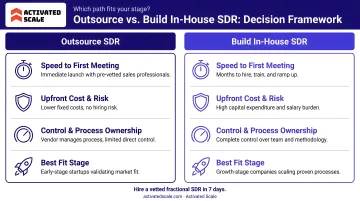
If neither column fits cleanly, a hybrid model may be the answer — and that's where Activated Scale sits. Rather than handing off to an opaque agency, you get vetted, US-based fractional SDRs embedded directly in your team on a try-before-you-buy basis. Get matched and active within 7 days, with the option to convert to full-time once fit is proven. It's a practical middle ground for B2B SaaS startups that need speed without giving up control.
Frequently Asked Questions
Does outsourcing SDRs save money compared to hiring in-house?
Yes, when you factor in fully loaded costs—salary, benefits, tools, recruiting, and ramp time—outsourcing typically costs 40-60% less. However, savings only materialize if the provider delivers qualified meetings. Cost-per-qualified-meeting, not retainer fee, is the right measure.
What is the difference between in-house SDRs and outsourced SDRs?
In-house SDRs are employees fully embedded in your team with deep product knowledge and cultural alignment. Outsourced SDRs are provided by a third party and focus on high-volume top-of-funnel execution.
Why do companies choose to outsource SDRs?
Companies outsource to build pipeline quickly without the time and cost of in-house hiring, test new markets without headcount commitment, and address high SDR turnover that makes maintaining consistent outbound difficult.
What are the advantages of outsourcing SDRs?
Key advantages include:
- Lower upfront cost compared to full-time hiring
- Access to pre-built expertise and proven outreach playbooks
- Faster launch time (2-4 weeks vs. 3-6 months in-house)
- Scalability without rehiring cycles
- Keeps internal teams focused on closing, not cold prospecting
Will AI replace SDRs?
AI is automating parts of the SDR role—email personalization, lead scoring, data enrichment—but hasn't replaced the human judgment required for nuanced outbound conversations. McKinsey reports 80% reduction in sales prep time, and SaaStr notes 36% of SaaS companies reduced SDR headcount in 2025-2026—yet the strongest programs still pair AI tooling with human SDRs for higher-volume, higher-quality outreach.