Introduction
A $110,000–$150,000 fully loaded SDR hire comes with a harsh reality: the role carries the highest attrition rate in sales. 36% of venture-backed B2B companies cut SDR headcount in 2025 — the steepest decline of any sales function. Factor in a 3+ month ramp period and average tenure of just 1.5–1.9 years, and that investment starts to feel shaky.
Two alternatives have emerged: outsource the SDR function entirely to an agency that manages reps and delivers meetings as output, or bring in external SDR talent that embeds directly into your team under your direction.
The choice goes deeper than speed to pipeline. It determines whether you retain brand control, build internal sales knowledge, and stay flexible when your ICP inevitably shifts. For early-stage startups still refining product-market fit, the wrong model can lock you into rigid scopes at exactly the wrong moment.
Key Takeaways
- SDR outsourcing = third-party agency manages reps, owns process, delivers meetings/pipeline; you define outcomes, they control execution
- Staff augmentation = fractional/contract SDR works inside your team, follows your playbook, reports to you; full messaging and process control
- Choose outsourcing when ICP is validated, messaging is proven, and you need a defined-scope campaign without internal management overhead
- Choose staff augmentation when your sales motion is evolving, product requires discovery-led selling, and you want to build knowledge in-house
- For most Seed-to-Series-A startups, staff augmentation is the lower-risk path — it lets you iterate on ICP and messaging without renegotiating agency scope
- Activated Scale connects you with vetted fractional SDRs in 7 days, with a try-before-you-buy option to convert to full-time
SDR Outsourcing vs. SDR Staff Augmentation: Quick Comparison
Here's how the two models stack up across the dimensions that matter most to early-stage founders.
| Dimension | SDR Outsourcing | SDR Staff Augmentation |
|---|---|---|
| Who manages the SDR | Vendor manages their team | Founder/sales lead manages directly |
| Control over messaging & ICP | Lower direct control; scope defined upfront | Full control; adjust targeting and messaging daily |
| Cost structure | Retainer ($3K–$8K/month) or pay-per-meeting ($150–$800) | Monthly per-rep rate on a fractional basis |
| Speed to first meeting | Deploys in 2–4 weeks | Rep quality varies; top platforms activate in 7 days |
| Flexibility to adjust strategy | Limited; scope changes require renegotiation | High; pivot ICP or messaging without contract revision |
| Knowledge retention | Stays with vendor after engagement ends | Stays in-house; rep accumulates product context over time |
| Best-fit startup stage | Defined campaigns, market tests, validated ICP | Seed–Series A, evolving ICP, complex product positioning |
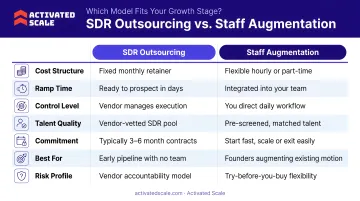
The biggest dividing line is control. Outsourcing trades flexibility for speed-to-deploy; augmentation gives you a rep who learns your product and adapts as your strategy evolves.
What is SDR Outsourcing?
SDR outsourcing means contracting a sales agency or business process outsourcer to run prospecting on your behalf. The agency recruits, trains, and manages their own SDRs, who then execute outreach to book meetings or generate leads for your company. You define target outcomes—50 meetings in Q3, for example—while the vendor owns execution, process, and day-to-day management.
Typical Engagement Structure
Most outsourced SDR programs operate on:
- Retainer pricing ($3,000–$8,000/month for a dedicated SDR equivalent) or pay-per-meeting models ($150–$800 per meeting, higher for enterprise targets)
- Fixed campaign scope defining ICP, target accounts, and messaging upfront
- Limited founder involvement in daily outreach decisions — quarterly alignment meetings are typical
- Vendor-owned playbooks and infrastructure already in place
For resource-constrained founders, outsourcing removes the recruiting burden, cuts management overhead, and gets outreach running fast. You focus on product and closing; the vendor handles execution.
The Core Limitation for Early-Stage SaaS
Outsourced SDRs typically represent multiple clients simultaneously, which creates a fundamental tension with complex or novel product positioning. Personalized cold email subject lines achieve a 7% reply rate versus 3% for non-personalized messages—a 133% conversion lift driven entirely by messaging quality and context. Entry-level outsourced programs ($2,500–$4,000/month) often rely on shared SDR capacity and templated email sequences, which give up the main advantage in outbound performance.
When your product requires discovery, or your ICP is nuanced (for example, selling to CTOs at Series B SaaS companies versus "all VP-level tech buyers"), outsourced models struggle. Volume-driven outreach optimized for broad targeting may miss the precision that closes enterprise deals.
When SDR Outsourcing Makes Sense
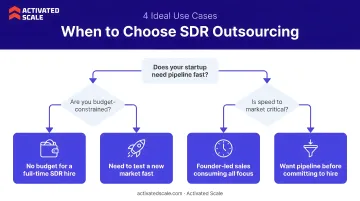
Outsourcing works best when:
- You're testing a new vertical or geographic market without building internal capacity
- You need a defined 90-day campaign with clear target accounts and success metrics
- You're bridging a gap while internal hiring progresses
- Your ICP is validated and messaging is proven through prior outbound testing
Outsourcing is less ideal when your product requires deep discovery, your ICP is still being refined, or your sales motion changes frequently. Scope rigidity makes these engagements fragile during pivots. Worth noting: companies that pivot 1–2 times raise 2.5x more capital than those that don't — iteration is common at the Seed-to-Series-A stage, not the exception.
What is SDR Staff Augmentation?
Staff augmentation means bringing in external SDR talent—fractional, part-time, or contract—who embed directly into your team. The augmented SDR follows your sales playbook, uses your CRM and sequencing tools, and reports to the founder or sales lead. You retain full control over outreach strategy, messaging, ICP targeting, and process.
How It Works Operationally
An augmented SDR joins daily standups, collaborates with AEs on handoff criteria, and refines messaging based on real prospect objections.
Platforms like Activated Scale connect B2B SaaS startups with vetted, US-based fractional SDRs who onboard in as little as 7 days (with the option to convert to full-time if performance justifies it). Current customers book 10–15 qualified meetings per month on average.
Unlike outsourced SDRs who rotate across clients, augmented reps accumulate context. They learn your product's technical nuances, adjust messaging based on what's working in live conversations, and improve conversion rates over time. Knowledge doesn't vanish when the contract ends—it stays embedded in your process.
The Compounding Advantage
Because augmented SDRs work exclusively for you during their engagement hours, they develop genuine product expertise. Two situations where this pays off directly:
- A prospect asks a technical question — the rep answers on the spot instead of escalating to the founder
- Messaging underperforms — the rep flags it immediately rather than waiting for a quarterly business review
Outbound connect rates have dropped to 3–10% (average 6%), down from historical 15–20% benchmarks. Email reply rates now average 5–6%, a 15% decline from 6.8% in 2023. In a tightening conversion environment, messaging precision and rep quality are the primary differentiators.
The Management Requirement
Staff augmentation assumes the founder or a sales lead has bandwidth to direct the SDR's work. Without clear direction—target accounts, talk tracks, qualification criteria—augmented reps lack the framework to perform. If you have zero sales leadership capacity, augmentation may not fit until you can dedicate 5-10 hours per week to coaching and pipeline review.
When SDR Staff Augmentation Makes Sense
Staff augmentation is ideal for:
- Seed-to-Series-A startups validating outbound motion and refining ICP
- Founders who need pipeline but can't justify a $110K-$150K fully loaded SDR salary
- Companies testing a sales rep before committing to full-time employment (Activated Scale reports 60% of fractional placements convert to full-time hires)
- Teams where ICP and messaging are still being refined—flexibility to pivot weekly without renegotiating scope
Staff augmentation is less suitable when there's no internal sales leadership to manage activity, the engagement is very short (under 4-6 weeks), or the goal is purely volume-based lead gen with no relationship context needed.
SDR Outsourcing vs. SDR Staff Augmentation: Which Is Right for Your Startup?
Three Core Questions to Ask Before Deciding
How much control do I need over messaging? If your product is straightforward to pitch and your ICP is broad, outsourcing's templated approach may suffice. If your value prop requires discovery or your buyer persona is nuanced, direct control over messaging becomes critical.
Do I have bandwidth to manage an external rep? Augmented SDRs need direction. If you can dedicate 5-10 hours per week to coaching, pipeline review, and talk track refinement, augmentation works. If not, outsourcing's hands-off model may be the better fit.
Am I building a repeatable motion or running a one-time campaign? For a defined 90-day campaign in a new vertical, outsourcing delivers speed without long-term commitment. For ongoing pipeline building where you're iterating ICP and refining messaging, augmentation preserves flexibility.
Choose Outsourcing If:
- Your ICP is validated and messaging is proven through prior testing
- You have a specific campaign objective (for example, "50 meetings in new vertical by Q3")
- You lack internal capacity to manage SDRs directly
- Speed to first meeting outweighs long-term knowledge retention
Outsourced programs deploy in 2-4 weeks and can generate first meetings within 30-60 days, compared to 4-6 months for in-house hiring (which includes 60-90 day recruiting plus 3+ month ramp).
Choose Staff Augmentation If:
- Your ICP is still evolving or your product requires discovery-led selling
- You want to build internal sales knowledge rather than outsource it permanently
- You're exploring whether to hire a full-time SDR and want to reduce hiring risk
- You have bandwidth to manage an embedded rep
On cost: fully loaded in-house SDR roles run $110,000-$150,000 annually once you factor in tools, management time, and recruiting. Outsourced retainers typically cost $42,000-$96,000 annually depending on scope. Fractional SDR pricing falls between those two figures, making it a practical middle ground for startups not ready to commit to a full-time hire.
Real-World Outcome: Activated Scale Client Data
Activated Scale client data shows consistent performance across the fractional SDR model:
- Fractional SDRs book 10-15 qualified meetings per month on average
- Althub averaged 11 qualified new meetings held monthly
- Flock Homes saw 14 new meetings set per month over six months
- 60% of fractional placements convert to full-time hires after the initial contract period
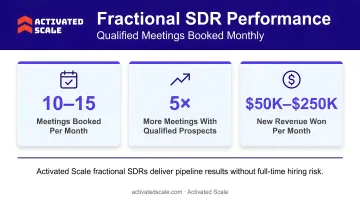
That last number matters most for founders on the fence about hiring. The try-before-you-buy model doesn't just reduce pipeline risk — it proves whether a rep is worth bringing on full-time before you commit.
Conclusion
Neither model is universally superior. The right choice depends on where you are in the sales maturity curve.
Outsourcing works when scope is defined, ICP is validated, and internal management overhead must be minimized. Staff augmentation works when control, brand alignment, and long-term pipeline building matter — which describes most early-stage B2B SaaS startups still iterating toward repeatable revenue.
The data underscores why flexibility matters: 88% of SaaS failures stem from mistimed pivots, and rigid outsourced scopes that lock ICP and messaging may conflict with the iterative nature of Seed-to-Series-A go-to-market. When your targeting shifts weekly, renegotiating an agency contract creates friction. When an augmented SDR sits in your Slack channel, pivots happen in real time.
For founders who want to test the staff augmentation model without the risk of a full-time hire, Activated Scale's try-before-you-buy model lets you start with a vetted fractional SDR in 7 days and convert to full-time if the results justify it. Pipeline shouldn't wait for perfect certainty. And it shouldn't be held hostage by rigid contracts while you're still figuring out who your best customers are.
Frequently Asked Questions
What is the difference between outsourcing and augmentation?
Outsourcing means handing full delivery responsibility to a vendor—they manage their own team, own the process, and deliver meetings or leads as output. Augmentation means bringing external talent into your team under your direct management, where you control messaging, targeting, and daily execution.
What is SDR outsourcing?
SDR outsourcing is contracting a sales agency to run prospecting on your behalf. The agency recruits and manages their own reps, executes outreach campaigns, and delivers meetings or qualified leads as the outcome—while you define target markets and success metrics.
Is contingent staffing better than staff augmentation?
Both involve external workers on a flexible basis, but staff augmentation implies closer integration—embedded reps working directly under your direction. Contingent staffing is the broader category, covering both embedded arrangements and standalone project-based work.
What is SDR staff augmentation?
SDR staff augmentation is embedding a fractional or contract SDR directly into your team, where they work under your direction using your playbook, CRM, and messaging. This allows you to build pipeline without committing to a full-time hire while maintaining full control over outreach strategy.
Which model is better for early-stage B2B SaaS startups?
Staff augmentation is the stronger fit for early-stage startups—ICP and messaging are still evolving, and you need the control that comes with managing an embedded rep directly. Outsourcing is difficult to course-correct mid-engagement, which is a real problem during the Seed-to-Series-A phase when strategy shifts often.
Can you switch from SDR outsourcing to staff augmentation later?
Yes. Many startups use outsourcing to test outbound, then move to staff augmentation once the motion is validated. The switch works best when the outsourcing phase has already defined your ICP, messaging, and target verticals.