
Introduction
You've just closed a Seed round. Your board wants pipeline. Your co-founder wants to focus on product. The obvious answer seems simple: hire an SDR.
Most early-stage B2B SaaS founders budget for the salary they see on the job posting — which covers roughly 40% of what they'll actually spend. The true fully loaded cost of an in-house SDR runs $110,000–$150,000 in Year 1, not the $55,000 base that shows up in the hiring budget.
Recruiting fees, ramp time, turnover risk, tech stack, and management overhead add another $60,000–$95,000 that never appears on the initial spreadsheet.
This cost gap creates a dangerous blind spot. When founders budget for one hire, they're unknowingly committing cash that could fund three months of runway. Approximately 38% of B2B SaaS companies now outsource part or all of their SDR operations — not because outsourcing is perfect, but because the in-house math doesn't work at their stage.
Choosing between agency, in-house, and fractional sales models affects more than your budget — it shapes your time-to-revenue, cash burn rate, and how quickly you can validate a repeatable sales motion. For Seed-to-Series A companies, getting this wrong doesn't just waste money. It can consume runway before you ever know if your sales approach actually works.
Key Takeaways
- In-house SDRs cost $110,000-$150,000+ in Year 1 once you factor in recruiting fees, benefits, tech stack, training, and 3-6 months of ramp time
- Agency models deliver meetings in 2-8 weeks and cost $42,000-$96,000 annually, but only 7% of companies report they "really worked"
- SDR turnover averages 25-39% annually; each departure costs $40,000-$90,000 and stalls your pipeline for months
- The right choice depends on funding stage, whether you have PMF, and how much management bandwidth you actually have
- Fractional sales talent bridges agency speed with in-house alignment — validate fit before committing to full-time salaries
Agency vs In-House Sales: Quick Comparison
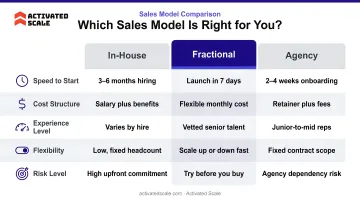
Here's how the three models stack up across the dimensions that matter most to early-stage B2B companies.
| Dimension | In-House SDR | Sales Agency | Fractional Sales Talent |
|---|---|---|---|
| Year 1 Total Cost | $110,000–$175,000+ | $42,000–$96,000 | $72,000–$144,000 |
| Time to First Qualified Meeting | 3–6 months | 2–8 weeks | 2–4 weeks |
| Turnover Risk | High (25–39% annually) | Agency absorbs | Minimal |
| Scalability | Slow — requires new hiring cycles | Limited by agency capacity | Flexible, can convert to FTE |
| Brand/Process Control | High (once ramped) | Low to medium | Medium to high |
These figures are estimated averages for U.S.-based B2B SaaS companies. Costs vary based on company stage, geography (SF/NYC vs. other markets), deal complexity, tech stack, and existing sales infrastructure.
The True Hidden Cost of Building an In-House Sales Team
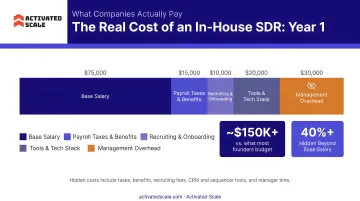
When you budget $55,000 for an SDR salary, you're seeing less than half the story. The real Year 1 cost breaks down like this:
Base salary: $55,000-$75,000 for mid-level SDRs in most U.S. markets. Senior SDRs in SF or NYC push $75,000-$93,000.
Recruiter fees: 15-25% of first-year salary. For a $65,000 hire, expect to pay $8,000-$15,000 in placement fees, job board costs, and background checks.
Payroll taxes and benefits: Employer benefits run approximately 30% of total compensation. On a $65,000 salary, that means:
- $7,800-$14,200 in payroll taxes (Social Security, Medicare, FUTA, SUTA)
- $15,000-$25,000 for health insurance, 401(k) match, PTO, and workers' comp
Tech stack: Annual tools cost per SDR runs $3,000-$5,000 and typically includes:
- CRM: Salesforce Pro Suite ($100/month) or HubSpot Professional ($90-$100/month)
- Sales engagement: Outreach ($100-$150/month)
- LinkedIn Sales Navigator ($80/month)
- Data and prospecting: ZoomInfo ($500-$1,000/year) + email verification ($200-$400/year)
Training and ramp-up: 4-6 weeks of formal onboarding plus 3-4 months operating at 30-50% productivity. You're paying full salary while the rep generates minimal pipeline—a monthly sunk cost of $6,500-$13,000. Total ramp-up investment: $12,000-$28,000.
Add it all up: $110,000-$154,800 per SDR in Year 1 for typical markets. High-cost metros push this above $210,000.
The Ramp-Up Blind Spot
That $110,000+ figure also doesn't account for what you lose during ramp. Most hiring managers budget for salary but ignore the 3-6 month productivity gap—average SDR ramp time is 3.2 months to reach target activity levels, and complex B2B roles can stretch 12-18 months.
During ramp, you're not just paying salary—you're losing pipeline. If your average deal is $25,000 and your sales cycle is 90 days, each month of ramp delays $50,000-$150,000 in potential revenue. For a company burning $150,000/month, that timing gap can stall fundraising or force a runway extension.
Turnover: The Compounding Risk
Sales has one of the highest attrition rates of any function. SDR annual turnover runs 25-39% depending on the source—significantly higher than the 35% B2B sales team average. Average SDR tenure is just 1.4-1.8 years, with many promoted internally after 15-16 months.
Each departure costs $40,000-$90,000 when you account for:
- Wasted recruiting and training investment
- Re-recruiting and onboarding the replacement
- Lost pipeline value during the gap ($20,000-$50,000)
- Knowledge transfer and relationship continuity loss
For lean startup teams, this compounds fast. When one of two SDRs leaves, pipeline stalls. The remaining rep absorbs double the load and starts looking for the exit. The founder gets pulled back into sales firefighting instead of closing deals or fundraising. What looked like a $110,000 hiring decision becomes a $200,000+ problem within 18 months.
Management Overhead: The Founder Time Tax
In-house reps don't manage themselves. Plan for 5-10 hours weekly coaching, pipeline reviews, messaging refinement, and performance management. At a typical VP of Sales hourly cost of $105/hour (based on $218,000 median base salary), that's $5,000-$10,000 in founder or sales leader time per SDR annually—time that could be spent closing deals, not coaching cold callers.
Agency Sales: What You're Really Paying For
Agency sales in this context means a third-party firm providing SDR or outbound prospecting services under a retainer or performance model. This differs from staffing agencies (which place full-time employees) and fractional talent (experienced individuals embedded in your team).
What's typically bundled in the agency fee:
- Dedicated SDR headcount (often offshore or shared across clients)
- Tech stack (CRM, engagement tools, data)
- Copywriting and messaging
- Team management and QA
- Weekly or monthly reporting
What you typically still own: ICP definition, final messaging approval, meeting acceptance criteria, and sales process beyond the handoff.
Agency Pricing Models
| Model | Price Range | Best For |
|---|---|---|
| Monthly retainer | $3,000–$10,000/month per SDR seat | Consistent pipeline volume; predictable budgets |
| Pay-per-appointment | $300–$600 per qualified meeting | Deals valued $15,000–$75,000; variable outreach needs |
| Hybrid | $2,000–$4,000/month base + $250–$400/meeting bonus | Splitting risk between agency and client |
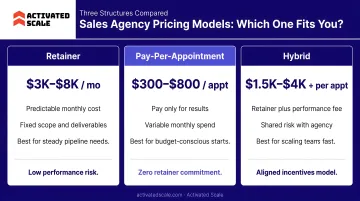
Common provider benchmarks for monthly retainers: Belkins ($3,000–$6,500), SalesRoads ($4,000–$8,000), EBQ ($4,000–$7,000), MarketStar enterprise ($8,000–$15,000). Add $1,500–$5,000 in one-time setup fees. Annual total per seat: $42,000–$96,000.
Pay-per-appointment rates range from ~$250 for low-intent meetings to $600–$900 for highly qualified enterprise meetings. Hybrid models split the risk—agencies get predictable base revenue, clients pay less if volume underperforms.
The Speed Advantage
Agencies typically deliver first qualified meetings within 2–8 weeks versus 3–6 months for in-house hiring and ramp. That time gap matters more than it looks on paper.
If your average deal is $35,000 and your close rate is 20%, a 4–5 month delay represents 8–10 lost opportunities worth $56,000–$70,000 in foregone revenue. That's more than the annual cost of the agency itself.
The Trade-Offs
The speed and bundled structure come with real limitations:
- Less day-to-day visibility: You see weekly reports, not live pipeline activity
- Variable quality across providers: Only 7% of companies report outsourced SDRs "really worked" in SaaStr's survey of 1,200+ respondents; 26% said "sort of" worked
- ICP targeting risk: Agencies optimize for meetings booked, not always meeting quality
- Institutional knowledge stays external: Your agency learns your market, but that knowledge walks when the contract ends
None of these are automatic disqualifiers. Managing them comes down to clear SLAs, strict meeting acceptance criteria, and 60–90 day pilot structures before committing to annual contracts.
Agency vs In-House: Which Model Fits Your Startup's Stage?
The decision isn't philosophical—it's tactical. Evaluate these factors:
- Funding stage and runway: Months of cash available, and whether you can absorb 6-9 months of negative ROI during hiring and ramp
- Product-market fit: Whether you have a repeatable sales process or are still iterating on ICP and messaging
- ICP clarity: Whether you can describe your ideal buyer in enough detail for an external team to target them accurately
- Deal size and sales cycle: Whether your ACV justifies dedicated headcount, or volume is the priority
- Management bandwidth: Whether a VP of Sales or experienced sales leader is in place to coach, or the founder is still running sales
Situational Recommendations
Choose agency when:
- You're pre-Series A or early Series A with limited runway
- You need meetings in weeks, not months, to prove traction for your next fundraise
- Your team lacks a dedicated sales manager to onboard and coach
- You want to validate a new ICP or market segment without headcount commitment
- Your current burn rate makes the 6-month in-house ramp timeline untenable
For a startup burning $150,000/month, every month of pipeline delay consumes 20% of remaining runway. Agencies typically break even in 2-4 months; in-house hires take 6-12 months to reach the same point.
Choose in-house when:
- You've reached PMF and have a repeatable sales playbook
- You have management capacity to onboard, coach, and retain talent
- Your sales cycle is long (6+ months) and requires deep product knowledge and relationship continuity
- You can absorb the 6-9 month ramp period financially and operationally
- You're ready to build institutional knowledge inside your company
The Hybrid Model
Many early-stage companies keep Account Executives in-house (closers who own relationships and contracts) while using fractional SDRs (openers who book meetings). The math supports it:
- AEs close $500,000+ in ARR annually — the $150,000-$200,000 fully loaded cost is defensible
- SDRs carry 25-39% annual turnover, shorter tenure, and commoditized skills, making them the natural candidates for externalization
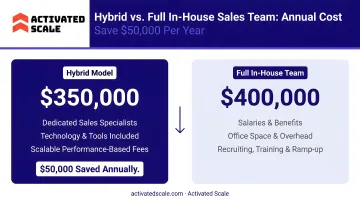
Simplified cost comparison:
- Full in-house team (1 AE + 1 SDR): $260,000-$350,000/year
- Hybrid model (1 in-house AE + fractional SDR): $210,000-$280,000/year
- Savings: $50,000-$70,000 annually while maintaining closing expertise internally
Running a Pilot Before Committing
Whether agency or in-house, run a 60-90 day pilot with clear success metrics:
- 10-15 qualified meetings booked per month
- 60%+ show rate on booked meetings
- 20-30% of meetings advancing to the next stage
Hit those numbers? Scale the model. Miss them? A fractional arrangement gives you a natural off-ramp — no annual contract to exit, no severance to pay.
The Third Option: Fractional Sales Talent for Early-Stage Startups
Fractional sales talent represents a middle path between agency speed and in-house control. These are experienced, U.S.-based sales professionals—often with backgrounds at companies like Salesforce, Oracle, Zendesk, and IBM—who work embedded in your business on a part-time or contract basis.
Unlike an agency, fractional reps carry your brand, learn your product, and report directly to your team. No black box—you manage the rep, own the data, and keep the institutional knowledge when the engagement ends.
Unlike a full-time hire, there's no $110,000-$150,000 Year 1 commitment, no 3-6 month ramp gamble, and no turnover replacement risk. You pay for hours worked—typically $6,000-$12,000/month depending on seniority and scope.
Who it's built for: Seed to Series A B2B SaaS founders who want agency speed without sacrificing in-house accountability. It works best for companies without a proven sales playbook—fractional professionals help build the motion that a future full-time hire can inherit.
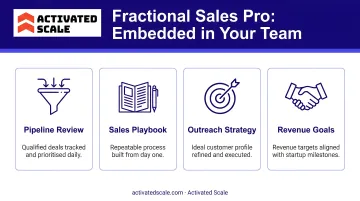
Activated Scale's fractional model connects founders with vetted talent in 7 days or less, with a try-before-you-buy structure and contract-to-hire options built in.
Rather than forcing a choice between expensive in-house risk and agency misalignment, fractional talent lets you build pipeline, validate your sales process, and create a repeatable playbook—then convert the hire to full-time if the fit works.
The result: Real pipeline and institutional knowledge built inside your company—without betting six figures on an unproven first hire.
Frequently Asked Questions
How much does it cost to outsource sales?
Agency retainer models typically run $3,500–$10,000/month ($42,000–$96,000 annually). Pay-per-appointment pricing ranges from $300–$600 per meeting. Total annual outsourced spend is generally 40–60% lower than a fully loaded in-house hire in Year 1—though your exact number will shift based on deal complexity and scope.
What are the benefits of in-house vs outsourcing?
In-house offers brand alignment, institutional knowledge retention, and full process control. Outsourcing delivers faster deployment (2–8 weeks vs. 3–6 months), lower fixed costs, and no turnover risk. If you have a repeatable sales process and dedicated sales management, in-house scales better. Without those two things, outsourcing is typically the lower-risk path.
What are the hidden costs of hiring an in-house sales rep?
Beyond base salary, the real Year 1 costs stack up fast:
- Recruiter fees: 15–25% of Year 1 compensation
- Payroll taxes and benefits: ~30% of base salary
- Tech stack: $3,000–$5,000/year
- Training: $12,000–$28,000
- Ramp-up productivity loss: 3–6 months of below-quota output
Combined, these push total Year 1 investment to $110,000–$150,000+.
How long does it take for an in-house SDR to become fully productive?
Typical ramp time is 3.2 months to reach target activity levels and 9–12 months to full performance competency. For early-stage companies with limited runway, this timing gap can delay pipeline by a quarter or more.
What is fractional sales and how does it differ from a sales agency?
A fractional sales professional works inside your company — under your brand, your direction, and your processes. Agency reps operate under the agency's own system. The practical difference: fractional talent can convert to full-time, letting you validate fit before committing to a permanent salary.
When should a B2B SaaS startup outsource sales rather than hire in-house?
Outsourcing makes sense when you:
- Are at Seed to Series A stage without a dedicated sales manager
- Haven't yet defined a repeatable sales process
- Need to validate your ICP before committing to permanent headcount
If your runway is under 12 months, outsourcing's faster time-to-pipeline is the safer bet.