Introduction
Too many B2B SaaS teams — especially at the seed and Series A stage — don't fail because they lack ambition. They fail because sales, marketing, and customer success operate in disconnected silos with zero shared visibility into the pipeline. Sound familiar?
- Your marketing team celebrates 50 new MQLs while sales complains about lead quality
- Your AE closes a deal, but customer success has no context from those sales conversations
- Your forecast meeting becomes a guessing game because no one's looking at the same numbers
RevOps platforms fix this by unifying data across functions, automating handoffs, and giving every team — sales, marketing, and CS — a shared view of pipeline health, customer interactions, and revenue forecasting. When done right, they transform fragmented teams into one collaborative revenue engine.
The market confirms this shift isn't just hype. The global revenue operations market reached $4.39 billion in 2024 and is projected to hit $16.98 billion by 2033, growing at 16.6% annually. In fact, 48% of companies now run a dedicated RevOps function — a 15% year-over-year jump — with another 11% planning to adopt. For seed-to-Series A founders, the question isn't whether to adopt RevOps tooling. It's which platform fits your team's stage, your existing stack, and your biggest collaboration gaps.
TL;DR
- RevOps platforms unify sales, marketing, and customer success — eliminating costly silos that slow B2B growth
- Top platforms combine CRM integration, automated workflows, and real-time pipeline visibility in one place
- Key evaluation factors: ease of CRM integration, collaboration features, transparent pricing, and fast implementation for lean teams
- Top 2026 picks: HubSpot CRM, Clari, Gong, Salesloft, and 6sense — each suited to a different RevOps priority
- Choose the right platform, then staff it with people who can act on the data — tools don't close deals
What Makes a RevOps Platform Good for Team Collaboration?
RevOps platforms are software systems that unify data from sales, marketing, and customer success into a single source of truth. They enable cross-team alignment, accurate forecasting, and automated workflows across the entire revenue lifecycle — from initial lead generation through renewal and expansion.
Forrester defines revenue operations as "a highly configured, iterative commercial execution strategy designed to maximize customer value and company performance". In practice, that means eliminating the silos between departments that have historically worked in isolation.
Why Collaboration Is the Critical Lens for 2026
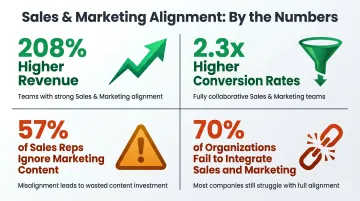
As teams scale or bring in fractional sales talent alongside in-house marketing and CS teams, shared visibility becomes the difference between cohesive execution and costly miscommunication. The data backs this up. Organizations with strong sales-marketing alignment see up to 208% higher revenue than misaligned peers. Teams that fully collaborate across the buyer journey experience approximately 2.3x higher conversion rates.
The flip side is just as telling. 57% of sales reps ignore marketing-produced content because it feels generic or unresponsive to buyer objections. Meanwhile, 70% of organizations fail to integrate their sales and marketing plays into CRM and automation systems.
Core Collaboration Capabilities to Look For
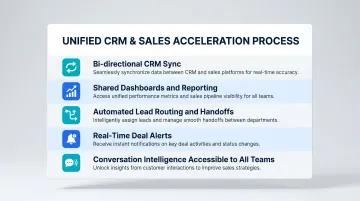
When evaluating RevOps platforms through the collaboration lens, prioritize these features:
- Bi-directional CRM sync — Data flows both ways between your platform and existing systems without manual updates
- Shared dashboards and reporting — Marketing, sales, and CS teams see the same metrics, pipeline stages, and account health scores
- Automated lead routing and handoffs — No more Slack messages asking "did you follow up with this lead?" — the system handles transitions
- Real-time deal alerts — When a high-value opportunity stalls or a customer shows churn risk, every relevant stakeholder knows immediately
- Conversation intelligence accessible to all teams — Not just sales reps reviewing calls, but marketing learning what messaging works and CS understanding customer objections before onboarding
The Common Mistake Early-Stage Teams Make
Too many seed-to-Series A teams select RevOps tools based on brand recognition or enterprise feature lists rather than collaboration fit and integration simplicity. A platform designed for 500-person sales orgs won't serve a 10-person team well — you'll pay for complexity you don't need and waste weeks configuring features you won't use for years.
Even the most powerful RevOps stack only delivers results when skilled salespeople act on the data it surfaces. Visibility without execution is just a dashboard. That's why many early-stage teams pair their RevOps platform with fractional sales professionals — people who already know how to interpret pipeline signals and move deals forward — rather than waiting months to hire full-time staff.
Best RevOps Platforms for Team Collaboration in 2026
These platforms were selected based on their ability to improve cross-functional alignment, pipeline visibility, and workflow automation for B2B teams — not just individual rep productivity.
HubSpot CRM
HubSpot is an all-in-one CRM and RevOps platform that connects marketing, sales, and customer service in one unified workspace. It's particularly accessible for seed-to-Series A B2B SaaS teams that don't yet have separate tools for each function.
HubSpot's shared contact and deal records are visible across sales, marketing, and CS without additional integration work. Native tools for email sequences, meeting scheduling, pipeline reporting, and live chat all feed into the same data layer — giving every team real-time context on every prospect and customer.
When marketing runs a campaign, sales sees which leads engaged. When a deal closes, CS immediately accesses the full conversation history.
The platform has been named a Leader in the Gartner Magic Quadrant for B2B Marketing Automation Platforms for five consecutive years. Users note the platform is "intuitive to learn, and the available resources, documentation, and support team make it easy to get up to speed quickly."
| Key Collaboration Features | Shared pipeline views, marketing-to-sales handoff automation, live deal activity feeds, integrated inbox for cross-team visibility |
| Best For | Early-stage B2B teams wanting an all-in-one RevOps entry point without a complex multi-tool stack |
| Pricing | Free tier (up to 2 users); Starter $9/seat/month (annual); Professional $90/seat/month (annual) with $1,500 onboarding; Enterprise $150/seat/month (annual only) with $3,500 onboarding |
HubSpot's Startups program offers 30-90% discounts for eligible early-stage companies, making it the lowest-risk starting point for seed-stage teams building their first RevOps stack.
Clari
Clari is a revenue orchestration platform built for teams that need reliable forecasting and pipeline management across multiple stakeholders. It's primarily suited for mid-market and scaling B2B organizations with more structured sales cycles.
Clari gives sales leaders, RevOps, and finance teams a unified view of pipeline health, deal risks, and forecast accuracy. Instead of the informal "gut check" forecast meeting, every team reviews AI-supported data together. Deal inspection tools let managers and reps collaborate on at-risk opportunities before they slip — surfacing risks that would otherwise hide in rep notes or spreadsheets.
Note: Clari and Salesloft completed their merger on December 3, 2025, forming a combined "Revenue AI powerhouse." R&D investment has doubled and product integration is underway — teams evaluating either platform should ask vendors about the post-merger roadmap.
| Key Collaboration Features | Multi-team pipeline dashboards, AI-driven deal risk alerts shared across leadership, forecast submission and roll-up workflows |
| Best For | Teams scaling beyond early-stage that need structured forecast collaboration between sales, RevOps, and finance |
| Pricing | Custom/enterprise pricing; third-party estimates suggest $100-$120/user/month for core modules, $200-$310/user/month for full stack plus $15K-$75K implementation |
Clari officially claims 448% ROI with 30% increase in first meetings booked and 15% faster deal cycles, though these are vendor-reported metrics.
Gong
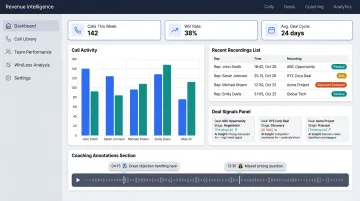
Gong is a conversation intelligence platform that captures and analyzes customer-facing calls, emails, and meetings — turning interaction data into shared insights that sales managers, coaches, and RevOps teams can all act on.
Unlike tools that keep call recordings siloed with individual reps, Gong surfaces deal signals, coaching opportunities, and competitive mentions across the team. Managers can annotate calls, share key moments with CS or marketing, and use data on winning conversation patterns to align all revenue teams around what actually moves deals.
When marketing hears the exact objections prospects raise, they can sharpen messaging. When CS sees what was promised during the sale, there are no re-introductions needed.
Gong maintains a 4.8 rating on both Gartner and G2 and serves 5,000+ customers. Analysis of over 1 million opportunities found that teams using Gong's AI features achieved 35% higher win rates.
| Key Collaboration Features | Shareable call snippets and deal scorecards, coaching playlists for managers, revenue intelligence dashboards accessible by marketing and CS teams |
| Best For | Teams that want shared conversation intelligence to improve rep performance, marketing messaging, and CS handoff quality simultaneously |
| Pricing | Custom quote required; third-party estimates suggest $120-$250/user/month plus $5K-$50K platform fees and $15K-$65K implementation |
Salesloft
Salesloft is a sales engagement platform that standardizes how revenue teams execute outreach, follow-ups, and pipeline cadences — ensuring that both in-house reps and external fractional sales contributors follow consistent, coordinated workflows.
Salesloft's cadence automation and task management features let sales leaders set shared playbooks that all team members can run immediately — whether they're new hires or fractional reps from Activated Scale. Managers see real-time activity data across every rep, enabling quick coaching interventions and process consistency across a distributed team. When everyone follows the same cadence structure, pipeline velocity becomes measurable.
Following the December 2025 merger with Clari, Salesloft is building what it calls the "first Predictive Revenue System". The company was named in G2's 2025 Best Software Awards for Best Sales Software Products.
| Key Collaboration Features | Shared cadence playbooks, team-wide activity dashboards, manager override and coaching tools, CRM sync for cross-team activity visibility |
| Best For | Sales teams that need consistent outreach execution and rep coordination, especially when onboarding new or fractional team members quickly |
| Pricing | Custom quote required; current packages are Advanced and Elite; third-party estimates based on legacy Premier plan suggest $100-$125/user/month after negotiation |
6sense
6sense is an account-based marketing and revenue AI platform that helps sales and marketing teams identify in-market buyers, prioritize accounts, and coordinate outreach based on intent signals — bridging the gap between pipeline generation and pipeline execution.
6sense is one of the few RevOps platforms purpose-built to close the gap between marketing and sales. Both teams see the same account intent data, scoring, and buying-stage signals — enabling them to coordinate on which accounts to prioritize, what content to send, and when to convert a marketing-qualified account to a sales conversation. That shared view cuts the handoff delays that typically stall pipeline momentum.
The platform has been named a Leader in the Gartner Magic Quadrant for Account-Based Marketing Platforms for five consecutive years and a Leader in The Forrester Wave for Revenue Marketing Platforms in Q1 2026.
| Key Collaboration Features | Shared account intent dashboards, unified buying-stage signals for sales and marketing, AI-driven account prioritization visible across functions |
| Best For | B2B teams running account-based motions who want marketing and sales to share the same targeting and pipeline intelligence |
| Pricing | Free tier available ($0/month with 50 credits); paid plans custom-quoted with 12-24 month contracts; median buyer pays ~$55,000/year; enterprise full platform $100K-$200K+/year plus $5K-$50K implementation |
For early-stage teams: Multiple sources characterize 6sense as built for mid-market to enterprise organizations with 50+ sellers and describe it as "overkill for teams without a dedicated RevOps administrator". Consider this platform only if ABM and intent data are central to your go-to-market motion from day one.
How We Chose the Best RevOps Platforms for Team Collaboration
These platforms were assessed specifically through the collaboration lens — the focus was on cross-functional visibility, ease of shared use between sales, marketing, and CS teams, quality of integrations with popular CRMs, and suitability for lean or scaling B2B SaaS teams rather than large enterprises with dedicated RevOps departments.
Key selection factors tied to business outcomes:
- Cross-team data visibility — Shared dashboards that marketing, sales, and CS can all access and act on, not just per-rep analytics
- Automated handoffs between teams — lead routing, deal transitions, and renewal alerts that trigger without manual coordination
- Fast implementation without dedicated IT resources
- Transparent pricing — Enough to budget accurately without a sales call
- Adoption success in smaller organizations — Evidence these tools work for growing B2B companies, not just Fortune 500 teams
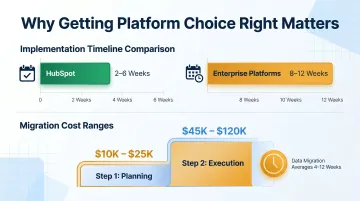
Implementation speed is a real cost for early-stage teams. HubSpot CRM implementations typically take 2-6 weeks for SMBs, while enterprise platforms can require 8-12 weeks or more.
The financial stakes are just as significant. CRM migration costs for small businesses range from $10K-$25K for planning to $45K-$120K for execution, with data migration averaging 4-12 weeks. Getting the platform choice right the first time protects both runway and time.
These costs are also why the wrong initial choice is so damaging. The most common mistakes buyers make when evaluating RevOps tools:
Common mistakes buyers make:
- Over-indexing on enterprise features that won't be used for years (complex CPQ, multi-org hierarchy forecasting)
- Choosing tools that serve only one function when the collaboration goal requires shared visibility across teams
- Ignoring implementation time and switching costs — a serious risk when you're a 10-person team burning runway
Conclusion
In 2026, the best RevOps platforms do more than boost individual rep output — they coordinate sales, marketing, and customer success teams into a single revenue engine. The right platform depends on your team's current size, existing tools, and where your collaboration gaps are most costly.
Evaluate each option on integration fit, collaboration depth, and implementation simplicity. Here's a quick summary:
- HubSpot — lowest-risk entry point with transparent pricing and fast setup
- Clari + Salesloft (merged) — powerful forecasting and engagement for structured sales teams
- Gong — best when conversation intelligence needs to inform all revenue functions
- 6sense — strong for account-based alignment, but requires dedicated operational support
Choosing the right platform gets you halfway there. The other half is having experienced people who know how to execute inside it. For early-stage B2B SaaS founders building their revenue motion for the first time, Activated Scale connects you with vetted, US-based fractional sales professionals who can plug into your RevOps stack from day one — so you get real execution alongside the infrastructure you've built, without the commitment of a full-time hire.
Frequently Asked Questions
What are RevOps systems?
RevOps systems are software platforms that unify sales, marketing, and customer success operations around shared data, automated workflows, and centralized reporting. They help revenue teams eliminate silos and make data-driven decisions across the entire customer lifecycle.
What is the end-to-end revenue cycle?
The end-to-end revenue cycle covers every stage from initial lead generation and prospecting through sales engagement, deal closing, customer onboarding, and renewal or expansion. RevOps platforms give all teams visibility into this full cycle rather than just isolated stages.
Which CRM software is best for sales teams?
The best CRM depends on team size and stack complexity. HubSpot is widely recommended for early-stage and mid-market B2B teams for its ease of use and built-in sales, marketing, and CS tools. Salesforce suits larger organizations with more complex pipeline and reporting needs.
What tools do sales teams use?
Sales teams typically rely on four core categories: a CRM (like HubSpot or Salesforce) for pipeline management, sales engagement platforms like Salesloft or Outreach for outreach cadences, conversation intelligence tools like Gong for call analysis, and forecasting platforms like Clari. In a mature RevOps setup, these tools share data through a centralized stack rather than operating in isolation.
What is the most effective way to align marketing efforts with sales?
Alignment works best when both teams operate from the same account-level data and pipeline visibility. Tools like 6sense for intent data, HubSpot for shared CRM, and Clari for pipeline forecasting give both functions a common view of which accounts to prioritize — and when to hand off.