Introduction
Most B2B SaaS startups don't fail because they built the wrong product. They stall because they lack a structured, scalable sales pipeline. Research shows that 73% of B2B startups hit a wall between $500K and $1M ARR, with sales process breakdown as the primary cause.
For Seed to Series A companies, this pressure peaks fast: founders are simultaneously building product, managing customer success, and trying to close deals—all without dedicated sales infrastructure.
The result? Close rates collapse from approximately 40% under founder-led sales to just 15% when the first sales hire operates without a documented process. Every month without a structured pipeline delays revenue, increases burn, and makes future fundraising harder.
Sales consultancy, particularly fractional and embedded models, has emerged as the fastest path to pipeline scale for early-stage companies. This guide answers three core questions: what modern sales consultancy actually does, how it builds your pipeline stage by stage, and how to choose the right model for your growth stage.
TLDR:
- Sales consultancy builds repeatable pipeline systems: ICP definition, outreach execution, and KPI frameworks
- Companies with formal sales processes achieve 18% higher revenue growth and 15% better win rates than those without
- Fractional sales talent delivers immediate pipeline impact without the $240K risk of a bad full-time hire
- Structured pipelines shorten sales cycles, sharpen forecast accuracy, and remove dependence on individual "superstar" reps
Why Early-Stage B2B Companies Struggle to Scale Sales Pipelines Alone
Founders face a brutal time allocation problem. Sam Corcos, CEO of Levels, tracked every 15-minute block of his time over two years and found he spent 10% of his total work hours—811 hours—on sales and marketing activities. That's time pulled away from product development, fundraising, and strategic planning—yet most founders have no choice but to own sales until they hit critical mass.
The internal bandwidth constraint creates a cascade of problems:
- Undefined ICP and qualification frameworks — Without clear targeting criteria, early teams chase low-quality leads that consume sales cycles but rarely convert
- Activity without pipeline impact — Founders generate meetings and demos but lack the systematic follow-up, stage progression, and nurture workflows that convert interest into revenue
- No measurable feedback loops — Without KPIs tracking conversion rates at each pipeline stage, teams can't identify where deals stall or what messaging drives progress
This isn't a people failure. It's a systems failure. M Accelerator's analysis of 500+ B2B founders found close rates plummeting from 42% to as low as 8% when founders hand off sales to their first hire without documented process infrastructure.
That close-rate collapse has real downstream consequences. Every month without a structured pipeline:
- Delays ARR milestones that unlock the next funding round
- Forces the company to burn through runway faster than planned
- Creates process debt that becomes harder to unwind as headcount grows
Companies with formal sales processes generate 18% higher revenue growth than those operating informally. For early-stage teams still building that infrastructure, external sales expertise closes the gap faster than hiring alone.
What Sales Consultancy Does to Scale Your B2B Pipeline
Modern B2B sales consultancy goes well beyond handing you a strategy deck. Today's consultants design processes, define ICPs, build outreach systems, and provide ongoing execution support. Pure strategy consultants deliver frameworks; embedded or fractional sales operators run the pipeline alongside your team and deliver measurable results.
Ideal Customer Profile and Targeting
A sales consultant's first job is tightening your ICP definition. Broad targeting forces reps to waste cycles on unqualified accounts that look promising but never convert. Effective ICP work identifies the firmographic, technographic, and behavioral signals that predict high conversion:
- Firmographic signals — Company size, revenue range, funding stage, geographic location
- Technographic signals — Current technology stack, integration needs, buying platform preferences
- Behavioral signals — Content engagement patterns, product usage indicators, website visit frequency
Poorly defined ICPs push sales teams toward volume over quality, inflating pipeline with noise that demoralizes reps and distorts forecasts.
Sales Process and Playbook Development
Without a defined playbook, rep performance varies by personality rather than process. A consultant-built playbook removes that variability and gives every rep a repeatable path to close. Typical components include:
- Qualification criteria — Frameworks like BANT (Budget, Authority, Need, Timing) or MEDDIC (Metrics, Economic Buyer, Decision Criteria, Decision Process, Identify Pain, Champion) that standardize how reps assess fit
- Outreach sequences — Multi-touch cadences for email, LinkedIn, and phone that define messaging, timing, and follow-up intervals
- Objection handling scripts — Pre-built responses to common blockers, tested and refined based on win/loss data
- Stage-exit criteria — Clear definitions of what must happen before a deal advances (e.g., discovery call complete = decision-maker confirmed + pain validated + budget range discussed)
- Follow-up cadences — Automated reminders and task triggers that prevent deals from going dark
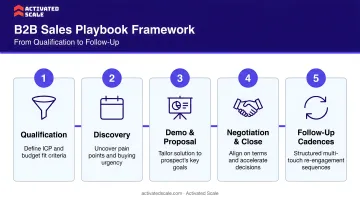
The result: new reps ramp faster, and quota attainment stops depending on who the rep is.
Pipeline Metrics and KPI Frameworks
Measurement is where most early-stage sales teams have blind spots. Consultants implement tracking systems that surface:
- Pipeline velocity — Speed of deal movement through each stage, flagging bottlenecks before they stall revenue
- Stage-to-stage conversion rates — Where leads drop off between discovery, demo, proposal, and close
- Average deal size — Helps forecast revenue and identify upsell opportunities
- Sales cycle length — Time from first contact to closed-won, segmented by deal type or segment
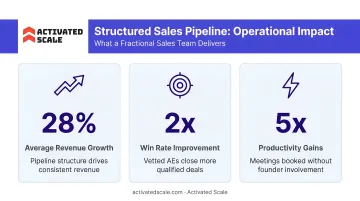
Without these metrics, companies cannot identify where deals stall or forecast revenue accurately. Companies that master formal sales processes, CRM utilization, and sales management training achieve 28% higher revenue growth than those without structured reporting.
The trust gap is real: only 35% of sales professionals trust the accuracy of their pipeline data, and over 72% of sales organizations report forecast accuracy below 80%. Consultants close this gap by establishing data hygiene standards, stage definitions, and reporting cadences that create reliable, audit-ready visibility.
Sales and Marketing Alignment
Pipeline metrics only tell part of the story. The other half is what happens upstream — where marketing hands off to sales. The typical friction points include:
- Marketing and sales disagree on lead quality — marketing says they hit MQL targets; sales says the leads don't convert
- Messaging gaps where campaign promises don't match what reps say on discovery calls
- No agreed definitions for what qualifies a lead or when the handoff to sales should happen
A consultant establishes shared KPIs, handoff protocols, and feedback loops between both teams. This includes:
- Agreed-upon MQL and SQL definitions
- Service-level agreements (SLAs) for response times
- Regular pipeline review meetings where both teams evaluate lead quality and conversion data
- Closed-loop reporting that shows marketing which campaigns drive pipeline and revenue
When both teams operate from the same definitions and data, pipeline quality improves — and reps spend time on accounts that are actually ready to buy.
How a Sales Consultant Structures Your B2B Pipeline: Stage by Stage
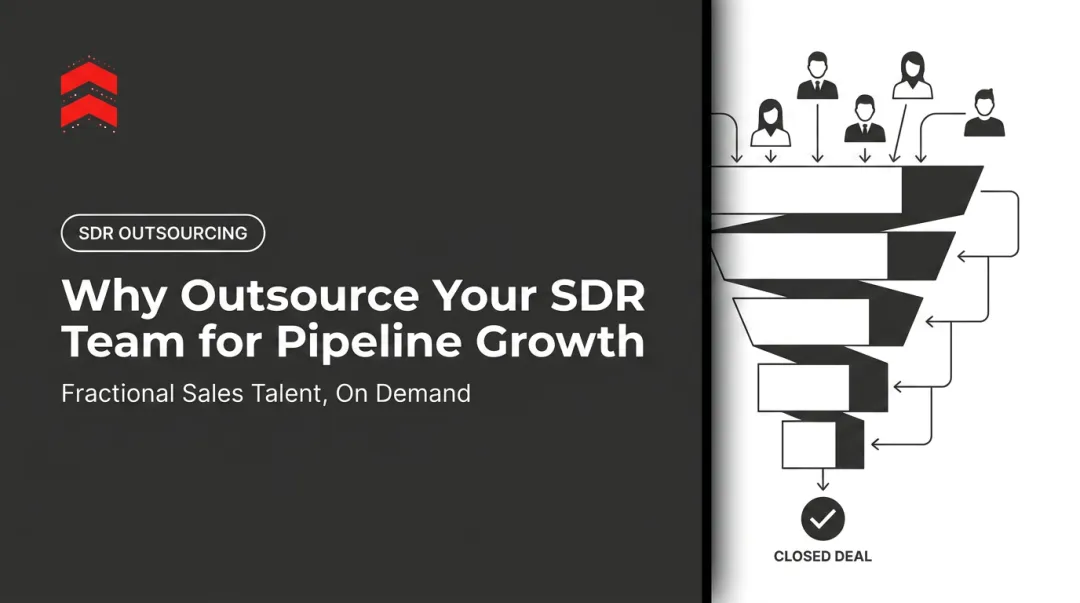
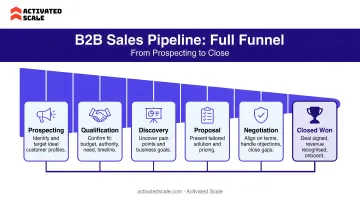
A structured pipeline functions like a staircase: each stage has clear entry criteria, exit criteria, and assigned actions. Poorly defined stages create confusion, kill momentum, and make automation impossible. Many startups operate with vague stages like "Contacted," "Interested," and "Proposal Sent"—labels that don't clarify what happened, what comes next, or why deals stall.
Here's how a consultant replaces that ambiguity, stage by stage.
Top-of-Funnel Stages
Early pipeline stages a consultant designs typically include:
- Prospecting/List Building: Identify target accounts matching ICP criteria; build contact lists with decision-maker information
- Initial Outreach (Contacting): First email, call, or LinkedIn message sent; triggers automated follow-up sequence
- Engagement Confirmation: Prospect responds with interest (replies to email, accepts meeting invite, engages on social)
- ICP Qualification: Rep confirms prospect meets minimum qualification criteria (budget range, authority, need, timing)
Many startups skip these stages and push all leads directly to demo. This inflates pipeline with noise, wastes demo slots on unqualified prospects, and demoralizes reps who spend time on deals that were never real.
Middle-of-Funnel Stages
Once top-funnel filtering is in place, the middle stages confirm intent and gather what's needed to build a compelling proposal:
- Discovery Call Scheduled: Prospect agrees to exploratory conversation; calendar invite confirmed
- Discovery Complete: Rep conducts structured discovery using a framework like MEDDIC or BANT; validates pain, budget, decision process
- Solution Fit Validated: Prospect confirms your solution addresses their core pain; decision-maker engaged
- Proposal/Scope Needed: Prospect requests pricing, proposal, or statement of work
Gong Labs research found that discovery calls with 11–14 targeted questions perform best. Fewer than 11 fails to surface critical pain points; more than 15 starts to feel like an interrogation. Consultants design call frameworks that hit that range naturally.
Bottom-of-Funnel Stages
Closing stages include:
- Proposal Sent: Formal quote, pricing, or contract delivered to decision-maker
- Negotiation: Prospect negotiating terms, pricing, or scope; may involve legal or procurement review
- Verbal Close/Proposal Accepted: Prospect commits verbally; final contract pending
- Contract Signed (Won): Deal closed; revenue recognized
One stage most startups omit: long-term nurture for qualified leads not ready to buy immediately. Gong Labs data shows enterprise deals are 233% less likely to close without decision-maker involvement, and deals touching at least four contacts achieve a 58% win rate.
Consultants ensure warm prospects don't disappear. They get tagged, nurtured, and re-engaged when buying intent resurfaces.
The Measurable Impact of Sales Consultancy on B2B Revenue
Structured sales processes deliver documented business outcomes:
Revenue and Win Rate Improvements
- 18% higher revenue growth for companies with formal sales processes versus those without
- 15% higher win rates on forecasted deals
- Rebuilt qualification models can increase close rates from 18% to 34% within 90 days (benchmark close rate for B2B scale-ups is 25-30%)
Operational Efficiency Gains
The impact extends beyond top-line revenue. Structured pipelines enable:
- Higher rep productivity — Sales reps spend 28% of their week on revenue-generating activities; structured processes increase this percentage by eliminating manual forecast prep and data entry
- More targeted marketing spend — Closed-loop reporting shows which campaigns drive pipeline and revenue, allowing marketing to optimize budget allocation
- Leadership visibility — Executives gain real-time insight into what's working versus what's wasting budget, enabling faster course corrections
Scalable Growth Engine
Repeatable pipeline systems reduce dependence on a few standout performers. The playbook becomes the competitive advantage, not the person. For early-stage companies preparing for their next funding round, this distinction matters: investors consistently prioritize predictable, process-driven revenue over growth tied to one or two individuals.
Fractional Sales Talent: The Modern Approach to B2B Sales Consultancy
Fractional sales reps don't just advise—they work inside your company, run outreach, book meetings, and build pipeline as embedded team members. Early-stage B2B companies have shifted toward this model because they need execution, not slide decks.
The Core Advantage:
Fractional sales talent provides immediate access to experienced, vetted sales professionals without:
- Average time to hire is now 66 days — up from 52 days in 2021, meaning a 3-6 month gap before anyone works a deal
- Average AE OTE is $190K; VP of Sales total comp averages $334K — costs that hit before a single meeting is booked
- Ramp time has stretched to 5.7 months — a 32% slowdown from 4.3 months in 2020
- 40% of sales hires fail using traditional resume-and-interview methods, with each miss costing up to $240K in salary, ramp time, and lost deals
Activated Scale's try-before-you-buy model lets companies work with fractional reps on a contract basis, with the option to convert to full-time. You validate performance in real deals before committing headcount.
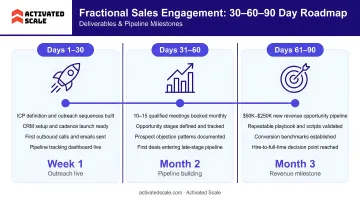
What Fractional Engagements Produce (First 30-90 Days):
- Target accounts identified, contact databases built, and outreach initiated against a validated ICP list
- Email templates, call scripts, and LinkedIn messaging tested in real buyer conversations and refined based on response data
- 10-15 qualified meetings per month booked with decision-makers (typical benchmark)
- Playbook, CRM workflows, and reporting infrastructure handed off — ready for a full-time hire or continued fractional execution
When to Use Fractional vs. Full-Time:
Fractional is ideal when:
- You're pre-product-market-fit or still validating your GTM motion
- You need to test a new market segment or buyer persona before committing to a full hire
- You're between $500K-$2M ARR and need pipeline infrastructure built before scaling the team
- Budget doesn't support a full-time salary but the pipeline work still needs to happen
Full-time hiring makes sense when:
- You've validated a repeatable sales process and need to scale it
- Deal volume and pipeline activity can support two or more full-time reps
- You're ready to invest in daily management, coaching, and long-term team development
How to Choose the Right Sales Consultancy Partner for Your B2B Pipeline
The wrong consultancy partner costs you time, budget, and pipeline momentum. Evaluate sales consultancy and fractional sales partners against these criteria before signing anything:
1. Relevant B2B/SaaS Industry Experience
Look for consultants who have sold in your buyer segment, deal size range, and sales cycle length. A consultant who built pipeline selling $10K deals to SMBs won't have the frameworks needed for $100K enterprise deals—and vice versa.
2. Proven Track Record at Similar Growth Stage
A VP of Sales who scaled a company from $50M to $200M ARR operates in a completely different context than a founder selling the first $1M. SaaStr segments SaaS companies into six ARR stages requiring different sales leadership types. Match the consultant's experience to your current stage.
3. Ability to Operate as an Executor, Not Just an Advisor
Ask: Will you build our outreach lists? Run discovery calls? Book meetings? Or will you deliver a strategy deck and exit? Execution-focused consultants deliver measurable pipeline activity, not just recommendations.
4. Transparent Reporting on Pipeline KPIs
Demand visibility into:
- Number of qualified meetings booked per month
- Lead-to-opportunity conversion rates
- Pipeline velocity and stage progression
- Average deal size and sales cycle length
Red flags include consultants who cannot name specific pipeline metrics they've moved for past clients or who charge purely for activity (calls made, emails sent) with no outcome accountability.
Once you've validated a consultant against those criteria, match their engagement model to how your team actually operates:
Engagement Models and Fit:
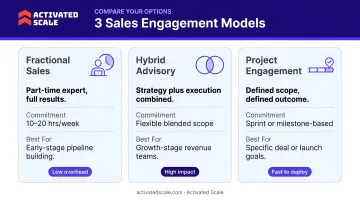
- Project-based pipeline audits and playbook builds: Best for teams that will execute internally; typically 30-60 day engagements
- Ongoing fractional sales talent: Best for companies that want reps building pipeline daily; typically 90-120 day initial engagements with month-to-month renewal
- Hybrid advisory + execution: Consultant designs the system; fractional reps execute it — useful when you need both strategic oversight and hands-on pipeline activity
Red Flags to Watch:
- Consultants who promise "instant results" without discussing ICP validation or process design
- Pricing models based solely on activity volume rather than outcomes
- No references from companies at similar ARR stages or in similar buyer segments
- Reluctance to share case studies, conversion data, or client results
Consultants who tie fees to pipeline metrics or revenue milestones are putting skin in the game. That alignment is worth more than any credential they can list on a pitch deck.
Frequently Asked Questions
What is the difference between a B2B sales consultant and a fractional sales rep?
A sales consultant typically designs strategy, defines processes, and builds playbooks—but doesn't execute daily outreach. A fractional sales rep is an embedded operator who actively builds pipeline, books meetings, and runs the sales cycle. Modern fractional sales talent platforms often combine both roles, providing strategic guidance and hands-on execution.
How quickly can sales consultancy start generating B2B pipeline results?
Most consultancy-led pipelines begin producing qualified meetings within 30-60 days. More substantial revenue impact typically appears in 60-90 days, depending on your average sales cycle length and how defined your ICP is at engagement start. Enterprise deals may close later, but pipeline itself builds within that same window.
When should a B2B startup hire a sales consultant instead of a full-time sales rep?
Consultancy is the right first move when there's no validated sales process, no defined ICP, or insufficient pipeline volume to justify a full-time hire. A consultant helps build and test the system before committing to full-time headcount. SaaStr recommends closing 10-20 customers yourself before hiring your first sales rep—consultancy helps you document what's working during that phase.
How much does B2B sales consultancy typically cost compared to full-time hiring?
Fractional VP of Sales retainers typically run $8,000-$15,000 per month—roughly 30-40% of a full-time VP's $280K-$450K total compensation. When you factor in ramp time, mis-hire risk, and vacancy costs, fractional models deliver faster ROI for most early-stage companies.
What pipeline metrics should a sales consultant help a B2B company track?
Core KPIs include: number of qualified meetings booked, pipeline velocity (time from stage to stage), lead-to-opportunity conversion rate, average deal size, and sales cycle length. Together, these metrics create forecast predictability and pinpoint exactly where pipeline is leaking—whether at top-of-funnel volume, mid-funnel qualification, or close execution.
Can sales consultancy work for companies with no existing sales team or process?
Yes—this is where consultancy (especially fractional sales talent) delivers the most value. Building from scratch with expert guidance is faster and less risky than attempting to construct a pipeline internally without sales expertise. Consultants provide the frameworks, playbooks, and execution capacity that prevent costly false starts and accelerate time to repeatable revenue.