Introduction
Enterprise sales is a minefield for startups. Unlike transactional B2B deals that close in weeks, enterprise sales involve extended timelines, 6–10+ stakeholders, and multi-department evaluation processes. Yet many early-stage founders approach these high-value deals with the same playbook they'd use for SMB accounts — then struggle to explain why opportunities stall at 60 days, champions go silent, and deals slip quarter after quarter.
Gartner research confirms that buyers spend only 17% of their purchasing time meeting with all potential suppliers combined. When evaluating three vendors, your team may get just 5–6% of the buyer's attention. That's a narrow window to earn trust across an entire buying committee.
Without a structured enterprise sales funnel, you're left guessing which prospects to prioritize, what content to send when, which stakeholders to engage, and when to push versus wait. The result: stalled pipelines and revenue that's nearly impossible to forecast.
This guide covers the structural differences of enterprise B2B funnels, the six stages of the enterprise buying journey, proven optimization strategies, and the metrics you need to diagnose and improve funnel health so you can close deals faster and more predictably.
Key Takeaways
- Most early-stage teams lose enterprise deals due to funnel gaps — not product gaps
- Enterprise funnels span 6-10+ decision-makers and 3-12 month cycles requiring multi-touch nurturing
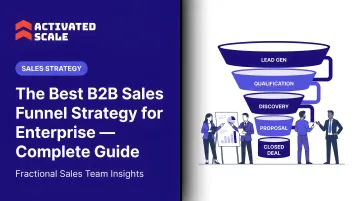
- The funnel has six stages: from Awareness through to Retention and Expansion — winning requires executing all of them
- ICP precision, multi-threaded stakeholder engagement, and stage-specific content are the core execution levers
- Monitor MQL-to-SQL conversion, opportunity-to-close rate, sales cycle length, and pipeline velocity to diagnose funnel health
Why Enterprise B2B Sales Funnels Are a Different Beast
Enterprise deals are structurally different from SMB or transactional sales. The typical B2B buying group now includes 6-10 stakeholders, according to Gartner. Challenger research shows this number has roughly doubled since 2009, growing from 5.4 people to approximately a dozen by 2024. Procurement reviews, legal approvals, and internal consensus-building mean a single champion is rarely enough to close a deal.
The Modern Enterprise Buyer Operates Independently
Today's enterprise buyers conduct extensive independent research before ever talking to a rep. According to Gartner's 2026 survey of 646 B2B buyers, 67% prefer a "rep-free" experience. They're consuming peer reviews, vendor comparisons, and analyst reports long before requesting a demo. This shift means most of your funnel work happens before a sales conversation begins — your content, brand presence, and digital footprint must do heavy lifting.
Enterprise vs. SMB: Fundamentally Different Sales Motions
The contrast with SMB or mid-market funnels is stark:
| Segment | ACV Range | Typical Cycle Length | Stakeholders |
|---|---|---|---|
| SMB | <$15K | 14-30 days | 1-2 decision-makers |
| Mid-Market | $15K-$50K | 30-60 days | 2-3 stakeholders |
| Upper Mid-Market | $50K-$100K | 60-90 days | Security/legal/budget review |
| Enterprise | >$100K | 90-180+ days | Committee decisions, RFP processes |
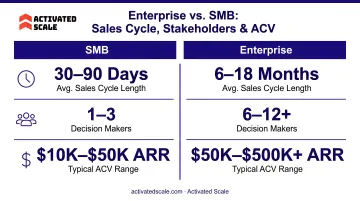
According to Optifai's 2026 pipeline study of 939 B2B SaaS companies, the median B2B SaaS sales cycle is now 84 days, and cycles have lengthened 22% since 2022. Salesforce's State of Sales report found that 57% of sales professionals say cycles are getting longer.
Teams that treat enterprise deals like transactional SMB sales consistently underperform — not because they lack effort, but because the playbook is wrong. The strategies that close a $10K deal in three weeks actively work against you at the $150K, six-month level.
The 6 Stages of an Enterprise B2B Sales Funnel
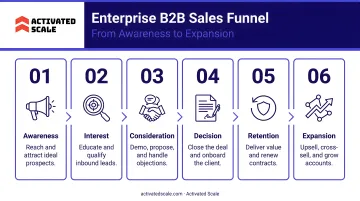
Funnel models vary by company, but the six stages below reflect how enterprise deals actually move — from a buyer's first search to post-sale expansion. Each stage maps both the buyer's mindset and what sellers need to do to advance the deal.
Awareness
Buyer Mindset: Enterprise buyers at this stage are identifying a problem or seeking better outcomes. They're researching symptoms, exploring potential solutions, and determining whether the pain point warrants action.
Seller's Role:
- Be discoverable and credible through SEO content, LinkedIn thought leadership, industry events, and analyst coverage
- Publish educational content that addresses pain points without pushing product features
- Build brand presence so you appear on initial research lists
The goal here is education, not selling. Your job is to surface when buyers search for solutions related to their challenge.
Interest
Buyer Mindset: Buyers actively research solutions and self-qualify vendors. They're downloading resources, attending webinars, and visiting pricing pages to understand feasibility.
Seller's Role:
- Use lead magnets (industry reports, ROI calculators, webinars) to capture intent signals
- Track engagement signals: content downloads, pricing page visits, repeat site visits
- Identify high-value prospects before reaching out
- Time initial outreach based on behavioral triggers, not arbitrary cadences
At this stage, you're qualifying accounts based on their digital footprint before any human contact.
Consideration
Buyer Mindset: Buyers are now evaluating 3-5 vendors. 6sense research found that buyers evaluate an average of 5.1 vendors, with 3.6 spots on the shortlist filled on "Day One" of the buying journey. 95% of the time, the winning vendor is already on that Day One shortlist.
To make that shortlist, sellers need to:
- Provide comparison content that positions your solution against competitors
- Share case studies with measurable outcomes for similar companies
- Develop ROI-focused collateral that addresses committee-level objections
- Align sales and marketing so reps have ready-made content at hand
Forrester's 2025 survey confirmed that 68% of buyers already have a front-runner vendor at the start, and that front-runner wins 80% of the time. If you're not on the initial shortlist, the numbers are not in your favor.
Evaluation
Buyer Mindset: The buying committee expands. Technical evaluators ask deep product questions. Security teams request documentation. Finance reviews pricing models. IT assesses integration requirements.
At this stage, deals stall when sellers rely on a single internal champion. Instead:
- Map all stakeholders through discovery — not just your primary contact
- Customize demos to specific use cases for each role (technical, financial, operational)
- Build relationships across multiple stakeholders simultaneously (multi-threading)
- Provide technical documentation, security questionnaires, and compliance certificates proactively
Landbase's 2026 analysis found that single-threaded deals close at half the rate of multi-threaded ones. For enterprise deals above $200K, target 7-10 engaged contacts across at least three different roles.
Decision
Buyer Mindset: Final negotiations, legal review, executive sign-off, and procurement processes. Internal stakeholders are building business cases for leadership approval.
Your job here is momentum. Keep it moving by:
- Providing clear implementation timelines to reduce friction
- Supplying business case templates for internal presentations
- Facilitating executive-to-executive alignment (your VP to their VP)
- Handling objections proactively before they become deal-breakers
- Staying engaged with procurement to address contract terms quickly
Challenger research shows that 38% of customer purchase attempts end in "no decision" — the buyer quits the process before deciding to change anything. Your job at this stage is to prevent deal stalls by maintaining momentum and removing obstacles.
Retention and Expansion
Buyer Mindset: Post-purchase, the focus shifts to implementation success, adoption, and ROI realization. Decision-makers evaluate whether the solution delivers on promises.
Post-sale execution determines whether the account renews, expands, or churns. That means:
- Executing a structured handoff between sales and customer success
- Running regular business reviews to track value delivery
- Surfacing upsell and cross-sell opportunities based on actual usage patterns
- Addressing issues before they escalate into churn conversations
The funnel doesn't end at close. Enterprise accounts with strong post-sale programs generate renewal and expansion revenue that compounds — often exceeding the value of the original deal. For startups building these relationships for the first time, Activated Scale's fractional Account Executives bring the enterprise relationship management experience that early-stage teams typically lack.
5 Proven Strategies to Build and Optimize Your Enterprise Sales Funnel
Strategy 1 — Start with a Precise Ideal Customer Profile (ICP)
Enterprise funnels fail most often because teams target too broadly. Without a tight ICP, reps waste cycles on accounts that will never close or take 18 months to decide.
How to Define an ICP:
- Use firmographic filters: industry verticals, company size (employee count and revenue), tech stack signals, and buying triggers (funding events, leadership changes, compliance deadlines)
- Map decision-maker roles: identify who initiates the purchase, who evaluates vendors, who controls budget, and who signs contracts
- Prioritize accounts where your solution delivers measurable ROI quickly
The impact is measurable. HubSpot research cited by CXL found that companies with a clearly defined ICP see 36% higher conversion rates and 68% higher ROI than broad targeting. RAIN Group data shows top performers with tight targeting convert 52 out of every 100 contacts into meetings — compared to just 19 for everyone else.
Strategy 2 — Build Multi-Threaded Stakeholder Engagement
Relying on a single internal champion is a deal-risk. Champions change jobs, lose influence, or fail to secure internal buy-in. Multi-threading means systematically identifying and engaging 3-4 stakeholders across different functions.
How to Multi-Thread Effectively:
- Map the buying committee early: operations, finance, IT, legal, and executive leadership
- Tailor messaging to each stakeholder's goals and concerns — what IT cares about (integration, security) differs from what finance cares about (ROI, contract terms)
- Build relationships across roles to create internal consensus before the final decision
For deals with $200K+ ACV, Landbase recommends targeting 7-10 engaged contacts representing at least three different roles. ZoomInfo and MongoDB's 2026 case study showed that implementing data-driven multi-threading tools resulted in a 30% reduction in sales cycles and 25% growth in revenue.
Strategy 3 — Map and Execute Stage-Specific Content
Matching content to funnel stage directly affects deal velocity in enterprise selling. Sending a case study during Awareness or a thought leadership blog during Evaluation misses the mark.
Content Mapping Framework:
- Top of funnel (Awareness/Interest): Educational blog posts, industry research reports, webinars, problem-focused guides
- Mid-funnel (Consideration): Comparison guides, ROI calculators, vendor evaluation checklists, product overview decks
- Bottom of funnel (Evaluation/Decision): Customer case studies with metrics, security documentation, reference calls, business case templates
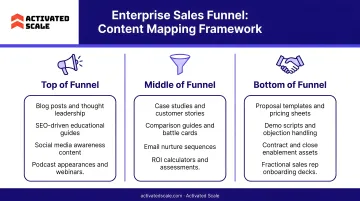
Teams with well-organized content libraries move deals faster because reps can respond to stakeholder questions immediately rather than creating materials under pressure.
Strategy 4 — Automate Nurturing Without Losing Personalization
Enterprise prospects rarely convert in a single cycle. Deals stall due to budget freezes, stakeholder changes, or competing priorities. RAIN Group found that 75% of outbound leads are long-term and require ongoing nurturing, with an average of 8 touchpoints needed to secure an initial meeting.
How to Automate Nurturing:
- Trigger sequences based on behavior signals: email opens, page revisits, content downloads, or prolonged inactivity
- Maintain engagement without requiring manual follow-up for every account
- Keep nurture messages insight-driven, not promotional — share industry trends, new research, or relevant case studies
Automation handles cadence; experienced reps handle judgment. Fractional enterprise AEs from Activated Scale are built for exactly this — managing the high-stakes human touchpoints that automated sequences can't replace.
Strategy 5 — Run Regular Funnel Analysis and Close the Leaks
Funnel optimization requires consistent monthly attention, not a single audit. Regular reviews surface which stage has the worst drop-off — and why.
How to Diagnose Stage-Specific Conversion Problems:
- Low SQL-to-Opportunity rates usually point to weak qualification criteria or unreliable lead scoring
- Low Opportunity-to-Close rates often trace back to poor demos, gaps in competitive positioning, or under-threaded buying committees
- Extended time-in-stage signals where deals are stalling — typically unengaged stakeholders or an unanswered objection
Track where deals get stuck and implement targeted interventions: add new content for a specific objection, improve demo structure, or increase stakeholder outreach.
Key Metrics to Track Enterprise Funnel Health
Sales Pipeline Velocity: The Core Formula
Sales pipeline velocity measures how quickly revenue flows through your funnel. The formula is:
Pipeline Velocity = (Number of Opportunities × Average Deal Value × Win Rate) ÷ Sales Cycle Length
This metric compounds small improvements across all four variables into significant revenue impact.
Example Calculation:
Base Scenario:
- 20 qualified opportunities
- $75,000 average deal value
- 22% win rate
- 90-day sales cycle
Pipeline Velocity = (20 × $75,000 × 0.22) ÷ 90 = $3,667/day = $110,000/month
Impact of Individual Improvements:
| Scenario | Change Made | Velocity/Month | Delta |
|---|---|---|---|
| Base | — | $110,000 | — |
| Improve win rate | 22% → 28% | $140,000 | +$30,000 (+27.3%) |
| Shorten cycle | 90 → 75 days | $132,000 | +$22,000 (+20.0%) |
| Grow pipeline | 20 → 25 opportunities | $137,500 | +$27,500 (+25.0%) |
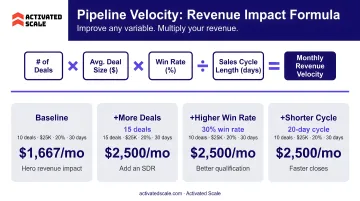
A 6-percentage-point win rate improvement (the smallest absolute change) produces the largest dollar increase. This shows why conversion optimization often delivers better ROI than simply adding more top-of-funnel leads.
Stage-by-Stage Conversion Benchmarks
Enterprise B2B funnels experience steep attrition at every stage. Here are industry benchmark ranges compiled from Winning by Design (2023), TOPO/Gartner (2019), and First Page Sage's 2026 B2B SaaS Report:
| Funnel Stage | Conversion Rate Range | What It Measures |
|---|---|---|
| Lead → MQL | 11-39% | Lead quality and initial qualification |
| MQL → SQL | 16-38% | Sales-readiness and qualification rigor |
| SQL → Opportunity | 42-59% | Discovery effectiveness and deal fit |
| Opportunity → Close | 17-37% | Sales execution and competitive positioning |
Sources: First Page Sage 2026 Report and Gradient Works' 2023 Benchmark Compilation.
Important Context: These are general benchmarks. Conversion rates vary based on how each company defines MQL, SQL, and Opportunity stages. Worth noting: pipeline generation decreased 47% in 2022 and sales cycles lengthened 32% from 2021 to 2022, compressing conversion rates across all stages.
Pipeline Coverage Ratio: Your Revenue Predictability Signal
Pipeline coverage ratio measures whether you have enough active opportunities to reliably hit revenue targets.
Formula: Pipeline Coverage Ratio = Total Pipeline Value ÷ Revenue Target
HubSpot states that most successful sales organizations maintain a coverage ratio of 3:1 to 5:1. At enterprise win rates around 20%, you need 4-5x coverage to account for deal losses and slippage.
Example:
- $500,000 in pipeline opportunities
- $100,000 quarterly revenue target
- Coverage ratio: 5:1 (healthy)
Interpretation:
- Below 3:1: Insufficient prospecting or unrealistic targets
- 3:1 to 5:1: Healthy range for most organizations
- Above 8:1: Poor lead qualification or inflated pipeline metrics
Enterprise-specific dynamics (longer cycles, higher complexity) require higher coverage ratios than SMB funnels to account for extended deal progression and potential losses.
Time-in-Stage Tracking: Where Deals Stall
Coverage ratios tell you how much pipeline you have — time-in-stage tracking tells you whether that pipeline is actually moving. Monitoring how long deals sit at each stage reveals exactly where momentum breaks down.
Common Stall Points:
- Consideration stage: Competitor enters the evaluation, requiring new competitive positioning
- Evaluation stage: Champion loses influence or leaves the company
- Decision stage: Budget freeze or leadership change
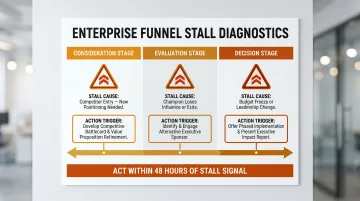
When a deal exceeds the average time for its stage, that's the trigger — not a quarterly review. Reps who act on stall signals within 48 hours are far more likely to re-engage the buying committee before a competitor fills the vacuum.
Conclusion
Enterprise sales funnels are complex by design — they reflect the reality of how organizations actually buy. Teams that invest in structuring their funnel, aligning content to buyer stages, and tracking the right metrics close more deals. More importantly, they close them faster and with far more predictability.
Building an enterprise funnel without the right sales expertise is one of the most common growth bottlenecks for early-stage B2B companies. Activated Scale helps B2B SaaS startups access vetted, US-based fractional sales professionals with enterprise experience, including Account Executives who have sold to companies like Datadog, IBM, and Salesforce.
With the try-before-you-buy model, founders can execute the strategies in this guide without waiting months to hire a full-time rep or risking a bad hire.
If this guide mapped out the strategy, the next step is having the right people to run it. Explore how Activated Scale can help you book qualified meetings, close your first enterprise deals faster, and de-risk your sales hiring with experienced fractional talent.
Frequently Asked Questions
What makes an enterprise B2B sales funnel different from a standard B2B funnel?
Enterprise funnels involve larger buying committees (typically 6-10+ stakeholders), longer sales cycles (often 3-12 months), and multi-department evaluation processes. Compared to SMB or mid-market funnels, they require far more multi-touch nurturing and stage-specific content to move deals forward.
How long does a typical enterprise B2B sales cycle take?
Enterprise sales cycles typically range from 3-12 months, depending on deal size, product complexity, and stakeholder count. Optifai's 2026 pipeline study found that enterprise deals above $100K ACV take 90-180+ days. Factor in that 38% of enterprise purchase attempts end in "no decision", and effective cycle times stretch even further.
What is the most important stage to optimize in an enterprise B2B sales funnel?
Optimize wherever your conversion drop-off is steepest — but for most teams, the Consideration-to-Evaluation transition is the highest-leverage target. This is where deals stall most often, as reps fail to qualify the full buying committee and lose internal momentum before evaluation even begins.
How do you manage a large enterprise buying committee during the sales process?
Multi-thread early: identify key stakeholders, map each person's goals and objections, and engage them with role-specific outreach — don't rely on a single champion to carry the deal internally. For deals above $200K, target 7-10 engaged contacts across at least three different roles.
What metrics should I track to know if my enterprise sales funnel is healthy?
Focus on the four pipeline velocity levers — SQL volume, average deal value, close rate, and sales cycle length — alongside stage-by-stage conversion rates (Lead→MQL→SQL→Opportunity→Close) to pinpoint drop-off points. A pipeline coverage ratio of 3-4x quota is the clearest forward-looking health signal.
Can a small or early-stage startup successfully sell into enterprise accounts?
Yes — but it requires a structured funnel, tight ICP discipline, and reps who have navigated enterprise buying processes before. Many founders hire fractional enterprise sales professionals through platforms like Activated Scale rather than attempting to build this motion from scratch, which cuts ramp time significantly.