Introduction
B2B technology founders and sales leaders face an unprecedented challenge in 2026: prospects now receive over 120 sales-related emails per week, and attention is fragmented across multiple channels. On top of that, buying committees for tech solutions now frequently involve 13 internal stakeholders and 9 external influencers, each with different priorities, technical fluency, and communication preferences.
Disorganized, one-off outreach no longer generates results. What separates high-performing B2B tech sales teams from those that burn through prospect lists without meaningful pipeline is a structured, multi-channel sales sequence: a repeatable system that moves prospects from cold contact to booked meeting with precision and consistency. This guide covers 12 actionable best practices — from sequence structure and timing to personalization and multi-stakeholder engagement — so you can build outreach that consistently converts in 2026.
Key Takeaways
- B2B sales sequences are structured, multi-channel touchpoint plans designed to move prospects systematically through the buying journey
- Following these 12 practices helps B2B tech teams book more meetings, shorten sales cycles, and convert cold outreach into revenue
- Effective B2B tech sequences typically require 10–14 touchpoints across email, LinkedIn, and phone, spaced over 2–4 weeks
- Startups without experienced SDRs often struggle to execute sequences consistently, turning a solid strategy into missed pipeline
What Are B2B Technology Sales Sequences (and Why 2026 Demands a New Approach)
A sales sequence is a planned, time-based series of touchpoints across multiple channels—email, phone, LinkedIn, video—that systematically moves a prospect toward a meeting or conversion. It differs from a sales cadence. The sequence is the specific playbook of steps and messages for a particular goal or audience segment; the cadence is the broader timing philosophy governing how frequently you reach out across all sequences.
B2B technology sales sequences are uniquely complex for three reasons:
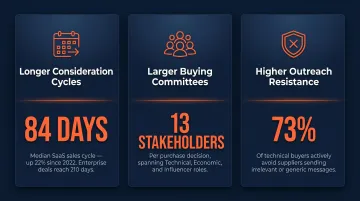
- Longer consideration cycles — The median B2B SaaS sales cycle is now 84 days, up 22% since 2022, with enterprise deals stretching to 120–210 days.
- Larger, more diverse buying committees — The typical B2B purchase now involves 13 internal stakeholders, spanning technical evaluators, economic buyers, and internal influencers.
- Higher resistance to generic outreach — 73% of technical buyers actively avoid suppliers that send irrelevant messages.
The following 12 practices reflect what top-performing B2B tech sales teams use to reach the right buyers, build credibility with technical decision-makers, and convert cold prospects into qualified meetings.
Practices 1–4: Laying the Sequence Foundation
Practice 1: Define Your ICP and Sequence Trigger Events
Every effective sequence starts with precise clarity on who you are reaching and what prompted the outreach. Your ICP (Ideal Customer Profile) should specify company size, industry vertical, tech stack, and specific pain points. But equally important is identifying the trigger event that makes your outreach timely, not templated.
Trigger events include:
- Funding announcements
- Executive job changes
- Product launches or new feature releases
- Company expansion into new markets
- Technology stack changes
Companies using trigger events see conversion rates jump by 400% compared to generic outreach. Trigger-based sequences also yield 30% shorter sales cycles and improve win rates by up to 74%. The first seller to contact a decision-maker after a trigger event is 5x more likely to win the sale.
Timing windows determine whether you capture the moment or miss it. Funding announcements and executive job changes demand outreach within 0–4 hours; product launches and new hire announcements give you a 4–24 hour window before the signal cools.
Practice 2: Research Each Prospect Before Enrollment
Before adding anyone to a sequence, invest 60 seconds in reconnaissance. Scan their LinkedIn activity for recent posts or engagement, check company news for announcements or coverage, and identify shared connections or common ground. Gather one or two specific details that make your opening touchpoint feel tailored, not templated.
Campaigns using advanced personalization achieve 18% reply rates—double the 9% average for generic templates. 81% of decision-makers engage with cold outreach when it's tailored to their company or context, yet 57% feel most sales outreach is impersonal and irrelevant.
Even 60 seconds of research moves the needle. The target is one credible, specific detail that signals you actually looked—not a 30-minute deep dive on every name in your CRM.
Practice 3: Map the Buying Committee Before Reaching Out
B2B technology purchases rarely involve a single decision-maker. The average enterprise deal includes 11–13 stakeholders, with strategic deals rising to 17 contacts. Effective sequences are designed for the committee, not the individual.
Your sequence should target three core roles:
- Technical Evaluator – Scrutinizes architecture, integration, and security
- Economic Buyer – Owns budget and assesses ROI and risk
- Influencer – Shapes internal consensus and advocates for solutions
Each role requires different messaging, different channels, and different value propositions. Build your sequence around all three from the start.
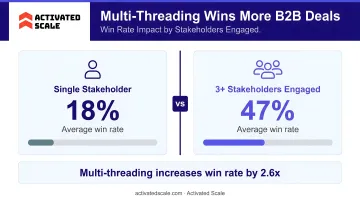
The data makes the case for multi-threading: won deals have twice as many buyer contacts as lost deals, and multi-threaded deals over $50K see a 130% increase in win rates. Yet 70% of B2B opportunities still have only one contact in the CRM—the largest untapped lever for most sales teams.
Don't contact the executive first. Reaching out to executives too early drops win rates by 6%; introducing them around the third touchpoint increases win rates by 5%.
Practice 4: Choose Your Channel Mix Based on Buyer Behavior
The recommended channel mix for B2B tech buyers in 2026 is:
- Email – Primary information delivery channel
- LinkedIn – Credibility building and social proof
- Phone – Pattern interrupt and conversion tool
Senior technical executives often respond better to LinkedIn and phone, while individual contributors lean email-heavy. Segment your sequence by communication preference before launching. Buyers average 16 interactions per person with the winning vendor across multiple channels, so multi-channel sequences aren't optional—they're expected.
Repeating the same message across channels wastes the reach. Each platform should carry a distinct angle: email for detailed value props, LinkedIn for social proof and connection, phone for directness and real-time objection handling.
Practices 5–8: Designing Multi-Channel Touchpoints That Convert
Practice 5: Lead With a Hook-First Opening Touchpoint
The first touchpoint determines whether the rest of your sequence is ever seen. The first email captures 58% of all positive replies, with engagement declining steadily after each subsequent step. Your opening must start with a specific, relevant insight—not a product introduction.
Strong opening hooks include:
- A trigger event: "I noticed your Series B announcement last week—congrats on the $15M raise."
- A data point tied to their role: "VP of Engineering at companies your size typically spend 40% of sprints on technical debt."
- A provocative question: "How are you currently managing API versioning across 12 microservices?"
Weak opening (generic product pitch): "Hi [Name], I wanted to reach out because we help B2B SaaS companies accelerate growth with our platform."
Strong opening (trigger + specific insight): "Hi [Name], saw you just joined as VP Engineering at [Company]. Most teams at your stage struggle with deployment velocity when migrating from monolith to microservices—does that resonate?"
Subject line matters just as much as the opener. 2–4 word subject lines achieve 46% open rates, and personalized subject lines boost opens by 50%. Keep first-touch emails under 75 words for executive outreach and 50–125 words for highest reply rates overall.
Practice 6: Vary Messaging and Value Across Every Touch
Each touchpoint in the sequence must introduce new value. Sending the same message across channels is just spam with extra steps.
Example sequence progression:
- Email 1 – Cold intro with relevant trigger event or insight
- Email 2 – Customer case study showing measurable results
- LinkedIn connection request – Reference shared connection or recent company news
- Email 3 – Useful content (whitepaper, benchmark report, tool)
- Phone call – Direct ask, address likely objection
- Email 4 – Direct challenge or provocative question
- Final email – Respectful breakup message
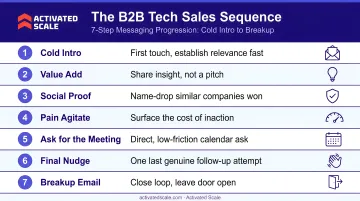
The breakup email is critical. It signals finality and often generates responses from prospects who were passively ignoring earlier touches.
Practice 7: Space Your Touchpoints Intentionally
Timing matters as much as message. A practical cadence for B2B tech sequences:
- Days 1–7: Space emails 2–3 days apart
- Days 8–14: Stretch to 4–5 days between touches
- Warm or event follow-up: Tighten to 1–2 days in week one to capitalize on recency, then stretch later touches
The most effective sequences contain 8–12 touchpoints spread over 2–4 weeks; cold outbound typically requires 10–12 steps.
80% of successful sales require 5+ follow-ups, yet 48% of reps never send a second follow-up and 44% give up after one. Most deals go to whoever stays in the conversation longest—not whoever reaches out first.
Pace matters in both directions. 44% of recipients unsubscribe due to high email frequency, and sending 4+ emails in quick succession more than triples unsubscribe and spam complaint rates. Crowding touches loses you deals just as surely as going silent does.
Practice 8: Write a Clear, Low-Friction CTA at Every Step
Ambiguous calls-to-action kill otherwise strong sequences. Each touchpoint should end with one specific, simple ask calibrated to that point in the sequence.
CTAs by sequence stage:
- Early touches – "Would it be worth a 15-minute call next Tuesday or Wednesday?"
- Mid-sequence – "Can I send you a quick 2-page overview of how we helped [similar company]?"
- Late-sequence – "Should I close your file, or would next quarter be better timing?"
Reduce the prospect's effort to say yes. Don't ask for a 60-minute discovery call in touch one, and don't request they "check their calendar and get back to you." Offer two specific times, ask a yes/no question, or propose a micro-commitment.
Practices 9–12: Personalization, Automation, and Optimization
Practice 9: Personalize at Scale Using AI-Driven Research and Signals
AI tools in 2026 can aggregate LinkedIn activity, funding news, job changes, content engagement, and intent signals to surface personalization data before enrollment. Reps no longer need to spend 30 minutes per prospect. Sellers who frequently use AI generate 77% more revenue than non-users, based on Gong's analysis of 7.1 million opportunities.
The goal is to use AI for research efficiency while keeping the human voice in the message. Fully AI-generated outreach is immediately recognizable and gets deleted. Use AI to surface personalization context—recent LinkedIn posts, company news, shared connections—then write messages that sound like they came from a human who actually read that context.
Two stats underscore why this matters:
- 83% of sales teams using AI report revenue growth
- 94% of B2B buyers now use AI in their buying process
Prospects expect relevance. AI makes relevance scalable.
Practice 10: Set Clear Exit Criteria and Breakout Logic
Sequences need defined off-ramps. Automatically pause when:
- A prospect replies (any response, positive or negative)
- Someone books a meeting
- A prospect unsubscribes or asks to be removed
- The sequence reaches its hard endpoint (10–14 touchpoints)
High-intent signals—pricing page visits, content downloads, repeat email opens—should trigger an immediate manual follow-up override. Don't let automation continue when a prospect is actively researching your solution.
Setting a hard endpoint prevents sequences from running indefinitely. When a prospect has gone cold after 10–14 touches, the sequence has done its job — move on and re-enroll in 60–90 days if intent signals resurface.
Practice 11: Track Sequence Metrics and Test Continuously
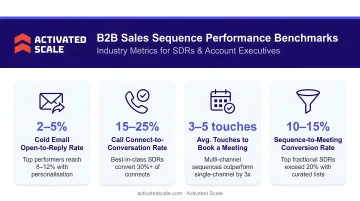
The key metrics B2B tech sales teams should track:
Positive reply rate (not just open rate)
- Platform average: 3.43%
- Solid performance: 5%+
- Excellent performance: 10%+
- Intent-led campaigns: 15–25%
Meeting-set-to-held ratio
- Benchmark show rate: 75–85%
Step-by-step drop-off
- Highest reply rate (8.4%) occurs at email 1, with performance steadily declining
- Identify where interest dies to refine messaging
LinkedIn engagement rate
- Track connection acceptance, profile views, and InMail responses
The best teams run A/B tests on one variable at a time — subject line, CTA, email length, or send timing — and measure impact on reply rates and meeting conversion. Sequences aren't set-and-forget assets; they get revised as the data comes in.
Practice 12: Pair Your Sequences with Experienced Sales Talent to Execute Them
Even the best-designed sequence underperforms without experienced execution. For B2B tech startups that don't yet have dedicated SDRs, the execution gap is often the biggest barrier to pipeline results.
The numbers explain why this is hard to solve with a full-time hire: a full-time SDR costs $110,000 to $150,000 annually, with a median ramp time of 3.2 months and average tenure of just 16 months. During ramp, expect only 30–50% productivity.
Fractional sales professionals close that gap without the commitment. Activated Scale connects B2B tech startups with vetted SDRs and AEs in 7 days or less — professionals with outbound experience at companies like Yelp, Datadog, IBM, and Udemy.
These reps bring the pattern recognition to personalize at scale, handle objections in real-time, and know when to deviate from the sequence — judgment that takes a full-time hire months to develop.
For early-stage companies without the budget or bandwidth to hire full-time SDRs, fractional talent offers a try-before-you-buy model: prove the sequence works, validate your ICP, and build pipeline without the $110K–$150K commitment.
Conclusion
Building an effective B2B technology sales sequence in 2026 requires more than volume. It demands a precise, multi-channel system built on a clear ICP, relevant personalization, and consistent iteration. The 12 practices above give founders and sales leaders the framework to cut through inbox noise, engage buying committees, and convert cold prospects into qualified meetings.
The gap between knowing best practices and executing them consistently is where most early-stage companies struggle. For B2B tech startups that lack the internal sales bandwidth to build and run these sequences, Activated Scale connects you with vetted fractional sales professionals in 7 days or less. These are experienced SDRs and AEs who hit the ground running and execute sequences built to book qualified meetings.
Frequently Asked Questions
What is the difference between a sales sequence and a sales cadence?
A sales sequence is the specific set of touchpoints and messages designed for a particular goal or audience segment (the playbook). A sales cadence is the broader timing philosophy governing how frequently outreach occurs across all sequences (the rhythm). One is tactical implementation; the other is strategic framework.
How many touchpoints should a B2B technology sales sequence have?
For cold outbound in B2B tech, 10–14 touchpoints over 18–24 days is standard. Warm leads or event follow-up sequences can be shorter (6–8 steps). Quality of each touch matters more than total volume.
What channels work best for B2B technology sales sequences?
The core three are email for information delivery, LinkedIn for credibility and social proof, and phone for pattern interruption and conversion. Adjust the channel mix based on buyer persona—senior technical executives often favor LinkedIn and phone over high-volume email, while individual contributors lean email-heavy.
How do you personalize a B2B sales sequence at scale?
AI tools can pull together prospect data—recent news, job changes, LinkedIn activity, intent signals—and bring the most relevant context to the rep before enrollment. Reps then use dynamic content blocks and segment-specific templates to tailor key message elements without manual one-by-one customization.
When should a sales sequence stop automatically?
Sequences should automatically pause when a prospect replies, books a meeting, unsubscribes, or reaches the defined maximum number of touchpoints (typically 10–14). High-intent signals like repeated pricing page visits or content downloads should trigger an immediate manual follow-up rather than continuing the automated sequence.
How do sales sequences differ for B2B technology versus other industries?
B2B tech sequences must account for multi-stakeholder buying committees (often 13+ people), longer evaluation cycles (84+ days median), and technically sophisticated buyers who won't engage with generic pitches. Messaging must address both technical pain points for evaluators and ROI/risk concerns for economic buyers, typically in separate sequence tracks.