Introduction
In seed-to-Series-A B2B SaaS startups, marketing and sales teams rarely speak the same language. Marketing chases lead volume while sales dismisses lead quality, and the revenue gap widens with every mishandled handoff. That misalignment is one of the most expensive growth blockers early-stage companies face.
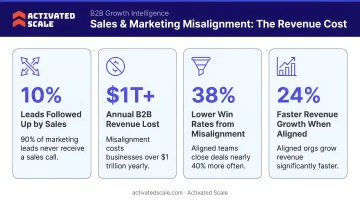
Organizations with aligned teams achieve 2.4x higher revenue growth and 2x higher profitability growth, while misaligned competitors see revenue decline by 7% year-over-year.
For fractional leaders operating within constrained timeframes and limited formal authority, fixing this requires a clear diagnosis and a repeatable process. This guide walks fractional CMOs and fractional sales leaders through a practical playbook for building real alignment — from initial audit to sustainable execution.
Key Takeaways
- Misalignment is a structural problem requiring system fixes, not just better communication
- Alignment starts before execution: agree on ICP, lead definitions, and shared KPIs first
- Key levers: behavioral lead scoring, CRM adoption, and weekly cross-functional reviews keep alignment from slipping
- The 5-step process: audit current state, align definitions, build handoff protocols, unify messaging, establish a feedback loop
- Common mistakes: skipping the audit, creating messaging without sales input, and treating alignment as a one-time project
Why Sales and Marketing Misalignment Is Especially Costly for B2B SaaS Startups
For funded startups, misalignment doesn't just waste budget — it compresses runway. When marketing spends on campaigns that sales ignores, or sales chases deals marketing hasn't nurtured, cost-per-acquisition climbs and revenue predictability collapses. Aberdeen Group documented a 39-percentage-point year-over-year revenue gap between aligned organizations (32% growth) and misaligned competitors (7% decline).
The symptoms show up fast at early-stage startups:
- Sales calls marketing leads "junk" while marketing blames sales for not following up
- Leadership can't forecast with confidence because conversion data is inconsistent
- No shared definition exists for what constitutes a "qualified lead"
- 79% of marketing leads never convert, and 73% are never even contacted by sales
The problem compounds faster at the fractional level. With limited hours and no formal authority, fractional leaders have a narrow window to course-correct. If the two teams operate from different assumptions, the engagement becomes friction management instead of growth acceleration. That's why alignment infrastructure has to come first — before strategy, before campaigns, before headcount decisions.
What Fractional Leaders Need to Establish Before Alignment Can Begin
Jumping into campaigns or pipeline fixes before foundational elements exist is why most alignment efforts fail. Three things must be in place first:
1. A shared ICP grounded in closed-won data — not marketing's aspirational targets or sales' easiest wins. Build one definition that includes firmographics, buying triggers, and decision-maker profiles.
2. A shared revenue goal with defined contributions : both teams need the total pipeline target spelled out, along with how marketing (lead volume and quality) and sales (conversion and velocity) each contribute.
3. Access to CRM and campaign data : without visibility into lead flow, conversion rates, and attribution, any diagnosis of the gap is guesswork. Assumptions about where things break down are almost always wrong.
Beyond these elements, fractional leaders need organizational buy-in from the CEO or founder. Without a clear mandate, attempts to enforce cross-functional processes meet passive resistance. Secure this buy-in in the first week by framing alignment as a revenue efficiency play, not a process project.
The cost of skipping this step is measurable: Gartner research found that 49% of Chief Sales Officers define MQLs differently than marketing does — and that gap directly impacts pipeline conversion.
One often-overlooked prerequisite: having the right sales talent in place. If the sales team is understaffed, mismatched to the ICP, or still being assembled, alignment work is premature. Activated Scale helps startups hire vetted fractional sales reps in as few as seven days — experienced professionals who can step into an active revenue motion without a lengthy ramp period.
How to Align Sales and Marketing as a Fractional Leader
Step 1: Audit the Current State of Both Teams
Start with a rapid alignment audit in the first 1-2 weeks:
- Review the existing ICP definition (or document its absence)
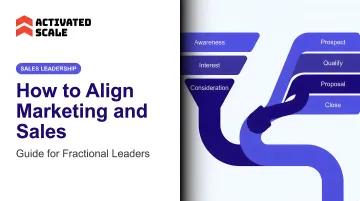
- Map lead flow from first touch to close, identifying where handoffs break down
- Pull CRM data on lead-to-opportunity and opportunity-to-close conversion rates
- Compare your client's metrics against stage-appropriate benchmarks
Early-stage B2B SaaS companies typically convert 15-25% of MQLs to SQLs and just 1-2% of MQLs to closed deals. Top performers hit 39-40% MQL-to-SQL conversion, revealing significant improvement potential.
Identify the core misalignment type:
- Messaging problem: Different stories told to the same buyer at different stages
- Process problem: No defined MQL-to-SQL handoff or response time SLA
- Metrics problem: Teams measured on different outcomes (volume vs. revenue)
Nail the diagnosis first — the right fix depends entirely on which problem you're actually solving.
Step 2: Align on Shared Definitions and Goals
Facilitate a structured working session within the first two weeks. Both teams must co-define:
- The ICP: Firmographics, buying triggers, decision-makers, and disqualification criteria
- MQL vs. SQL criteria: What constitutes a Marketing Qualified Lead versus a Sales Qualified Lead
- Shared KPIs: Metrics tied to revenue outcomes, not activity (no "emails sent" or "calls made")
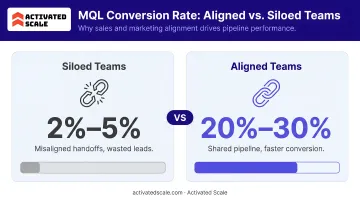
Two teams can share the same CRM and still be fundamentally misaligned if they disagree on what "qualified" means. Organizations with unified lead definitions convert 30%+ of MQLs, compared to 13% for siloed teams — a gap that directly hits pipeline velocity and revenue predictability.
Step 3: Build a Structured Lead Handoff Protocol
Create a written Service Level Agreement (SLA) between marketing and sales:
- Marketing commits to: Delivering X leads per week that meet the agreed MQL criteria
- Sales commits to: Following up within Y hours and logging outcomes in the CRM
- Escalation path: Clear process for disputes about lead quality
The response time commitment matters more than most leaders realize. Leads contacted within 5 minutes have 21x higher qualification rates than those contacted after 30 minutes, yet the average B2B SaaS response time is 42 hours. Even moving from 42 hours to same-day response creates measurable conversion lift.
Implement or configure a lead scoring model that reflects actual buying intent:
- Behavioral signals: Demo requests, pricing page visits, content engagement depth
- Firmographic match: Alignment to your ICP criteria
- Engagement recency: How recently they've interacted with your brand
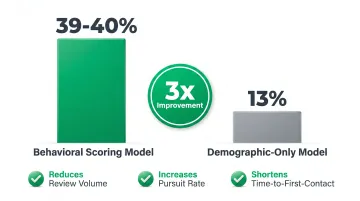
Behavioral lead scoring models achieve 39-40% MQL-to-SQL conversion compared to 13% for demographic-only approaches. Simple behavioral signals outperform firmographic-only qualification by 3x.
Step 4: Unify Messaging Across the Funnel
Closing the messaging gap between marketing content and sales conversations often produces the fastest pipeline impact. Start with a message audit:
- Pull recent sales call notes or recordings
- Extract common objections and buyer language
- Compare to what appears in marketing campaigns, website copy, and outbound sequences
67% of B2B buyers refuse to do business with vendors providing inconsistent messages, yet only 8% of companies report fully aligned narratives. This gap kills deals before they reach negotiation.
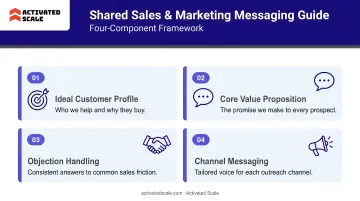
Create a shared messaging guide that includes:
- Primary value proposition and positioning
- Top 3 buyer pain points your solution addresses
- Differentiation narrative against key competitors
- Objection-handling language validated by real sales conversations
Treat it as a living document — sales contributes buyer language from the field, marketing keeps it consistent across channels.
Step 5: Install a Cross-Functional Feedback Cadence
Set up a recurring weekly or biweekly pipeline review that includes both marketing and sales leads. The agenda should cover:
- Lead quality feedback from sales on the previous period's MQLs
- Conversion rates by source and campaign
- Messaging or targeting issues surfacing in sales conversations
- Adjustments to lead scoring or qualification criteria based on closed-won analysis
This cadence converts a one-time alignment project into a sustainable operating rhythm. Organizations with weekly pipeline tracking achieve 34% revenue growth versus 11% for those with irregular tracking — and forecast accuracy improves from 52% to 87%.
Without this recurring review, teams drift back into silos within 30-60 days. The cadence creates accountability and ensures alignment doesn't regress when quarterly pressure mounts.
Key Variables That Determine Whether Alignment Sticks
ICP Clarity
A vague or assumed ICP means marketing targets a broader audience than sales can close, leading to perpetual lead quality disputes. Alignment built on a fuzzy ICP is temporary at best.
When both teams share a data-validated ICP grounded in closed-won analysis (not guesses), lead quality disputes drop, conversion rates improve, and campaign spend becomes more efficient. The ICP should answer: What firmographics predict success? Which buying triggers indicate readiness? Who are the decision-makers and influencers?
Lead Scoring Rigor
If the lead scoring model isn't calibrated to actual buying behavior, marketing hands off leads that look good on paper but go cold in sales conversations. Research what signals most reliably predict conversion in your client's pipeline and weight the model accordingly.
Companies using behavioral scoring achieve 39-40% MQL-to-SQL conversion versus 13% for demographic-only models. A well-calibrated model reduces the volume of leads sales must review, increases the percentage they pursue, and shortens time-to-first-contact for high-intent prospects.
CRM Adoption and Data Quality
Alignment requires shared visibility. If sales reps aren't logging activity, or if marketing attribution isn't connected to the CRM, neither team has an accurate picture of what's driving revenue.
Poor data quality costs organizations 15-25% of total revenue, and sales reps waste 27% of their time dealing with bad CRM data. For fractional leaders, clean CRM data enables attribution analysis, identification of which campaigns produce pipeline (not just leads), and evidence-based budget decisions.
Cadence and Accountability Structure
Alignment doesn't hold on its own — it needs structure to survive quarterly pressure. The variable that separates lasting change from a 90-day improvement that reverses is whether a structured accountability cadence was installed. That means:
- Shared KPIs reviewed by leadership, not just the revenue teams
- Scheduled cross-functional check-ins with documented outcomes
- Clear ownership for follow-through between sessions
Teams that enforce this cadence sustain conversion improvements and pipeline predictability well beyond the fractional leader's engagement. Without it, alignment regresses the moment targets get tight.
Common Mistakes Fractional Leaders Make When Driving Alignment
Four patterns consistently undermine alignment work — even when fractional leaders are doing everything else right:
Skipping the audit phase. Pressure to show quick wins pushes many fractional leaders straight to campaign changes or process fixes before diagnosing the root cause. The result: surface-level improvements that don't hold, and more friction when they don't.
Messaging without sales input. Marketing-led frameworks that ignore actual sales conversation data produce polished content that sounds nothing like the real buying journey. 65% of sales reps can't find content to send prospects, and 60–70% of B2B content goes unused because sales finds the topics irrelevant. Include reps in the messaging audit — not just the marketing team.
Misaligned metrics that stay misaligned too long. When marketing owns MQL volume and sales owns closed revenue, the incentive structures actively work against each other. Push for shared revenue-contribution metrics early — even imperfect ones — to create genuine accountability across both teams.
Treating alignment as a deliverable, not an operating system. The failure mode that kills alignment long-term: a fractional leader builds a framework, presents it to leadership, and considers the job done. Without embedding feedback cadences and shared reporting into the company's rhythm, alignment deteriorates within weeks of the engagement scaling back.
Conclusion
Marketing and sales alignment functions as an operating system — not a communication fix or a one-time project. For fractional leaders working within constrained timeframes and limited authority, the highest-leverage approach focuses on foundational variables first:
- Shared ICP that both teams have agreed to and can act on
- Clear lead definitions (MQL, SQL) with documented handoff criteria
- Structured handoff protocols that eliminate dropped context between teams
- Recurring feedback cadence so both sides stay calibrated over time
The fractional model is well-suited to driving this kind of alignment. Fractional leaders bring objectivity, cross-industry pattern recognition, and no organizational politics — which makes them unusually effective at getting both teams to agree on the basics.
The startups that get the most from fractional leadership give those leaders the mandate and access to build alignment infrastructure, not just run campaigns or fill quotas. When alignment becomes embedded in how the company operates — not just what revenue teams discuss — it outlasts any single engagement and keeps compounding long after the fractional leader moves on.
Frequently Asked Questions
What is the 3-3-3 rule in marketing?
The 3-3-3 rule is a framework for breaking marketing planning into three timeframes (short, medium, long-term), three priority channels, and three key performance indicators. Fractional leaders apply it during new engagements to sequence priorities across 30-, 90-, and 180-day horizons.
What is the 2-2-2 rule in sales?
The 2-2-2 rule is a follow-up cadence principle: contact prospects two days after a meeting, two weeks later, and two months after. This cadence gives marketing a clear framework for building nurture content that reinforces what sales is saying at each touchpoint.
What are the P's used in sales and marketing?
The classic marketing mix includes Product, Price, Place, and Promotion (the "4 P's"). Fractional leaders use it as a diagnostic tool to confirm both teams share consistent assumptions about positioning, pricing, and promotional messaging.
How long does it take for a fractional leader to align sales and marketing?
Initial structural alignment (shared ICP, lead definitions, handoff protocol) can be established in 30-60 days. However, lasting behavioral change and measurable revenue impact typically emerge over a 90-180 day engagement period, as teams adopt new processes and conversion data validates the changes.
What metrics should be used to measure sales and marketing alignment?
The most meaningful shared metrics are lead-to-opportunity conversion rate, MQL-to-SQL conversion rate, pipeline contribution by channel, and average sales cycle length. These replace activity metrics like lead volume or call counts as the indicators of true alignment and should be reviewed weekly by both teams.
What is the difference between a fractional CMO and a fractional sales leader when it comes to driving alignment?
A fractional CMO owns the demand generation strategy and marketing-side processes, while a fractional sales leader owns the pipeline, conversion process, and sales team execution. The most effective alignment happens when both fractional roles are in place and working toward shared revenue goals, creating accountability on both sides of the handoff.