Introduction
84% of B2B sales reps missed quota last year — not because they lacked tools, but despite having too many. The average seller juggles 8 different platforms while the average sales cycle still drags on for 4.6 months.
Adding more software isn't the answer. 57% of sales professionals say cycles are getting longer, even as the tool stack keeps growing.
The real gap is execution. Most founders invest in sales acceleration platforms without pairing them with the right strategy or experienced operators to run them. This guide covers the top sales acceleration tools for B2B companies and the strategies that actually turn those tools into revenue.
Key Takeaways
- Sales acceleration tools automate prospecting, outreach, and pipeline management to shorten B2B sales cycles
- Five tool categories matter most: CRM, lead intelligence, sales engagement, conversation intelligence, and outreach automation
- Strongest options by category include HubSpot, Apollo.io, LinkedIn Sales Navigator, Gong.io, and Outreach
- The right tools plus experienced sales talent produce faster results than either alone
What Are Sales Acceleration Tools — and Why B2B Companies Need Them
Sales acceleration is the process of using software, automation, and data to move buyers through the pipeline faster and eliminate manual bottlenecks. Unlike a CRM, which stores customer data, acceleration tools act on that data to drive deals forward through automated sequences, lead scoring, and behavior-based follow-up.
B2B companies face unique challenges that make these tools essential:
- Longer sales cycles with multiple touchpoints across 4-6 months
- Complex buying committees involving 6-10 decision-makers on average
- High cost of delayed follow-up: 35-50% of sales go to the vendor that responds first
- Lost deals from poor prioritization: 89% of B2B buyers report purchase deals stalled in the past year
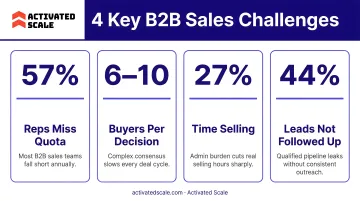
Engaging a lead within 60 seconds boosts conversion by 400%, yet most reps spend 60% of their time on non-selling tasks. For seed-to-Series A teams with lean headcount, that gap is where deals die. The tools covered below address exactly that — from prospecting automation to pipeline intelligence — so small teams can compete against larger sales organizations.
Top Sales Acceleration Tools for B2B Companies
These tools were evaluated based on startup-friendliness, integration ease, AI capabilities, pricing transparency, and relevance to outbound-heavy B2B sales motions.
HubSpot Sales Hub
HubSpot Sales Hub is an all-in-one CRM and sales automation platform well-suited to B2B startups building their first structured sales process. Its free tier and scalable paid plans make it accessible for early-stage teams, and it often serves as the CRM backbone that other tools integrate with.
Key differentiators include unified pipeline tracking, email sequences, deal stage automation, guided selling insights, and strong integrations with marketing tools. HubSpot has 228,000+ customers globally with a G2 rating of 4.4/5 from over 12,000 reviews.
| Best For | Key Features | Pricing |
|---|---|---|
| Teams building their first CRM-driven sales process; startups scaling from founder-led to team-led sales | Pipeline management, email sequences, AI-guided selling, meeting scheduler, reporting dashboards | Free tier available; paid plans start at $20/seat/month (Starter) up to $150/seat/month (Enterprise) |
Apollo.io
Apollo.io is an end-to-end prospecting and outreach platform that combines a large B2B contact database (275 million contacts and 73 million companies) with sequencing, lead scoring, and AI-powered personalization.
It's a strong single tool for early-stage teams that need prospecting and outreach in one place. The combination of intent data, data enrichment, pipeline builder, and AI call assistant in one platform—at a price point well below enterprise alternatives like Salesloft or ZoomInfo—makes it unusually complete for its cost.
| Best For | Key Features | Pricing |
|---|---|---|
| Startups needing prospecting + outreach in a single, budget-friendly platform | B2B contact database, AI lead scoring, email sequencing, call recording, data enrichment | Free tier available; paid plans from $59/user/month (Basic) to $149/user/month (Organization) |
LinkedIn Sales Navigator
LinkedIn Sales Navigator is the go-to tool for identifying and engaging decision-makers at target accounts, particularly valuable for B2B companies selling to mid-market or enterprise buyers where stakeholder mapping matters.
Real-time company signals (job changes, funding news), advanced search filters to surface ICP-aligned buyers, and InMail access to reach contacts outside your network are its core strengths. A Forrester TEI study found that Sales Navigator delivers 312% ROI over 3 years with a payback period of less than 6 months, and users achieve 22% higher win rates when engaging with buyers showing intent.
| Best For | Key Features | Pricing |
|---|---|---|
| SDRs and AEs targeting specific personas or accounts on LinkedIn before cold outreach | Advanced lead and account filters, real-time alerts, InMail messaging, CRM sync, stakeholder mapping | Core: $119.99/month ($89.99/month annually); Advanced: $159.99/month ($149.99/month annually); Advanced Plus: Custom pricing |
Outreach
Outreach is a sales execution platform designed for teams running structured multi-channel outreach sequences across email, phone, and social—built for SDR teams managing high-volume pipelines.
The platform's differentiators are AI-driven prospecting agents, deal risk insights, mutual action plans, and conversation intelligence (Kaia) that surfaces objections and coaching moments in real time. The platform focuses on unifying sales workflows across channels rather than siloing activities by medium.
| Best For | Key Features | Pricing |
|---|---|---|
| Growing SDR teams that need sequenced multi-channel outreach with built-in deal intelligence | Sequence automation, conversation intelligence, deal risk insights, AI prospecting agent, mutual action plans | Custom pricing; median annual contract value is $44,152 based on third-party data |
Gong.io
Gong is the leading revenue intelligence platform that records and analyzes every sales interaction—calls, emails, meetings—and turns them into coaching insights, pipeline health scores, and forecast signals for sales leaders.
The platform's core value is identifying what top performers do differently, flagging at-risk deals early, and coaching reps at scale—without managers sitting through hours of call recordings. Teams using Gong Smart Trackers achieved 35% higher win rates, and organizations regularly using AI tools generate 77% more revenue per rep.
| Best For | Key Features | Pricing |
|---|---|---|
| Sales leaders and founders who want data-driven coaching and accurate revenue forecasting | Conversation intelligence, predictive forecasting, pipeline inspection, deal risk scoring, CRM sync | Custom pricing; estimated at $1,360-$1,600/user/year plus platform fees |
Instantly.ai
Instantly.ai is a cold email outreach platform built for high-volume, personalized campaigns across multiple domains—popular with B2B startups running lean outbound programs that need scale without landing in spam.
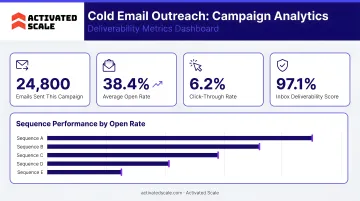
Automated domain warming, campaign analytics, website visitor identification, and AI-generated email personalization are its defining features. With a G2 rating of 4.8/5 from over 3,800 reviews, it's one of the most accessible outbound tools for early-stage teams with limited budgets.
| Best For | Key Features | Pricing |
|---|---|---|
| Founders and small sales teams running cold email campaigns at scale on a startup budget | Multi-domain email sending, domain warmup, campaign personalization, website visitor tracking, analytics | Growth: $47/month ($37.60/month annually); Hypergrowth: $97/month ($77.60/month annually); Light Speed: $358/month ($286.30/month annually) |
Key Sales Acceleration Strategies for B2B Growth
Tools generate data and efficiency—but strategy determines whether that translates into pipeline and revenue. These four core strategies compound the impact of the tools listed above.
Automate Outbound to Create Consistent Pipeline
Automating lead generation, email sequences, and follow-up cadences removes reliance on manual effort and keeps outreach running consistently without manual tracking. Automation should support personalization, not replace it—generic blasts don't accelerate sales.
How it works in practice:
- Use Apollo or Instantly.ai to build targeted sequences triggered by ICP-fit signals
- Combine automated outreach with HubSpot tasks for rep follow-up when engagement occurs
- Track engagement metrics and adjust messaging based on response rates
Impact: Most deals require 5-12 touchpoints to close. Automation ensures consistent follow-up without manual tracking.
Prioritize Leads Using Intent Data and Scoring
Not all leads deserve equal attention. Intent data—job changes, funding events, competitor research signals—helps SDRs focus time on accounts already in-market.
Tools like Apollo, LinkedIn Sales Navigator, and Gong surface these signals natively. Intent data can predict buying behavior with 60-75% accuracy when combining multiple signals with AI-powered platforms. Coordinated sales-marketing activities around high-intent accounts also drive a 48% average increase in conversion rates.
Without lead scoring and prioritization, even well-staffed teams waste cycles on low-fit prospects—a particularly expensive problem for lean B2B startups where every rep hour counts.
Use Conversation Intelligence to Coach and Replicate Wins
Tools like Gong let sales leaders identify what top-performing reps say (and when), then turn those behaviors into playbooks and coaching moments that elevate the entire team.
For early-stage companies, this strategy has an added benefit: it helps founders extract institutional knowledge from early sales wins and transfer it to new hires, reducing ramp time significantly. Teams using Gong Smart Trackers for deal execution achieved 35% higher win rates compared to teams without these insights.
Align Sales and Marketing Around Shared Pipeline Data
Disconnected sales and marketing teams create friction that slows deals. Sales chases accounts that marketing hasn't warmed, while marketing invests in content that never gets used in live conversations.
Integrating tools like HubSpot (marketing automation) with Outreach or Gong (sales execution) gives both teams a single view of what's driving engagement—so both sides can adapt faster. Businesses with sales-marketing alignment grow revenue 32% faster, while those without alignment lose over 10% of annual revenue.
How to Choose the Right Sales Acceleration Tools for Your B2B Team
The most common mistake: buying tools based on feature lists or peer recommendations without assessing fit for your current sales stage, team size, and ICP. An enterprise tool like Salesforce may be overkill for a five-person startup, while a lightweight tool may not scale past Series A.
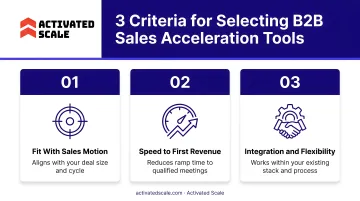
Evaluate tools using three core criteria:
- Integration with your existing CRM or data stack — Does it plug into your current infrastructure, or does it require rebuilding workflows?
- Ease of adoption given your team's current skill level — Can your reps start using it immediately, or does it require weeks of training?
- Whether it directly addresses your biggest pipeline bottleneck — Is your issue lead volume, conversion rate, or deal velocity?
Important reality: Adoption failure—not feature gaps—is what kills most tool investments. 20-70% of CRM projects fail to meet expectations due to poor user adoption, and only 49% of software features get used on average.
For B2B startups without an established sales team, platforms like Activated Scale provide vetted fractional sales professionals already fluent with these tools. Founders can activate their stack and start booking qualified meetings without the ramp time of a full-time hire.
Conclusion
The most effective sales acceleration stacks share one trait: every tool in them has a measurable job. Wrong tools, or the right tools without people who know how to use them, just add overhead.
Audit your current stack against one question: Is this tool actively shortening our sales cycle, or just adding another dashboard? Start with one category (CRM or prospecting) and build outward from there.
If the bottleneck is talent rather than tooling, Activated Scale connects founders with vetted fractional sales reps who can work these systems from day one. The try-before-you-buy model means you're not committing to a full-time hire before you know it's the right fit.
Frequently Asked Questions
What is sales acceleration in B2B sales?
B2B sales acceleration refers to using tools, automation, and data-driven strategies to move prospects through the pipeline faster, reduce manual tasks, and shorten the time from first contact to closed deal.
How are sales acceleration tools different from a CRM?
A CRM stores and organizes customer data, while sales acceleration tools act on that data: automating outreach, scoring leads, surfacing coaching insights, and triggering follow-ups to actively move deals forward.
What are the best sales acceleration tools for a small B2B startup?
Start with HubSpot (CRM and pipeline), Apollo.io (prospecting and sequences), and LinkedIn Sales Navigator (targeting) as a practical starting stack. Add conversation intelligence tools like Gong as the team scales.
How do you measure the ROI of sales acceleration tools?
Key metrics include change in average sales cycle length, pipeline conversion rate at each stage, meetings booked per rep per month, and deal velocity. Track these before and after adopting new tools to measure actual impact.
What sales acceleration strategies work best for B2B companies?
The highest-impact strategies for most B2B companies are outbound automation for pipeline consistency, intent-based lead prioritization, conversation intelligence for rep coaching, and tighter sales-marketing data alignment. Prioritize based on your biggest current bottleneck.
Can sales acceleration tools replace a dedicated sales team?
No. Tools automate and optimize the process, but cannot replace the relationship-building, objection-handling, and judgment that skilled salespeople provide. The companies that accelerate fastest pair strong tooling with experienced salespeople who know how to act on the signals those tools surface.