Introduction
Most founders know they need "a salesperson." They just don't know which one — and that confusion costs real money.
Hiring an SDR before you have an AE to close their meetings burns runway. Bringing on a VP of Sales before you've validated your sales motion wastes even more.
According to Forrester's 2024 State of Business Buying report, the average B2B purchase involves 13 stakeholders and 86% of deals stall during the buying process. That complexity requires a team built with intention, not guesswork.
This guide covers the core B2B sales roles in plain language — what each one does, how they fit together, the career path they form, and how early-stage startups can use this knowledge to hire smarter. It's written for founders, hiring managers, and anyone new to B2B sales who wants a clear map before making their first hire.
Key Takeaways
- B2B sales roles are specialized by funnel stage — prospecting, closing, and retention are separate jobs
- SDRs generate pipeline; AEs close it; CSMs/AMs protect it
- Standard B2B career progression runs SDR → AE → Manager → VP/CRO
- Hire in the right sequence — the right role at the right stage beats the most impressive title
- Fractional sales talent lets you validate a hire before committing to a full-time salary
The Core B2B Sales Roles You Need to Know
B2B sales teams divide the revenue function into distinct jobs. Some people find new business, some close it, and others make sure customers stay. Expecting one person to do all three equally well is where hiring goes wrong.
Sales Development Representative (SDR)
The SDR works at the top of the funnel. Their job is to generate pipeline for Account Executives, not to close deals themselves.
Key activities include:
- Outbound prospecting via cold email, LinkedIn, and phone
- Qualifying inbound leads against frameworks like BANT or MEDDIC
- Booking discovery calls or demos for AEs
- Handing off warm, qualified leads with context
SDRs are measured on meetings booked and pipeline generated. They are not measured on revenue — that's the AE's job.
Business Development Representative (BDR)
The BDR title is often used interchangeably with SDR — and the confusion is real. Here's the practical distinction:
- BDRs focus on purely outbound prospecting and identifying new market opportunities or partnerships
- SDRs often also handle inbound lead qualification alongside outbound work
In practice, many companies use whichever label they prefer and the responsibilities overlap significantly.
Account Executive (AE)
The AE is the closer. They inherit warm pipeline from SDRs/BDRs and own it from discovery through signature.
AE responsibilities include:
- Running discovery calls and demos
- Building proposals and handling objections
- Negotiating contracts and closing
- Owning a revenue quota
AE roles scale with deal complexity. SMB AEs work shorter cycles with smaller ACVs; enterprise AEs manage complex deals involving multiple stakeholders that can span 6–18 months. According to Bridge Group's 2024 SaaS AE benchmark report, the median annual ACV quota for a SaaS AE is $800,000.
Account Manager (AM) and Customer Success Manager (CSM)
These are the post-sale roles that protect revenue and drive growth from the existing customer base.
| Role | Primary Focus |
|---|---|
| Account Manager (AM) | Upsells, expansions, and renewals |
| Customer Success Manager (CSM) | Onboarding, adoption, and customer outcomes |
In early-stage startups, one person often covers both functions. Both roles directly impact net revenue retention (NRR) — the metric that determines whether a SaaS business grows or shrinks from its existing base.
Sales Engineer (SE) / Solutions Engineer
Sales Engineers are the technical layer of the sales process. They handle product demonstrations, proof-of-concept work, and complex technical questions during the evaluation stage.
This role is critical in SaaS and enterprise technology sales, where buyers need to validate product fit before committing. SEs work alongside AEs — they don't own quota, but they often determine whether a deal closes.
VP of Sales / Head of Sales
The VP of Sales is a leadership and strategy role. They hire, set quotas, define the sales process, and report to founders or the C-suite.
At early-stage companies, this person is often a player-coach — still carrying a bag while building the team. Most early-stage founders should hire an AE or SDR before bringing on a VP of Sales — you need pipeline and closed deals before you need someone to manage the process.
How B2B Sales Teams Are Structured
The Pod Model
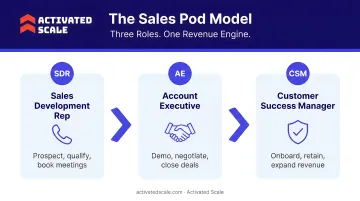
Most high-performing B2B sales teams are built around a "pod" structure: each pod contains the roles needed to cover the full revenue cycle.
A standard pod looks like this:
- SDR/BDR — generates pipeline through outbound and inbound qualification
- Account Executive — closes the pipeline
- CSM/AM — retains and expands the closed accounts
This structure puts marketing, sales, and customer success together around a shared goal: helping customers solve problems. Winning by Design benchmarks a balanced pod at roughly ½ SDR and ½ CSM per AE.
How Teams Scale by Stage
| Stage | Typical Team |
|---|---|
| Pre-seed / Seed | Founder selling (or 1 full-cycle AE) |
| Early Series A | 1-2 SDRs + 2-3 AEs |
| Series B+ | Multiple pods, SE function, sales manager layer, RevOps |
The critical mistake at each stage is hiring out of sequence. Get the order wrong and the whole machine stalls:
- SDRs without AEs generate pipeline that dies — no one closes the meetings they book
- AEs without pipeline support can't hit quota and burn out chasing cold leads on their own
- A VP of Sales hired too early will spend your runway building infrastructure that doesn't yet need to exist
Essential Skills for B2B Sales Success
Skills matter differently by role. Screening every candidate for a generic "sales personality" leads to mis-hires. Here's what actually matters by function.
Hard Skills Across Roles
- CRM proficiency — Salesforce, HubSpot; a 2021 LinkedIn study found 70% of sales professionals said CRM was very important to closing deals
- Sales engagement tools — Outreach, Apollo, Salesloft for outbound sequencing
- Sales intelligence — LinkedIn Sales Navigator, ZoomInfo for prospecting research
- Methodology knowledge — MEDDIC, Challenger Sale, SPIN Selling; Pavilion's research of 400 sales leaders found these are the most commonly studied frameworks across B2B SaaS organizations
Soft Skills by Role
| Role | Critical Soft Skills |
|---|---|
| SDR/BDR | Persistence, high activity tolerance, coachability |
| AE | Discovery questioning, strategic thinking, negotiation |
| CSM/AM | Empathy, product depth, proactive communication |
| VP of Sales | Coaching, forecasting, process-building |
Salesforce's State of Sales report found sales professionals spend 60% of their time on non-selling administrative tasks and juggle an average of 8 tools to close a single deal. That's why workflow and tool fluency belong on every job scorecard — not just selling ability.
B2B Sales Career Path: How Roles Evolve
The Standard Progression
The most common path in B2B sales runs:
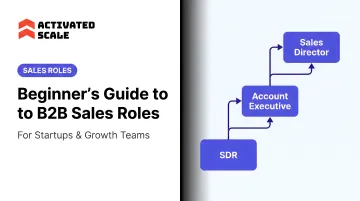
SDR/BDR → AE (SMB) → AE (Mid-Market) → Senior AE (Enterprise) → Sales Manager → Director of Sales → VP of Sales / CRO
This isn't the only path, but it's the one that produces the most consistent revenue growth. The underlying logic is that each stage builds skills the next one requires.
Compensation Across the Career Ladder
RepVue's 2024 Salary Guide gives the clearest picture of where the money sits:
| Role | Median Base | Median OTE |
|---|---|---|
| SDR | $55,000 | $83,000 |
| AE (SMB) | $68,000 | $130,000 |
| AE (Mid-Market) | $85,000 | $160,000 |
| AE (Enterprise) | $130,000 | $255,000 |
| Sales Manager | $135,000 | $250,000 |
| VP of Sales | $200,000 | $380,000 |
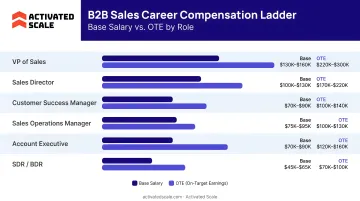
Those OTE figures come with an important caveat. RepVue's Q4 2024 Cloud Sales Index tracked 42,000 quota-carrying professionals and found overall quota attainment at 43.14%. Mid-Market AEs hit 40.2%; Enterprise AEs came in at 37.7%. OTE reflects earning potential at 100% quota — not typical take-home pay.
The SDR-to-AE Transition
The SDR-to-AE promotion is the most important milestone in the early sales career. What it typically takes:
- Consistent quota attainment over multiple quarters
- Strong pipeline quality (not just meeting volume)
- Demonstrated ability to run basic discovery calls
- Product knowledge sufficient to handle early objections
Most SDRs who earn the AE promotion do so within 12–24 months, though timelines vary by company.
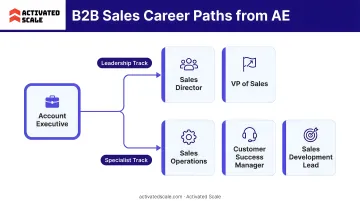
Parallel Paths Beyond AE
Not every strong AE wants to manage people. Other directions include:
- Sales Engineering — for technically-oriented AEs
- Revenue Operations — for process-oriented contributors
- Sales Enablement — for those who want to coach without managing headcount
- Partnerships/Alliances — for relationship-driven sellers
The leadership track (AE → Manager → Director → VP) requires a genuine shift in skill set. Coaching, forecasting, and building repeatable process look nothing like closing individual deals.
Great AEs don't automatically make great managers. Founders who promote solely on sales performance tend to lose a top closer and gain an ineffective manager in the same move.
How Startups Should Approach Their First B2B Sales Hire
The Most Common Mistake
Founders hire the title they admire rather than the function they need. The two most expensive mistakes:
- Hiring a VP of Sales too early — before product-market fit is clear, a VP will build process around a motion that doesn't work yet
- Hiring an SDR before you have an AE — an SDR who books 12 meetings a month is useless if no one closes them
Founder-Led Sales First
Most early-stage B2B companies should have the founder selling first. This isn't just financial pragmatism — it's how you validate your ICP, sharpen your messaging, and build the playbook that your first sales hire will execute.
When you start seeing repeatable patterns — consistent objections, consistent buyer profiles, consistent reasons deals close — that's the signal to hire someone who can run the proven play. At that point, you want a full-cycle AE or an experienced SDR/AE combo, not a VP.
What to Have in Place Before Hiring
Once you're ready to bring someone in, make sure these are in place before their first day:
- A defined ICP — who you're selling to, in specific terms (industry, company size, job title)
- A basic playbook — even a one-page document describing how deals typically progress
- A CRM set up and ready (HubSpot or Salesforce both work at this stage)
- A realistic OTE budget — SDR OTE typically starts around $83K; AE OTE from $130K+
Without these, even a strong rep will underperform. The environment fails them.
The Fractional Alternative
For startups not ready to commit to $130K+ in annual salary for a role they haven't yet proven, fractional sales talent is a lower-risk path. Rather than a full-time hire, you engage an experienced sales professional on a contract basis to validate whether the role generates results before converting to full-time.
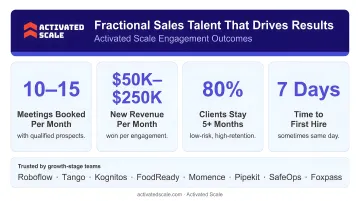
Activated Scale connects B2B SaaS startups with experienced, US-based fractional SDRs and AEs, with talent sourced from companies like Salesforce, Oracle, IBM, and Zendesk. The typical engagement starts on a monthly retainer ($4,500/month plus performance pay for SDRs or $6,500/month plus performance pay for AEs), and startups can get matched and started in 7 days or less.
The model is explicitly try-before-you-buy: a 3-month contract gives you enough time to evaluate fit and results before deciding to hire full-time. Approximately 85% of startups do convert their fractional rep to a full-time employee after the initial engagement — which means the model functions as a low-risk recruiting pipeline as much as a short-term solution.
Clients on average book 10–15 meetings per month through fractional SDRs by the third month, and fractional AEs have helped startups close between $50,000 and $250,000 in new revenue per engagement.
Frequently Asked Questions
What is the difference between an SDR and a BDR in B2B sales?
Both roles focus on top-of-funnel prospecting, but SDRs typically handle both inbound lead qualification and outbound outreach, while BDRs are usually focused on purely outbound prospecting and new business development. Many companies use the terms interchangeably — the actual responsibilities depend on how each organization defines the role.
What are typical B2B sales salaries?
Compensation scales significantly by role. According to RepVue's 2024 data, SDRs earn a median OTE of $83,000, SMB AEs hit $130,000, Mid-Market AEs reach $160,000, and Enterprise AEs go up to $255,000. VP of Sales OTE sits at approximately $380,000. Base salaries are roughly 50–55% of OTE across most roles.
Is B2B sales cold calling?
Cold calling is one tactic — primarily used by SDRs and BDRs — but modern B2B sales runs across multiple channels simultaneously, including email, LinkedIn outreach, video messages, and events. Cold calling still works, but it's rarely the only strategy and works best as part of a coordinated multi-channel sequence.
What is B2B sales in recruitment?
In a recruitment context, B2B sales refers to hiring people for roles that sell products or services to other businesses, or to the staffing agencies and platforms that specialize in placing sales talent within B2B companies (Activated Scale is one example). This is distinct from recruiting for B2C sales, retail, or consumer-facing roles.
What is the best first sales hire for an early-stage B2B startup?
Most early-stage startups should hire a full-cycle Account Executive (someone who can both prospect and close) rather than a VP of Sales or a pure SDR. If budget is tight or the sales motion is unproven, a fractional AE on a short-term contract is the preferred first move before committing to full-time headcount.