Getting this hire wrong doesn't just cost money. According to SaaStr's Jason Lemkin, a bad first sales leadership hire can set a startup back a full year and burn through half its cash. The decision deserves more rigor than most founders give it.
This guide covers exactly that: how to know when you're actually ready, what role to hire, what profile to screen for, how to structure compensation, and the mistakes that derail most founders before the new rep even clears their first 90 days.
Key Takeaways
- Only hire your first salesperson after closing 10–20 customers yourself and documenting a repeatable sales motion
- Match the hire to your company stage, not an impressive title — startup-experienced sellers consistently outperform big-company résumés at early-stage companies
- Hire two reps simultaneously when possible to create a performance baseline and reduce single-point-of-failure risk
- Expect above-market base, performance-driven incentive (8–10% of first-year ACV), and equity in the 0.75%–1% range for a founding sales leader
- A fractional sales model lets founders validate their playbook before committing to a full-time hire
Signs You're Ready to Hire Your First B2B SaaS Salesperson
The Founder-Led Sales Prerequisite
Before any sales hire, founders need to have personally closed at least 10–20 customers. Not to prove the product works, but to document what works in the sales process so someone else can replicate it.
Y Combinator puts it plainly: founders who learn sales early develop customer knowledge that can't be delegated away. Hiring before you've done this sets the new rep up to fail.
The question isn't "do we need a salesperson?" It's "have we built something a salesperson can actually sell using a process they can follow?"
Three Signals That It's Time
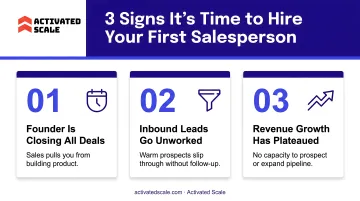
If you've cleared the founder-led prerequisite, look for these capacity ceiling indicators:
- Slow follow-up is costing deals — prospects are going cold because you can't respond fast enough
- Product development is stalling — you're buried in demos and discovery calls instead of building
- Consistent demand exists — inbound or outbound leads are coming in reliably, not just through warm introductions
On the flip side, if your deals all look different, most come from personal connections, and you can't clearly explain your sales process to a new hire, it's too early. Ask yourself: could you hand someone a written playbook today and expect similar results within 60 days?
Demand Threshold and Runway
Two practical filters before committing to a full-time hire:
- Lead volume: A handful of leads per week won't keep a full-time rep busy. If top-of-funnel is thin, an SDR or demand gen investment may generate better ROI than a closing-focused AE
- Runway: With 2–3 years of runway, you can afford a more experienced hire who builds a scalable foundation. Under 6 months of runway, prioritize someone who can close deals immediately — a builder can come later
What Role Should Your First Sales Hire Be?
Avoid Going Too Junior or Too Senior
Too junior: Early-career AEs and SDRs are trained to work within functioning systems — refined CRMs, existing collateral, steady lead flow. Without those, they look to the founder for direction, and founders end up managing a junior rep with no sales expertise to offer. Nothing gets built.
Too senior: A VP of Sales or CRO hired too early spends the first 90–180 days building strategy decks, headcount plans, and tech stacks instead of closing deals. The cost is high, ramp is long, and near-term revenue impact is low. SaaStr's Jason Lemkin is direct on this: never hire a VP of Sales until two individual reps are already hitting quota consistently.
The Profile That Actually Works
The sweet spot is a Founding AE, Head of Sales, or Sales Director — someone close enough to the deal flow to close immediately, but experienced enough to build process and eventually lead a small team.
This person should:
- Has carried a full quota recently (not just managed reps)
- Has built at least one sales process from scratch at a previous startup
- Is willing to do unglamorous early-stage work: prospecting, admin, and iteration
That profile also shapes how the role should operate. At the startup phase, a full-cycle seller handling prospecting through closing outperforms a split SDR/AE structure. Specialization makes sense as pipeline volume grows; forcing it early adds coordination overhead without enough deals to justify the division.
The Ideal Candidate Profile for a First B2B SaaS Sales Hire
Match Stage and Deal Size First
Startup-stage fit matters more than industry experience. A rep who has sold at a seed-stage company understands ambiguity, limited brand recognition, and building their own pipeline from scratch. Enterprise reps from well-resourced companies often struggle when there's no SDR support, no established pitch deck, and no warm inbound to lean on.
ACV matching is equally important. SaaStr's research on deal size dynamics shows that selling motions are consistent within a given ACV range. Someone who has only closed $10K deals may not have the multi-stakeholder navigation skills needed for a $100K enterprise sale — and vice versa, a large-deal seller may over-engineer a simple SMB close. As a baseline, look for at least 18 months as a quota-carrying AE — not just SDR experience — and 2–3 years of relevant SaaS selling.
Screen for the Right Intangibles
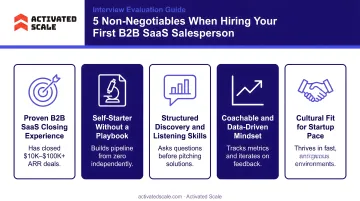
Five non-negotiables to evaluate in interviews:
- Curiosity — Do they ask sharp, probing questions about your product and market, or just talk about themselves?
- Extreme ownership — Do they take accountability for losses, or blame territory, timing, and product gaps?
- Adaptability: Can they point to specific moments where they thrived in a fast-changing environment?
- Coachability: Are they genuinely eager to learn your context, or do they push back on feedback?
- Closing instinct — When you ask what they love most about sales, do they light up talking about winning?
Beyond the five core traits, two filters most founders skip are worth treating as hard requirements:
- Reference checks with prior managers or customers — the risk of a wrong hire at this stage is too high to rely on interviews alone. Get at least two references who can speak specifically to their ability to close and build without hand-holding.
- The "would you buy from them?" test — coined by Jason Lemkin, this is one of the most reliable and most overlooked filters. Every lead is precious. If you wouldn't personally buy your own product from this candidate, don't hire them regardless of how impressive the résumé looks.
How to Compensate and Structure an Offer
Base, Incentive, and OTE
Early B2B SaaS sales hires who are the right fit expect above-market compensation on both sides of the equation. Based on SaaStr's published guidance:
- Performance pay rate: typically 8–10% of first-year ACV
- OTE structure: rep OTE generally runs around 20% of revenue closed, with 25% as a practical ceiling
- Base/variable split: a 50/50 structure is common for a founding sales leader, with additional upside for exceeding plan
Carta's 2024 startup compensation data shows sales function base salaries at US startups averaging around $150K–$160K, though this is a function-level figure rather than a precise Founding AE benchmark. Use it as directional context, not a precise target.
Equity
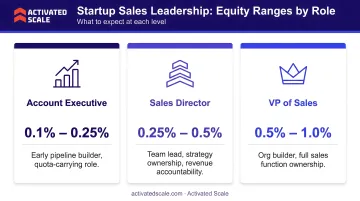
Founding sales leaders typically receive:
- Head of Sales: 0.75%–1% equity
- VP of Sales (later stage): ~1%
- CRO: 1.5%–2.5%
Before deciding on equity, ask honestly whether this hire is your long-term sales leader or a bridge hire. If it's the latter, be deliberate about preserving equity capacity for the person who will eventually build and scale the team.
The ROI Frame
Reframe the cost before you negotiate. A16z's Peter Levine offers a clear benchmark: a sales organization should generate at least 3x its loaded cost. A Founding AE at $200K fully loaded who closes $700K in ARR in year one is net positive by a wide margin. The real cost to measure is lost revenue from deals that never get worked.
Where to Source and How to Screen Candidates
Best Sourcing Channels
- LinkedIn: Identify reps who joined a B2B SaaS company at seed or pre-Series A and have recently gone through a funding round or liquidity event — these are moments when salespeople reassess options
- VC networks: Your investors have backed dozens of companies; they've seen who performed at similar stages
- Peer founder communities: Warm referrals from founders who've already made this hire are more reliable than any recruiter pitch
- Don't cut corners on sourcing costs: SaaStr explicitly recommends using recruiters and paid channels for this hire — being cheap here is a false economy
Hire Two Reps When You Can
Without a control group, a single rep's results tell you almost nothing. If they underperform, you can't know whether the problem is the person, the product, the market, or the process. Hiring two reps simultaneously lets you A/B test approaches, spread onboarding investment, and protect against sudden attrition.
Consider Fractional Sales as a Starting Point
For many early-stage founders, hiring two full-time reps isn't yet realistic — the budget isn't there, or the playbook isn't proven enough to justify the commitment. If that's where you are, fractional sales is worth considering before locking in a full-time hire. Activated Scale's fractional sales model connects B2B SaaS startups with pre-vetted, experienced sales professionals on a try-before-you-buy basis — with matching completed in as little as 7 days.
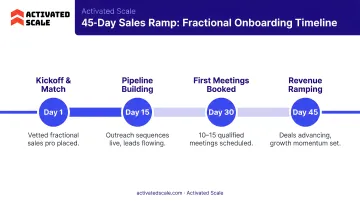
The engagement starts with a structured 45-day onboarding ramp — learning the product and ICP, testing outbound messaging, then accelerating pipeline — with pricing of $4,500/month plus performance pay for fractional SDRs and $6,500/month plus performance pay for fractional AEs. Compare that to the cost of a wrong full-time hire, and the math is straightforward.
About 85% of Activated Scale clients who start with fractional talent convert that person to a full-time role after seeing real results. Roboflow used this exact path for their first sales hires.
Common Mistakes Founders Make When Hiring Their First Salesperson
Three patterns that appear repeatedly in failed first sales hires:
No documented sales motion yet. If deals are still closed primarily through the founder's personal network, or no two deals look the same, there's nothing for a new rep to replicate. They'll fail through no fault of their own.
Hiring based on title rather than the body of work. A "VP of Sales" at one company may reflect a manager-level role. An "Account Executive" at a Series A company may have built the entire sales process from scratch. Evaluate the last two jobs and the actual outcomes — not the title on the business card.
Valuing domain expertise over startup-stage experience. Reps with extensive experience at large, well-resourced companies in your vertical often struggle without brand recognition, SDR support, or a mature CRM. Startup sales experience beats domain familiarity almost every time. SaaStr makes this point directly: watch out for candidates who depended on brand, existing customer relationships, or an established pitch — because none of those transfer.
Frequently Asked Questions
When should a B2B SaaS startup hire its first salesperson?
After the founder has personally closed 10–20 customers and can articulate a repeatable sales process. The other signal: consistent enough demand to keep a dedicated rep genuinely busy — not just a handful of leads per week from warm introductions.
Should my first sales hire be an SDR or an Account Executive?
For most early-stage startups, a full-cycle AE (or Founding AE/Head of Sales) is the better choice. Pipeline volume rarely justifies splitting SDR and AE functions at the seed stage, and a full-cycle rep who can both prospect and close generates faster, cleaner feedback on what works.
What salary and equity should I offer my first B2B SaaS salesperson?
Expect a base in the $130K–$160K range for a Founding AE, with OTE around 20% of revenue closed and incentive at 8–10% of first-year ACV. Equity typically falls in the 0.75%–1% range. Validate against current benchmarks from Carta or comparable sources before finalizing.
Should I hire a full-time salesperson or a fractional sales rep first?
If your sales playbook isn't yet documented or validated, a fractional rep is a smart de-risked starting point. It lets you test fit, build process, and generate real pipeline data before committing to the cost and risk of a permanent hire. Many startups use fractional talent as the first sales hire, then convert once results are proven.
How do I know if my first sales hire isn't working out?
Watch pipeline activity, meeting volume, and conversion rates in the first 60–90 days. Red flags aren't just missed quota — they're waiting to be told what to do, no process-building initiative, and a pipeline that stalls despite founder support.
What's the biggest mistake founders make when hiring their first salesperson?
Hiring before the sales motion is repeatable and documented. Hiring based on an impressive title or big-company background — rather than proven ability to sell in a resource-constrained, low-brand-recognition startup — runs a close second.