The pressure to hire is real. Your pipeline is growing, your reps are stretched, and every week without more coverage feels like lost revenue. But expanding too early, with the wrong structure or the wrong model, compounds the problem rather than solving it.
This guide covers four things: how to know when you're genuinely ready to expand, which hiring model fits your current stage, how to structure and equip your team for growth, and the mistakes most founders make along the way.
Key Takeaways
- Expand only when pipeline volume, LTV:CAC ratios, and process maturity can support additional headcount
- Full-time, fractional, and contract-to-hire each serve different stages; choosing wrong costs time and money
- Document your sales process before adding reps — otherwise you multiply chaos, not revenue
- Budget for a 5.7-month average AE ramp before expecting net-positive contribution
- The five most common scaling mistakes are avoidable if you catch them before hiring
Signs Your B2B SaaS Startup Is Ready to Expand Its Sales Team
The Quota Saturation Signal
When your current reps are consistently at or above quota and qualified leads are still going unworked (or response times are slipping past 24 hours), that's a capacity problem, not a performance problem. The fix isn't coaching. It's headcount.
The distinction matters because founders often misdiagnose it. If reps are hitting quota but leads are piling up, adding a rep makes sense. If reps are missing quota and leads are piling up, adding a rep makes the problem worse.
The Pipeline Math Test
Before you hire, run the numbers. A sustainable hiring decision requires your LTV:CAC ratio to exceed 3:1 — the minimum threshold established by David Skok's SaaS Metrics framework. Below that threshold, you're acquiring customers at a cost that doesn't justify scaling the acquisition engine.
Ramp time is the other variable founders underestimate. According to the Bridge Group's 2024 SaaS AE benchmark report, the average AE ramp time is 5.7 months — up from 4.3 months in 2020. With a median OTE of $190K ($100K base, $90K variable), that's nearly two quarters of carry cost. A new rep won't contribute net-positive revenue until month six at the earliest.
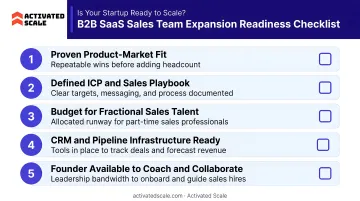
The pre-hire checklist:
- LTV:CAC above 3:1
- Qualified leads going unworked for 24+ hours
- Current reps consistently at or above quota
- Cash runway to cover 6+ months of base salary per new hire
- Inbound or outbound volume exceeding current team capacity
The Process Maturity Prerequisite
Passing the pipeline math test is necessary — but not sufficient. If every rep sells differently, adding people multiplies chaos. Before expanding, your sales process needs to be documented and repeatable, not just understood by one or two high performers. This is the prerequisite founders most often skip, and it's the one that causes the most damage at scale.
Choosing the Right Hiring Model for 2026
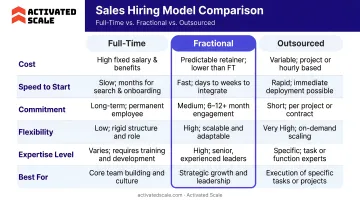
Full-Time Hiring
Full-time hires offer complete commitment, cultural alignment, and long-term upside. For teams with a proven process and reliable pipeline, they're the right answer.
The problem is the risk profile for early-stage companies. SHRM data shows 43% of bad hires happen because companies needed to fill a role quickly — a dynamic that maps directly onto resource-constrained startups under pressure to grow. SaaStr notes that hiring a great VP of Sales can take 12–18 months, and many first VP Sales hires don't survive their first year.
Full-time hiring works best when: your process is proven, your ICP is clearly defined, and you have the runway to absorb a slow ramp.
External Sales Agencies
The appeal is obvious: fast start, no permanent headcount, someone else handles recruiting. The reality is messier. Agency reps lack the product depth to handle complex objections. Feedback loops between the agency and your team are slow. And the economics benefit the agency, not your company.
SaaStr survey data tells the story plainly: only 7% of respondents said agency-based SDRs actually worked. Another 26% said they "sort of" worked. For high-ACV products that require genuine ICP expertise, there's no substitute for reps who live inside your process every day.
Fractional and Contract-to-Hire
This model gives early-stage startups access to senior sales talent — AEs, SDRs, VPs of Sales — on a part-time or contract basis, without the full-time cost or commitment. It's particularly effective at seed through Series A, when the ICP is still being refined and a bad full-time hire could set the company back six months.
Activated Scale's model is built around this exact problem. Founders get matched with vetted, US-based fractional sales professionals — with backgrounds from companies like Salesforce and Oracle — and can be up and running in as little as 7 days, sometimes the same day.
The initial engagement runs approximately three months. If the rep hits their metrics and the fit is strong, the company can convert to full-time for a conversion fee. 65% of clients make that conversion after seeing real results.
The try-before-you-buy structure saves real time, too: Activated Scale clients report saving 20+ hours per salesperson on interviewing and evaluation.
Decision Framework
| Variable | Full-Time | Fractional / Contract-to-Hire | External Agency |
|---|---|---|---|
| Sales process maturity | Proven and documented | Still being refined | Fully proven (narrow use) |
| Runway | 12+ months | 6–12 months | Short-term stopgap only |
| Speed needed | Slow (3–6 months to hire) | Fast (days to weeks) | Fast but high failure rate |
| ICP clarity | Well-defined | Still validating | Must be fully defined |
Defining Roles and Structure for a Growing Sales Team
Core Roles and When to Add Them
Most early-stage B2B SaaS startups begin with AEs who handle the full cycle — prospecting through close. Role specialization comes later, once you have enough volume to justify it.
Here's the general sequencing:
- First hire (AE): Handles demos, negotiations, and closing. Add when pipeline volume exceeds what the founder can manage
- SDRs: Add once the AE role is full and qualified lead generation becomes the bottleneck
- Sales Manager: Necessary around 4–6 reps, when deal-level coaching and pipeline inspection require dedicated attention
- Customer Success Manager: Add when churn risk warrants dedicated attention beyond what AEs can handle
Team Structure Options
For B2B SaaS startups with a focused ICP and limited headcount, the hybrid structure typically makes the most sense. Here's how the common options compare:
| Structure | How It Works | Best For |
|---|---|---|
| Hybrid | Generalist AEs cover all accounts; SDRs feed a shared pipeline | Early-stage teams with a single ICP |
| Territory-based | Reps own geographic regions | Teams with 10+ reps and regional demand variation |
| Product-based | Reps specialize by product line | Multi-product companies with distinct buyer personas |
Territory-based and product-based structures add operational complexity that most early-stage teams don't need yet.
If you're not ready to commit to full-time hires for each of these roles, Activated Scale places pre-vetted fractional sales professionals — SDRs, AEs, Sales Managers, and Customer Success — on contract-to-hire terms, so you can test fit before locking in a salary.
The Role Pollution Problem
As teams grow, salespeople get pulled into support tickets, account management, and admin work that erodes selling time. According to Salesforce's 2026 State of Sales report, reps spend only 40% of their time actually selling — with the remaining 60% consumed by non-selling tasks.
Adding headcount without fixing role boundaries doesn't solve the capacity problem. It just adds more people spending 60% of their time on the wrong things. Clear job descriptions, CRM discipline, and a dedicated ops function (even part-time) are what you need in place before adding headcount actually works.
Building a Repeatable Sales Process Before You Add Headcount
The process must exist before the hire. Without it, every new rep reinvents their approach, onboarding takes longer, coaching is inconsistent, and performance variance across reps stays high. One proven rep who can train others is worth more than three reps experimenting in parallel.
Core Stages Every B2B SaaS Sales Process Needs
- Prospecting and qualification: Define ICP criteria upfront, including clear disqualification rules
- Discovery: Ask problem-focused questions — resist the urge to demo before you understand the pain
- Demo and proposal: Tailor every presentation to what you learned in discovery, not a generic overview
- Negotiation: Establish discount authority and documented objection responses before reps are in the room
- Close — documented next-step commitments and decision-maker confirmation
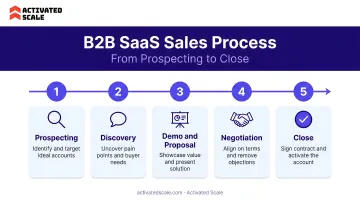
Each stage needs defined entry and exit criteria. If a rep can't articulate why a deal moved from Stage 2 to Stage 3, the pipeline data is unreliable — and scaling decisions made on unreliable data are guesses.
The Sales Playbook
A living document that captures messaging, talk tracks, objection handling, and qualification criteria. Build it with your existing reps, not for them. Reps who contribute to the playbook are more likely to follow it — and more likely to catch when it's outdated.
CRM as the Enforcement Layer
A properly configured CRM should reflect your sales stages, require key fields at each step, and prevent deals from advancing without completing defined actions. Without CRM discipline, you don't have pipeline visibility. You have a list of optimistic guesses — and when you scale, those guesses scale with you.
Onboarding, Training, and Performance Management
Structured Onboarding
A new AE needs roughly 5.7 months to fully ramp — that's the 2024 Bridge Group benchmark. A structured onboarding program compresses the unproductive portion of that window.
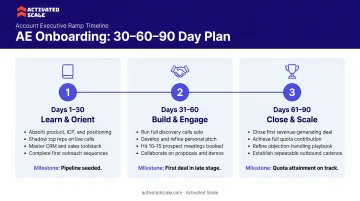
Effective onboarding includes:
- Days 1–30: Product knowledge, ICP deep-dive, CRM certification, shadowing experienced reps
- Days 31–60: Mock calls and role plays, solo outreach with manager review, first independent pipeline building
- Days 61–90: Independent quota targets, weekly deal reviews, coaching on specific skill gaps
Aberdeen's B2B research shows firms with structured onboarding had 61% of first-year reps hit quota, compared to 40% at firms without structured programs. That 21-point difference compounds fast as your team grows.
Performance KPIs to Track by Rep
Don't track these in aggregate — track them by individual. Aggregate numbers mask the rep-level variance that reveals coaching opportunities early.
| KPI | 2024 SaaS Benchmark (Bridge Group) |
|---|---|
| Win rate | 19% median |
| Sales cycle length | 5.0 months median |
| Pipeline coverage needed | 5.3x |
| AEs hitting annual quota | 51% |
Compensation Alignment
Plans that reward activity (calls made, emails sent) rather than outcomes (qualified pipeline, closed revenue) train reps to optimize for the wrong things. Salesforce's 2026 State of Sales data shows 76% of reps want more transparency in how their compensation is calculated.
Xactly's research found that plans with more than three objectives cause reps to lose focus on high-value goals. Keep plans simple:
- Clear cause-and-effect between behavior and payout
- No caps that demotivate overachievement
- Fast feedback loops so reps can course-correct in real time
Common Mistakes Founders Make When Scaling Their Sales Team
Scaling before the process is proven. Hiring three AEs before you've validated a repeatable motion means three people failing in three different ways with no clear path to correction. Validate with one rep first. Then scale what works.
Misaligning compensation with company goals. Early-stage startups typically need new logo acquisition above all else. If the comp plan doesn't weight that heavily, reps will optimize for renewal, upsells, or whatever generates the fastest paycheck — regardless of what the company actually needs.
Ignoring sales and marketing alignment. Expanding the sales team without enough qualified pipeline to support new headcount is a fast way to burn runway. New reps with empty pipelines either go dark or start chasing unqualified leads — both outcomes are expensive. Pipeline demand planning must happen in parallel with headcount decisions, not after them.
Frequently Asked Questions
What does scaling your sales team mean?
Scaling a sales team means growing its size, structure, and capacity to handle more pipeline and close more revenue without proportionally increasing cost or complexity. Process and infrastructure come first; headcount comes after.
What is the difference between team expansion and upselling?
Team expansion grows your sales organization's capacity to acquire new logos. Upselling is a revenue strategy focused on increasing value with existing customers. Both grow revenue, but through entirely different motions and team structures.
When should a B2B startup hire its first dedicated salesperson?
After the founder has personally closed several deals and can articulate a repeatable process. Hiring before product-market fit is validated typically results in a wasted hire and early churn — the rep can't sell what hasn't been proven yet.
What is the difference between a fractional sales rep and a full-time hire?
Fractional reps work part-time or on contract, giving startups access to experienced talent at lower cost and risk than a full-time hire. Seed and Series A companies rely on this model most heavily while still validating their go-to-market approach.
What KPIs should I track when expanding my sales team?
Track pipeline-to-quota ratio, win rate, average sales cycle length, and quota attainment — broken down by individual rep, not just in aggregate. The Bridge Group's 2024 benchmarks (19% median SaaS win rate, 5.3x pipeline coverage) give you a concrete baseline to measure against.