
The problem is that most hiring advice assumes you already have infrastructure — a defined sales process, a manager to coach the rep, and enough pipeline to keep them busy. Early-stage founders rarely have any of that.
This guide covers everything you actually need: how to know you're ready, what to look for in a candidate, where to find them, how to structure comp, and how to onboard for success.
Key Takeaways
- Only hire an AE after personally closing 10–20 customers and establishing a repeatable sales motion
- Hire for hustle, adaptability, and a hunter mentality over brand-name resume logos
- Source through referrals and targeted outreach — fractional or contract-to-hire models reduce hiring risk
- Ramp takes 1–3+ months — co-sell actively throughout or the hire will likely fail
Signs You're Ready to Hire Your First AE
The Founder-Led Sales Prerequisite
Before handing off to anyone else, you need to have sold yourself. SaaStr recommends closing at least 10–20 customers personally before bringing in a first AE. That threshold exists because you need to genuinely understand why customers buy, which objections kill deals, and what actually moves someone from interest to close.
An AE can only scale what's already proven. They cannot discover product-market fit on your behalf.
The Repeatability Signal
Readiness isn't about hitting a revenue milestone. It's about having a documented, testable sales motion that another person could follow without relying on your intuition.
Before hiring, you should be able to clearly articulate:
- Your Ideal Customer Profile (ICP) — who buys and why
- Your qualification criteria — how you separate real opportunities from noise
- Your pitch — a consistent narrative with known objections and proven responses
- Your close — what pushes deals over the line
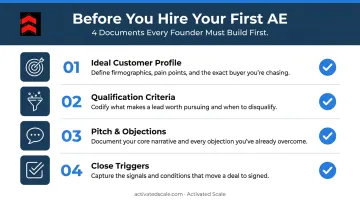
If you can't write this down and hand it to someone on day one, you're not ready.
ACV and Capacity Triggers
Two signals together confirm you're ready:
- ACV floor: SaaStr puts the minimum at $5K–$10K ACV. Below that threshold, the economics rarely support a traditional inside sales rep.
- Capacity bottleneck: When you're dropping follow-ups, missing replies, or losing deals because you're out of hours — that's the real trigger. Desperation and strategic growth can look identical from the outside; the difference is whether a documented sales motion exists to hand off.
A practical planning note: start your search 3–6 months before you anticipate needing full AE productivity. Between sourcing, interviews, and ramp time, the gap between "I need help" and "my AE is closing deals" is longer than most founders expect.
What to Look for in Your First AE
Scrappiness Over Pedigree
SaaStr is direct about this: seasoned President's Club winners from large organizations can "melt and fail" as a first rep when there's no brand recognition, no established lead flow, and no playbook to follow. The candidate who asks mainly about existing systems is the wrong candidate.
Your first AE needs to build the engine, not just run it.
The Hunter Profile
There are two archetypes in sales:
- Hunters — active prospectors who generate pipeline through cold outreach, referrals, and personal initiative
- Farmers — relationship managers who expand and retain existing accounts
Your first AE must be a hunter. They'll be starting with limited inbound, minimal brand recognition, and no SDR support. If they can't create pipeline from scratch, nothing else matters.
Stage-Appropriate Experience
SaaStr notes that deal-size experience doesn't stretch easily — selling $3K deals and $300K deals require fundamentally different motions. Look for someone who has sold at your ACV, to your buyer type, in a similarly complex environment.
An AE with only high-velocity SMB experience will struggle moving upmarket. A pure enterprise background will create friction and slow your velocity.
Two Filters Worth Running
Run these two checks before extending an offer:
- Would you buy from them in the first meeting? This gut-check filters for credibility, communication quality, and genuine conviction. SaaStr surfaces it as one of the clearest early signals. If the answer is "not sure," keep looking.
- Do they translate prospect feedback into signal? Your first AE feeds intelligence back to product and marketing — not just revenue forward. Ask candidates to describe a time prospect objections changed how they positioned a deal. Candidates who can't answer specifically are unlikely to develop this habit on the job.
How to Source and Evaluate AE Candidates
Start With Referrals
First Round's research confirms that referrals are the lowest-cost, highest-quality source of sales hires. Your first call should be to your investors, advisors, existing customers, and anyone who's watched you sell.
A 30-minute LinkedIn review of your network can surface 5–10% strong candidates from a few hundred contacts. Don't skip this step in favor of posting a job description.
Targeted Cold Outreach
Identify AEs at companies with a similar ICP, deal size, and sales motion — then reach out directly. This approach has a secondary benefit: it signals to candidates that you're a founder who thinks strategically and sells intentionally. That matters to the type of person you want to hire.
The Fractional and Contract-to-Hire Option
One of the highest-risk moments in any early-stage company is committing to a full-time AE before you've confirmed the sales motion is transferable. Platforms like Activated Scale offer a smarter on-ramp.
Activated Scale matches founders with pre-vetted fractional AEs from companies like Yelp, Datadog, IBM, and Udemy, specifically matched to your ICP and ACV. Key details:
- Pricing: Engagements are $6,500/month plus performance pay
- Time-to-match: 7 days or less — sometimes same-day
- Vetting: Only the top 5% of applicants pass a three-stage screening process
- Comparison: Traditional full-time AE hiring typically takes 90+ days
The contract-to-hire model lets you evaluate fit, validate whether the sales motion transfers, and convert to full-time only after seeing real performance. Since that filtering already happened, you skip the resume pile entirely.
For first-time sales hirers, the model removes risk from what is otherwise a costly, hard-to-reverse decision.
Interview Evaluation Tactics
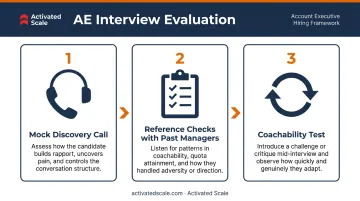
Don't evaluate on resume alone. Run these additional steps:
- Mock discovery call — have them run a live demo or discovery exercise from scratch
- Reference checks with past managers — peer references are not sufficient; you want to hear from someone who managed them
- Coachability test — give constructive feedback mid-interview and watch how they respond; defensiveness at this stage rarely improves on the job
How to Structure Compensation for Your First AE
OTE Benchmarks
The standard AE compensation model is base salary plus variable performance pay, typically structured as a 50/50 split. According to RepVue's current data, the US median for Account Executives is $100K base / $200K OTE. By segment:
| Segment | Base | OTE |
|---|---|---|
| SMB AE | $70K | $135K |
| Mid-Market AE | $90K | $180K |
| Enterprise AE | $140K | $270K |
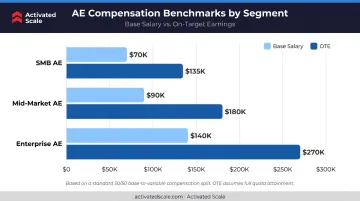
For early-stage B2B SaaS, you're typically competing in the SMB-to-mid-market range. Betts Recruiting's 2025 data shows remote AEs with 0–3 years experience earning $70K–$100K base / $140K–$200K OTE.
Quota Calibration and Ramp
The standard benchmark: quota should be 4–5x OTE. A $200K OTE maps to roughly $800K–$1M in quota. That's a steady-state number, though — not what you should set from day one.
During ramp, set a reduced or step-function quota that gives your AE a realistic path to covering their cost in the first 90 days. An AE who hits a lower early quota builds confidence and generates useful performance signal.
An AE drowning under an unrealistic number demoralizes quickly — and you won't know whether the problem is the person or the setup.
Raise quotas as the motion proves out. In months one through three, the priority is learning whether the hire can close your deals. Revenue maximization comes later.
Onboarding Your First AE: A 30-60-90 Day Plan
Days 1–30: Foundation Building
The first month is immersion only. Do not expect deals to close.
Focus areas:
- Product training and value proposition
- ICP, competitive landscape, and common objections
- CRM setup and deal stage definitions
- Shadowing the founder on live calls
- Listening to recorded calls and customer success conversations
A new AE who hasn't heard dozens of real customer conversations before selling independently will make avoidable mistakes. Build this in deliberately.
Days 31–60: Market Engagement
Transition to active prospecting and live selling — with the founder still present on most calls.
This is the co-selling phase. Your AE runs discovery calls, delivers demos, and refines their pitch with your direct coaching after each call.
The instinct to step back here is understandable — but resist it. The rep needs your context, and you need visibility into whether the motion is actually transferring. Most founders who disengage too early find out at the 90-day mark, not the 60-day mark.

Days 61–90: Driving Results
By month three, your AE should be running deals more independently and building real pipeline. This is also when they should start contributing to a formalized sales playbook — documenting what's working, what objections they're hitting, and how deals are progressing.
Performance gaps at the 90-day mark are meaningful signal. No pipeline and no progress means something is broken — the hire, the process, or both. Waiting another 90 days to diagnose it only compounds the cost.
Common Mistakes Founders Make When Hiring Their First AE
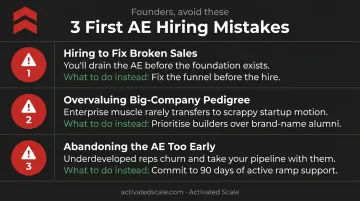
Three patterns show up repeatedly when first AE hires go wrong:
Hiring to fix broken sales. An AE cannot rescue a motion the founder hasn't figured out yet. If deals aren't closing with you selling, they won't close with someone else selling either. The first AE scales what's already working — not what isn't.
Overvaluing big-company pedigree. An AE from a structured enterprise org — with brand recognition, inbound lead flow, and a full support team — is often a poor fit where none of those things exist. Scrappy and entrepreneurial beats prestigious at this stage.
Abandoning the AE too early. This is the most common reason first AE hires fail. Founders step back after two weeks assuming their new hire will figure it out. The AE doesn't have enough context, pipeline, or coaching to succeed — and by the time the problem is visible, months of runway are gone. Co-sell for the full ramp period. That investment of time during onboarding is what determines whether the hire works.
Frequently Asked Questions
Frequently Asked Questions
What is an enterprise AE?
An enterprise AE handles large, complex deals with long sales cycles, multiple stakeholders, and custom contract negotiations — typically deals over $250K, according to Betts Recruiting's 2025 benchmarks. This is distinct from SMB or mid-market AEs who operate at higher velocity with lower deal complexity.
How much does it cost to hire an AE?
Full-time AE OTE typically runs $135K–$200K+ depending on segment and geography, plus benefits, tools, and a 90-day ramp period at reduced productivity. Fractional AE engagements through platforms like Activated Scale cost $6,500/month plus performance pay, offering a lower-cost entry point that lets you validate fit before committing to a full-time salary.
What's the difference between an AE and an SDR?
SDRs focus on top-of-funnel work — prospecting, qualifying, and booking meetings. AEs own the full sales cycle from discovery through close. Your first hire is typically an AE with prior SDR or BDR experience, so they can generate their own pipeline without SDR support behind them.
How long does it take a new AE to ramp up?
Traditional full-time hires take 4–6 months to reach full productivity, per SaaStr/ICONIQ benchmarks — with quota attainment often not expected until month three or four. Fractional AEs from vetted platforms ramp in 2–4 weeks due to pre-matched ICP and ACV experience.
Should my first AE be full-time or fractional?
Full-time offers full commitment but carries real financial risk if the hire doesn't work out. Contract-to-hire through platforms like Activated Scale lets you test fit and validate whether the sales motion transfers before converting to a permanent role.