Introduction
Hiring a full-time SDR in 2026 carries real financial weight. According to RepVue's 2026 Sales Salary Guide, the median SDR OTE sits at $85,000 — and when you stack in benefits (29.9% of employer compensation costs per BLS December 2025 data), recruiting fees, tooling, and management overhead, the fully loaded annual cost climbs well past $100,000.
The cost is only part of the problem. Bridge Group research puts average SDR ramp at 3 months ± 2 weeks, with normal attrition running 40–50% annually. For a Seed or Series A founder still validating ICP and messaging, that's a lot of capital behind an unproven motion.
Fractional SDR services offer a direct alternative: experienced sales development capacity at $3,000–$10,000/month, without the ramp time or long-term commitment. You build qualified pipeline and pressure-test outbound playbooks before betting on full-time headcount.
What follows is a practical breakdown of the top fractional SDR providers for 2026 — with honest criteria for choosing the right one at your stage.
Key Takeaways
- Fractional SDR services give you part-time, experienced sales development talent — typically priced at $3,000–$10,000/month — with no salary, benefits, or ramp risk
- Best fit: Seed to Series A B2B SaaS companies validating outbound motion or bridging to a first in-house hire
- Key evaluation criteria: SDR experience level, contract flexibility, B2B specialization, reporting transparency, data ownership
- Activated Scale is the top pick for B2B SaaS startups — vetted US-based reps, 7-day deployment, try-before-you-buy model
- Start fractional to validate your playbook, then scale once pipeline demand is predictable
What Is a Fractional SDR Service?
A fractional SDR service gives you part-time access to an experienced sales development representative and the supporting infrastructure through an external provider for a fixed monthly fee.
Coverage typically includes ICP definition support, prospect research, outbound sequencing, multi-channel outreach (email, phone, LinkedIn), and meeting booking — all without adding a full-time employee.
Who Gets the Most Value
Three types of companies benefit most:
- Early-stage startups still figuring out ICP, messaging, and which segments actually convert
- Scaleups moving from founder-led sales to their first SDR team, where they need pipeline but not a permanent hire yet
- Companies running time-limited campaigns — a new vertical, geography, or product launch — where full-time headcount is overkill
Fractional vs. Traditional Outsourced SDR
These aren't the same thing. Here's how the two models compare:
| Traditional Outsourced SDR | Fractional SDR | |
|---|---|---|
| Rep experience | Junior, often entry-level | Senior, with named-account backgrounds |
| Outreach approach | High-volume templated sequences | Account-level research and personalization |
| Optimization goal | Send count | Conversation quality |
| Best fit | High-volume, transactional sales | Complex B2B cycles with longer buying committees |
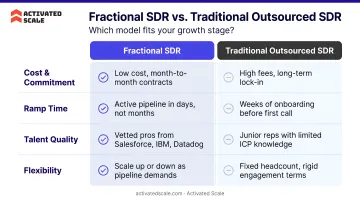
Conflating the two is a common mistake — companies expecting senior, research-driven outreach often end up with bulk email blasts that damage their domain reputation instead.
Best Fractional SDR Services for 2026
Providers below were selected based on SDR experience level, genuine contract flexibility, B2B specialization, reporting transparency, and client results — not marketing claims.
Activated Scale
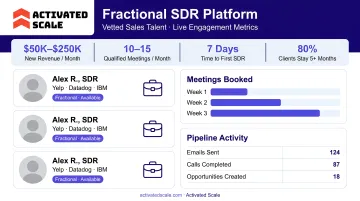
Activated Scale is a fractional B2B sales talent platform built specifically for Seed-to-Series A B2B SaaS startups. The model connects founders with vetted, US-based fractional sales professionals through a structured three-stage vetting process: application review, a 60–90 second pitch video assessed by peers, and a subject matter expert interview. Only candidates who pass all three stages join the network.
Pricing is $4,500/month plus performance pay, with engagements running 15–20 hours per week. There are no minimum contract terms — clients work month-to-month, can pause or cancel anytime, and can request a free rematch if the fit isn't right.
What separates Activated Scale is the try-before-you-buy structure. 65% of clients convert their fractional SDR to a full-time employee after seeing results, with a conversion fee of 18% on base salary. All tools are client-owned from day one — sequences, contact lists, call scripts, and CRM data belong to the client, not the provider.
| Criteria | Details |
|---|---|
| Best For | Seed to Series A B2B SaaS startups needing vetted, US-based fractional sales talent with a try-before-you-buy model |
| Pricing | $4,500/month plus performance pay; month-to-month, no minimums |
| Key Differentiators | 7-day deployment, try-before-you-buy, contract-to-hire at 18% base, full client data ownership, free rematch guarantee |
Belkins
Founded in 2017, Belkins is one of the larger B2B appointment-setting agencies globally, serving 1,000+ clients across 50+ industries with a 4.9 rating across 230 Clutch reviews.
Their omnichannel approach covers email, LinkedIn, and cold calling, delivered through a cross-functional pod model: SDR, lead researcher, copywriter, deliverability expert, and account manager.
A standout differentiator is Folderly, a proprietary email deliverability platform developed internally at Belkins. Engagements are more structured than pure fractional specialists — better suited to companies that want operational infrastructure and documented AE acceptance rates rather than maximum flexibility.
| Criteria | Details |
|---|---|
| Best For | B2B companies needing high-volume, omnichannel appointment setting with proven operational infrastructure |
| Pricing | Email-only from ~$6,500/month; omnichannel packages from ~$7,995/month (verify directly) |
| Key Differentiators | Full-pod delivery model, proprietary deliverability monitoring via Folderly, 50+ industry track record |
Martal Group
Martal Group is a Canadian B2B lead generation agency with genuine depth in the technology sector — their IT practice covers cybersecurity, SaaS platforms, cloud infrastructure, DevOps, network security, and enterprise software. One documented IT sector engagement ran 14 months, producing 103 booked meetings and 133 SQLs.
Their engagement tiers include a 3-month pilot structure with monthly subscriptions afterward. Part-time engagements are available but not formally productized — ask explicitly for a fractional structure during the sales process. Dollar pricing isn't published; contact them directly for current rates.
| Criteria | Details |
|---|---|
| Best For | B2B tech companies selling to technical buyers where message credibility matters more than outreach volume |
| Pricing | ~$3,000–$7,000/month for part-time engagements (indicative; verify directly) |
| Key Differentiators | Technical SDR capability, international reach (North America, Europe, APAC), adaptable to complex product narratives |
memoryBlue
memoryBlue has been in B2B tech sales development since 2002, with 600+ SDRs/ISRs/AEs deployed across 3,000+ clients in 107 countries.
Their Academy program puts every rep through a 4-day bootcamp plus 5 weeks of live coaching before client deployment — meaning you're not onboarding someone who's still learning the fundamentals on your dime.
Their "Try + Hire" model lets clients convert their dedicated SDR to an in-house employee after a trial period — similar in concept to Activated Scale's contract-to-hire structure. Higher price point than most fractional options, so it's best suited to companies with the deal size and budget to justify a dedicated seat.
| Criteria | Details |
|---|---|
| Best For | B2B tech companies wanting fractional-to-full-time talent optionality with structured Academy training |
| Pricing | Dedicated resource model starting at ~$11,000/month; custom pricing based on team size |
| Key Differentiators | "Try + Hire" in-house conversion model, 4-day bootcamp + 5-week coaching, strong B2B tech vertical track record |
SalesHive
SalesHive is a US-based B2B outbound agency combining experienced SDRs with a proprietary AI platform. Their eMod tool generates hyper-personalized emails at scale. Published pricing is transparent across three tiers:
- Starter — $7,000/month (1 SDR, 150+ daily touches)
- Growth — $8,000/month (1 SDR, 250+ daily touches)
- Crush — $12,000/month (2 SDRs, 500+ daily touches)
All packages are month-to-month with no annual contracts.
The main caveat: their outbound infrastructure is proprietary, so confirm data portability and asset ownership before signing. Fractional framing is informal — SalesHive operates more like a structured outbound agency than a pure fractional talent model.
| Criteria | Details |
|---|---|
| Best For | US-focused B2B tech companies wanting transparent pricing and a tech-stack-included outbound engagement |
| Pricing | $7,000–$12,000/month published; month-to-month |
| Key Differentiators | Transparent published pricing, AI-assisted sequencing via proprietary platform, no annual contracts |
How We Selected These Providers
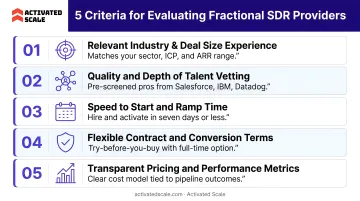
Five criteria drove the evaluation. Here's what each one means in practice:
1. Contract flexibility : Month-to-month terms with the ability to scale, pause, or exit without punitive lock-ins. Providers with 6–12 month minimums score lower for early-stage buyers.
2. SDR experience level : Experienced B2B reps who've worked complex deal cycles are fundamentally different from entry-level graduates running scripts. The gap shows up in reply quality and meeting-to-opportunity conversion, not just meeting volume.
3. B2B/SaaS specialization : Can the rep engage technical buyers, navigate multi-stakeholder buying committees, and adapt messaging to a longer sales cycle? Generic outreach experience doesn't transfer.
4. Reporting transparency : Providers who share weekly metrics on reply rates, show rates, and pipeline generated score higher than those reporting only meetings booked. You need visibility into the full funnel, not just the top.
5. Data and asset ownership : All sequences, contact lists, ICP documentation, and CRM records should belong to the client when the engagement ends. Providers who can't confirm this create long-term risk, especially if you later want to bring the motion in-house.
The Common Evaluation Mistake
Most buyers anchor on headline monthly pricing or meeting volume promises. The metric that actually matters is cost-per-qualified-meeting — and behind that, AE acceptance rates. A provider booking 20 meetings a month at a low show rate and poor qualification is more expensive than one booking 12 meetings where 10 convert to active opportunities.
Bridge Group data puts normal SDR attrition at 40–50% annually, with role fill time averaging 25–30 days. A mis-hired full-time SDR can easily cost $35,000–$50,000 before generating a single pipeline dollar once you factor in:
- Base salary and benefits during ramp
- Recruiting fees or internal time-to-hire costs
- 60–90 days of ramp time before full productivity
Fractional providers let you avoid that exposure entirely while you validate the motion.
Fractional SDR vs. Outsourced SDR vs. In-House: Which Is Right for You?
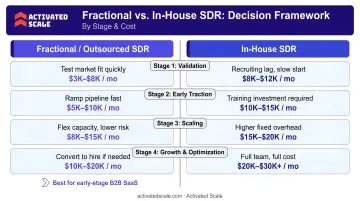
| Model | Typical Cost | Commitment | Best For |
|---|---|---|---|
| Fractional SDR | $3,000–$8,000/month | Month-to-month | ICP validation, early-stage pipeline, seasonal needs |
| Outsourced SDR | $6,000–$15,000/month | 6–12 month contracts | Scaling a proven playbook with dedicated reps |
| In-House SDR | $85,000–$120,000/year fully loaded | Permanent hire, 3–6 month ramp | Series B+ companies with proven motion and SDR management capacity |
The Decision Framework
Use fractional when:
- ICP or messaging is still being validated
- Pipeline needs are lumpy or tied to specific campaigns
- You lack in-house capacity to coach and manage an SDR
Upgrade to agency-based or in-house when:
- Pipeline demand is continuous and predictable
- The outbound playbook consistently produces qualified meetings
- The math on cost-per-qualified-meeting favors a dedicated seat
- You have someone internally who can manage and develop an SDR
The Most Effective Pattern in B2B SaaS
Start fractional. Validate the motion with minimal risk. Then either scale with the same provider or use the validated playbook as the template for your first in-house hire.
Activated Scale's try-before-you-buy model is built for exactly this path. 65% of clients convert their fractional SDR to a full-time hire, and the conversion process is mapped out from day one so the transition doesn't stall momentum.
Conclusion
For most Seed-to-Series A B2B SaaS founders, fractional SDR services are the lowest-risk, fastest path to qualified pipeline in 2026. You get an experienced rep, a proven outreach infrastructure, and real market feedback — before committing to the cost and complexity of a full-time hire.
When evaluating providers, focus on outcomes: cost-per-qualified-meeting, AE acceptance rates, and whether you'll own everything when the engagement ends. Headline pricing and meeting volume promises are easy to inflate — those outcome metrics are not.
If those are the criteria that matter to you, Activated Scale is worth a close look. They connect B2B SaaS startups with vetted, US-based fractional sales talent in 7 days or less, with the option to convert top performers to full-time employees as your team scales.
Frequently Asked Questions
What is a fractional SDR service and how does it differ from a full-time SDR hire?
A fractional SDR service gives you part-time access to an experienced sales development rep through an external provider — covering prospecting, outbound sequencing, and meeting booking — without salary, benefits, ramp time, or management overhead. You pay only for the capacity you need, typically on a month-to-month basis.
How much do fractional SDR services cost in 2026?
Most fractional SDR engagements run $3,000–$10,000/month depending on scope, provider, and SDR seniority. For context, the fully loaded cost of a full-time SDR hire runs $7,000–$10,000/month when you include salary, benefits, and overhead. Track cost-per-qualified-meeting, not just the monthly fee.
How quickly can a fractional SDR engagement start booking meetings?
Most well-structured engagements complete onboarding and launch active outreach within 1–3 weeks, with first qualified meetings typically appearing in weeks 2–4. Timeline depends heavily on the provider's onboarding process and how clearly the client's ICP is defined going in.
How is fractional SDR different from an agency SDR?
Fractional SDR is part-time, flexible, and suited to earlier-stage companies still validating their outbound motion. Agency SDR typically means dedicated full-time reps or pods with longer contracts and higher monthly spend. If your outbound playbook is still being tested, fractional is the lower-risk starting point.
What should I look for when evaluating fractional SDR providers?
Five criteria matter most:
- Contract flexibility — month-to-month terms, no long lock-ins
- SDR seniority — senior reps vs. entry-level makes a real difference
- Industry fit — B2B specialization in your specific market
- Reporting transparency — weekly pipeline metrics, not just activity counts
- Data ownership — your sequences and contact lists stay with you at engagement end
When should a B2B startup upgrade from fractional to a full-time SDR hire?
Upgrade when all four of these are true:
- Your outbound playbook consistently produces qualified meetings
- Pipeline demand is continuous, not sporadic
- You have in-house SDR coaching capacity
- The cost-per-qualified-meeting math favors a dedicated seat
For most B2B SaaS companies, that point arrives 9–18 months into a fractional engagement.