
The result? Founders end up doing outreach themselves. Between product decisions, investor updates, and closing deals, outbound becomes the first thing that gets dropped when life gets busy.
Fractional SDRs are frequently mentioned as the answer, but most coverage stops at the definition. This article focuses on what actually matters: the concrete operational advantages, the KPIs they move, and the conditions under which the model delivers real value.
Key Takeaways
- A fractional SDR handles prospecting, outreach, and lead qualification on a part-time or contract basis — without the cost of full-time headcount
- The three core advantages are cost efficiency, faster time-to-pipeline, and operational flexibility
- Full-time SDR hiring takes 60–90 days to fill plus 3 months to ramp; fractional engagements start within days
- Without a dedicated SDR, founders absorb outbound work — killing focus and producing inconsistent pipeline
- The model fits best for seed-to-Series A companies validating GTM motion, testing new markets, or bridging between full-time hires
What Is a Fractional SDR?
A fractional SDR is a sales development professional who works on a part-time, contract, or retainer basis. The core responsibilities are identical to a full-time SDR: prospecting, outbound outreach across email, phone, and LinkedIn, lead qualification, and booking meetings for founders or account executives to close. The difference is structural: no permanent headcount, no benefits cost, no long-term commitment.
Where the Model Fits
Fractional SDRs are most commonly used in three situations:
- Early-stage companies that need pipeline activity but aren't ready to build an in-house SDR team
- Validation phases where a company is still testing ICP, messaging, or a new market before committing to full-time sales headcount
- Bridge periods when a full-time rep leaves and pipeline continuity can't wait 60–90 days for a replacement
The practical difference from traditional external SDR services comes down to talent caliber. Platforms like Activated Scale connect startups with vetted, US-based fractional SDR professionals who have sold to specific buyer personas: CIOs, VPs of HR, CMOs. Most can start within 7 days — far faster than the standard 60–90 day full-time hiring cycle.
Key Advantages of Hiring a Fractional SDR
The advantages below are measured against the realistic alternative for most early-stage companies: a founder doing outreach themselves, an inconsistent outbound function, or a lengthy full-time hiring process. These aren't abstract claims — they map directly to metrics founders and investors actually track.
Cost Efficiency Without Sacrificing Expertise
A full-time SDR hire carries costs well beyond base salary. Using current benchmarks:
- Base salary: Payscale's 2026 data puts the average US SDR base salary at $51,244, with total compensation often reaching $60,000–$80,000+
- Benefits burden: BLS data from December 2025 shows benefits add approximately 29.9% on top of wages across private industry
- Recruiting costs: SHRM estimates average cost-per-hire at nearly $4,700, with some estimates putting total recruiting burden at 3–4x the position's salary when soft costs are included
- Ramp time: The Bridge Group reports average SDR ramp is 3 months, during which productivity is minimal
- Attrition risk: SDR annual attrition typically runs 40–50%, meaning replacement costs recur frequently
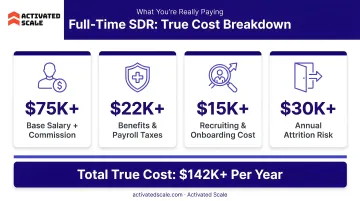
A fractional SDR eliminates most of that exposure. Activated Scale's fractional SDRs work 15–20 hours per week on a monthly retainer at $4,500 per month plus performance pay — with no severance, no benefits overhead, and no termination fees.
KPIs this affects: Cost per meeting booked, SDR cost as a percentage of revenue, monthly sales headcount spend
When it matters most: Pre-revenue companies with limited runway; companies needing to prove outbound ROI before scaling the team
Speed-to-Pipeline
Cost is only half the problem. Time is a pipeline killer — and the full-time SDR path looks like this:
| Stage | Typical Duration |
|---|---|
| Job search to accepted offer | 41 days (LinkedIn average) |
| SDR-specific time-to-fill | 25–30 days (Bridge Group) |
| Ramp to full productivity | ~3 months (Bridge Group) |
| Total to productive pipeline | Up to 4–5 months |
That's four to five months before a single qualified meeting gets booked from a new hire. For a company in active fundraising or validating a new ICP, that delay has real consequences — fewer market conversations, slower iteration on messaging, and weaker traction narratives.
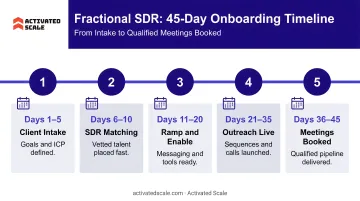
Fractional SDRs compress this timeline. Because they arrive with existing outbound playbooks, CRM familiarity, and qualification experience from working across multiple companies, the ramp looks different. Activated Scale's internal benchmark: 2 weeks to productive outreach, versus 90 days for a traditional full-time SDR.
The first 15 days focus on intake and messaging — learning the company's buyer, churn reasons, and current acquisition channels. By days 16–45, targeted outreach is underway across email, phone, and LinkedIn, with messaging being actively tested and refined. Most clients reach 10–15 qualified meetings per month by Month 3.
KPIs this affects: Time to first meeting booked, pipeline velocity, outbound activity in the first 30 days
When it matters most: Startups demonstrating traction for fundraising; companies entering new markets; bridge periods after a full-time SDR departure
Scalability and Operational Flexibility
Early-stage SaaS companies don't operate in a straight line. GTM strategies shift, ICP assumptions get revised, and outreach intensity fluctuates based on campaigns, funding timelines, and product releases. Fixed sales headcount doesn't flex well with any of that.
A 2024 SaaS benchmarks report from High Alpha and OpenView found that 76% of SaaS founders cite go-to-market strategy as a top concern, and companies under $5M ARR saw median headcount cuts of 25–41%. That gap — sustained outbound need with fewer people to cover it — is where fractional SDRs fit naturally. The same report found 81% of SaaS companies maintained or increased BDR investment even while cutting overall headcount.
The fractional model handles this tension directly:
- Increase hours during a targeted campaign for a new vertical, then scale back when it ends
- Test two different ICPs simultaneously without hiring separate reps for each
- Pause or adjust engagement scope without severance or legal risk
- Convert to full-time when the motion is proven — approximately 65% of Activated Scale clients eventually hire their fractional SDR full-time
KPIs this affects: Outreach volume by segment, meeting-to-opportunity conversion rate, SDR utilization rate, time founders spend on sales activities
When it matters most: Companies validating PMF across multiple segments; campaign-driven outreach pushes; organizations between full-time hires
What Happens When You Skip a Dedicated SDR Function
Most founders who delay building an SDR function don't choose to do their own outreach — they end up there by default. And it tends to look fine until it isn't.
The pattern is predictable. Outreach happens when founders have time, which means it stops when fundraising intensifies, a key hire needs to be made, or a major customer needs attention. The result is a feast-or-famine pipeline: deals close in clusters, followed by dry spells because prospecting paused weeks earlier.
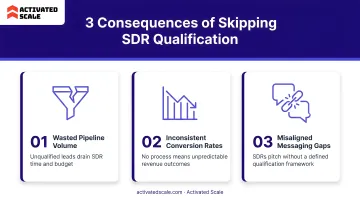
The less visible cost is harder to quantify. Early SDR activity isn't just about booking meetings — it's where the real groundwork gets laid. Skip that phase, and the company scales later with no playbook:
- Qualification criteria go untested, so the team chases the wrong prospects
- Messaging never gets refined through real prospect reactions
- Outreach processes stay undocumented, so new hires inherit guesswork instead of a repeatable system
CB Insights' analysis of 431 VC-backed shutdowns found 70% cited running out of capital and 43% cited poor product-market fit. Inconsistent pipeline doesn't just slow revenue — it cuts off the market feedback that shapes product decisions and fundraising narratives.
How to Get the Most Value from a Fractional SDR
Fractional SDRs aren't plug-and-play. The engagement needs structure to deliver consistent output.
What to provide from day one:
- A documented Ideal Customer Profile — even a rough one — so prospecting starts with a clear target
- CRM access and any existing sales collateral, email templates, or call scripts
- Context on why current customers bought, and why others have churned
What to build into the rhythm:
- A weekly check-in to review activity metrics, discuss what's working, and adjust messaging
- Monthly performance reviews against the KPIs established in the Statement of Work
- Clear meeting criteria so qualified opportunities don't get conflated with courtesy conversations
Activated Scale's try-before-you-buy model supports this kind of structured start. Clients evaluate fit before committing to an extended engagement, and the onboarding period (days 1–15 focused on intake and messaging alignment) ensures the first outreach sequences reflect real company context rather than generic templates.
Worth building into your evaluation from the start: all tools and data belong to the client company. Prospect lists, email sequences, LinkedIn templates, and CRM records stay with your startup — so whether you extend, convert to full-time, or transition out, nothing built during the engagement walks out the door.
Conclusion
Fractional SDRs solve a specific and common problem: the gap between needing pipeline activity and being able to justify full-time sales headcount. Lower cost exposure, faster time-to-pipeline, and the ability to scale outreach up or down as conditions shift — these advantages hit hardest precisely when a company is still figuring out what works.
The model isn't a stopgap. When structured well, a fractional SDR engagement leaves behind something durable:
- Tested outreach sequences your full-time team can build on
- Documented messaging frameworks refined through real prospect conversations
- Qualification criteria grounded in actual pipeline data
For seed-to-Series A companies, that infrastructure is what converts early traction into a repeatable sales motion — and that's the real return on the engagement.
Frequently Asked Questions
What is a fractional SDR?
A fractional SDR is a part-time or contract-based sales development professional who handles prospecting, outreach, and lead qualification for a company. They deliver the same core output as a full-time SDR — qualified meetings booked, pipeline generated — without the permanent headcount costs or hiring overhead.
What does SDR mean in sales?
SDR stands for Sales Development Representative. It's a role focused on top-of-funnel activities: identifying prospects, running outbound outreach, qualifying leads, and booking meetings for account executives or founders to close.
What is a fractional sales company?
A fractional sales company provides businesses with experienced, part-time or contract-based sales professionals — SDRs, account executives, or sales leaders — on a flexible engagement basis. Activated Scale is one example, connecting B2B startups with pre-vetted US-based fractional sales talent across multiple roles.
Is fractional work legitimate?
Fractional work is a legitimate and increasingly common employment model. According to MBO Partners' 2025 State of Independence report, 72.9 million Americans work independently, with 63% doing so by choice — many of them senior professionals who prefer the variety of working across multiple companies.
How much does a fractional VP of Sales charge?
According to FractionalJobs' 2026 data, most fractional sales leaders charge $5,000–$10,000 per month, with US-based fractional Heads of Sales typically billing $200–$300 per hour.
When should a startup hire a fractional SDR instead of a full-time one?
A fractional SDR makes sense when a startup:
- Needs pipeline activity quickly without waiting on a full hiring cycle
- Is still validating ICP or outbound messaging
- Has limited runway for full-time headcount
- Is bridging a gap after a full-time SDR departure
Once the outbound motion is proven and repeatable, converting to full-time becomes a lower-risk decision.