The stakes are real. Forrester's 2026 State of Business Buying report found that the typical B2B purchase decision now involves 13 internal stakeholders and 9 external influencers. A standard salesperson following a script isn't built for that environment. A true expert is.
This guide covers what a B2B sales expert actually is, the skills that define them, the process they follow, and the strategies that consistently close complex deals.
Key Takeaways
- A B2B sales expert independently navigates multi-stakeholder buying committees, long sales cycles, and high-value contracts
- The core skills that matter: consultative discovery, ICP development, multi-stakeholder mapping, and disciplined pipeline management
- Insight-led selling and account-based targeting have the strongest evidence supporting them as winning strategies
- Key metrics to track span both lead measures (activities) and lag measures (outcomes) — quota attainment alone tells you nothing useful
- Startups can access senior sales expertise without a full-time hire through fractional models that deliver results quickly
What Is a B2B Sales Expert?
A B2B sales expert is a professional who specializes in selling products or services from one business to another, with enough experience to navigate complex buying committees, long sales cycles, and high-value contracts without constant direction.
Expert vs. Rep: A Real Distinction
The difference between a B2B sales rep and a B2B sales expert isn't just seniority. It's about what they can do without being told.
- A rep executes the process handed to them — follows the sequence, runs the demo, submits the proposal
- An expert builds the process, diagnoses why deals stall, adjusts their approach based on pattern recognition from prior cycles, and makes judgment calls that aren't covered in any playbook
Experts require less oversight. They can walk into an early-stage company with no CRM hygiene, no defined ICP, and no outbound infrastructure — and create one.
B2B vs. B2C: The Structural Gap
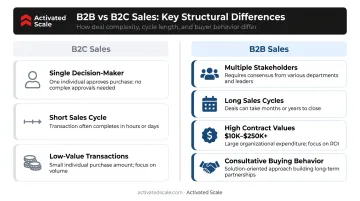
B2C sales is largely a one-to-one transaction. B2B involves a fundamentally different structure:
- Multiple stakeholders and decision-makers at different seniority levels
- Sales cycles that stretch from weeks to over a year for enterprise deals
- Contract values in the $10K–$250K+ range that justify extensive evaluation
- Consultative, not transactional, buying behavior — buyers are solving business problems, not making purchases
Where B2B Sales Experts Operate
The most common contexts include SaaS companies, enterprise software, professional services firms, and early-stage startups establishing their sales motion. That last category is where Activated Scale focuses: seed and Series A B2B companies that need a proven sales professional immediately, not a trainee.
Core Skills Every B2B Sales Expert Must Have
ICP Development and Prospect Research
Top B2B sales experts don't wait for leads to arrive. They define who the right buyer is, why they'd buy, and where to find them — then build targeted outreach from scratch.
This matters because qualification upstream saves enormous time downstream. An expert can describe their ideal customer profile with specificity: company size, revenue band, industry, the specific pain their product solves, and the buyer persona most likely to champion the deal internally.
Consultative Discovery
The distinction between a discovery call and a good discovery call comes down to depth. An average rep asks surface-level questions. An expert asks about business impact:
- "What happens to the business if this problem isn't solved in the next quarter?"
- "Who else feels the impact of this beyond your team?"
- "What did you try before, and why didn't it work?"
Those answers become the foundation of every conversation that follows: the proposal, the objection responses, and the close.
Multi-Stakeholder Navigation
Gartner research shows the typical B2B purchase now involves 6 to 10 internal stakeholders. An expert maps the buying committee before the second meeting.
They identify:
- The economic buyer — who controls the budget and ultimately signs
- The champion — who wants the problem solved and will advocate internally
- The end users — who have operational concerns that can quietly derail a deal
- The blockers — legal, security, finance — who need to be managed proactively
Messaging that works for the VP of Sales rarely lands with the CFO. Experts tailor it for each.
Objection Handling and Pipeline Discipline
Expert sellers uncover objections before they derail the deal. They ask "What would need to be true for this not to move forward?" in discovery — not during the final negotiation when it's too late to address.
Pipeline discipline separates good closers from great ones. Poor CRM hygiene, inaccurate deal stages, and inconsistent follow-up cadences all compound over time. An expert maintains accurate forecasting, tracks deal velocity, and can self-diagnose where pipeline is stalling without needing a manager to flag it.
The B2B Sales Process a True Expert Follows
Prospecting and Qualification
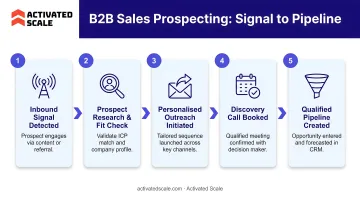
Experts use inbound signals (content downloads, site visits, trial activity) and outbound outreach (cold email, LinkedIn, cold calls) to generate pipeline. They also apply firm qualification gates — budget, authority, need, and timing — so they don't invest two hours on a prospect who was never going to buy.
The timing of outreach matters. CEB/Google research found that B2B buyers completed roughly 57% of their purchase decision before engaging a sales rep. That means reaching the right prospect early — before they've already formed strong opinions about alternatives — creates a meaningful advantage.
RAIN Group's prospecting research adds to this: top-performing prospectors achieve 2.7x more conversions than average performers, based on a study covering 488 buyers and $4.2B in purchases.
Discovery, Proposal, and Negotiation
The expert's first meeting isn't a pitch. It's a diagnostic.
They come prepared with company and industry research, ask questions that surface business impact, and listen for what the buyer is actually trying to achieve — not just the feature gap they mentioned.
Proposals follow the same logic. An expert structures them around stakeholder-specific concerns, leads with ROI rather than product specs, and negotiates to protect deal terms rather than concede ground just to avoid friction.
Closing and Post-Sale Expansion
The close isn't a moment — it's the result of every step before it. An expert removes ambiguity throughout the process by defining clear next steps at every interaction. By the time a contract lands in someone's inbox, every stakeholder already knows what's coming and why they said yes.
Post-sale, the signed deal marks the beginning of the account relationship — not the end of the work. A B2B sales expert handles this phase with the same discipline as the deal itself:
- Ensures a clean handoff to customer success with documented context
- Tracks outcomes against commitments made during the sales cycle
- Identifies upsell and referral opportunities as the account matures
Proven B2B Sales Strategies Experts Deploy
Insight-Led Selling
The most consistently supported differentiator in B2B sales research is this: winners teach buyers something they didn't already know.
RAIN Group's analysis of 700+ B2B purchases found that sellers who win educate buyers with new ideas and perspectives 3x more often than those who finish second. If your sales conversations only reflect back what the buyer already told you, you're not adding value.
Insight-led selling means bringing industry data, competitive perspective, or operational analysis to conversations that shifts how the buyer thinks about the problem. It positions the seller as a trusted advisor before a contract is signed.
Account-Based Selling (ABS)
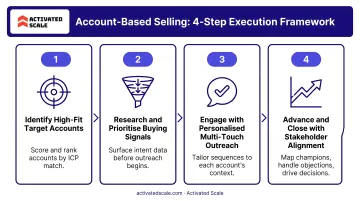
Rather than working high volumes of loosely qualified leads, account-based selling focuses effort on a defined list of high-fit accounts, pursued with personalized, multi-touch outreach across multiple stakeholders.
Forrester's 2024 ABM research found the most common ROI lift was 21% to 50% higher than non-ABM approaches, with 23% of respondents reporting 51–200% higher ROI.
For early-stage B2B startups with limited capacity, quality outweighs volume. Fifteen well-researched accounts outperform 500 generic sequences. In practice, ABS execution comes down to a few repeatable behaviors:
- Identify 10–20 high-fit target accounts based on ICP criteria before any outreach begins
- Map 3–5 stakeholders per account, noting their role in the buying decision
- Build account-specific messaging that references the prospect's business context, not just their job title
- Coordinate touchpoints across channels (email, LinkedIn, phone) over a 4–6 week sequence
Social Selling via LinkedIn
LinkedIn social selling isn't about posting content for its own sake. It's about being visible and credible to buyers before a formal outreach begins.
Concrete actions that move the needle:
- Publishing insights that address problems your ICP is actively dealing with
- Commenting substantively on prospects' posts before cold-reaching them
- Personalizing connection requests with a specific, relevant reason for connecting
- Building relationships with multiple stakeholders at target accounts before a buying cycle starts
LinkedIn's own data shows that sellers with at least four connections at a target account are 16% more likely to close a deal there. Four connections is a realistic target for any account on your ABS list.
Key Metrics a B2B Sales Expert Tracks
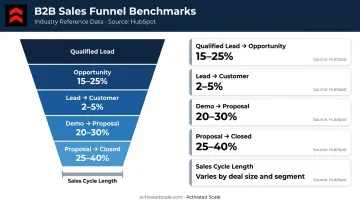
B2B sales experts distinguish between two types of metrics — and track both. Lag measures — closed revenue, win rate — tell you what happened. Lead measures — outreach volume, meeting conversion rate, pipeline velocity — tell you what's going to happen and where to intervene.
The combination gives a complete picture of pipeline health.
Essential B2B Sales Metrics
| Metric | Benchmark |
|---|---|
| Qualified lead to opportunity | 15–25% (HubSpot) |
| Lead to customer | 2–5% for B2B |
| Demo to proposal | 20–30% |
| Proposal to closed | 25–40% |
| Sales cycle length | Varies by deal size; sub-$10K ACV typically 30+ days |
Using Data to Self-Diagnose
CRM data becomes a diagnostic tool when sales experts use it to answer questions like:
- Which personas convert fastest through the funnel?
- Where do deals consistently stall (after demo, during legal review)?
- Which outreach channels generate the most meetings per hour invested?
- Are discounts actually accelerating close, or just eroding margin?
An expert doesn't wait for a pipeline review to surface these patterns. They monitor their own numbers weekly — and when something shifts, they know exactly which lever to pull.
How Startups Can Access B2B Sales Expertise Without Full-Time Hiring
The Hiring Problem
Early-stage B2B startups face a genuine bind: they need proven sales expertise now, but a senior full-time sales hire is expensive. According to BLS data, the median annual wage for sales managers is $138,060, with the top 10% earning over $239,200. Add benefits, equity, and onboarding time — and the real cost of a wrong hire is substantial.
The other risk is less discussed but equally serious: if the sales motion isn't validated yet, a full-time senior hire has nothing proven to execute against.
The Fractional Model
A fractional B2B sales expert works with a startup on a part-time or contract basis — typically 15–20 hours per week — applying senior-level skills from day one without the overhead of a full-time employee.
One way to access this model quickly is through a marketplace like Activated Scale, which connects B2B startups with pre-vetted fractional professionals who can start within 7 days. The talent network spans SDRs, Account Executives, and VP-level leaders — professionals who've built pipeline at companies like Salesforce, Oracle, and IBM — matched based on ICP and ACV fit.
The engagement model is deliberately low-risk:
- Month-to-month retainers with no minimum duration
- A try-before-you-buy structure so you evaluate fit before committing
- Option to convert to a full-time hire when ready (about 85% of clients do)
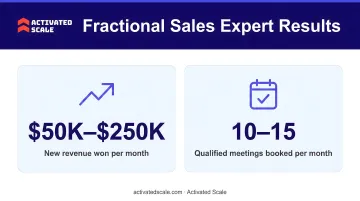
Client results by month three:
- Fractional SDRs average 10–15 qualified meetings booked per month
- Fractional AEs generate $50,000–$250,000 in new monthly revenue, depending on deal size and sales cycle
What to Look For When Vetting
Whether through Activated Scale or independently, the criteria for evaluating a fractional B2B sales expert are straightforward:
- Sold to your specific buyer persona and ACV range before (not just adjacent markets)
- Demonstrated success at comparable-stage companies — enterprise veterans often struggle building process from scratch at a 10-person startup
- Able to operate without infrastructure — building outreach, setting up CRM workflows, and generating pipeline independently
Activated Scale's vetting accepts roughly 7% of applicants, screening for communication, pitch quality, and demonstrated sales chops across real-world case studies.
Frequently Asked Questions
What is a B2B sales specialist?
A B2B sales specialist is a sales professional who focuses exclusively on selling to business buyers — typically managing the full cycle from prospecting to close. They usually have deep expertise in a specific industry vertical or deal type, such as SaaS, enterprise, or mid-market.
How is a B2B sales expert different from a regular sales rep?
The core difference is self-direction. A B2B sales expert brings strategic judgment, multi-stakeholder experience, and the ability to build and optimize a sales process — not just execute one. They typically require less oversight and can diagnose pipeline problems without a manager flagging them.
What skills separate top B2B sales experts from average salespeople?
The top differentiators are consultative discovery, multi-stakeholder navigation, insight-led selling, and disciplined pipeline management. Underneath all of that is emotional intelligence — the ability to build genuine trust with senior decision-makers who have heard every pitch before.
When should a startup hire a B2B sales expert?
The right timing is when the founder has validated early product-market fit through a handful of deals but lacks the bandwidth to build pipeline systematically — typically at or shortly after seed funding, before Series A. Waiting too long locks the company into months of founder-led sales that never scale.
What strategies do B2B sales experts use to close deals?
Insight-led selling, account-based targeting, proactive multi-stakeholder engagement, and clear ROI framing are the core strategies. None of them work in isolation — each tactic needs to run inside a structured sales motion where qualification criteria, follow-up cadence, and handoff points are defined upfront.
How long does it take to see results from a B2B sales expert?
An experienced expert focused on a validated ICP can begin booking meetings within the first few weeks. Closed revenue depends on your average sales cycle — SMB SaaS deals under 30 days can close within the first couple of months, while enterprise cycles of 90+ days push that timeline out proportionally.