
A full-time VP of Sales carries a median total pay of $307,000 per year in the US, according to Glassdoor. For most early-stage B2B companies, that's not just premature — it's the wrong move entirely.
Fractional sales management has emerged as a practical middle path. According to HBR, over 110,000 LinkedIn users identified as fractional leaders in 2025, up from just 2,000 two years earlier. The model isn't a niche workaround anymore — it's becoming the default for growth-stage startups.
This guide covers what fractional sales management actually is, what it includes, when it makes sense, and how to find the right person.
Key Takeaways
- Fractional sales management means hiring an experienced sales leader part-time to build and run your sales function
- VP-level sales expertise at a fraction of full-time cost, with no equity or benefits overhead
- Ownership of process, pipeline, coaching, CRM, and hiring — not just advisory input
- Best fit for B2B companies with 2–15 reps that have hit a growth ceiling
- Unlike consultants or coaches, a fractional sales manager is accountable for actual revenue results
What Is Fractional Sales Management?
Fractional sales management is an arrangement where an experienced sales leader divides their time across multiple companies, giving each business part-time sales management expertise (typically 10 to 20 hours per week) at a fraction of a full-time salary.
Where the Model Came From
The model traces back to the fractional CFO. The CFO Centre was founded in 2001 specifically to give small and mid-sized businesses high-level financial leadership without full-time executive overhead. The same logic now applies across the C-suite — and sales leadership is one of the clearest fits.
What "Fractional" Actually Means
This is where most people get confused. A fractional sales manager is not:
- A temp filling a seat
- A contractor doing admin or data entry
- A coach checking in once a month
- A consultant handing over a deck and disappearing
They take on genuine accountability for the sales team's goals, culture, and results. If reps aren't hitting quota, it's their problem to solve.
Management vs. Leadership — and Why the Distinction Matters
The two terms get used interchangeably, but they describe different work:
- Sales management: day-to-day oversight — pipeline reviews, rep coaching, accountability structures
- Sales leadership: strategic direction — vision setting, team design, hiring process
A quality fractional sales manager handles both. At the early stage, that combination is what actually moves revenue.
Who Fills These Roles
Most fractional sales managers are former VPs of Sales or Sales Directors with 15 to 20+ years of experience. They've chosen to work across multiple growth-stage companies rather than return to a single corporate seat.
Through platforms like Activated Scale, many come from companies like Salesforce, Oracle, IBM, and Zendesk — bringing structured sales processes from enterprise environments into early-stage teams.
What Does a Fractional Sales Manager Actually Do?
A fractional sales manager's job is to build the sales system, manage the team, and own the outcomes — not to personally make cold calls or close deals. That distinction matters, especially for founders who've been covering both roles by default.
Core Responsibilities
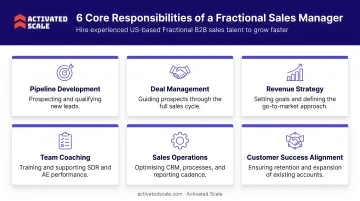
Day-to-day, a fractional sales manager typically handles:
- Process documentation — defining the sales stages, qualification criteria, and handoff points that reps actually follow
- KPI and target setting — establishing what "good" looks like and holding reps to it
- Weekly pipeline reviews — identifying stalled deals, coaching on next steps, and forecasting accurately
- One-on-one coaching — working directly with individual reps on calls, objection handling, and close rates
- CRM strategy and hygiene — ensuring Salesforce or HubSpot reflects actual pipeline status
- Performance reporting — giving founders clear visibility without requiring them to dig through the CRM themselves
The hiring and team-building function is also squarely in scope. A fractional sales manager takes ownership of recruiting new reps, onboarding them with a real process, and managing underperformers — including the difficult conversations most founders avoid for too long.
The Management Cadence They Create
One of the most immediate changes a fractional sales manager brings is structure through rhythm. Regular standups, one-on-ones, and quarterly goal reviews create accountability — making individual performance visible on a consistent schedule rather than surfacing only when something breaks.
Founders frequently describe this as the first time they actually knew what their sales team was doing week to week.
What a Fractional Sales Manager Is NOT
The confusion with adjacent roles is worth addressing directly:
| Role | What They Do | What They Don't Own |
|---|---|---|
| Sales Consultant | Advises on process and strategy | Doesn't manage people or own revenue targets |
| Sales Coach | Improves rep skills | Doesn't make hiring decisions or hit team goals |
| Fractional Sales Manager | Manages people, builds process, owns results | Accountable for team performance, not just recommendations |
As Activated Scale puts it, fractional sales professionals are "doers as opposed to the ones that will tell you what to do" — they hold the accountability, not just the advice.
Key Benefits of Fractional Sales Management for B2B SaaS Startups
Cost Efficiency
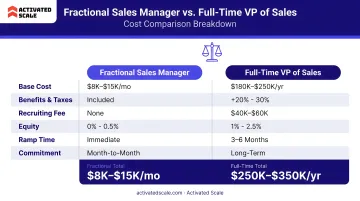
A VP of Sales costs $307,000 in median total pay — before benefits, equity, or the ramp period before they're productive. Per OpenView, average VP Sales tenure runs just 19 months, with many first hires churning within 12.
That's a significant bet on a role with a high failure rate.
Fractional engagements operate on a monthly retainer model. At the leadership level, that typically runs $12,000 per month plus bonus — a fraction of full-time cost with no equity dilution, no benefits overhead, and no severance risk.
Immediate Impact Without the Ramp
A new full-time sales leader needs months to learn the business, build credibility with the team, and start making changes. A fractional sales manager with cross-company experience arrives with proven systems already tested across multiple environments. They can diagnose pipeline problems and start building improvements in weeks, not quarters.
Founder Time Liberation
Founder-led sales has a hidden cost beyond the hours on calls. Every hour spent managing pipeline or fielding rep questions is an hour not spent on strategy, product, or high-leverage growth decisions. As OpenView has noted, founders who manage the sales team too long see slower growth and a less efficient sales org as a result.
Activated Scale clients save 20+ hours of founding team time per salesperson on interviewing alone. Day-to-day sales management reclaims even more time on top of that.
A De-risked Path to Full-Time Hiring
There's a "try-before-you-buy" logic here that matters. Working with a fractional sales manager helps you understand what you actually need in a permanent hire — the skill profile, the management style, the industry background — before making a $300K+ commitment.
Activated Scale's contract-to-hire model formalizes this: fractional engagements can convert directly to full-time roles. Roughly 65% of clients hire their fractional sales talent full-time after seeing real results. A conversion fee only applies if and when you make that hire — so the initial engagement carries almost no downside.
When Does Fractional Sales Management Make Sense?
The Ideal Company Profile
The model fits best for B2B companies with a small sales team — typically 2 to 15 reps — that have proven product-market fit but have plateaued. This usually looks like one of the following:
- The founder is still personally running sales alongside everything else
- The team operates without consistent structure or accountability
- Growth has stalled despite real customers and a working product
OpenView recommends waiting until at least $1M ARR before hiring a full-time VP of Sales. Fractional fills that gap — bringing leadership structure and accountability before the budget or team size justifies a full-time hire.
Warning Signs It's Time
- Pipeline is inconsistent and hard to forecast
- Reps lack direction and aren't clear on what a good deal looks like
- CRM data doesn't reflect reality
- Conversion rates are low and no one knows why
- Founder is spending too much time on sales calls and team issues
- Revenue has stalled despite having real customers and a working product
That said, the model has real limits. Fractional works when there's a team to lead and a foundation to build on — it breaks down when those conditions aren't in place.
When It Doesn't Make Sense
Avoid fractional sales management if:
- The company is in full crisis and needs someone present every day
- There's no internal team to manage — the fractional manager needs people to lead
- The expectation is that the fractional manager will personally handle all prospecting and closing
- The team size has grown to the point where a fractional arrangement doesn't provide sufficient coverage
Fractional Sales Management vs. The Alternatives
Fractional vs. Full-Time Sales Manager
A full-time manager offers daily presence and deeper immersion. But for companies with small teams, the cost per rep rarely makes sense at that scale, and the limited scope may not retain top sales talent for long. Fractional fits the actual scope of what most small-team sales management requires — and it costs significantly less.
Fractional vs. External Sales Agency
An external sales agency replaces your internal sales execution entirely — an outside team handles prospecting, calls, and closing. Fractional sales management builds internal capability instead. You retain full ownership of your pipeline, relationships, and process. That distinction matters more than it sounds: an external agency means starting over if you ever part ways; fractional leaves you with a trained team, documented process, and owned pipeline.
Fractional vs. Sales Coach or Consultant
Here's the gap most founders don't see until it's too late: coaches improve skills, consultants improve processes — but neither one manages people, makes hiring calls, or has skin in the game on revenue targets.
A fractional sales manager carries actual accountability. If the number isn't hit, that's on them — not just flagged in a slide deck.
How to Find and Hire the Right Fractional Sales Manager
What to Look For
Strong candidates share a few characteristics:
- Minimum 10–15 years of sales leadership experience — management roles, not just individual contributor success
- A documented management process — if they can't walk you through their system step by step, they probably don't have one
- Cross-company or fractional experience, which signals they can adapt quickly to a new environment
- Industry familiarity — more critical when you need fast strategic direction and can't afford a learning curve
How to Evaluate Them
Treat the process like a blend of hiring an employee and selecting a vendor. Strong evaluation tactics include:
- Ask what went wrong with past clients, not just what went right — evasiveness here is a red flag
- Use working sessions on real business problems instead of standard 30/60/90 presentations
- Check whether they ask diagnostic questions about your business, or whether they're primarily selling themselves
- Use a scorecard with objective criteria so you're comparing candidates consistently
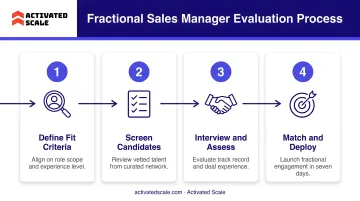
Finding the Right Person Faster
For B2B SaaS startups specifically, Activated Scale connects founders with vetted, US-based fractional sales professionals — many with backgrounds at Salesforce, Oracle, IBM, and similar companies. The vetting process covers three stages — experience review, a pitch video assessment, and a subject matter expert interview — so candidates arrive pre-screened for actual sales ability, not just resume depth.
SDR matches typically happen in under 7 days, AE roles within 10, and leadership-level positions follow a similar pace. Every engagement includes the option to convert to a full-time hire if the fit proves out.
Frequently Asked Questions
How much does a fractional VP of Sales charge?
Fractional VP of Sales engagements typically run $12,000/month plus bonus on a retainer basis. Manager-level fractional roles generally run lower: $4,500/month plus performance pay for SDR-level roles and $6,500/month plus performance pay for AE-level roles.
How much does a full-time Sales Director make?
According to Glassdoor, the median total pay for a Director of Sales in the US is $223,000 per year, with total compensation ranging from $169,000 to $301,000. For early-stage companies, a fractional arrangement delivers comparable expertise at a fraction of that cost.
What is the difference between a fractional sales manager and a sales consultant?
A consultant advises on process and strategy but doesn't manage people or own revenue goals. A fractional sales manager takes on direct accountability for the team — including coaching, hiring, pipeline reviews, and hitting sales targets.
When should a startup hire a fractional sales manager?
The clearest trigger points: the founder is still running all sales personally, the team lacks consistent structure and accountability, or revenue has plateaued despite having a working product and real customers.
Is fractional sales management the same as using an external sales agency?
No. An external sales agency replaces your internal sales execution with an outside team. Fractional sales management builds and leads your internal team — the company keeps full ownership of its pipeline, customer relationships, and sales process.
Can a fractional sales manager transition to a full-time role?
Yes, and it happens frequently. Roughly 65% of Activated Scale clients convert their fractional hire to a full-time employee — the contract-to-hire model keeps the transition structured and low-risk, since you've already seen them perform in your environment.