That's the core tension: sales leadership is critical, but the wrong hire at the wrong time drains runway and disrupts culture precisely when neither can afford disruption.
This article breaks down when fractional sales leadership makes sense, when full-time is the right call, and how to use the contract-to-hire bridge to de-risk the decision entirely.
Key Takeaways
- Fractional sales leaders are part-time executives: ideal for early-stage companies that need senior strategy without the full-time price tag
- Full-time sales leaders are permanently embedded, best suited for companies with a proven sales motion ready to scale
- Fractional VP retainers run $12,000/month plus bonus; full-time VP of Sales OTE runs $350K–$380K — the math strongly favors fractional at early stage
- The right model depends on ARR stage, pipeline maturity, team size, and whether you can define 2–3 clear outcomes
- A contract-to-hire path lets founders validate fit before committing to the full cost and risk of a permanent hire
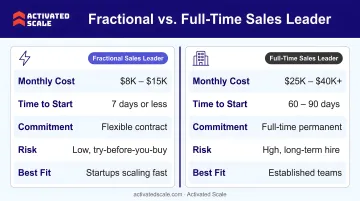
Fractional vs Full-Time Sales Leadership: Quick Comparison
| Factor | Fractional | Full-Time |
|---|---|---|
| Cost | $12,000/month plus bonus | $300K–$380K OTE + ~32% benefits burden + equity |
| Time to Start | 7 days or less (platforms like Activated Scale) | 3–6 months for senior sales roles |
| Commitment | Flexible, contract-based, scalable up or down | Long-term employment; harder to adjust |
| Best Fit Stage | Pre-PMF to early growth (0–$5M ARR) | Stable, proven motion ($10M+ ARR) |
| Risk Profile | Lower mis-hire risk; defined outcomes; easy to exit | Higher mis-hire risk; VP Sales tenure averages ~19 months |
On cost: According to Founderpath's 2026 SaaS benchmarks, a full-time VP of Sales carries a median OTE of $350K. Stack on the BLS-reported 32% benefits burden for management roles plus equity, and total comp easily clears $500K — before you've seen a single deal close. For a seed-stage startup, that's a significant portion of an entire funding round tied to one hire.
On hiring timelines: SaaStr notes that hiring a great VP of Sales can take 6–12 months. Meanwhile, pipeline stalls, deals go cold, and the window to hit your next ARR milestone narrows.
What Is Fractional Sales Leadership?
A fractional sales leader is an experienced VP of Sales, Head of Sales, or CRO-equivalent engaged on a part-time or contract basis. They provide strategic direction, build sales processes, and drive revenue without the fixed cost or long-term commitment of a full-time executive hire.
What They Actually Do
The scope is broader than most founders expect. A fractional sales leader typically:
- Diagnoses pipeline gaps and identifies ICP drift
- Builds repeatable sales playbooks and outreach cadences
- Implements CRM structure and KPI frameworks
- Defines messaging and refines the go-to-market motion
- Coaches early sales reps and assesses team capability
Outcomes are measured in weeks, not quarters. Because experienced fractional leaders have built these systems before, there's no six-month ramp time to get them productive.
Fractional vs. Consultant: A Real Distinction
This matters. A sales consultant delivers advice, frameworks, or specific project outputs and then exits. A fractional sales leader takes ownership of outcomes. They operate inside the leadership team, attend pipeline reviews, and are accountable to revenue metrics, not just deliverables.
Forbes describes the distinction clearly: fractional staffers fill a functional role for a set duration, while consultants are more advisory and project-oriented.
When Fractional Fits Best
Three scenarios where fractional wins consistently:
- Founder-led sales transition — the founder is closing deals but can't build a scalable motion alone
- Pre-Series A first sales function — no structured process exists; the company needs one built from scratch
- Post-bad-hire rebuild — a full-time sales leader didn't work; the company needs to stabilize before committing again
For startups navigating any of these situations, Activated Scale connects B2B SaaS companies with pre-vetted, US-based fractional sales leaders — including VP of Sales-level talent — in 7 days or less. The talent network includes professionals with backgrounds at Salesforce, Oracle, Zendesk, IBM, and Datadog, among others.
What Is Full-Time Sales Leadership?
A full-time VP of Sales or CRO is a permanently embedded executive responsible for long-term team development, revenue forecasting, cross-functional alignment, and building sales culture from the inside. The role extends well beyond deal strategy; it requires organizational continuity and daily presence.
When Full-Time Makes Sense
Full-time is the right call when:
- Revenue is predictable and the sales motion is proven
- You're managing 5+ quota-carrying reps who need daily coaching
- The company needs board-level reporting and investor relations that require full commitment
- You're entering a new market or scaling internationally
SaaStr's guidance is specific: wait until you have approximately $1M ARR, a repeatable sales process, and at least 2 reps consistently hitting quota before bringing in a VP of Sales. At that point, the new VP should be prepared to hire 8–10 reps in their first year — the priority is building the team, not carrying a personal quota.
The Limitations at Early Stage
For pre-product-market-fit companies, full-time sales leadership creates real structural problems:
- Hiring cycles of 3–6 months (sometimes longer) stall pipeline momentum
- Fixed cost of $300K–$380K OTE strains budgets before the motion is validated
- Mis-hire risk is disproportionate — OpenView reports VP of Sales tenure averaging just 19 months, and a wrong hire during team formation damages culture in ways that take far longer to repair
The cost of a wrong hire goes beyond the exit package. Replacing a senior sales leader means reopening a 3–6 month search while the team is disrupted and pipeline sits frozen.
Which Model Fits Your Growth Stage?
The right model depends entirely on where your company sits today — not on abstract comparisons between the two approaches.
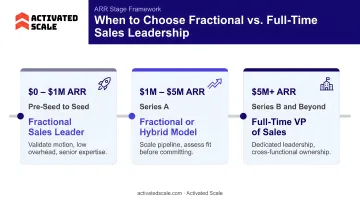
ARR-Stage Framework
| Stage | Model | Rationale |
|---|---|---|
| 0–$1M ARR | Fractional | Build first sales motion; validate ICP and messaging |
| $1M–$5M ARR | Fractional-to-Full-Time hybrid | Fractional builds the system; full-time hire takes over once motion is proven |
| $5M–$10M ARR | Full-Time (with fractional support) | Motion is proven; full-time leader drives team growth and execution |
| $10M+ ARR | Full-Time | Continuous oversight, team scaling, culture-building |
Founder Self-Assessment
Before committing to either model, answer these four questions honestly:
- Can you define 2–3 specific, measurable outcomes for this leader right now?
- Does your team need daily hands-on management, or strategic direction?
- Is your pipeline predictable enough to support a six-figure fixed cost?
- Do you expect to see ROI from this hire within 12 months?
If your answers lean toward structure, defined scope, and speed — fractional wins at early stage. If they lean toward continuity, scale, and team depth — full-time is warranted.
The Contract-to-Hire Bridge
The smartest founders don't treat fractional and full-time as binary options. They start fractional with conversion terms (compensation, equity, and timeline) already on the table. After 3–6 months, both sides have real data: the leader has demonstrated fit and impact, and the founder can commit to a permanent hire with confidence rather than hope.
Activated Scale reports that approximately 65% of clients hire their fractional sales talent as full-time employees after the initial contract period. That's not a failure of the fractional model — that's the model working exactly as designed.
Situational guidance:
- Choose fractional if you're building from scratch, fixing pipeline gaps, or testing a new GTM motion
- Choose full-time when you're scaling a proven motion, managing a growing team, or need a long-term culture carrier
Real-World Results: How B2B SaaS Startups Use Fractional Sales Leadership
The pattern repeats across early-stage B2B SaaS companies: a technical founder closes the first deals, growth stalls, ICP is fuzzy, and there's no repeatable process. The instinct is to hire a full-time VP of Sales. Without a defined motion, that hire often fails — and at $200K+ in total comp, the cost of a failed VP hire can set a startup back 6–12 months of runway.
What a Fractional Engagement Looks Like in Practice
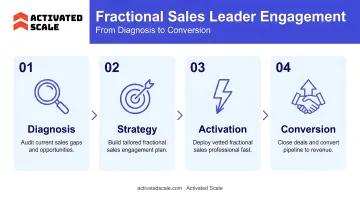
The typical arc with a fractional sales leader moves quickly:
- Week 1–2: Pipeline diagnosis — where deals are stalling, why ICP is undefined, what the outreach looks like
- Week 3–4: Refinement — sharpened ICP, revised messaging, CRM structure implemented
- Month 2–3: Execution — qualified pipeline building, cadence running, reps being coached
- Month 3+: Either continue fractional as the motion matures, or convert to full-time as scale demands it
Raven Health's results illustrate the pace: a fractional Head of Sales working 10 hours/week hit quota within 6 weeks, sustained 3 consecutive months of quota attainment, and compressed the average sales cycle to 18 days. Experienced leaders don't need ramp time — they diagnose and act from day one.
Activated Scale's Track Record
Across their 200+ client engagements, Activated Scale reports:
- Clients averaging 10–15 qualified meetings per month
- Fractional AE clients winning $50,000–$250,000 in new revenue per month
- 80% of clients continuing engagements for 5+ months
Client-level outcomes follow the same pattern:
- Windsor's co-founder reported a 4X increase in average deal size
- Dresma.ai saw a 5X increase in meetings with qualified prospects
- CaseActive built a complete sales process from scratch — saving 25 hours in hiring time — with a fractional hire who had previously built sales functions at three startups
The through-line across these engagements: speed to impact. Fractional leaders arrive with pattern recognition from prior startup roles, which means the diagnostic and execution phases compress significantly compared to a traditional full-time hire working through a 90-day ramp.
Conclusion
Fractional and full-time sales leadership serve different purposes at different stages. Full-time makes sense when you're scaling something proven. Fractional makes sense when you're still building the foundation worth scaling.
For most seed-to-Series A B2B SaaS companies, fractional is the strategically sound starting point. It builds pipeline fundamentals, generates early revenue wins, and validates leadership fit — all before you commit to the fixed cost and organizational risk of a permanent executive hire. The contract-to-hire model lets you validate fit before making a permanent commitment — so when you do hire full-time, you're deciding with real data, not a gut call. Platforms like Activated Scale are built around exactly this approach, connecting B2B SaaS startups with pre-vetted fractional sales professionals they can bring on in days and convert to full-time if the fit is right.
Frequently Asked Questions
What does fractional sales mean?
Fractional sales refers to engaging an experienced sales professional — individual contributor or leader — on a part-time or contract basis to drive revenue outcomes. It delivers senior expertise without the cost, equity commitment, or permanence of a full-time hire.
When should a startup hire a full-time sales leader instead of fractional?
Full-time makes sense when the company has a proven, repeatable sales motion and a team of 5+ reps requiring daily management. Revenue scale — typically around $1M ARR with consistent quota attainment — is usually the tipping point that justifies the long-term fixed cost.
How much does a fractional sales leader cost compared to a full-time hire?
Fractional VP of Sales retainers typically run $12,000/month plus bonus ($144K/year base retainer). A full-time VP of Sales carries a median OTE of $350,000–$380,000 plus a ~32% benefits burden and equity. The math favors fractional by 40–70% at early stage, depending on exact compensation structure.
Can a fractional sales leader transition to a full-time role?
Yes — this is a common outcome. Activated Scale reports approximately 65% of clients hire their fractional talent full-time after the initial contract period. The 3-month trial gives both sides real performance data before any permanent commitment is made.
What is the difference between a fractional sales leader and a sales consultant?
A fractional sales leader takes ownership of revenue outcomes and operates inside the leadership team with accountability to pipeline and KPI metrics. A sales consultant delivers advice or project deliverables without ongoing execution responsibility or revenue ownership.
Is fractional sales leadership right for seed-stage B2B SaaS startups?
Seed-stage is the primary use case. These companies need senior expertise to build pipeline fundamentals and define a repeatable sales motion — without the runway strain of a $350K+ full-time executive hire. Fractional closes that gap at 40–70% of the cost and with significantly less hiring risk.