
Introduction
Revenue pressure mounts fast at early-stage B2B SaaS companies. Yet hiring a full-time VP of Sales — with total compensation ranging from $253K to over $454K annually according to Glassdoor — is a commitment few seed-to-Series A founders can justify before product-market fit is confirmed.
Part-time sales leadership is often dismissed as a budget workaround — but the actual value runs deeper. It brings structured pipelines, senior-level accountability, and faster revenue growth without locking a company into an organizational commitment it isn't ready for.
What follows breaks down exactly what fractional sales leadership enables, where companies stall without it, and how to make it work at each stage of growth.
Key Takeaways
- Fractional sales leaders deliver VP-level expertise at a fraction of full-time executive cost
- Startups gain cost efficiency, faster pipeline growth, and the ability to scale headcount without long-term hiring risk
- Without sales leadership structure, founders become the bottleneck — and growth stalls
- Most companies see pipeline growth and win rate improvements within 60–90 days of engagement
- Activated Scale connects startups with vetted fractional sales professionals in 7 days or less — on a try-before-you-buy basis
What Is Part-Time Sales Leadership?
A part-time or fractional sales leader is an experienced sales executive — typically with VP, Head of Sales, or CRO-level experience — who works with a company on a contract or retainer basis rather than as a full-time employee.
This model is most common at seed-to-Series A B2B SaaS companies: teams that have validated their product but haven't yet built the internal sales infrastructure or budget to support a full-time executive.
That context matters when distinguishing fractional leaders from advisors. Advisors offer perspective; fractional leaders are accountable for outcomes. In practice, that means they:
- Build and refine the sales process end-to-end
- Run pipeline reviews and manage deal stages
- Coach reps on methodology and execution
- Own forecasting accuracy and revenue outcomes
That level of operational ownership is what separates fractional leadership from a consulting engagement — and why it produces measurable revenue impact rather than a strategy deck.
Key Advantages of Part-Time Sales Leadership
The advantages below map to real operational and financial outcomes. These are the metrics founders and revenue leaders track when evaluating whether their sales motion is working.
Cost-Efficient Access to Senior Sales Talent
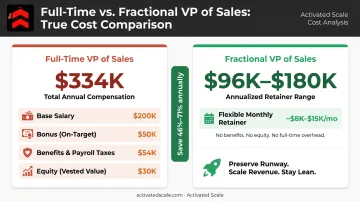
A full-time VP of Sales carries a significant price tag beyond the base salary — bonuses, benefits, and equity can push total annual compensation well past $300K. Fractional leaders work on monthly retainers, which cuts that commitment significantly — often by more than half.
For context: according to RevenueNomad's 2025 provider benchmarks, fractional sales leader retainers in the US range from $6K to $25K per month depending on scope. Activated Scale's Fractional VP of Sales engagements run $12,000 per month plus bonus, with 15–20 hours per week of dedicated time included.
Annualized, that's roughly $96K–$180K versus $334K in total pay for a full-time equivalent. The savings don't just preserve runway. They free budget for demand generation, headcount, and product investment.
KPIs most affected:
- Leadership cost as a percentage of revenue
- Sales budget utilization
- Runway preservation
- Time-to-hire
At seed-to-Series A, recurring revenue often isn't high enough to justify a six-figure executive salary — and the sales process is still being defined. That's where this model pays for itself fastest.
Faster Pipeline Growth and Revenue Acceleration
Experienced fractional sales leaders don't need months to ramp up. They arrive with diagnostic instincts and get to work quickly: reviewing CRM data, win/loss patterns, and ICP clarity before implementing structured sales processes within weeks.
That process installation is where the revenue impact shows. CSO Insights data shows win rates of 49.0% with sales enablement versus 42.5% without. Formal, chartered enablement pushed win rates to 55.1% versus 39.2% for ad-hoc approaches.
The methodology piece matters too. According to 2025 GTM Benchmarks from Ebsta and Pavilion, completing SPICED by the Solution Presented stage increased win probability by 307%. MEDDPICC completion at the same stage lifted it by 324%. Weekly CRM updates made opportunities 17% more likely to close won.
A fractional leader installs exactly this kind of structure : qualification criteria, deal stage discipline, and outreach cadences. Intuition-driven selling gets replaced with a repeatable system.
KPIs most affected:
- Qualified pipeline volume
- Monthly meetings with qualified prospects
- Win rate and average sales cycle length
- Forecast accuracy (which directly impacts investor reporting and hiring decisions)
The impact is sharpest when founder-led sales has hit a ceiling: the product or market has expanded, but the team's capacity to sell it consistently hasn't kept pace.
Flexible Engagement That Scales With Your Business
Unlike a full-time hire, fractional sales leadership is built to flex. Engagements range from lightweight advisory (10 hours/month) to deeply embedded operational leadership. Scope adjusts as revenue matures, a product line launches, or a full-time hire becomes the right next move.
That flexibility also reduces hiring risk. SHRM data puts the cost of a bad hire as high as $240K in recruiting, hiring, and onboarding. According to SaaStr, roughly 8 out of 10 first VP Sales hires at startups fail, with failed hires averaging around 11 months before being let go.
Activated Scale's try-before-you-buy model directly addresses this risk. Companies engage a fractional leader on an initial 3-month contract, evaluate their impact in the real sales environment, then decide whether to extend the fractional arrangement or convert to a full-time hire. The leader remains on Activated Scale's payroll during the contract with no W2 costs or benefits burden to the client.
What this model protects against:
- Costly mis-hires in a high-stakes leadership role
- Bloated sales leadership overhead during lean growth stages
- Founder time lost to managing a misaligned hire
- Delayed progress toward a self-sufficient sales team
It's particularly well-suited to transitional moments: a leadership gap, a new product launch, or a market expansion where senior sales ownership is needed fast, but a permanent hire isn't yet the right call.
What Happens When Sales Leadership Is Missing
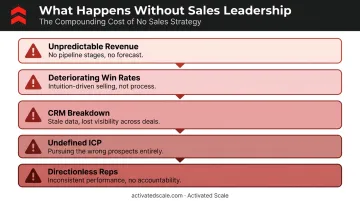
Without sales leadership structure, founders become the default sales leader. Demos, follow-ups, negotiations, and CRM hygiene all land on the same person also responsible for operations, fundraising, and product decisions. That creates a hard ceiling on growth.
The downstream effects compound quickly:
- Revenue becomes unpredictable — no defined pipeline stages, no reliable forecast
- Win rates deteriorate — deals are worked on intuition, not qualification criteria
- CRM hygiene breaks down — stages are skipped, data goes stale, visibility disappears
- The ICP stays undefined — the team pursues whoever shows interest rather than who they can win
- Reps lack direction — without coaching and accountability, performance varies wildly
The cost of this inaction is invisible until it becomes a crisis. Slow growth gets attributed to product fit or market conditions when the actual issue is the absence of sales structure — and by then, months of pipeline are already gone.
SaaStr recommends hiring a first VP of Sales once two reps are consistently hitting quota — typically around $1M–$2M ARR. Below that threshold, fractional leadership fills the gap without the commitment risk.
How to Get the Most Value from Part-Time Sales Leadership
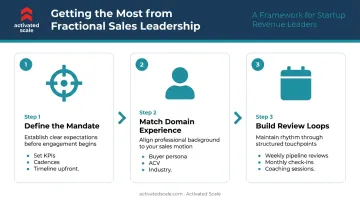
Structure separates high-impact fractional arrangements from ones that stall. A few principles make the difference:
1. Define the mandate upfront. Set the KPIs the fractional leader owns — pipeline coverage, win rate, meeting volume — along with the cadences they'll run and a timeline for progress. Ambiguity is where fractional engagements lose momentum.
2. Match domain experience, not just seniority. A VP-level hire from a different market won't compress your ramp time. For B2B SaaS, that means someone who has sold to your buyer personas, at your deal sizes, with comparable sales cycles. Activated Scale vets specifically for this fit, matching professionals by prior buyer persona, ACV, and industry, and can place candidates in 7 days or less.
3. Build consistent review loops. Weekly pipeline reviews, monthly check-ins, and structured coaching sessions keep the engagement building past the initial process-build phase. The first 45–90 days establish the foundation. Review cadences are what compound it.
Done right, a fractional sales leader delivers measurable pipeline impact within weeks — not the months it takes to hire, onboard, and ramp a full-time VP.
Conclusion
Part-time sales leadership gives early-stage companies the structure, expertise, and pipeline momentum they need to compete — without the financial risk of a premature full-time hire.
The model compounds over time. Cost efficiency preserves runway. Structured pipeline processes build predictable revenue. Flexible engagement means the arrangement scales as the business does. Activated Scale's try-before-you-buy model lets companies evaluate a fractional leader's real-world impact before any long-term commitment is required.
If your pipeline is inconsistent, your sales growth is stalling, or founder hours are disappearing into demos instead of strategy — a fractional sales leader is likely the highest-leverage hire you're not making yet.
Frequently Asked Questions
What is a fractional sales leader?
A fractional sales leader is an experienced executive — typically VP or CRO-level — who works part-time or on contract, taking ownership of sales strategy, process, team coaching, and pipeline outcomes without the cost or commitment of a permanent hire.
How much does a part-time sales leader cost compared to a full-time hire?
Fractional leaders typically charge a monthly retainer. Activated Scale's Fractional VP of Sales engagements run $12,000/month plus bonus. Compare that to a full-time VP of Sales averaging $334K in total annual compensation according to Glassdoor — the savings are substantial even at the higher retainer end.
When should a startup consider hiring a part-time sales leader?
Key signals: founder-led sales has become a growth bottleneck, pipeline is inconsistent or unforecastable, rapid growth has outpaced the team's selling capacity, or budget constraints make a full-time executive hire impractical before reaching $1M–$2M ARR.
What does a part-time sales leader actually do day-to-day?
Typical responsibilities include:
- Refining ICP and go-to-market messaging
- Building a repeatable sales process and qualification framework
- Running pipeline reviews and coaching reps
- Cleaning CRM data and improving forecast accuracy
- Owning accountability for revenue outcomes
How long does it take to see results from part-time sales leadership?
Most companies see measurable improvements in pipeline quality, win rates, and forecast accuracy within 60–90 days. That timeline assumes deal stages are defined and qualification criteria are embedded into the team's daily workflow.
Can a part-time sales leader eventually transition into a full-time role?
Yes. Activated Scale structures engagements as try-before-you-buy, with an initial 3-month contract period. If the fractional leader proves fit, they can convert to a full-time hire — reducing the risk of a costly permanent mis-hire from the start.