Yet most sales training still assumes an office. It assumes a manager walking by, a team energy you absorb, and in-person cues you read naturally. Strip those away and a lot of reps struggle without knowing exactly why.
The core problem is structural: remote inside sales requires you to deliberately engineer the conditions that an office gives you for free — focus, accountability, momentum, and trust. This post breaks down seven concrete strategies that address exactly that: how to structure your day, build genuine rapport through a screen, run a multi-channel outreach cadence that actually gets responses, choose the right tools, and track the numbers that tell you where your performance ceiling is.
Key Takeaways
- Block your calendar around prospect availability — mid-morning windows outperform open time.
- Build rapport deliberately with pre-call research and video-first habits.
- Run a multi-channel cadence across phone, email, and LinkedIn instead of betting on one channel.
- Keep your tool stack lean: a CRM, a dialer, and a solid video setup cover 90% of what you need.
- Track activity metrics daily, outcome metrics weekly, and close the loop yourself.
Structure Your Day for Maximum Selling Time
Salesforce's 2024 State of Sales research found that sales reps spend 70% of their time on non-selling tasks — and that 84% missed quota the prior year. The connection is direct: without a structured day, admin work, Slack, and inbox management fill every available hour.
Time-Block Around Prospect Availability
The most important scheduling decision a remote rep makes is when to dial. HubSpot's survey of 379 sales professionals found that 10 AM–12 PM is the most successful calling window for 51% of regular callers, with Tuesday ranking as the top day for 39% of them. That mid-morning window matters because prospects are settled into their day but not yet buried in afternoon meetings.
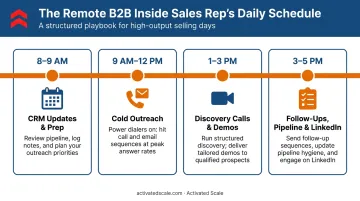
A workable daily structure for most B2B inside sales reps:
| Time Block | Activity |
|---|---|
| First hour (8–9 AM) | CRM updates, prospect research, call prep |
| Mid-morning (9 AM–12 PM) | Cold outreach — calls first, emails second |
| Post-lunch (1–3 PM) | Discovery calls and demos |
| Late afternoon (3–5 PM) | Follow-ups, pipeline review, LinkedIn touches |
Locking in that schedule is step one. Step two is making sure your environment supports it.
Set Up Your Physical Space Intentionally
Your home workspace affects more than video aesthetics — it shapes your own mental switch into work mode. At minimum:
- Camera at eye level, not angled up from a laptop on a desk
- Natural or ring light facing you, not behind you
- Clean, neutral background — bookshelves work, a messy kitchen doesn't
- Wired headset or quality USB mic — audio quality matters more than video quality on calls
Build Momentum Rituals
The office gave you external energy. Remote removes it. The reps who perform consistently replace that energy with deliberate rituals: a 5-minute daily target review before the first dial, a virtual stand-up with a peer, or a specific playlist that signals it's go time.
Isolation and reduced social interaction are genuine productivity risks for remote workers — not abstract concerns. Build your own structure, or the day will build itself around distractions.
Build Genuine Rapport Without Meeting in Person
Trust forms faster than most reps realize. Princeton researchers found that people form trait judgments from a face in as little as 100 milliseconds. On a cold call or video meeting, you have seconds to establish credibility — or lose it.
Pre-Call Research That Actually Helps
Generic openers fail because they signal you haven't done any work. Before every call, spend 5–7 minutes checking:
- Recent LinkedIn activity — a post they wrote or commented on is a natural conversation opener
- Company news — funding rounds, product launches, leadership changes
- Job postings — hiring signals reveal priorities and pain points
- Mutual connections or shared context — conferences, communities, previous companies
The goal is one specific, relevant observation that opens with genuine curiosity rather than a canned hook.
Active Listening on the Phone
Without visual cues, your ears have to do more work. Top-performing reps talk roughly 46% of the time on calls, while average performers talk in the high 60% range, according to Gong's analysis of millions of sales interactions. The difference shows up in deal outcomes.
Concrete techniques for phone-only calls:
- Use verbal affirmations ("That makes sense," "Interesting — tell me more") to signal engagement
- Leave deliberate pauses after a prospect finishes speaking — top reps pause five times longer than average reps during objections
- Ask one open-ended follow-up question before shifting to your next point
Video Builds Trust Faster Than Anything Else
When to push for video: any discovery call, any demo, and any follow-up where you're discussing price or next steps. Gong found deals were 127% more likely to close when video was used at any point, with win rates 94% higher when the seller's webcam was on.
Two habits that make video more effective:
- Look at the camera when making a key point, not at your own thumbnail
- Match the prospect's speaking pace — mirroring energy on video builds subconscious rapport faster than any script
Between-Call Relationship Continuity
Live calls build the connection; what happens between them determines whether it holds. Follow-up emails that reference something specific the prospect said outperform generic "thanks for your time" messages every time.
A few touches that signal you were actually listening:
- Send a short Loom walkthrough addressing a specific concern they raised
- Share a case study that maps to their company stage or use case
- Forward an article tied directly to a problem they mentioned
- Reference a detail from the call in your subject line
Sharpen Your Multi-Channel Outreach Cadence
Single-channel outreach underperforms. Salesloft's analysis of 15 million sales emails and 120 million cadence interactions found that multi-channel cadences improved outbound engagement by 4.7x compared to single-channel approaches. Three to four channels was identified as the optimal mix for outbound.
What a Practical Cadence Looks Like
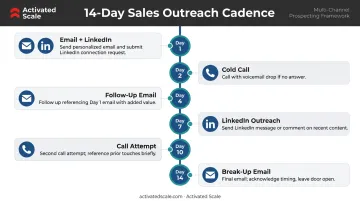
A 10–15 touch sequence spread across two to three weeks, using three channels:
- Day 1: Personalized email + LinkedIn connection request
- Day 2: Cold call (leave voicemail if no answer)
- Day 4: Follow-up email referencing something specific
- Day 7: LinkedIn message or comment on their content
- Day 10: Call attempt
- Day 14: Final email with a clear "break-up" line
The Salesloft data also supports same-day double touches — a call and email on the same day tripled outbound engagement in their dataset. Use it selectively, not as a default.
Cold Call Openers That Work
Avoid permission-asking openers. Gong found that "Did I catch you at a bad time?" produced a 0.9% success rate, well below the 1.5% baseline. Stating the specific reason for the call increased success by 2.1x.
A better structure for the first 15 seconds:
- State your name and company (1 sentence)
- Give a specific, relevant reason for calling (1 sentence)
- Ask a question that invites engagement
For common objections like "send me an email" or "not interested," respond with a question rather than a counter-pitch. According to Gong, top reps respond with questions 54.3% of the time during objections — not counter-pitches.
Email Personalization at Scale
The difference between a mail-merge and real personalization is one specific detail. Salesloft found that 25% personalization in a Day 1 email increased reply rates by over 300%. That personalization doesn't need to be elaborate — a sentence referencing their recent funding round, a specific product they're building, or a challenge their job posting reveals is enough.
On length: emails under 50 words got twice the replies of 100-word emails in Salesloft's B2B sales data. Short, specific, and easy to respond to outperforms thorough every time.
Use the Right Tools to Sell Smarter Remotely
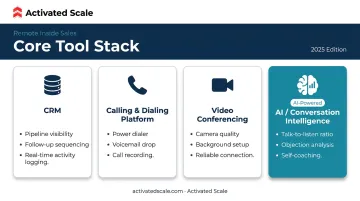
A bloated tech stack slows reps down. The three non-negotiable categories:
The Core Three
CRM — Non-negotiable for pipeline visibility, follow-up sequencing, and activity logging. The main mistake reps make: treating CRM as a reporting tool rather than a daily selling tool. Log every interaction in real time.
Calling/Dialing Platform — Power dialers, voicemail drop, and call recording are the main features that matter. Voicemail drop alone saves 30–45 seconds per no-answer, which compounds across 50+ daily dials.
Video Conferencing — A solid camera, clean background, and reliable connection aren't optional. Given what Gong's data shows about video's impact on close rates, treating this as a premium setup is worth the investment.
AI and Conversation Intelligence
Salesforce found that 83% of sales teams using AI saw revenue growth, compared to 66% without it. For remote reps specifically, conversation intelligence tools (which transcribe and analyze calls) solve a real problem: you don't have a manager listening in to give feedback after a tough call.
With call recordings, you can self-coach on:
- Talk-to-listen ratios
- How long you talk after a prospect raises an objection
- Whether your discovery questions are actually open-ended
Iron Mountain shortened new hire ramp time by three months after implementing Gong — because immediate, specific coaching feedback made coaching feedback immediate and specific.
Scaling a Remote Inside Sales Function
For B2B SaaS startups that need remote inside sales capacity without committing to a full-time hire, Activated Scale offers pre-vetted, US-based fractional SDRs and Account Executives who can be placed in seven days or less.
Their professionals bring backgrounds from companies like Salesforce, Oracle, IBM, and Zendesk. The try-before-you-buy model carries low risk — 80% of clients stay on for five months or more after seeing results.
Track the Metrics That Actually Drive Performance
84% of sales reps missed quota last year. Most didn't know they were off-track until the end of the quarter. Metrics solve that, but only if you look at the right ones at the right frequency.
Daily Activity Metrics
These are your inputs — the levers you directly control:
- Dials made
- Emails sent
- LinkedIn touches
- Live connects (actual conversations)
- Meetings booked
Track these daily. Not because a number on a spreadsheet motivates you, but because patterns in your activity data tell you what's broken before your pipeline does.
Weekly Outcome Metrics
These reveal whether you have a volume problem or a quality problem:
| Metric | What It Tells You |
|---|---|
| Connect-to-meeting rate | Are your openers and pitches working? |
| Meeting-to-opportunity rate | Are you qualifying well in discovery? |
| Average deal cycle length | Where are deals stalling? |
| Win rate | Is your closing motion effective? |
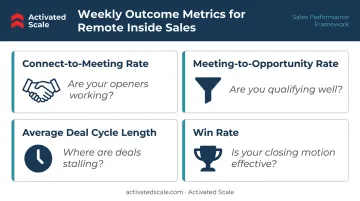
If your activity numbers are healthy but your connect-to-meeting rate is low, you have a messaging problem. If meetings are converting but deals aren't moving, the issue is elsewhere in the funnel. Each metric points to a different fix — know which one you're solving before you change anything.
Build a Simple Self-Coaching Dashboard
Once you know which metrics to watch, the tracking system itself can be simple. A spreadsheet with five to eight fields updated daily is enough. Log your activities, calculate your conversion rates weekly, and compare week-over-week.
Remote reps who track this consistently don't need to wait for a quarterly review to know they're off-track. They see it in the data three days before a manager does.
Frequently Asked Questions
Does inside sales or outside sales make more money?
Outside (field) sales reps typically earn more. Glassdoor data shows median total pay around $128K for field sales versus $111K for inside sales roles. That said, B2B SaaS inside sales can be highly lucrative, with incentive on high-velocity deals compounding quickly, especially at the AE level.
What are the biggest challenges of working as a remote inside sales rep?
The three that come up most often: maintaining self-discipline without office structure, staying motivated through extended rejection cycles, and building trust without face-to-face interaction. Structured daily routines and deliberate skill development address most of these directly.
How many calls and emails should a remote inside sales rep send per day?
Exact benchmarks vary by segment and product, so treat published ranges as starting points rather than gospel. The more important variable is personalization and sequencing quality — a smaller number of well-researched, multi-touch outreach sequences consistently outperforms raw volume.
What tools do remote inside sales representatives need to succeed?
Start with a CRM, a calling/dialing platform, and a solid video conferencing setup. A conversation intelligence tool adds real value once you're generating enough call volume to analyze. Resist adding tools until you've maxed out what you already have.
How do you build trust with prospects without meeting them in person?
Pre-call research, deliberate active listening, consistent video use for key meetings, and follow-ups that reference what the prospect actually said all build credibility fast. Prospects notice when a rep has done their homework — and they remember it.
How can a startup quickly build a remote inside sales team?
Options include full-time hiring, contract-to-hire, or engaging fractional sales talent. When the sales playbook is still being refined, fractional approaches reduce the risk of a costly mismatch — you validate fit and performance before committing to a permanent hire. Activated Scale specializes in exactly this: connecting early-stage B2B companies with experienced, US-based fractional inside sales professionals who can start within a week.