
The cost of getting it wrong compounds fast. SDR attrition in the industry runs 40–50% annually, according to The Bridge Group's 2024 research, and every failed hire means wasted ramp time, hollow pipeline, and delayed revenue — at a stage when each month matters.
This article covers what a top SDR actually looks like: the traits that predict sustained performance, the skills you need at hire, how to evaluate candidates during the interview, and the metrics to track post-hire.
Key Takeaways
- Hiring the wrong SDR quietly drains pipeline — and costs more than most founders budget for
- Top SDRs share five core traits: resilience, curiosity, process discipline, empathy, and goal orientation
- Skills matter too — strong communication, objection handling, and CRM proficiency are non-negotiable baselines
- The interview is a live audition — use role-plays, goal-setting questions, and coachability tests to screen effectively
- Post-hire, track both activity volume and meeting quality to validate the hire before it's too late
What Is a Sales Development Representative (SDR)?
An SDR is the top-of-funnel specialist responsible for identifying, qualifying, and nurturing prospects before passing them to an Account Executive to close.
Core SDR responsibilities include:
- Outbound prospecting and cold outreach across email, phone, and LinkedIn
- Qualifying inbound leads against your ICP
- Booking discovery meetings for AEs
- Maintaining clean CRM records that the broader revenue team depends on
SDRs generate pipeline — they don't close deals. That distinction matters when you're calibrating expectations and comp plans.
At early-stage B2B SaaS companies, SDRs handle more without support than their counterparts at larger firms. There's no sales ops function cleaning up CRM entries, no enablement team writing sequences. One misaligned SDR can consume weeks of founder time and still deliver little qualified pipeline — which is why evaluating fit carefully before hiring matters more than moving fast.
What to Look For in a Top SDR
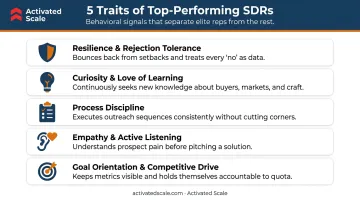
Identifying a top SDR means looking past resume credentials. The traits that predict sustained performance are behavioral, not purely experiential. Here are the five that matter most.
Trait 1: Resilience and Rejection Tolerance
SDRs face rejection as a daily constant. Cold calls go unanswered, emails get ignored, and warm leads push back. According to RAIN Group's research across 489 outbound sellers, it takes an average of 8 touchpoints to generate an initial meeting or conversion — top performers average 5.
That volume of outreach requires someone who can absorb no after no without losing their energy or conviction.
Resilience shows up in interviews as composure when challenged, the ability to reframe setbacks without becoming defensive, and a track record of persistence — not necessarily in sales roles. Athletes, fundraisers, and anyone who's worked in customer-facing environments where rejection is routine can show this trait clearly.
Trait 2: Curiosity and a Love of Learning
The best SDRs are genuinely curious about their prospects' businesses, not just their own product. That curiosity drives better discovery conversations, more relevant outreach, and faster adaptation when your ICP or messaging evolves.
Curiosity is easy to detect in an interview:
- Did the candidate research your company before the call?
- Do they ask sharp, informed questions — or generic ones?
- Can they speak to your industry without prompting?
The candidates who show up prepared and ask questions that reveal actual thinking are telling you something important about how they'll run outreach.
Trait 3: Process Discipline
SDR success is a volume-and-consistency game. Top performers follow a repeatable daily process — research, outreach, follow-up, CRM logging — without cutting corners, even when the results aren't showing yet.
Without this discipline, even a charismatic rep produces inconsistent results. You'll see bursts of activity followed by quiet weeks, patchy CRM data, and follow-up sequences that fall apart after the second touch.
What process discipline looks like in practice:
- Predictable activity metrics week over week
- Systematic follow-up cadences that don't rely on memory
- Clean CRM records that actually help your AEs prep for discovery calls
Ask candidates to walk you through a typical workday in their last role. Structured, specific answers signal discipline. Vague answers about "staying organized" don't.
Trait 4: Empathy and Active Listening
SDRs who listen deeply — catching subtle signals about readiness, pain, and hesitation — book higher-quality meetings and reduce wasted AE time. Empathy is what separates a rep who fills the calendar from one who fills it with the right meetings.
The clearest way to test for this is a role-play scenario during the interview. Give the candidate a simple prospect character and watch what they do. Do they ask questions and genuinely respond to the answers? Or do they talk through a script regardless of what the "prospect" says?
Reps who listen and adapt in real time consistently book more meetings — and better ones.
Trait 5: Goal Orientation and Competitive Drive
Look for candidates who can point to specific goals they've set — personal or professional — and walk you through exactly how they hit them. Goal orientation here doesn't mean aggressive or pushy. The best SDRs are driven by personal benchmarks and the satisfaction of moving names to meetings. They track their own numbers before their manager asks.
Ask: "Tell me about a specific goal you set outside of work and how you hit it." Financial goals, fitness milestones, academic targets — all valid. Concrete answers with clear actions and outcomes tell you more about drive than any hypothetical sales scenario.
Must-Have Skills for an Effective SDR
Traits are largely innate. Skills are learnable — but they still need to be present at hire or demonstrably acquirable within a short ramp period.
Communication and Objection Handling
Clear, confident verbal communication and real-time objection handling are the baseline for any SDR. The ability to listen, pivot, and address a core objection without losing momentum is what converts cold calls into booked meetings.
Gong's analysis of 300M+ cold calls found that average B2B sales reps have a 5.4% connect rate, while top-quartile performers hit 13.3%. The conversation-to-meeting set rate shows an even wider gap: 4.6% average vs. 16.7% for top performers. Communication quality drives a large share of that gap.
ICP Fluency and Discovery Questioning
Top SDRs understand your Ideal Customer Profile well enough to quickly qualify or disqualify a lead — and they use targeted discovery questions to gather the context AEs need to close. Naturally curious candidates learn this faster than those who treat qualification as a checklist.
This matters most in early-stage SaaS, where the ICP often shifts. A rep who can adjust their qualification lens as you refine your target market is far more durable than one who memorizes a static criteria list.
CRM and Outreach Tool Proficiency
Baseline familiarity with common sales tools reduces ramp time and keeps pipeline data clean. Key platforms to ask about include:
- CRM: Salesforce, HubSpot
- Outreach & sequencing: Outreach, Salesloft, Apollo
A candidate doesn't need to know every tool on your stack. Comfort with structured workflows matters more — especially for early-stage teams without dedicated ops support.
How to Evaluate SDR Candidates During the Hiring Process
The interview is a live demonstration of the SDR's core competencies. Treat it that way.
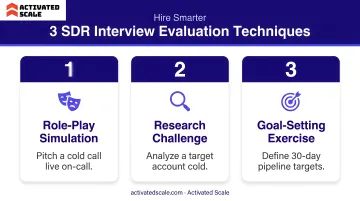
Three techniques that actually reveal fit:
Company research test — Notice whether the candidate researched your company before the call. Did they reference something specific, or did they open with generic flattery? Preparation before an interview predicts preparation before a cold call.
Role-play scenario — Give the candidate a brief mock prospect scenario and ask them to qualify it. Listen for question quality, how they respond to pushback, and whether they listen or just recite. A candidate who handles a curveball gracefully tells you more than a smooth rehearsed pitch.
Goal-setting question — Ask for a concrete example of a goal they set and hit outside of a sales context. Specific answers — with a target, a plan, obstacles, and an outcome — reveal goal orientation and follow-through without requiring prior SDR experience.
Screening for Coachability
Ask candidates to describe a time they received critical feedback, what they changed, and what happened as a result.
Coachable candidates give specific, behavioral answers. Vague responses about "always being open to feedback" tell you nothing — the best answer includes a named behavior change and a measurable outcome.
SDR Performance Metrics: Knowing When You Hired the Right Person
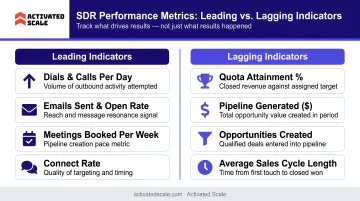
Post-hire, performance measurement falls into two categories: activity metrics (leading indicators) and outcome metrics (lagging indicators).
Leading Indicators to Track
These tell you whether the SDR is putting in the consistent effort that generates pipeline:
- Connect rate: Top-quartile B2B reps hit 13.3%, per Gong's data
- Outreach volume: Consistent week-over-week sequencing across email, phone, and LinkedIn
- Tracks whether they're completing the full sequence or dropping leads after one touch
Lagging Indicators That Validate Pipeline Quality
Activity alone isn't enough. These metrics tell you whether the work is producing real results:
- Meetings booked per month: Activated Scale clients average 10–15 qualified meetings by Month 3, segmented by target company size
- Meeting-to-qualified-opportunity rate: The strongest quality signal — tells you if the SDR is prospecting within your ICP or just filling the calendar
- Pipeline contribution: Revenue opportunities generated and actively progressing through the funnel
Ramp Time Expectations
Set these clearly on day one. The Bridge Group's 2024 SDR data puts average ramp-to-productivity at 3 months, plus or minus 2 weeks — a benchmark that has held consistent since 2007.
Early-stage startups can shorten this with a clear ICP, a defined outreach process, and daily coaching during the first 30–60 days. Without that infrastructure, even a strong hire will underperform. Set weekly activity benchmarks from the start so both sides know what success looks like well before the 90-day mark.
How Activated Scale Helps You Find Top SDR Talent
For seed-to-Series A founders who need pipeline generation without the infrastructure to hire, onboard, and ramp a full-time SDR from scratch, Activated Scale offers a direct alternative.
Activated Scale is a fractional sales talent marketplace built specifically for early-stage B2B SaaS companies. Every SDR in the network has passed a 3-step vetting process — application review, a 60–90 second pitch video assessment reviewed by peers, and a 30–45 minute subject matter expert interview. In 2024, Activated Scale accepted only 7% of all applicants.
Key differentiators:
- Faster time-to-hire — connect with a vetted SDR in 7 days or less (sometimes 48 hours), versus 90+ days for a traditional full-time hire
- Lower cost, lower commitment — SDRs work 15–20 hours per week at $4,500/month plus performance pay, compared to $60,000–$100,000+ annually for a full-time hire
- Try-before-you-hire — 65% of clients convert their fractional SDR to a full-time employee after seeing results; if the fit isn't right, Activated Scale will rematch you at no additional cost
- Results that stick — 80% of clients continue their engagement for 5+ months
- Performance benchmarks built in — every engagement starts with a Statement of Work outlining specific monthly targets, so both sides know what success looks like from day one
For early-stage teams without established sales infrastructure, the fractional model reduces financial risk, confirms the role is worth a full-time hire, and gets qualified meetings on the calendar faster.
Frequently Asked Questions
What to look for in an SDR?
Focus on five behavioral traits: resilience under rejection, genuine curiosity about prospects' businesses, process discipline, empathy and active listening, and goal orientation. These qualities predict sustained performance more reliably than years of experience — particularly at early-stage companies still refining their sales motion.
What are the most important KPIs for SDRs?
Track connect rate, outreach volume, and meetings booked per month as leading indicators. The most important quality metric is the meeting-to-qualified-opportunity conversion rate — it tells you whether meetings are real pipeline or calendar noise.
What is the difference between an SDR and a BDR?
SDRs typically focus on inbound lead qualification and meeting-setting, while BDRs focus on outbound prospecting. In practice, many startups use the terms interchangeably — the distinction is organization-specific, not universal.
How long does it take for a new SDR to ramp up?
The Bridge Group benchmarks average SDR ramp at 3 months, plus or minus 2 weeks. Early-stage startups can compress that timeline with a clear ICP, a defined outreach process, and daily coaching through the first 30–60 days.
Should an early-stage startup hire a full-time SDR or a fractional one?
Fractional is often the smarter starting point for seed-to-Series A companies. It reduces financial risk, lets you validate the function before committing to a full-time salary, and gives you a clear conversion path once the model is proven.
How do you screen for coachability in an SDR interview?
Ask candidates to describe a time they received critical feedback, what they specifically changed, and what the outcome was. Coachable candidates give specific, behavioral answers with measurable outcomes — not generalities about being open to feedback.