
Introduction
A wrong sales hire is one of the most expensive mistakes a startup can make. According to the Bridge Group's 2024 SaaS AE Benchmark Report, median annual AE turnover in B2B SaaS sits at 30%, and the average rep takes 5.7 months to reach full productivity — time your startup doesn't have to waste on someone who won't work out.
The harder problem is that salespeople are exceptionally good at interviews. The charisma, rapport-building, and confidence that signal a great first impression are the same skills that make a mediocre performer look compelling — and most founders, especially technical ones, walk away thinking "that person was great" when the more accurate read is "that person was easy to talk to."
This guide covers the specific qualities, skills, red flags, and interview structures that separate a rep who performs from one who just performs well in interviews.
Key Takeaways
- Coachability, resilience, and curiosity matter more than polish — they're harder to fake over time
- The right profile depends on your sales motion; early-stage SaaS needs self-starters, not playbook-followers
- Structured interviews with roleplay scenarios reveal more than resumes or gut feelings ever will
- Watch for script-dependence, compensation-first conversations, and zero self-criticism after a roleplay
- A try-before-you-buy model like Activated Scale cuts hiring risk when you can't afford a bad sales hire
Why Hiring a Sales Rep Is Harder Than It Looks
Salespeople are professionally trained to make you like them. That's the job. But it creates a real evaluation problem: the interpersonal ability that makes a candidate appealing in an interview can mask underdeveloped discovery skills, poor pipeline habits, or an inability to work without structure.
That charm is exactly what fools most hiring managers.
At a large company, these gaps get covered. There's a playbook, an SDR team feeding warm leads, a recognized brand opening doors, and a sales manager running weekly coaching sessions. At a seed-stage startup, none of that exists.
What this means practically:
- Your first rep needs to build pipeline from scratch, without inbound support
- They'll need to develop their own messaging, since there's no established pitch deck that works
- They'll be the only voice on calls, with no brand recognition backing them up
- They'll hit cold periods and need to self-motivate through them
When someone can't operate in that environment, the costs compound fast. You lose 5+ months of potential pipeline activity. Prospect relationships get handled poorly and often don't recover. The founder ends up spending hours managing someone who isn't producing, time that could go toward product or fundraising.
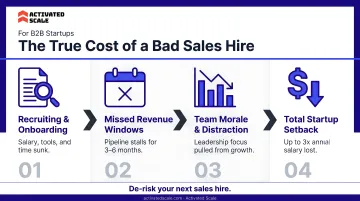
SHRM notes that recruiting, hiring, and onboarding a single employee can cost as much as $240,000 when all costs are factored in. For an early-stage startup, that's not an abstract HR statistic — it's a real threat to runway.
Key Qualities to Look for in a Sales Representative
Skills can be taught. Qualities — the behavioral tendencies that determine how someone approaches their work — are far harder to develop in someone who doesn't already have them. At the early-stage level, where bandwidth for coaching is thin, these traits are often the deciding factor.
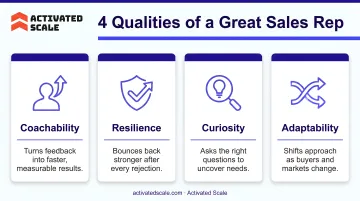
Coachability
A rep who can't receive and apply feedback will plateau fast. In a startup where the sales process is still being defined week by week, the ability to iterate is non-negotiable.
A peer-reviewed study of 211 B2B salespeople found that coachability was a significant predictor of sales performance — and separate research in the Journal of Business & Industrial Marketing suggests using it as a primary screening criterion during recruiting.
How to test it: Give feedback during the interview itself — right after a roleplay, offer one specific critique. Watch what happens. Does the candidate get slightly defensive and explain why they did it that way? Or do they absorb it, ask a clarifying question, and adjust? The response tells you more than anything on the resume.
Self-Motivation and Resilience
Sales involves constant rejection. In an outbound-heavy B2B role at a company with no inbound pipeline, the emotional weight of that rejection falls entirely on the rep.
Look for candidates who:
- Have worked at small or early-stage companies before
- Can describe a cold period — and how they pulled out of it
- Have concrete examples of creating pipeline opportunities with minimal support
Candidates who've only worked in well-resourced environments with warm inbound leads often struggle when those conditions disappear.
Curiosity and Active Listening
Curious reps ask better discovery questions. They actually want to understand the prospect's business — and that genuine interest shows up in conversations in ways that scripted engagement never can.
This trait surfaces in interviews, too. Does the candidate ask substantive questions about your product, customers, and sales challenges? Or do they talk about themselves for 45 minutes and ask nothing? Candidates who treat interviews as one-way presentations tend to treat sales calls the same way.
Problem-Solving and Adaptability
A rep who can position your product as the specific solution to a buyer's problem will outperform someone who recites features every time. In complex B2B deals with nuanced stakeholder dynamics, that difference shows up directly in win rates.
Adaptability is the related trait that matters most in a startup context. Ask candidates directly: "Tell me about a time you had no playbook and had to build your own approach." How they answer — and whether they have a real story — tells you a lot about their ceiling in an unstructured environment.
Skills That Separate Good Sales Reps from Great Ones
Unlike qualities, skills are measurable. For early-stage hires, you want candidates who already have the fundamentals — there's limited time and infrastructure for on-the-job skills training.
Discovery and Qualification
Discovery is the foundation of effective B2B sales. A rep who can't uncover a prospect's real pain, decision timeline, budget constraints, and internal politics won't close consistently — regardless of how well they pitch.
Test this directly. Give the candidate a one-paragraph description of your product and ask them to walk you through the questions they'd ask in an initial discovery call. Strong candidates will ask layered, open-ended questions that expose business context. Weaker candidates will start pitching.
Communication and Storytelling
Strong sales communication means translating technical features into business outcomes, tailoring a message to a specific buyer persona, and structuring a conversation that leads somewhere. It's not just being articulate.
Written communication is equally telling. Gong's analysis of 30,000+ prospecting emails found that 87% of buyers say sales emails fail to address relevant organizational challenges. Look for clear, specific writing in any pre-interview communications or take-home exercises — generic outreach is a signal.
Objection Handling and Negotiation
Candidates should be able to reframe objections without dismissing the prospect's concern or folding under pressure. This is a learnable skill, but candidates should already have a baseline.
On negotiation: great reps protect deal value rather than defaulting to discounts. For a SaaS company managing ARR integrity, a rep who immediately offers a discount when a deal stalls is a liability.
Pipeline Management and CRM Proficiency
Pipeline hygiene — knowing where every deal stands, forecasting accurately, following up systematically — separates top performers from average ones. This is professional discipline, and it shows up or doesn't within the first 60 days.
Ask candidates how they manage their pipeline. Ask what their CRM workflow looks like on a typical Friday afternoon. A candidate who can't tell you their close rate, average deal size, or pipeline coverage ratio isn't running a real sales process — they're winging it.
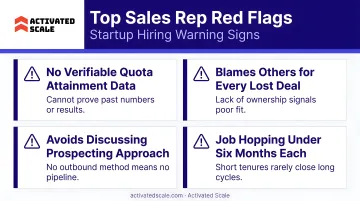
Red Flags to Watch for When Hiring a Sales Rep
These aren't disqualifiers on their own — they're patterns worth probing further.
- Script-dependence without adaptability: A polished pitch that falls apart the moment you ask an unexpected question is a warning sign. During roleplay, throw in an objection that isn't on any standard list. See what happens.
- Compensation-first conversations: Candidates who spend most of early conversations focused on base salary and performance pay rates — before understanding what they'll be selling and to whom — may be motivated more by income than outcomes.
- No self-criticism after a roleplay: Ask "How do you think that went?" after any mock exercise. A candidate who says it went great without any specific reflection almost certainly isn't coachable.
- Talking more than listening: Gong's research on sales calls found that reps in won deals averaged 57% talk time; reps in lost deals averaged 62%. Candidates who dominate every conversation in the interview may replicate that pattern with buyers.
How to Structure Your Interview Process to Reveal True Sales Ability
Most founders run unstructured interviews and make hiring decisions within the first five minutes — SHRM research confirms this is common, and that gut-feel decisions have little predictive validity. A structured process changes that.
1. Build a skill/will matrix before you interview anyone. List the specific skills (qualification, CRM use, communication) and behavioral traits (coachability, resilience, curiosity) the role requires. Assign each interviewer specific questions or tasks designed to probe those dimensions — not just a general conversation.
2. Run a mock discovery call. Give the candidate a one-paragraph product brief and ask them to run a 10-minute discovery call with you as the prospect. This single exercise reveals:
- Whether they listen or default to pitching
- The quality and sequence of their discovery questions
- Their composure when you push back mid-call
- Whether they can adapt on the fly without a script
3. Ask questions that require real self-awareness. "What would you do in your first 30 days to start building pipeline?" and "Walk me through a deal you lost and what you'd do differently" are more revealing than standard prompts. Strong candidates show initiative and intellectual honesty. Watch for vague answers that skip accountability — those are a signal.
4. Evaluate written communication separately. Ask them to draft an outreach email to a specific buyer persona for your product. Quality of writing, specificity of messaging, and understanding of buyer pain are all visible in a single exercise.
How Activated Scale Helps You Find the Right Sales Rep
For B2B SaaS founders at the seed to Series A stage, knowing what to look for is only half the problem. The other half is finding candidates who actually match those criteria — without spending weeks on a search that pulls you away from everything else.
Activated Scale connects founders with pre-vetted, US-based fractional sales professionals from companies including Salesforce, Oracle, IBM, Zendesk, Glassdoor, Indeed, Crunchbase, and UiPath — typically within 7 days, sometimes faster.
Every candidate goes through a three-stage vetting process before entering the network:
- Experience verification to confirm relevant B2B SaaS background
- A pitch video reviewed by peers already in the network
- A subject matter expert interview
The model that matters most for early-stage companies is the try-before-you-buy structure. Founders engage a fractional rep on a contract basis, evaluate fit in real selling conditions — with their actual product, buyers, and sales motion — and then convert the best performers to full-time roles. The standard contract-to-hire period is three months, which means you know whether the rep is right for you long before making a permanent commitment.
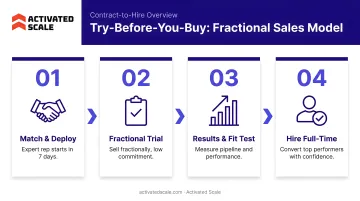
In practice, Activated Scale clients save 20+ hours of founding team time per hire (one client, CaseActive, specifically logged 25 hours saved), and 80% of clients continue working with their Activated Scale sales talent for 5+ months — which reflects how well the matching process holds up past the initial trial period.
Clients like Roboflow, Kognitos, Tango, and Momence have used this model to get experienced sales talent in quickly and grow from it. Kognitos founder Binny Gill put it directly: "Activated Scale quickly understood my current stage and recommended an expert that has sold to my buyer to help me build my Sales GTM."
Conclusion
The best sales hires aren't the most enthusiastic interviewees. They're the candidates whose behavioral traits, demonstrated skills, and working preferences align with your specific sales motion — the complexity of your product, the profile of your buyers, and where you are in building the sales function.
Use the qualities and skills outlined here as an evaluation framework, not a rigid checklist. The weight of each factor shifts with context: your first rep versus your fifth, SMB versus enterprise, a defined playbook versus one you're still building.
However you approach the hire — through your own process or through a platform like Activated Scale that lets you test fit before committing — what matters is finding someone who generates real pipeline and earns the trust of your buyers. That's the rep worth building around.
Frequently Asked Questions
What are 5 good qualities of a salesperson?
The five that matter most are curiosity, coachability, self-motivation, resilience, and strong communication. Together, these traits determine how well a rep learns, recovers from rejection, and ultimately closes deals.
What is the biggest mistake companies make when hiring their first sales rep?
Hiring based on likeability or a polished interview rather than evaluating proven skills, adaptability, and fit for the specific sales motion. A great interviewer isn't always a great seller — and in an early-stage startup, that gap surfaces quickly.
Should I prioritize industry experience or coachability when hiring a sales rep?
Industry experience shortens ramp time, but coachability is typically more valuable long-term — especially when your product, messaging, and ICP are still evolving. A coachable rep can learn your market; a rigid rep with industry experience will keep selling it the wrong way.
What interview questions best reveal whether a sales candidate is truly motivated?
"What would you do in your first 30 days to build pipeline?" and "Walk me through a deal you lost and what you'd do differently" are the most revealing. Strong candidates show specific initiative and honest self-assessment — not polished but empty answers.
How long does it take to know if a new sales rep is a good fit?
The Bridge Group's 2024 benchmark puts average AE ramp time at 5.7 months in B2B SaaS. That said, early indicators — pipeline activity, CRM consistency, quality of follow-up communication — are usually visible within the first 30–60 days.
What is the difference between a fractional sales rep and a full-time sales hire?
A fractional sales rep works part-time or on a contract basis, giving companies access to experienced talent without full-time salary and benefits costs. Platforms like Activated Scale offer a contract-to-hire model — typically a three-month engagement — so founders can assess fit in real conditions before committing to a full-time role.