

Introduction
Most B2B SaaS founders get burned not by a shortage of sales candidates, but by a hiring process that rewards confident talkers over actual closers. Someone who crushes a 45-minute interview can spend six months failing to build pipeline — and by then, you've burned leads and stalled revenue you'll never recover.
The numbers back this up. According to SBI Growth's sales-hire cost model, a bad sales hire costs at least $95,000 in recruiting, onboarding, salary, and benefits before you even calculate lost revenue. Meanwhile, RepVue's Q2 2024 Cloud Sales Index found that only 42.68% of quota-carrying B2B cloud sales reps hit their number — across 213 companies and roughly 39,000 sellers.
Hiring a proven rep requires more than scanning for years of experience. You need to define what success looks like for your specific motion, source through the right channels, and validate real performance data before making an offer.
This guide covers that full process: from identifying the traits that predict results to structuring onboarding so new hires perform within 90 days.
Key Takeaways
- Hire reps with proven performance in environments that match your deal size, buyer type, and sales motion
- Define your sales motion and success criteria before writing a job description
- The best candidates aren't job hunting — source through referrals, direct outreach, and targeted platforms
- Evaluate with structured interviews, quota-attainment questions, and live role-plays
- Manage new hires against 30-60-90 day activity milestones, not just annual revenue targets
What Makes a Sales Rep "Proven" — The Traits That Actually Drive Results
"Proven" doesn't mean a long resume or a recognizable company logo. It means demonstrated, consistent performance in a sales environment that closely mirrors yours — similar product complexity, deal size, and buyer type.
The Five Traits That Separate Top B2B Performers
| Trait | What It Looks Like in Practice |
|---|---|
| Resilience | Bounces back from rejection without losing momentum or needing a pep talk |
| Coachability | Takes feedback, adjusts approach, and improves — not defensive |
| Intrinsic drive | Self-motivated; doesn't need micromanagement to hit activity targets |
| Curiosity | Asks layered discovery questions before pitching — listens more than talks |
| Process-orientation | Follows a repeatable methodology (MEDDIC, SPIN, Challenger) consistently |
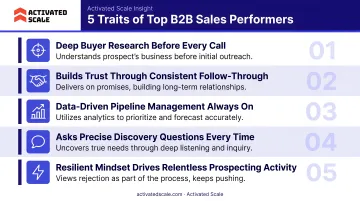
That fifth row — intrinsic drive — carries more weight than most hiring managers expect. A 2023 Baylor University meta-analysis of 127 studies covering 77,560 salespeople found that intrinsic motivation has a significantly stronger relationship with B2B performance than performance-based incentives. Compensation still matters, but reps driven by ownership and impact consistently outperform those chasing a check.
Pipeline Generation Is the Non-Negotiable
For early-stage B2B SaaS, the single most critical trait is pipeline generation ability — the capacity to create conversations from cold outreach, not just close warm leads handed to them. Many candidates have closed deals; far fewer have built pipeline from scratch.
A rep who drove revenue at a resource-constrained startup often outperforms one who hit quota riding a well-known brand's tailwind. Ask specifically: How much of your pipeline did you self-source versus receive inbound? The answer tells you everything.
Early-stage environments where reps help define the ICP, test messaging, and shape the playbook are a strong draw for this profile. The best salespeople want ownership, not just a territory.
How to Define Your Hiring Criteria Before You Post a Job
The most common early mistake is writing a job description before defining what success actually looks like. The result: you attract candidates who look good on paper but don't fit your actual motion.
Answer These Questions First
Before posting anything, nail down the following:
- What is your average deal size and sales cycle length? A rep who closes SMB deals in 30 days will struggle in a 90-day multi-stakeholder enterprise process.
- Is the rep expected to self-source leads or work inbound pipeline? These require completely different skill sets.
- Who are the buyers? Technical buyers (CTOs, developers) require different discovery than business buyers (CFOs, VPs of Sales).
- What CRM and tools will they use? CRM fluency affects ramp time, especially if your stack is non-standard.
Build Your Profile Around Your Motion
Once you've answered those questions, map them to a rep archetype:
- Outbound, consultative, long-cycle: prioritize prospecting skills, patience, and the ability to manage multiple stakeholders over time
- Inbound, transactional, short-cycle: look for speed, high-volume discipline, and fast qualification instincts
- Hybrid, mid-market: requires both skill sets — expect to search longer and pay more to find the right fit
- Pipeline-less, early-stage: needs someone comfortable building from scratch with minimal infrastructure or playbook
Putting these details in the job description filters out mismatched applicants before the first screen. Candidates who've done the wrong type of selling will self-select out — saving you interviews and saving them a bad fit.
Where to Find Proven B2B Sales Representatives
The best candidates are rarely actively job hunting. Posting to a general job board and waiting is a volume play, not a quality play.
According to CareerPlug's 2024 Recruiting Metrics Report, referrals generated only 2% of applications but 11% of hires — making referred candidates 11x more likely to be hired than job-board applicants. Job boards drive volume; referrals drive conversion.
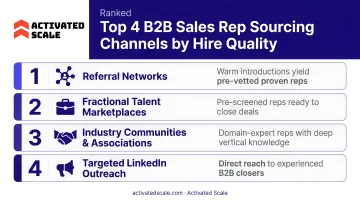
Highest-Yield Sourcing Channels
- Your network and customers — Ask your best customers: Who's the best salesperson you've ever dealt with on the vendor side? These referrals come pre-validated.
- LinkedIn direct outreach — Target reps at companies one or two stages ahead of yours. They understand your buyers, your problems, and what good looks like.
- Investor and founder networks — Your investors have seen dozens of sales hires across their portfolio. Ask who they'd call first.
- Specialized sales talent platforms — General job boards mix signal with noise. Platforms built for sales hiring improve match quality significantly. Activated Scale, for example, places vetted US-based fractional sales reps — SDRs, AEs, and sales leaders — within 7 days. 65% of clients convert their fractional rep to a full-time hire after seeing results, which is a useful indicator of fit before you commit.
How to Evaluate Sales Candidates Rigorously
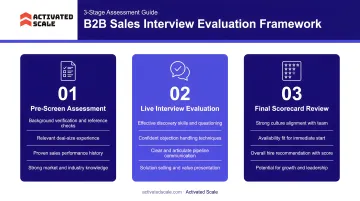
Traditional interview formats favor charisma over capability. The candidate who's most polished in the room often turns out to be the most disappointing in the role. Structured, multi-stage evaluation cuts through that pattern.
Start With a Written Pre-Screen
Before any call, send candidates a short set of biographical and behavioral questions. This step:
- Filters out low-effort applicants immediately
- Tests written communication, which matters for outbound sales
- Creates a consistent baseline across all candidates
Performance Data Questions That Reveal Real Track Records
In interviews, ask for specifics — not stories. Strong candidates answer immediately with numbers; weak ones hedge or go vague.
Use these questions:
- What specific quota were you responsible for, and what percentage did you attain?
- What was your average sales cycle length and deal size?
- How much of your pipeline did you self-source versus receive inbound?
If a candidate can't answer these precisely, that's the answer.
Role-Plays and Live Selling Scenarios
Require candidates to pitch your actual product. They should have researched your value proposition from public materials. Then introduce a curveball — a pricing objection, an unexpected stakeholder, a deal stall — and observe whether they listen and adapt or push through a script regardless.
This is a work sample test in practice. A landmark meta-analysis by Schmidt & Hunter found that structured work samples are among the highest-validity predictors of job performance — outperforming unstructured interviews by a wide margin.
Behavioral Questions That Surface Accountability
Two questions cut through rehearsed answers quickly:
- Walk me through a deal that fell apart — what happened and what would you do differently?
- Tell me about a time you missed quota — how did you respond?
Top performers own their outcomes and articulate specific lessons. Underperformers deflect — bad leads, bad product, bad timing. Watch for the pattern, not just the answer.
Red Flags That Reveal an Underperformer Early
These are the warning signs founders most often overlook because the candidate interviews well.
Interview red flags:
- Vague or inconsistent metrics — claims big wins but can't explain quota attainment or deal specifics
- "I just build relationships" with no methodology behind it — personality over process
- Blame pattern — missed targets are always someone else's fault
Resume red flags:
- Multiple tenures under 18 months with no explanation (pipeline roles need time to mature)
- Titles like "Sales Manager" or "Head of Sales" when you need someone who carries a bag and closes
- No measurable outcomes listed per role — if they can't quantify it on a resume, they didn't track it in the role
One flag founders miss: Candidates pushing hard for a 70/30 base-heavy split usually prefer account management over new business hunting. If you need pipeline creation, that's the wrong hire. For outbound-focused B2B SaaS roles, a 50/50 split is the right structure — and the right candidate won't push back on it.
How to Set Your New Sales Rep Up for Success in 90 Days
The most common post-hire failure is handing someone an annual revenue target and waiting. By the time underperformance is obvious, six months are gone. A milestone-based 90-day plan catches problems while there's still time to correct them.
The 30-60-90 Day Framework
| Period | Activity Milestones | Key Outputs |
|---|---|---|
| Days 1–30 | Product training, shadowed calls, CRM setup | Can demo independently; knows ICP and messaging |
| Days 31–60 | Self-generated outreach; consistent prospecting activity | Pipeline started; meetings being booked |
| Days 61–90 | First proposals sent; at least one deal progressing toward close | Revenue visibility emerging |
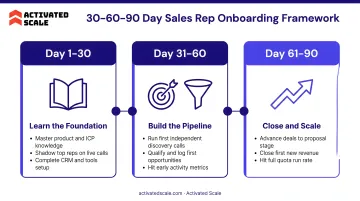
Tracking activity in the first 60 days — calls made, emails sent, meetings booked — is early warning, not micromanagement. A rep who isn't generating pipeline activity in month two won't close deals in month four.
Compensation Structure
The market benchmark for a first B2B SaaS AE hire is a 50/50 base-to-variable split. The Bridge Group's 2024 AE benchmark reports a median OTE of $190,000 with a 53:47 base-to-variable split across 170+ B2B SaaS companies. Entry-level AEs in major markets typically run $90,000 base / $180,000 OTE.
A few practical notes:
- Pay 10–20% above benchmark on base if you've found the right candidate. The cost of a failed hire runs $95,000+ before you factor in lost revenue — a few thousand on salary is a small tradeoff
- Avoid performance-only arrangements — they signal instability and attract candidates who can't find a company willing to back them with a base
Clear Onboarding Reduces Attrition
Compensation gets a rep in the door. Onboarding determines whether they stay. Before a rep makes their first call, they need:
- Defined territory or target account list
- CRM set up with their workflow
- A documented sales process (even a basic one)
- At least five shadowed calls before solo outreach
Skipping these steps extends ramp time and increases early attrition — which you're then paying to replace.
Frequently Asked Questions
Frequently Asked Questions
How much does it cost to hire a sales rep?
B2B SaaS AEs run $90,000–$150,000 base with $180,000–$300,000 OTE; SDRs typically land at $50,000–$65,000 base with $70,000–$85,000 OTE. Fractional options cost far less upfront — monthly retainers are $4,500/month plus performance pay for fractional SDRs and $6,500/month plus performance pay for fractional AEs.
What is the 70/30 rule in sales?
A 70/30 split means 70% base, 30% incentive, which signals lower risk appetite. Candidates who push for this arrangement often prefer account management or renewal work over new business hunting. For an outbound-focused first hire at a B2B SaaS startup, a 50/50 split is the more appropriate standard.
What qualities make a proven sales rep stand out?
The five core traits are resilience, coachability, intrinsic drive, curiosity, and process-orientation. For early-stage B2B companies, pipeline generation ability matters most: you need someone who creates conversations from cold outreach, not just closes warm leads handed to them.
How do you verify a sales rep's track record during hiring?
Ask for specific quota attainment percentages, average deal sizes, and what proportion of their pipeline they self-sourced versus received inbound. Follow up with reference checks from former direct managers, not references the candidate hand-picks. Verification matters because resume claims are easy to inflate.
Should I hire a full-time or fractional sales rep first?
For most early-stage B2B SaaS companies, a fractional hire is lower risk. It lets you validate sales fit and refine your motion before committing to a full-time salary and benefits package. Activated Scale's try-before-you-buy model is specifically designed for this — you can test fit during an initial contract period and convert to full-time once performance is proven.
How long before a new sales rep starts delivering results?
Expect 3–6 months to reach full productivity in B2B SaaS. Activity metrics — pipeline generated, meetings booked — should be visible within 30–60 days. First deals should be actively progressing by day 90. If pipeline activity isn't visible by day 45, that's a signal worth addressing directly.