
This guide covers the full picture: how to know when you're actually ready, which type of rep to hire first, what to look for, how to pay them, and how to set them up so they don't fail in the first 90 days.
One important note before diving in: SaaS sales hiring is different from generic sales hiring. Subscription models, longer sales cycles, and technically sophisticated buyers require a specific profile — and the mistakes founders make here are expensive.
Key Takeaways
- Validate product-market fit with at least 10 paying customers and a repeatable pitch before making your first hire
- Hire two reps simultaneously — not one — to establish a performance baseline and reduce dependency risk
- Match rep experience to your company stage and deal size, not just your industry vertical
- Early hires take real career risk — pay above market on base, incentive, and equity
- Document your sales process before day one (ICP, objection handling, CRM) so reps can hit the ground running
Before You Hire: Signs Your SaaS Startup Is Ready
The 10 Customers and 30 Lost Deals Benchmark
ScaleView's B2B SaaS hiring guide frames readiness around two numbers: at least 10 paying customers acquired through founder-led sales, and at least 30 failed opportunities in your history. Both matter. The wins tell you what the repeatable pattern looks like. The losses tell you which objections surface repeatedly, where deals stall, and which prospects were never a real fit to begin with.
Without working through those 30 losses yourself, you have no material to hand a new rep. They'll walk in with no objection-handling guide, no ICP definition, and no sense of what "good" looks like in a discovery call. They'll be building from scratch — on your payroll.
Revenue Readiness
On the MRR side, practitioners use $8K–$10K MRR as an early readiness signal. SaaStr's founder example places the first full-time sales hire at roughly $8K MRR, with the company closing more than one new non-self-service customer per week. ScaleView puts the bar at $10K MRR ($120K ARR). Neither is a hard rule — both point to the same threshold: enough traction to justify the hire without draining runway.
That MRR floor carries a secondary signal for investors, too. Reaching $10K MRR shows your value proposition is articulable beyond the founder — something that matters if you're mid-raise or planning to be.
The Founder-as-First-Salesperson Prerequisite
Y Combinator's guidance is direct: founders shouldn't hire a sales team until they know how to do sales themselves. First Round Review adds that customer discovery is mature enough to hand off when founders can predict roughly 75% of what a customer will say in a discovery call.
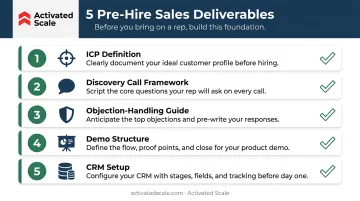
The deliverable before your first sales hire isn't "we have traction." It's a documented process a rep can actually use from day one:
- ICP definition — who you're targeting and why they buy
- Discovery call framework — the questions that reliably surface pain
- Objection-handling guide — your 5–8 most common deal blockers and responses
- Demo structure — what you show, in what order, and why
- CRM setup — a clean pipeline they can work from, not rebuild
Without this foundation, you're not hiring a rep — you're hiring someone to figure out what you already know.
Which Type of SaaS Sales Rep Should You Hire First?
SDR, AE, or Hybrid — Choosing the Right Role
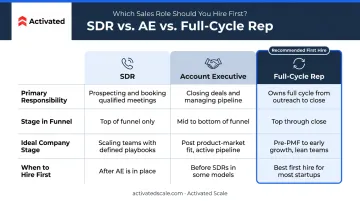
Three core roles define early-stage SaaS sales:
- SDR (Sales Development Rep): Owns outbound prospecting and lead qualification. Fills the top of the funnel but doesn't close.
- Account Executive (AE): Manages the discovery-to-close motion. Needs qualified pipeline to work from.
- Full-cycle / hybrid rep: Owns the entire customer journey — prospecting, qualifying, and closing — in one role.
For most early-stage startups with limited headcount, the hybrid role is the most practical starting point. Activated Scale recommends hiring AEs with SDR experience specifically because first reps need to prospect 50+ new accounts while also qualifying and closing. Splitting the roles makes sense only after pipeline volume justifies dedicated headcount for each function.
When to prioritize SDR-first: Your product has a short sales cycle, lead volume is high, and you (the founder) can still close deals while an SDR feeds your pipeline.
When to prioritize AE-first: Your ACV is $10K+ annually, the buying process involves multiple stakeholders, and you need someone who can run a full sales motion without you in every call.
De-Risking with Fractional and Contract-to-Hire Reps
Before committing to a full-time salary, consider a fractional or contract-to-hire arrangement. This model lets you test a rep's fit — both their sales skills and cultural alignment — before making a long-term employment decision.
Activated Scale connects B2B SaaS startups with pre-vetted, US-based fractional sales professionals (SDRs, AEs, and full-cycle reps) in 7 days or less. Engagements are structured to stay low-risk:
- Fractional SDRs cost $4,500/month plus performance pay
- Fractional AEs cost $6,500/month plus performance pay
- Defined 3-month contract period with an option to convert to full-time
Roughly 65–85% of clients end up hiring their fractional rep full-time after the initial period.
The Hire-Two-at-Once Rule
SaaStr makes this point clearly: hiring one rep prevents you from running any meaningful test. If they underperform, you can't tell whether the problem is the rep, the process, or the market. If they leave, you're back to founder-led sales overnight.
Two reps create a performance baseline. You can compare approaches, share onboarding investment, and maintain coverage continuity when one person hits a rough patch or moves on.
Key Qualities to Look for in SaaS Sales Reps
Stage-Matched Experience
A rep who thrived at a 500-person company — with a dedicated SDR team, inbound marketing, and a structured playbook — will struggle at a 5-person startup where none of that exists. The environment is simply too different.
Look for candidates who have sold at similar company stages: comfortable with ambiguity, scrappy and self-sufficient, willing to build process rather than inherit it.
Resume signals to watch for: early-stage company experience, time spent at companies before they scaled, or founders who have carried quota solo.
ACV-Matched Track Record
Deal size matters — often more than industry. A rep who has spent their career closing $200K enterprise contracts has a completely different motion than someone who has built a book of $8K–$15K annual deals. The latter is what most early-stage SaaS startups actually need.
Good interview questions to uncover ACV history:
- "What was the average deal size in your last role?"
- "Walk me through the longest deal in your pipeline — how many stakeholders, what was the timeline?"
- "What percentage of your revenue came from deals over $50K?"
Coachability Over Polish
Early reps need to iterate fast. The pitch will change. The ICP will shift. Pricing might get restructured mid-quarter. A polished rep who can't incorporate feedback is more dangerous than a rougher rep who adapts quickly.
In interviews, ask directly: "Tell me about a time you changed your sales approach based on feedback from a prospect or manager."
Listen for specifics — not a general "I'm always open to feedback" — but an actual story about what changed and why. Vague answers here are a red flag.
Full-Cycle Comfort
For first hires, ask what percentage of pipeline they self-sourced in past roles. A rep who has always relied on inbound handoffs or SDR support will need significant adjustment time when they're responsible for generating their own top-of-funnel activity. If they can't point to deals they hunted themselves, factor that ramp cost into your timeline.
How to Structure Compensation for SaaS Sales Reps
The OTE Model
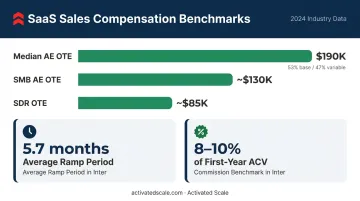
SaaS sales comp runs on On-Target Earnings (OTE): a base salary plus variable performance pay, where the variable is tied to quota attainment. According to the Bridge Group's 2024 SaaS AE Benchmark Report, the median AE OTE sits at $190K, with a 53:47 base-to-variable split — close enough to 50/50 that it's a reasonable starting framework.
For early-stage roles (SMB-focused, smaller ACV), OTE is lower. Cross-market data from RepVue places SMB AE OTE around $130K and SDR OTE around $85K, though those figures cover broader market averages, not seed-stage startups specifically.
Early hires take real risk — no brand name, no proven playbook, no guaranteed pipeline. Expect to pay above market on base to compensate for that uncertainty.
SaaS-Specific Variable Pay Structure
Because SaaS revenue is recurring, incentive should be tied to MRR or ARR booked, not total contract value at signing. This aligns rep incentives with business health: a rep who closes deals that churn in 60 days shouldn't earn the same as one whose accounts renew.
SaaStr suggests performance pay rates often land at 8–10% of first-year ACV as a reasonable starting framework.
Common comp mistakes to avoid:
- Setting quota based on benchmarks designed for larger, established sales orgs
- Skipping a ramp period — the Bridge Group's 2024 data shows SaaS AE ramp averages 5.7 months, not 90 days
- Failing to build ramp expectations into your cash flow projections
The Equity Component
First sales hires are betting on your company. A meaningful equity grant — even a small one — signals that you see them as a genuine partner in building the business, not just a number on a spreadsheet.
Seed-stage equity norms vary widely, but a few principles hold across most situations:
- Discuss ranges openly with candidates — transparency builds trust early
- Anchor grants to role seniority and your current valuation, not gut feel
- Confirm cliff and vesting terms with legal counsel before making offers
- Even a small grant changes how a rep thinks about the work they're doing
Setting Up Your New Sales Reps for Success
The work before day one determines whether your first sales hire succeeds. Hand off:
- ICP definition — who you're targeting, firmographic and behavioral signals
- Discovery call framework — the questions that reliably surface pain and qualify fit
- Objection handling guide — the 10 objections that come up in every deal cycle and how to address them
- Demo structure — what to show, in what order, and why
- CRM setup — stages, fields, and activity logging conventions already configured
Reps who start without this spend their first month reconstructing what you already know.
Once that foundation is in place, protect their time. Pulling new sales hires into product feedback sessions, customer support tickets, or marketing brainstorms is one of the most common reasons early reps underperform, and they often get unfairly blamed for what's really a structural problem.
Build a feedback loop from week one. Weekly 1:1s to review pipeline, surface blockers, and share market feedback keep you close to what's actually happening in deals. Ask reps to document wins and losses in detail — that output becomes your next hiring foundation and the first draft of a real sales playbook.
Frequently Asked Questions
How many sales reps should I hire at once for my startup?
Hire two simultaneously if budget allows. One rep gives you no performance baseline — you can't tell whether the process or the person failed. Two reps enable direct comparison, spread onboarding investment, and keep you from starting over if one doesn't work out.
When is the right time to hire my first SaaS sales rep?
Look for three signals before hiring: at least 10 paying customers from founder-led sales, a documented process you can hand off, and MRR in the $8K–$10K range. Below those thresholds, a rep will have too little to work from.
Should I hire an SDR or an Account Executive first?
At the early stage, a full-cycle AE who can both prospect and close is the right first hire. Splitting SDR and AE functions only makes sense once pipeline volume is high enough to justify dedicated headcount for each.
What is a typical OTE for a SaaS sales rep at a startup?
Bridge Group's 2024 benchmark puts the median SaaS AE OTE at $190K with a roughly 50/50 base-to-variable split. SMB-focused or early-stage AE roles typically run lower — around $130K OTE. Expect to pay above those averages for early hires who are taking on additional risk by joining a pre-proven organization.
What is a fractional sales rep and should I consider one?
A fractional rep works part-time (typically 15–20 hours per week) on a monthly retainer, without a full-time employment commitment. For startups not yet ready for a full-time hire, this model lets you validate fit and build pipeline before committing to permanent headcount.
How long does it take for a new SaaS sales rep to ramp up?
Bridge Group's 2024 data puts the average SaaS AE ramp at 5.7 months — not the 90 days many founders budget for. Build that timeline into both quota expectations and cash flow planning. Setting full quota expectations in month one is one of the fastest ways to create misaligned incentives and early rep turnover.