

The model works. It just requires more preparation than most companies realize. Get the performance pay rate wrong, skip onboarding, or hire the wrong profile, and you'll cycle through reps without closing a single deal. Get it right, and you can build real sales momentum without the fixed overhead of a full-time hire.
This guide covers exactly what "getting it right" looks like: when performance-only makes sense, what to prepare before day one, a step-by-step hiring process, how to structure compensation competitively, and the mistakes that derail most attempts.
Key Takeaways
- Performance-only works best with a validated product, repeatable process, and incentives worth chasing
- Preparation — training materials, a lead list, and a written agreement — determines whether a rep stays or leaves within weeks
- Your job listing needs to sell the opportunity, not just describe it; vague postings consistently repel experienced candidates
- Variable pay structure type matters as much as rate: straight, tiered, residual, and draw plans each suit different situations
- Misclassifying a performance-only rep as an employee — or vice versa — carries real legal and financial risk
When Should You Hire Performance-Only Sales Reps?
Performance-only is not a default cost-cutting move. It's a specific model that works under specific conditions — and fails predictably when those conditions aren't met.
When It Makes Sense
This model fits well when:
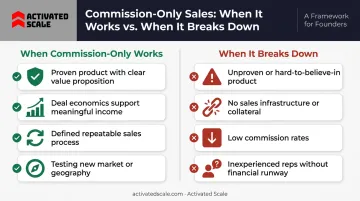
- Your product is proven — you have paying customers, a repeatable pitch, and a clear value proposition
- Deal economics support it — your average contract value is high enough (or deal volume sufficient) that a rep can earn meaningful income within a few months
- Your sales process is defined — you can describe the steps from first contact to close, and you have materials to support each stage
- You're testing a new market or geography — performance-only lets you run a low-overhead experiment before committing to a full-time hire
Early-stage B2B SaaS companies trying to scale without fixed payroll are a natural fit, as are businesses validating product-market fit in a new segment.
When It Breaks Down
The model fails predictably in these situations:
- Unproven product — reps can't sell what they can't believe in, and no variable pay structure compensates for weak positioning
- No sales infrastructure — if you have no pitch deck, no case studies, and no lead list, experienced reps will disengage fast
- Low performance pay rates — a rate that doesn't compensate for the absence of a base salary won't attract anyone worth hiring
- Inexperienced reps — 100% incentive environments are genuinely hard. Reps without strong pipeline skills or financial runway typically struggle without ramp support
As SaaStr has noted, performance-only B2B SaaS arrangements tend to fall apart quickly when a rep doesn't earn meaningful incentive within the first few weeks. Deal economics and upfront preparation are what determine whether this model works or wastes everyone's time.
What to Prepare Before Hiring Performance-Only Sales Reps
The most common reason performance-only arrangements fail isn't the rep — it's the company. A rep who can't sell in week one due to missing materials, no leads, or unclear agreements will disengage. Preparation directly determines how fast a new rep can start earning.
Training Materials and Product Knowledge
You need a structured onboarding resource — whether a document, slide deck, or short video series — that covers:
- What the product does and who it's for
- Your ideal customer profile (ICP)
- Common objections and how to handle them
- The sales process from first outreach to signed contract
The goal is simple: a rep should be ready to make their first call after session one. Keep it lean — a 100-page PDF rarely gets read, and reps who feel overwhelmed in week one rarely stick around.
Sales Materials and Collateral
Before hiring, assemble the baseline toolkit every rep needs:
- A sales deck or pitch document
- Branded email templates for outreach
- Case studies or customer proof points
- A product demo recording (if applicable)
Experienced reps working without proper collateral lose confidence in the opportunity fast. Missing even one of these items signals that the company isn't ready — and they'll move on.
A Defined Lead List or Pipeline
Expecting performance-only reps to build their own pipeline from scratch with zero support is one of the most common mistakes founders make. Provide at least 20–30 qualified leads as a starting point.
This starting list does two things: it gets reps to first contact faster, and it shows you're invested in their success. Handing someone a quota with no support is the fastest way to lose them.
A Written Independent Contractor Agreement
Before any rep starts work, you need a signed written agreement covering:
- Performance pay rate and payment schedule
- Deal attribution rules (who gets credit when multiple reps are involved?)
- Non-solicitation terms
- IP protection
- What happens to in-progress deals at termination
This isn't optional. Consult an employment attorney to ensure the agreement meets independent contractor classification requirements in your state — more on that in the common mistakes section.
How to Hire Performance-Only Sales Reps
Step 1: Define Your Ideal Rep Profile
Before writing a single word of your job listing, document what you actually need:
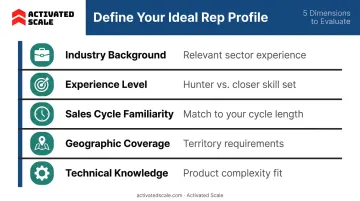
- Industry background and relevant sector experience
- Experience level — hunter (self-generates leads) vs. closer (converts warm leads)
- Familiarity with your sales cycle length
- Geographic coverage requirements
- Technical knowledge needed to sell your product
Hunter and closer are fundamentally different skill sets. Know which one you need before you start evaluating candidates.
Step 2: Write a Compelling Job Listing
Performance-only roles face skepticism from experienced reps. Your listing has to sell the opportunity.
A strong performance-only job listing includes:
- Realistic on-target earnings (OTE) based on actual deal size and close rates (not aspirational numbers)
- Transparent performance pay rate and deal size range
- Clear description of support — what leads, materials, and training you provide
- Social proof — testimonials from reps or clients if available
Vagueness drives high-quality candidates away. The rep calculating whether your opportunity beats their current role needs specific numbers to make that call.
Step 3: Source Candidates Through the Right Channels
Effective sourcing channels for performance-only sales talent include:
- LinkedIn outreach targeting reps with relevant industry backgrounds
- Niche sales job boards and industry-specific communities
- Professional referrals from existing sales contacts
- Slack groups for sales professionals in your vertical
Founders on a tighter timeline can also use platforms like Activated Scale, which connects B2B SaaS companies with pre-vetted, incentive-aligned sales professionals and can place candidates in 7 days or less.
Step 4: Vet and Interview Rigorously
Go beyond the resume. Ask candidates to walk through a specific deal they've closed: the sales cycle length, how they handled objections, what the variable pay structure was, and what their quota attainment looked like.
Look for:
- Specific, numbers-driven answers — vague talk of "relationship building" isn't a good sign
- Demonstrated autonomy — performance-only reps manage their own pipeline with minimal oversight
- Genuine conviction in the product — reps who aren't sold on what they're selling rarely close consistently on incentive
Step 5: Onboard Fast and Set Clear Expectations
Schedule training within 24–48 hours of signing. Cover the product, ICP, sales process, and incentive terms in full.
Then lock in concrete 30-day activity targets:
- Number of outbound calls per week
- Meetings booked
- Proposals sent
Speed of first incentive earned is the strongest predictor of rep retention. Set reps up with every tool, contact, and piece of access they need on day one. Not day five.
Key Variables That Affect Performance-Only Hiring Success
Variable Pay Structure Types
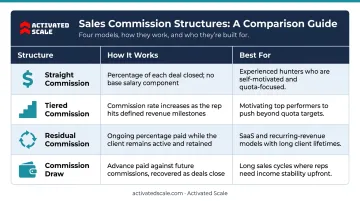
Not all incentive plans are built the same. The four most relevant structures for B2B environments:
| Structure | How It Works | Best For |
|---|---|---|
| Straight incentive | Percentage of deal value, no base | Experienced hunters with strong pipeline |
| Tiered incentive | Rate increases after hitting milestones | Motivating top performers; fair for reps still ramping |
| Residual incentive | Ongoing % as long as client stays active | SaaS with recurring revenue; rewards retention |
| Incentive draw | Advance against future incentives | Long sales cycles where reps need income stability |
A recoverable draw — where the rep owes it back if incentives don't cover it — creates financial anxiety during ramp. A non-recoverable draw costs the company more but reduces that pressure, which often means better rep performance early on.
Incentive Rate Competitiveness
This is where most companies go wrong. Experienced performance-only reps mentally price in a risk premium for giving up a base salary. If your rate doesn't account for that, you'll attract only the candidates who couldn't get a salaried role.
SaaStr's framework for B2B SaaS sales comp describes 8–10% of first-year ACV as a common incentive component in employee base-plus-variable plans. A performance-only structure — where the rep bears full income risk — should offer a noticeably higher rate to be competitive.
Before setting your number, research rates for comparable roles in your industry. Then stress-test the math: at your average deal size, close rate, and sales cycle length, what would a rep realistically earn in months one through three? If that number isn't compelling, adjust the rate — or reconsider the model entirely.
Deal Size and Sales Cycle Fit
A $500 deal with a 10% incentive and a 60-day sales cycle will not attract or retain experienced reps. The math simply doesn't work.
For context, The Bridge Group's 2024 B2B SaaS benchmark found a $47K median ACV and 5.0-month median sales cycle across 172 B2B SaaS companies — and those are salaried AEs with base pay bridging the gap during that ramp period. Performance-only reps in longer-cycle environments need either higher deal values, shorter cycles, or a draw to survive the wait.
SaaS Capital's 2025 data reports a $26,265 median ACV for private B2B SaaS companies — useful context when modeling whether your deal size can support a performance-only arrangement.
Attribution and Payment Terms
Ambiguity around payment kills rep motivation fast. Before a rep starts, define:
- When incentive is paid — at contract signing, at payment receipt, or monthly
- Who gets credit — especially when multiple reps touch a deal
- What happens to in-progress deals if the arrangement ends
Delayed or unclear payment is one of the leading causes of rep disengagement. Get this in writing before day one.
Common Mistakes When Hiring Performance-Only Sales Reps
Most hiring mistakes with performance-only reps fall into three categories — and each one is avoidable with a bit of preparation up front.
1. Underpaying or Structuring Incentives Poorly
Many founders default to whatever feels affordable rather than what's competitive. That attracts reps who bounce between performance-only roles without hitting quota — not closers who see real income potential.
Research market rates, factor in the income risk premium reps expect, and run the math on realistic first-year earnings before posting anything.
2. Hiring Before You're Ready
Bringing on a rep before you have training materials, sales collateral, or a lead list is the fastest way to lose them. Reps without tools or leads default to inaction, lose confidence in the opportunity, and disengage within weeks.
Have the basics ready on day one: a pitch deck, a target account list, and a clear onboarding path.
3. Misclassifying Independent Contractors
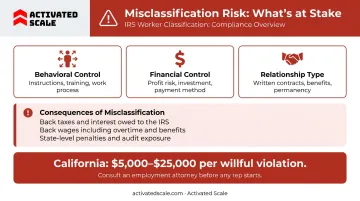
A written contractor agreement doesn't automatically create valid contractor status. The IRS and state agencies apply fact-based tests based on behavioral control, financial control, and the nature of the relationship.
Getting this wrong can expose you to back taxes, back wages, and state-level penalties. Some states can assess $5,000–$25,000 per violation for willful misclassification. Consult an employment attorney before any rep starts work.
Frequently Asked Questions
How much do performance-only sales reps make?
Earnings vary by industry, deal size, performance pay rate, and close volume — with no reliable published benchmark, since surveys like BLS and RepVue cover salaried employees only. In B2B SaaS, high performers can earn well above salaried counterparts, but income is highly variable during ramp.
Is paying sales reps 100% incentive legal?
Yes — 100% incentive arrangements are legal in the US, provided the rep is correctly classified as an independent contractor. The classification depends on the actual working relationship, not the contract label. If a rep works set hours, uses your equipment, and operates under close supervision, different wage and hour laws may apply regardless of what the agreement says.
What performance pay rate should I offer performance-only sales reps?
Performance-only roles should offer higher rates than salaried equivalents to compensate for income risk — the exact premium depends on your deal size and complexity. Model what a rep would realistically earn in the first 90 days, then work backward to a rate that's genuinely attractive.
What is the difference between a performance-only rep and a fractional sales rep?
Performance-only reps are paid purely on results with no base. Fractional sales reps typically work on a part-time contract basis and often include a retainer or base component alongside incentive. Fractional reps — like those available through Activated Scale — tend to bring senior-level experience and are a popular option for early-stage companies that want flexible, accountable sales support without full-time overhead.
How do I keep performance-only sales reps motivated long-term?
Tiered variable pay structures, fast payment, quality lead support, and regular communication all drive retention. Reps disengage when they lack the tools or product credibility to close — so prioritize getting them to their first incentive win as quickly as possible.