Candidates see equity, ownership, and the chance to build something from scratch. What they often don't see: no inbound pipeline, no playbook, no SDR handing them qualified meetings. Founders, meanwhile, sometimes treat this hire as a shortcut past the hard work of founder-led sales—which creates its own set of problems.
This post cuts through both narratives. Whether you're a sales professional weighing this kind of opportunity or a founder deciding when and how to make this hire, here's a clear-eyed look at what the Founding AE role actually demands.
Key Takeaways
- A Founding AE is a startup's first dedicated salesperson—responsible for prospecting, closing, and building the entire sales process simultaneously
- OTE typically ranges from $100K–$260K depending on stage and experience, plus equity (usually 0.05%–0.5%)
- Top Founding AEs combine sales skills with comfort in ambiguity, a builder mindset, and the ability to operate without structure
- Startups should only make this hire after the founder has personally closed several deals and has a working ICP hypothesis
- For startups not ready for a full-time commitment, fractional options can test fit before converting
What Is a Founding Account Executive?
A Founding AE is a startup's first dedicated sales hire—responsible for establishing the initial customer base and building the sales foundation from zero. That last part matters more than the first.
A traditional AE executes within a system: they get leads from marketing, hand off post-sale to customer success, and work within defined stages and quotas. A Founding AE creates that system while simultaneously trying to close deals inside it.
How This Differs From a Standard AE Role
The table below captures the practical difference:
| Factor | Standard AE | Founding AE |
|---|---|---|
| Inbound pipeline | Provided by marketing | Self-generated |
| Sales playbook | Inherited | Built from scratch |
| SDR support | Usually available | Rarely available |
| ICP definition | Already established | Must be discovered |
| CRM/tools | Pre-configured | Candidate selects and sets up |
| RevOps support | Typically available | Usually nonexistent |
The Founding AE is simultaneously the SDR, AE, VP of Sales, and sometimes the customer success team. Bessemer's 2025 playbook for scaling to $1M ARR describes the ideal first sales hire as someone who can "sell directly and build repeatable sales processes": two very different skill sets required at the same time.
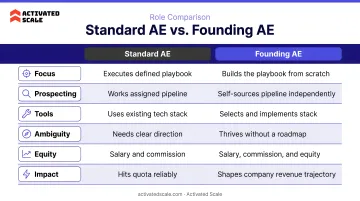
That tension explains why stage-fit matters more than brand-name experience. A candidate from a 1,000-person sales org may be technically excellent but unprepared for the absence of structure that defines this role.
Key Responsibilities: What Does a Founding Account Executive Do?
The job description can be summarized simply: own everything that touches revenue.
Full-Cycle Sales Ownership
Without an SDR feeding them pipeline, Founding AEs source their own leads—typically using tools like Apollo, LinkedIn Sales Navigator, or Clay for prospecting. From there, they qualify, run demos, negotiate, and close—all without a manager reviewing their calls or a deal desk helping structure contracts.
Every stage requires more improvisation than it would in a mature org. Pricing conversations happen without established discount authorization. Discovery calls surface objections that don't fit neatly into a known framework yet.
Playbook Creation and GTM Infrastructure
This is the part that surprises most candidates. Beyond closing deals, the Founding AE:
- Selects and configures the CRM (typically HubSpot or Salesforce at this stage)
- Defines sales stages and pipeline milestones
- Builds outreach sequences and email templates
- Documents the ICP based on what's actually working
- Establishes forecasting logic—with no historical data to reference
Strategic Collaboration With the Founder
Founding AEs don't just execute GTM strategy—they inform it. Pricing assumptions get tested on real calls. Positioning language that resonates in demos feeds back into the website. Objections that keep surfacing in discovery tell the product team what's missing.
Y Combinator notes that YC founders use tools like Apollo and LinkedIn Sales Navigator for early prospecting—and that the insights gathered during that founder-led sales phase become the raw material the Founding AE builds on.
Customer Feedback Loop
Before product-market fit solidifies, the Founding AE is often the first person systematically collecting what the market is actually saying. Lost deals carry information. Repeated objections point to gaps in positioning, pricing, or product.
Founding AEs who document this well—competitor mentions, pricing resistance, feature requests—give founders something concrete to act on. Those who treat it as an afterthought leave one of the most valuable parts of the role on the table.
Skills and Traits That Define a Successful Founding AE
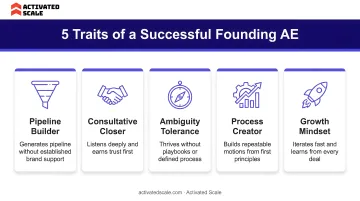
Technical sales skills matter, but they're not the differentiator here. The traits that predict success in this role are more specific.
Comfort With Ambiguity
This is the one non-negotiable. Founding AEs operate without detailed instructions, structured onboarding, or established precedent. Sierra Ventures describes the ideal first AE as someone who "thrives in ambiguity, wears multiple hats, and iterates quickly based on market feedback."
Those who need a clear process before they can execute will struggle here. The role rewards people who treat the absence of structure as an invitation to create it.
Full-Cycle B2B Sales Experience
The ideal profile, according to OpenView's hiring guidance, is someone with 4–5 years of B2B SaaS sales experience who has sourced and closed deals independently. Not someone who has managed one half of the funnel—someone who owns it end to end.
Builder Mindset
Executors follow established processes. Builders design them from scratch, then scale them to others. Founding AEs need to be the latter — selecting tools, building outreach sequences, and eventually onboarding the next sales hire as the team grows.
GTM Tool Proficiency
Founding AEs are expected to be hands-on with the tech stack, not to delegate setup to an admin. Common tools include:
- CRM: HubSpot, Salesforce
- Sales engagement: Apollo, Outreach, Instantly
- Prospecting: LinkedIn Sales Navigator, ZoomInfo, Clay
- Intelligence: Gong (for call recording and coaching)
Resilience Without External Motivation
No leaderboard, no President's Club, no structured coaching. The Founding AE generates their own momentum — and rejection comes faster than wins at this stage.
Pavilion's first-hire guidance identifies "grit and commitment" as the defining qualities, with commitment ranked above all others. The feedback loop is slower than in a mature org, and emotional durability matters more than most candidates anticipate going in.
Founding AE Salary and Compensation
Comp for this role varies more than most. Here's what the available data shows.
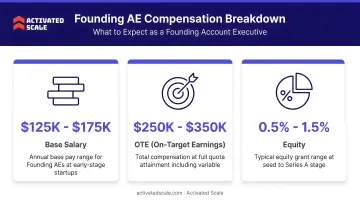
Base Salary and OTE
Glassdoor's Founding AE salary data (from 12 submissions) shows:
- Base range: $64K–$116K
- Median total pay: $144,157
- Typical total range: $108K–$199K
That range shifts significantly at well-funded companies. A current Wellfound listing for a Founding AE at a Series A company shows $120K–$140K base with $240K–$260K OTE, reflecting what strong startups pay to land their first sales hire.
Most roles fall somewhere in the $100K–$200K OTE range, with variation based on funding stage, geography, and candidate experience.
Equity
Equity is standard for this role, typically in the 0.05%–0.5% range. The most common vesting structure is a 4-year schedule with a 1-year cliff—meaning no equity vests unless the candidate stays at least 12 months. That same Wellfound listing showed 0.2%–0.35% equity—on the higher end of typical for a Series A hire, which often signals a company prioritizing long-term retention over short-term cash.
Job postings are frequently vague on equity details. Before accepting any offer, ask explicitly about:
- Number of shares granted (not just percentage)
- Current fair market value or exercise price
- Vesting schedule and cliff period
- Expected dilution through future fundraising rounds
Compensation Red Flags
Watch out for:
- Quotas that assume inbound pipeline that doesn't exist
- Plans that are heavily variable with a below-market base
- Equity used to justify cash comp well below market rate
Career Path: How People Become Founding AEs and What Comes After
The Typical Path In
Most Founding AEs follow a clear progression: SDR → AE → Senior AE or team lead → deliberate leap into a startup's first sales hire. The "deliberate" part matters. This isn't a default next step—it's a choice to trade structure for ownership and upside.
Experience and a verifiable track record of closing deals increasingly outweigh credentials. When screening candidates, founders should prioritize:
- Startup experience at a similar stage — not enterprise logos
- Comfort operating without a defined sales playbook
- Evidence of building process from scratch, not just executing within one
First Round Capital's guidance on first sales hires explicitly warns against candidates from large organizations when the sales motion isn't yet defined.
The Career Acceleration Opportunity
Successful Founding AEs often advance to Head of Sales, VP of Sales, or eventually CRO as the company scales. They've built the system and accumulated institutional knowledge that outside candidates simply can't walk in with.
The risk is real, though. Even strong performers can get replaced as the company matures — startups pivot, products change, and institutional investors often push for "proven" external executives. Going in clear-eyed about that possibility is part of what separates candidates who thrive in these roles from those who feel blindsided later.
What Startups Need in Place Before Making This Hire
This is where most hiring mistakes happen. The failure mode, according to First Round Capital's research, is hiring before the sales motion is developed and expecting the new hire to figure out what the founder couldn't.
Founder-Led Sales Comes First
Y Combinator is direct on this point: if a founder can't sell the product themselves, they probably can't hire someone else to do it either. The Founding AE scales a validated process—they don't create one from nothing.
Before posting the job, a founder should be able to answer:
- Have I personally closed at least a handful of paying customers?
- Do I have a working hypothesis about who buys and why?
- Can I articulate which messages land and which objections keep coming up?
Without these answers, you're asking your Founding AE to do product discovery, not sales.
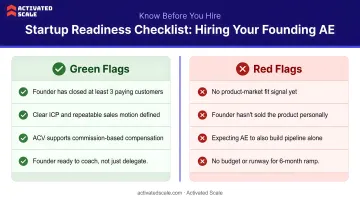
The Readiness Checklist
Green flags before hiring:
- Founder has closed 3–5+ paying customers personally
- Basic CRM is in place (or a clear plan to implement one)
- Budget exists for core sales tools
- There's a rough 30/60/90-day onboarding plan with defined success metrics
Red flags that mean you're not ready:
- Zero paying customers
- No ICP hypothesis
- No onboarding plan beyond "just get some wins"
- Quota expectations built on inbound that doesn't exist yet
Bessemer places the Founder + first hire stage between $100K and $1M ARR—and OpenView notes it can take 6–9 months to determine whether a sales hire is a poor fit. That window is expensive, which means getting the timing right matters more than moving fast.
An Alternative for Startups That Aren't Quite Ready
For founders who want to test the sales motion before committing to a permanent hire, Activated Scale offers vetted fractional sales professionals on a try-before-you-buy basis. Startups can access experienced B2B SaaS AEs within 7 days (sometimes same-day), with engagements at $6,500/month plus performance pay.
The conversion path is structured: 65% of clients hire their fractional AE full-time after seeing results, with a conversion fee of 18% of base salary—below the standard 20% of OTE charged by traditional recruiters.
The model works especially well for startups that have cleared the founder-selling threshold but aren't certain enough about ICP and deal size to commit to a $200K+ full-time hire before validating the motion further.
Frequently Asked Questions
What does a founding Account Executive do?
A Founding AE owns the entire sales cycle—prospecting, discovery, demos, negotiation, and close—without SDR support or an inherited pipeline. They simultaneously build the sales playbook, configure the CRM, define the ICP, and feed customer insights back to the founding team.
How much do founding Account Executives make?
Founding AE OTE typically ranges from $100K to $260K depending on stage, location, and experience. Glassdoor's benchmark shows a $144K median total pay, while current Wellfound listings for Series A companies show $240K–$260K OTE. Equity (0.05%–0.5%) is standard on top of cash comp.
What is the difference between a Founding AE and a regular Account Executive?
A regular AE executes within an existing sales system—with inbound leads, a defined ICP, RevOps support, and a playbook already in place. A Founding AE builds all of that from scratch while simultaneously trying to close deals. There's no SDR, no established pipeline, and no precedent to follow.
What skills does a Founding Account Executive need?
The non-negotiables are full-cycle B2B sales experience (ideally 4–5 years in SaaS), comfort with ambiguity, a builder mindset, and hands-on proficiency with tools like HubSpot or Salesforce, Apollo, and LinkedIn Sales Navigator. Resilience and self-motivation carry more weight here than in most sales roles.
When should a startup hire a Founding Account Executive?
A startup is ready when the founder has personally closed several deals, has a working hypothesis about their ICP, and has basic sales infrastructure in place. Hiring before that point—without a validated sales motion—sets the AE up to fail and wastes both time and runway.
What does a Founding AE career path look like?
Most Founding AEs come up through the SDR → AE → Senior AE track before deliberately stepping into an early-stage role. On the back end, successful ones typically advance to Head of Sales, VP of Sales, or CRO as the company scales, though external leadership hires are always a possibility.