
This distinction matters beyond just title and pay. An AE and SAE operate with different autonomy, own different parts of the sales cycle, and drive different outcomes. Getting this right directly affects how fast a startup can build pipeline and close deals, especially when 76.6% of sellers missed quota in 2024 despite lowered targets.
Key Takeaways
- AEs close new accounts and run individual deals independently, typically with 1–3 years of experience and $150K–$190K OTE
- SAEs own complex, high-value accounts and shape sales strategy — 5+ years of experience, $200K–$250K OTE
- AEs execute a defined playbook; SAEs build and lead the playbook while executing
- For early-stage startups, hire an AE if you have product-market fit and infrastructure; hire an SAE if you're building the sales motion from scratch
- Hiring the wrong role costs $160K–$220K in direct costs — plus lost deals and a slower team
Senior Account Executive vs Account Executive: Quick Comparison
| Category | Account Executive | Senior Account Executive |
|---|---|---|
| Experience Required | 1-3 years sales or customer-facing | 5+ years sales or account management |
| Primary Focus | New business acquisition, closing deals | Strategic accounts, team mentorship, process design |
| Deal Complexity | Mid-market ($15K-$50K ACV), 2-3 month cycles | Enterprise ($100K+ ACV), 6-12 month cycles |
| Decision-Making Authority | Executes within set parameters, escalates exceptions | Broad latitude to customize pricing, position strategy |
| Mentorship Role | Individual contributor, no team responsibility | Guides junior AEs, contributes to enablement |
| Key Metrics | Individual quota, new logo acquisition, conversion rate | Account growth %, team performance, strategic revenue |
| Base Salary Range | $83K-$126K (avg $102K) | $88K-$144K (avg ~$116K) |
| OTE Range | $150K-$190K | $200K-$250K |
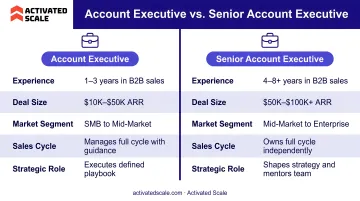
These benchmarks are a useful starting point, but role definitions shift considerably by company size and industry. An SAE at a 10-person startup often runs full sales cycles solo, while the same title at an enterprise software firm may mean managing a pod and influencing strategy — the title doesn't tell the whole story.
What is an Account Executive?
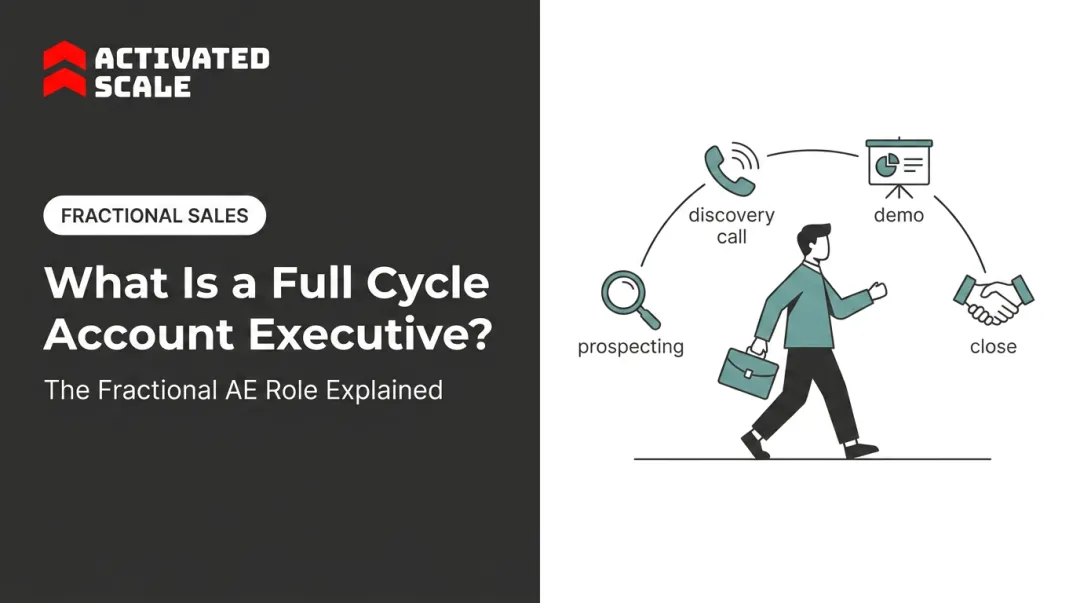
An Account Executive is a sales professional responsible for prospecting, building relationships with new prospects, and closing deals to bring new revenue and logos into the company. AEs are fundamentally "hunters" focused on new business acquisition, managing the full sales cycle from first contact through signed contract.
Core day-to-day responsibilities:
- Conducting cold outreach and prospecting via email, calls, and social media
- Running product demos and discovery calls with qualified leads
- Managing a pipeline of deals at various stages using CRM tools
- Creating proposals and negotiating contracts within established parameters
- Updating CRM records and forecasting weekly pipeline
- Following up persistently with prospects until close or disqualification
An AE's calendar is built entirely around moving deals forward. Time blocks for prospecting, demo calls, proposal writing, and deal reviews dominate the week.
Typical qualifications:
- Bachelor's degree in business or related field
- 1-3 years of experience in sales or customer-facing roles
- Proficiency in CRM tools like Salesforce or HubSpot (3-6 months development timeframe)
- Strong communication, time management, and relationship-building skills
- Demonstrable ability to hit individual targets
Key performance indicators:
- Quota attainment: 70-80% of reps should hit quota by industry standard, though actual attainment averages just 42.7%
- New logo acquisition rate: new customers closed per month or quarter
- Average deal size: contract value per closed deal, typically $15K-$50K ACV
- Demo-to-close rate: percentage of demos that convert to signed contracts
- Sales cycle length: time from first contact to signed contract, typically 2-3 months
- Pipeline coverage: maintaining 3x-4x quota in active pipeline at all times
An AE's success is measured entirely on individual output. Companies typically set quota at approximately 5x the AE's OTE: a $160K OTE corresponds to an $800K annual quota.
Use Cases of an Account Executive
An AE fits best in an early-stage B2B SaaS company when there is already a defined ICP, a sales playbook (or at least basic messaging in place), and enough inbound or outbound infrastructure for them to execute against. They need a defined process to execute — not a blank slate to build from scratch.
Typical deals AEs own:
- Mid-market accounts with $15K-$50K ACV
- 2-3 month sales cycles involving discovery, demos, and internal planning
- Departmental buyers or mid-level decision makers who control discretionary budgets
- Deals that don't require executive-level negotiations or extensive cross-functional coordination
According to SaaS Capital's 2024 survey, the median ACV for private SaaS companies is $26,265, placing most AE opportunities squarely in the mid-market range. AEs operate across both transactional and consultative sales motions — making them versatile individual contributors who perform best in high-volume, high-velocity environments.

What is a Senior Account Executive?
A Senior Account Executive is a seasoned sales professional who manages larger, more complex accounts, closes higher-value deals often involving C-suite stakeholders, contributes to sales strategy, and mentors junior reps. SAEs are still individual contributors but operate with significantly more autonomy and strategic weight than standard AEs.
That strategic weight shows up across every part of the role.
Core day-to-day responsibilities:
- Managing and growing a portfolio of key strategic accounts
- Negotiating enterprise-level contracts with C-suite executives
- Running strategic account planning sessions to identify expansion opportunities
- Guiding and mentoring junior AEs on complex deal strategy
- Contributing to sales process design, playbook refinement, and go-to-market planning
- Engaging directly with decision-makers at the executive level
- Collaborating with solutions engineers and customer success teams on multi-stakeholder deals
Typical qualifications:
- 5+ years of experience in sales or account management
- Demonstrable track record of exceeding quota consistently
- Strategic thinking ability and financial acumen to evaluate deal profitability
- MBA or advanced sales certifications preferred but not required
- Executive presence and comfort navigating C-suite conversations
- Experience managing 6-12 month enterprise sales cycles
Key performance indicators:
- Revenue from strategic accounts — Total ARR generated from high-value portfolio
- Account growth percentage — Expansion revenue within existing accounts
- Client retention and satisfaction scores — NPS or CSAT for key accounts
- Team performance contribution — When mentoring junior reps, their success factors in
- Win rate on complex deals — Percentage of enterprise opportunities converted
- Contribution to sales strategy — Measurable impact on process improvements
Unlike standard AEs, SAEs carry accountability beyond their own number — their impact is measured across accounts, teammates, and the sales process itself.
Use Cases of a Senior Account Executive
An SAE fits best when a startup needs someone to build the sales playbook from scratch, sell into enterprise accounts with longer and more complex buying cycles, or establish credibility with executive buyers. SAEs are especially valuable when the founder is the only seller and needs to hand off strategic deals without losing momentum.
Where SAEs deliver maximum value:
- Building the first sales motion — Designing repeatable processes before any playbook exists
- Enterprise deals — $100K+ ACV with 6-12 month cycles involving multiple stakeholders
- Executive selling — Navigating C-suite conversations, business case development, and ROI justification
- Strategic account planning — Identifying expansion opportunities within existing enterprise customers
- Fractional sales leadership — Acting as a bridge between individual contributor execution and future sales management
However, hiring an SAE too early carries real risk. Without a defined process, active pipeline, or junior reps to lead, an SAE may end up doing work a standard AE could handle at 30-50% lower cost.
The premium you pay for strategic capability must match the strategic work available.
AE vs SAE: Key Differences That Actually Matter
Responsibilities and Scope
AEs focus on execution within a defined sales motion. They work individual deals, follow the playbook, and hit personal quotas. The role is tactical: prospecting daily, running demos, creating proposals, negotiating within parameters, and closing.
SAEs take ownership of larger accounts, drive strategy, and often shape the process others follow. The biggest shift is from "doing" to "leading and doing."
An SAE might close three $200K enterprise deals in a quarter, refine the discovery framework, mentor two junior AEs, and collaborate with product on a new vertical.
Client Interaction Level
AEs primarily engage with mid-level buyers — department heads, managers, or procurement contacts who control discretionary budgets. These conversations focus on product fit, features, implementation timelines, and value delivery.
SAEs regularly navigate C-suite conversations with CEOs, CFOs, and CIOs. They handle multi-stakeholder deals requiring business-case fluency, ROI modeling, and strategic alignment across departments. Enterprise sales cycles of 6-12 months demand this level of executive engagement — deals stall without it.
For B2B SaaS companies selling into enterprise or scaling upmarket, this distinction directly impacts close rates. Junior buyers can say "yes" to $20K tools; they can't commit to $200K platforms without executive sponsorship.
Decision-Making Authority
AEs have limited autonomy. They execute deals within set parameters and escalate anything requiring pricing flexibility, custom contract terms, or strategic exceptions. An AE who tries to discount 20% without approval risks deal approval delays or internal friction.
SAEs have broader latitude to make account-level decisions, customize pricing structures within approved thresholds, and influence how the company positions itself with high-value clients. They're trusted to evaluate trade-offs — a 15% discount today for a 3-year commitment and reference-customer status tomorrow.
That authority gap directly shapes how each role is compensated.
Compensation Structure
Both AEs and SAEs follow the standard 50/50 base-to-variable pay split in B2B SaaS. However, SAEs earn 20-35% more in base salary than standard AEs, and the OTE gap is even wider due to larger quotas and accelerator potential.
Current salary benchmarks (2024-2025 data):
| Role | Base Salary | OTE Range | Top Performer OTE |
|---|---|---|---|
| Account Executive | $83K-$126K (avg $102K) | $150K-$190K | $250K+ |
| Senior Account Executive | $88K-$144K (median $88K, growth-stage avg $96K) | $200K-$250K | $350K+ |
| Enterprise AE | $130K-$150K | $260K-$300K | $400K+ |
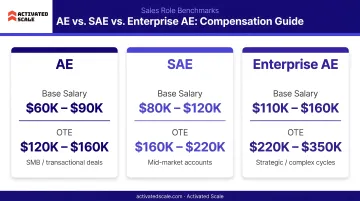
Quota-to-OTE ratio: Both roles typically operate at a 5:1 to 7:1 quota-to-OTE ratio. An AE with $160K OTE carries approximately an $800K quota; an SAE with $225K OTE carries $1.1M-$1.6M.
Commission structure differences:
- AE compensation is heavily commission-weighted, with aggressive accelerators kicking in at 100%, 110%, and 125% of quota
- SAE packages feature higher bases with variable components tied to both individual and account performance, including account growth %, retention metrics, or junior rep results
The compensation delta is meaningful: hiring an SAE instead of an AE costs approximately 30-50% more in total comp, so the strategic value must justify the premium.
Career Trajectory Context
The AE role is the entry point into a B2B SaaS sales career path. Most AEs come from SDR/BDR roles or adjacent customer-facing positions and spend 1-3 years mastering the fundamentals: pipeline management, discovery, demos, objection handling, and closing.
The typical AE-to-SAE progression takes 2-4 years, with cumulative experience of 3-5 years at SAE entry. High-performing AEs accelerate this path by:
- Consistently exceeding quota (110%+ attainment)
- Managing increasingly complex deals and multi-stakeholder conversations
- Demonstrating strategic account planning skills
- Mentoring newer AEs informally
After SAE, the path branches: continue as an Enterprise AE/Strategic AE on the individual contributor track, or move into sales management (Sales Manager → Director of Sales → VP of Sales).
Which One Should Your B2B SaaS Startup Hire First?
Situational Recommendation Framework
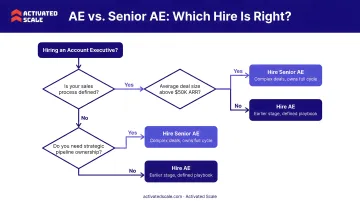
Hire an Account Executive if:
- You have product-market fit and a defined ICP
- Basic sales infrastructure exists (CRM, messaging, lead sources)
- Your ACV is $15K-$50K with 2-3 month sales cycles
- You need someone to execute a repeatable motion and close volume
- Your deals primarily involve mid-level buyers with discretionary budgets
- You're at $1M-$2M ARR and need to scale pipeline coverage
Hire a Senior Account Executive if:
- You're selling into enterprise accounts with $100K+ ACV
- Your deals require C-suite engagement and 6-12 month cycles
- You need someone to build your first real sales process from scratch
- You're transitioning away from founder-led sales and need a senior individual who can operate without hand-holding
- You have (or will soon have) junior AEs who need mentorship
- Your product requires strategic account planning and expansion motions
The Risk of Getting the Level Wrong
Hiring a junior AE when you need strategic leadership:
- Deals stall in executive conversations the AE isn't equipped to navigate
- Process gaps remain unfilled because the AE lacks experience to build frameworks
- You spend months coaching on basics instead of scaling revenue
- Pipeline quality suffers as the AE chases volume over strategic fit
Hiring a senior SAE when you just need execution:
- High cost ($200K+ OTE) with low output because the volume motion doesn't apply their strategic skills
- Early churn when the SAE realizes there's no strategic work or team to mentor
- Misalignment on expectations — the SAE wants to shape process, but you just need them to work the phones
- Runway risk: the cost of a bad sales hire ranges from $160K-$220K in direct costs alone
Both mistakes burn cash and waste time — often 3-6 months before the mismatch becomes obvious.
Reducing Risk with Fractional Talent
One way to avoid that mismatch: test the level before committing to full-time comp. Activated Scale connects early-stage companies with vetted fractional AEs and SAEs from companies like Salesforce, Oracle, and Zendesk — so you can match talent to your current deal complexity without a long-term bet. This try-before-you-buy approach lets founders:
- Test the right level of talent before committing to full-time comp
- Match sales talent to current pipeline and deal complexity
- Scale up or down based on performance and company stage
- Convert fractional talent to full-time employees once product-market fit is validated
For Seed-stage companies especially, this means senior talent — and the optionality to go full-time once you know what's actually working.
Conclusion
Choosing between an AE and SAE comes down to one thing: what your current sales stage actually demands. AEs are built to execute; SAEs are built to lead while executing.
Before posting a job description, get clear on what your pipeline looks like, how complex your deals are, and whether you need someone to run plays or write them. That clarity will point you to the right hire — and keep you from burning time, budget, and deal momentum on a role that doesn't fit where you are right now.
Frequently Asked Questions
Frequently Asked Questions
What is the difference between account executive and senior account executive?
An AE focuses on new business acquisition and executing a defined sales process with 1-3 years of experience. An SAE manages larger or more complex accounts, takes on strategic responsibilities like sales process design, and often mentors junior reps with 5+ years of experience.
What is the role of a senior account executive?
An SAE manages high-value accounts, closes enterprise deals with 6-12 month sales cycles, and contributes to sales strategy and process design. They combine hands-on execution with informal leadership — often guiding junior reps without carrying formal management accountability.
How much does a senior account executive earn?
Senior AEs earn a median base salary of $88K-$96K with OTE ranging from $200K-$250K, following a 50/50 base-to-variable split. Top performers frequently earn $350K+ through accelerators. Compensation varies by company stage, industry, and location — late-stage and public companies pay higher bases ($144K average) than early-stage startups ($50K-$90K).
Is senior account executive a high position?
An SAE sits above a standard AE and below management titles like Sales Manager or VP of Sales. It's a high-earning, high-autonomy role with real strategic responsibility — but not a people-management position unless explicitly structured that way.
How long does it take to become a senior account executive?
Most high performers make the jump in 2-4 years by consistently exceeding quota, managing complex deals, and building skills in strategic account planning. Timeline varies by company, industry, and individual track record.
Can an early-stage startup hire a senior account executive instead of an account executive?
Yes — if you're selling into enterprise or need someone to build the sales motion from scratch, an SAE is the right call. If the playbook already exists and you need execution on mid-market deals, an AE is more cost-effective. The decision comes down to deal complexity and whether strategic process-building is part of the role.