
Introduction
Early-stage B2B SaaS founders frequently treat "Business Development Manager" and "Sales Representative" as interchangeable titles. This is a costly mistake. These roles serve fundamentally different functions in your revenue engine, and mixing them up can stall pipeline growth and burn through runway fast.
The misalignment is more expensive than most founders realize. Only 45% of US sales reps hit quota when they're in the right role — the numbers are worse when someone's doing the wrong job entirely. Put a closer in a strategist role (or vice versa) and you get ownership confusion, wasted recruiting cycles, and stalled revenue. Sales roles already take 53 days to fill on average — you can't afford to fill them wrong.
This post clarifies what each role actually does, where they differ in scope and seniority, and how to decide which one your startup needs first.
Key Takeaways
- BDMs drive long-term growth through partnerships, new markets, and strategic pipeline creation; Sales Reps close qualified leads into revenue
- BDMs operate at a senior strategic level; Sales Reps are execution-focused and typically earlier in the sales hierarchy
- Different KPIs: BDMs measured by pipeline growth and market entry; Sales Reps by quota attainment and close rates
- For early-stage startups, hire based on your bottleneck—lead creation needs a BDM, deal closing needs a Sales Rep
- Both roles work best when clearly separated with distinct goals, not when one person is stretched across both
BDM vs. Sales Rep: Quick Comparison
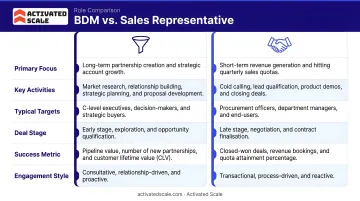
If you're deciding which role to hire first — or trying to clarify responsibilities on your current team — this table shows where each role starts and stops.
| Dimension | Business Development Manager | Sales Representative |
|---|---|---|
| Primary Focus | Long-term growth, market expansion, partnerships | Short-term revenue execution, closing qualified leads |
| Time Horizon | 6-12+ months for deals to materialize | 1-6 months sales cycles depending on deal size |
| Key Responsibilities | Market research, strategic partnerships, opportunity mapping, C-suite relationship building | Product demos, objection handling, pipeline management, negotiation, closing deals |
| Success Metrics | Qualified opportunities created, new market segments entered, partnership agreements, pipeline value generated | Quota attainment, monthly/quarterly closed revenue, conversion rate, average deal size |
| Core Skills | Strategic thinking, market analysis, high-level negotiation, comfort with ambiguity | Persuasion, objection handling, pipeline discipline, product knowledge, time management |
| Seniority Level | Mid-to-senior level, manages teams and cross-functional initiatives | Entry-to-mid level, individual contributor focused on execution |
| Typical Compensation | $154,288/yr total (base $92K + $62K additional pay) | $126,000/yr total (base ~$77K + ~$49K commission) |
The key hiring distinction: if your startup needs revenue closed now, hire a Sales Rep first. If you're mapping new markets or building channel partnerships, that's BDM territory.
What is a Business Development Manager?
A Business Development Manager is a senior, strategy-oriented position responsible for identifying new markets, forging partnerships, and creating the conditions for revenue growth—not necessarily closing deals themselves.
According to LinkedIn's job description guide, BDMs are "experienced professionals responsible for driving long-term growth and measurable results" by partnering with multiple departments to expand company reach and strengthen client relationships.
Core Responsibilities
Market research and opportunity mapping:
- Conduct high-level industry research to identify viable new segments
- Evaluate potential partnerships and channel relationships
- Analyze competitive positioning and market entry barriers
Strategic relationship building:
- Initiate contact with C-suite decision-makers in target accounts
- Develop relationships with potential partners and channel stakeholders
- Represent the company in collaborative meetings with target partners and key accounts
Pipeline creation and handoff:
- Qualify high-value opportunities using frameworks like BANT
- Pass vetted prospects to sales teams for execution
- Monitor pipeline value generated from new market initiatives
Sales team enablement:
- Provide continuous feedback to sales professionals
- Train sales teams on new market segments and partnerships
- Review contracts to ensure alignment with corporate guidelines
Skills That Define Strong BDMs
- Identifies long-term growth opportunities across new markets, geographies, and verticals
- Evaluates segments and competitive dynamics through structured market research
- Navigates complex partnership agreements and enterprise contracts with confidence
- Builds trust with C-suite prospects over extended timelines and deal cycles
- Thrives in ambiguous situations where the playbook doesn't exist and results take months to surface
How BDM Performance Is Measured
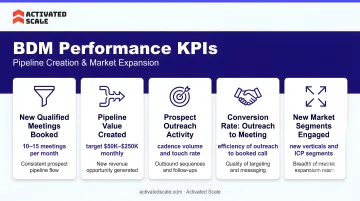
BDMs aren't measured by closed revenue. Their KPIs focus on pipeline creation and market expansion:
- Qualified opportunities created (vetted prospects handed to sales)
- Total pipeline value generated from new market initiatives
- New segments entered — geographies, verticals, or customer tiers
- Partnership agreements signed with channel partners, resellers, or strategic alliances
- Pipeline-to-quota ratio: most B2B organizations target 3x–3.5x pipeline coverage
Salary Benchmark
According to Glassdoor's 2025 data from 32,700 salaries, Business Development Managers in the US earn:
| Compensation Component | Range | Average |
|---|---|---|
| Base salary | $71K–$119K | $92K |
| Additional pay (bonuses/commissions) | $47K–$87K | $62K |
| Total compensation | $118K–$206K | $154,288 |
For SaaS-specific roles, PayScale reports lower base salaries ($63K–$90K, average $72K), likely reflecting equity and commission upside at startups.
Use Cases for a Business Development Manager
When a BDM delivers the most value:
You have product-market fit but need to break into new industries, geographies, or customer segments where you have no existing relationships or brand awareness.
Concrete B2B SaaS scenario:
A Series A startup has found traction selling to SMBs in healthcare. Now they want to expand into mid-market financial services — where deal sizes are 3–5x larger but require different stakeholders, longer cycles, and regulatory knowledge the current team lacks.
A BDM hired for this expansion would:
- Research financial services buying committees and compliance requirements
- Identify and qualify the right decision-makers at 20-30 target accounts
- Explore channel partnership opportunities with industry consultants or compliance software providers
- Hand off qualified enterprise accounts to the sales team once stakeholders are engaged and interest is validated
What is a Sales Representative?
A Sales Representative is an execution-focused role responsible for working qualified leads through the sales funnel: discovery calls, demos, objection handling, negotiation, and closing deals.
HubSpot defines sales reps as professionals who "connect products or services with people who need them" by building trust, solving problems, and guiding customers through their decision-making journey.
Core Day-to-Day Responsibilities
Pipeline management:
- Track and prioritize active prospects in CRM systems
- Follow up consistently with warm leads to maintain momentum
- Forecast revenue based on deal stage and probability
Product demonstrations:
- Run tailored demos showing value specific to each prospect's needs
- Answer technical questions and position features as solutions
- Build urgency by anchoring on the prospect's specific business impact
Objection handling and negotiation:
- Address pricing, timing, and feature concerns transparently
- Negotiate contract terms that protect margins while meeting the buyer's actual needs
- Navigate competitive comparisons and differentiate your offering
Relationship maintenance:
- Stay connected with recently closed accounts during onboarding
- Identify expansion and upsell opportunities
- Gather feedback to inform product and marketing teams
Skills That Distinguish Strong Sales Reps
- Reframes objections and builds buyer confidence without pressure
- Maintains rigorous CRM hygiene and a consistent follow-up cadence
- Knows the product deeply — features, use cases, and how it stacks up against competitors
- Listens to uncover real pain points before pitching solutions
- Juggles multiple deals at different stages without letting opportunities go cold
How Sales Rep Performance Is Measured
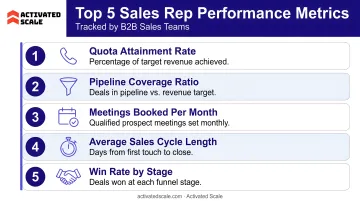
Sales Reps are directly accountable for revenue. HubSpot's 2026 survey of 1,000+ sales professionals found these top tracked metrics:
- Conversion rate: 52% of reps track this as a primary metric
- Quota attainment: 42% prioritize hitting monthly or quarterly revenue targets
- Win rate: 42% measure the percentage of final-stage prospects who become customers
- Average deal size: Contract value per closed deal
- Sales cycle length: Time from first contact to signed contract
Worth noting when hiring: only 45% of US reps hit quota in 2024, down 7% since 2021. Build realistic ramp timelines into your expectations from day one.
Salary Benchmark
Compensation shapes how you attract and retain reps. According to Glassdoor's 2025 data from 135,500 salaries, Sales Representatives earn:
- Base salary: $60K–$97K
- Total compensation (OTE): $97K–$166K (median $126,000)
- Additional pay: $37K–$69K (bonus, profit sharing, commission)
The BLS reports technical/scientific sales reps earn a median of $99,710, with top earners reaching $193,470.
Most Sales Rep roles use a base + commission structure, so OTE is the number that matters most when evaluating an offer. Startups under 100 employees typically pay $45K–$75K base with high commission potential; larger companies run $90K–$150K+ with performance bonuses.
Use Cases for a Sales Representative
When a Sales Rep delivers the most value:
You have a consistent flow of inbound leads or a warm pipeline that isn't being worked fast enough. The bottleneck is closing, not finding opportunities.
Concrete B2B SaaS scenario:
A seed-stage startup runs content marketing and paid ads that generate five qualified demo requests per week. The founder runs initial calls but has no time for systematic follow-up, objection handling, or closing. Deals sit untouched for weeks, and interested prospects go cold. A Sales Rep directly addresses this gap by:
- Taking over all inbound demo requests within 24 hours
- Running discovery calls and tailored product demos
- Following up consistently with prospects through a structured cadence
- Handling pricing objections and contract negotiations
- Closing deals and maintaining relationships through onboarding
BDM vs. Sales Rep: Which Role Should You Hire First?
Before hiring either role, answer one question: Where is my biggest bottleneck right now—lead creation or deal closing?
If your pipeline is thin or non-existent, hire a BDM to build it. If leads are sitting untouched or you're struggling to close, hire a Sales Rep first.
Three Situational Scenarios
Scenario 1: No pipeline yet
You have fewer than 10 active opportunities, inbound leads are sporadic, and you're entering new markets where you have no brand recognition.
Hire a Business Development Manager to create strategic pipeline through outbound prospecting, partnership development, and market entry.
Scenario 2: Pipeline exists but close rate is low
You have 20+ active opportunities but deals stall in the demo or negotiation stage. The founder is spread too thin to nurture every lead.
Hire a Sales Representative to work existing pipeline, run demos, handle objections, and close deals systematically.
Scenario 3: Founder is doing both
You're prospecting into cold markets and trying to close warm leads at the same time—and doing neither well.
Track where you spend more time over two weeks. If 60%+ goes to prospecting and qualifying, replace that function first with a BDM. If 60%+ goes to demos and closing, hire a Sales Rep.
The Startup Reality: When to Split Functions
At very early stages (pre-seed, first 10 customers), founders often play both roles simultaneously. But as deal complexity grows, that split becomes unavoidable.
Jason Lemkin of SaaStr advises that "almost everyone waits too long to specialize the sales team. You can do it even at $2M ARR." The signal isn't a revenue number—it's deal complexity. Cloudflare reached $100M with no sales team by keeping onboarding simple, only hiring sales when large customers self-selected into enterprise tiers.
When to split BD and sales functions:
- Your ACV exceeds $50K and sales cycles extend beyond 3 months
- You're entering verticals where you have zero relationships
- The founder spends 10+ hours weekly on activities outside their strength zone
- You cross $2M ARR with consistent deal flow (Lemkin's threshold)
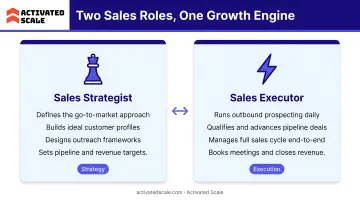
The skills required are fundamentally different. BDMs think in quarters and years, building relationships that may not convert for 6-12 months. Sales Reps think in weeks and months, optimizing for this quarter's revenue. Asking one person to toggle between these modes daily kills momentum in both.
Reducing Hiring Risk with Fractional Talent
Not sure which role to hire first? The cost of a bad hire is severe: SHRM estimates replacement costs reach 50%-250% of salary, and the US Department of Labor pegs mis-hire costs at up to 30% of annual salary.
Activated Scale offers a practical alternative. Both BDMs and Sales Reps can be engaged as fractional hires, letting you test which role delivers more immediate ROI before committing to a full-time hire.
Fractional Account Executives are available for $4,000-$5,000/month plus commissions, with hours ranging from 20-40 per week depending on your needs. This reduces the financial risk of choosing the wrong role and gives you real data on what your business actually needs.
Conclusion
There's no universal answer to "BDM or Sales Rep first?" The right hire depends on where your startup is in its growth cycle and where your revenue bottleneck sits. A BDM unlocks future pipeline when you need strategic market expansion. A Sales Rep converts the pipeline that already exists when execution is your constraint.
For B2B SaaS startups, these roles are complementary, not competing. The fastest-growing companies need both working in alignment — with clear handoffs at the qualification stage, separate KPIs that reflect their distinct contributions, and ownership over their specific stage of the revenue process.
Hire deliberately, one specialized role at a time. Companies that blur these boundaries end up with unclear ownership, missed quotas, and a frustrated hire who was set up to fail from day one.
Frequently Asked Questions
What is the difference between a business development manager and a sales representative?
A BDM focuses on long-term strategy—creating pipeline through market expansion, partnerships, and new segment entry—while a Sales Representative focuses on converting existing qualified leads into closed revenue through active selling, demos, and negotiation.
Is a Business Development Representative (BDR) an entry-level role?
Yes, a BDR is typically an entry-level or early-career role focused on lead qualification and outbound prospecting. Don't confuse it with a Business Development Manager, which is a more senior, strategic position with broader scope and revenue ownership.
Is a business development manager higher than a sales manager?
In most organizations, BDMs and Sales Managers sit at similar seniority levels, but their authority differs. A BDM focuses on strategic growth and new market opportunities, while a Sales Manager focuses on managing a team's pipeline performance and quota attainment.
What is the difference between a VP of Sales and a VP of Business Development?
A VP of Sales oversees the execution side: managing the sales team, hitting revenue targets, and optimizing the closing process. A VP of Business Development leads strategic growth initiatives including partnerships, new markets, and long-term pipeline creation.
Can one person do both business development and sales at an early-stage startup?
At early-stage startups, founders typically handle both functions. Splitting the roles as the team grows leads to better performance in both areas—BD requires strategic thinking; sales requires execution discipline. These are genuinely different skill sets.