Introduction
Most sales roles come with a territory, a CRM full of leads, and a manager who's done the job before. The founding salesperson gets none of that.
You walk in on day one to a blank slate — no pipeline, no proven process, no SDR team feeding you qualified meetings. The startup needs revenue fast, but the tools to generate it don't exist yet. You're closing deals while building the engine to close them.
A B2B SaaS startup with early product-market fit has validated that someone will pay for the solution. What it hasn't figured out is whether a non-founder can replicate that success at scale — and most founding sales hires fail not from lack of skill, but from lack of a repeatable system to build on.
This guide covers:
- What the founding salesperson role really involves
- Who's built for it (and who isn't)
- The five traits that separate success from burnout
- A practical 90-day playbook
- How to work with your founder and what to expect on compensation
Key Takeaways
- The founding salesperson builds the sales motion from scratch — no playbook, no pipeline, no SDR support
- Builders thrive here; managers and reps who've only worked structured orgs typically don't
- SaaStr recommends founders close 10–20 customers before making this hire
- Your first 90 days are about learning, documenting, and closing at least one real deal
- Fractional engagements through Activated Scale offer a lower-risk way to test fit before committing full-time
What Is a Founding Salesperson?
The founding salesperson is the first (or one of the first) sales hires at an early-stage startup — typically brought in after the founder has validated initial traction through their own selling.
That last part matters. According to Y Combinator, founders should learn sales before hiring a sales team so they understand what good looks like, what customers actually care about, and whether weak results reflect a sales execution problem or a product problem. SaaStr puts a number on it: close 10–20 customers yourself before handing the function to someone else.
The founding salesperson's job is to take that founder-validated motion and make it repeatable. The challenge: doing it without the natural advantages the founder carries, including deep product conviction, full context on every customer conversation, and the credibility of being the person who built the thing.
How This Differs From a Standard AE Role
This is not a scaled-company AE job with a different title. The differences are structural:
| Founding Salesperson | Standard AE (Mature Company) |
|---|---|
| No CRM or playbook on day one | Defined process, established CRM |
| Generates own pipeline from scratch | Marketing and SDR team feeds pipeline |
| Builds deal stages, sequences, objection handling | Inherits and executes existing framework |
| Acts as product feedback loop to founders | Submits feature requests through a process |
| No defined ICP — must identify it | ICP already validated and documented |
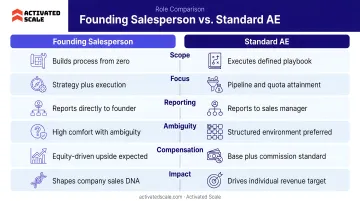
As a16z describes it, the first sales rep in an early market often doesn't just sell. They qualify customers, find budget where no defined category exists, map organizations, and quarterback deals while the founder remains central. That's a fundamentally different job description — and requires a different kind of person to do it well.
Signs the Role Is (and Isn't) Right for You
Getting this wrong wastes six months — for both the rep and the startup. Be honest about which profile fits you.
Who Thrives
Entrée Capital describes what early startups actually need: builders who invent processes rather than manage existing ones. In sales, that means someone who can close without a RevOps stack, create their own decks, and work directly with product.
The profile that works:
- 2–5 years of full-cycle B2B SaaS experience, including generating their own pipeline through cold outreach
- Never relied on BDRs or inbound alone to fill their funnel
- Comfortable with ambiguity — doesn't freeze when there's no playbook to follow
- Energized by building, not just executing
- Has personally run every stage of a deal from first touch to close
Who Struggles
Saastr is direct on this: don't hire someone who has never worked at a startup — they may be unable to sell without an established brand, sales ops support, and ready-made collateral.
The profiles that commonly burn out in this role:
- Sales managers or VP-level candidates who've spent years running teams and reviewing forecasts
- Reps whose entire quota was built on marketing-generated or BDR-sourced leads
- Anyone who needs structure to perform at their best
The role will feel like a regression to a manager-type hire. They'll want to build a team before proving the motion. That's a mismatch, not a failing.
Testing the Waters Before Committing
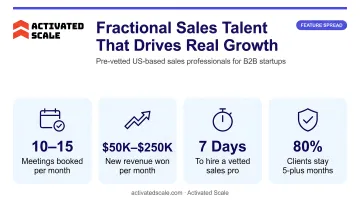
If you're still unsure whether a founding sales role fits, a fractional engagement is the lowest-risk way to find out. Activated Scale connects vetted B2B sales professionals with early-stage startups on a contract basis, with most engagements running 3–6 months part-time before both sides decide on full-time.
Around 85% of these engagements convert to full-time hires — meaning the model functions as a genuine validation period, not a temp arrangement. Matches typically happen within 7 days.
Key Traits That Define Successful Founding Salespeople
Prioritizes Outcomes Over Process
A founding salesperson treats the sales playbook as a hypothesis, not a rulebook. They test outreach sequences, drop what isn't generating responses, and adapt messaging based on what prospects actually say rather than what the internal deck suggests.
The contrast is a rep who follows a rigid process even when pipeline data signals it needs to change. In a startup, that rigidity is fatal. There's no management layer to catch the drift, so the rep has to catch it themselves.
Generates Their Own Pipeline
No inbound engine exists yet. No SDR is booking meetings on your behalf. The founding salesperson has to be capable of sourcing the overwhelming majority of their own pipeline through cold outreach, personal network activation, and creative prospecting.
YC's illustrative outbound funnel for founders gives useful framing: 500 outreach messages might yield 50% opens, 5% responses, 10 demos, and 2 customers. Those numbers aren't benchmarks — they're a reminder that outbound at this stage requires volume and iteration before any pattern emerges.
Demonstrates Self-Criticality
That volume mindset only compounds when paired with honest loss reviews. When deals fall through, great founding salespeople look inward first. Did I multi-thread the account? Did I qualify the budget owner early enough? Did I scope the proof of concept correctly?
A startup environment will always supply excuses: the product has gaps, the timing was off, the champion got promoted. Reps who internalize losses and adjust are the ones who build something repeatable. Reps who externalize them stall.
Carries a "Something to Prove" Mentality
A 2022 meta-analysis across 77,560 salespeople found that intrinsic motivation had a stronger association with performance than extrinsic motivation — r = .298 vs. r = .176 — with the effect even stronger in B2B contexts specifically (r = .354).
The founding salesperson role demands that internal drive. People who've had to fight for their place — through cold-start careers, competitive backgrounds, or breaking in without the "right" pedigree — tend to bring the irrational commitment this work requires. They don't need external validation to stay in motion.
Asks the Right Questions
Surface-level curiosity asks what a company does. The kind of discovery that closes deals goes deeper:
- What happens to the business if this problem stays unsolved?
- How does the buyer actually measure success?
- What's blocking the decision internally?
This depth shows up before the meeting too, in how a founding salesperson prepares, what they know about the account when they dial in, and how they adjust when a prospect's answer doesn't match the hypothesis. Good curiosity is a research habit, not just a conversational skill.
Your First 90 Days: A Tactical Playbook
Days 1–30: Learn, Target, Start Moving
The most important early task is understanding the value proposition from the customer's perspective, not the founder's. What pain does this product eliminate? How does the customer describe that pain in their own words?
That language is the foundation of every outreach message and every discovery call. Get it wrong here and everything downstream suffers.
Practical priorities in the first 30 days:
- Spend the first week doing nothing but listening — recorded calls, customer interviews, support tickets, anything where customers describe their problems
- Build a prioritized target list based on your best read of the ICP from early customers
- Start outbound immediately — don't wait for the list to be perfect. Early activity generates feedback that sharpens targeting faster than any internal exercise
- Set up or clean up the CRM. If the startup hasn't invested in tooling, a free option works fine. What matters is that every conversation, objection, and outcome gets documented from day one
Days 31–60: Close Something, Build Structure
The goal by day 60 is a real closed deal. It doesn't need to be big. The first customer beyond the founder-sold cohort validates the value proposition independently, gives the team a referenceable case study, and gives you a story to replicate.
Three underused shortcuts to an early close:
- Partnerships with complementary vendors whose customers already have the budget problem your product solves
- Existing relationships from prior roles — warm outreach moves faster than cold in a new environment
- Referrals from early customers or advisors — a single warm introduction at this stage often beats 50 cold emails
On the process side, this is when you start documenting what's working. Track objection patterns and note which ICP characteristics appear in deals that progress versus those that stall. Even a rough deal stage framework beats having none at all.
Days 61–90: Document, Replicate What Works, Flag What Doesn't
By day 90, you should have the foundation of a working playbook:
- A testable ICP hypothesis based on the deals you've run
- Outreach sequences generating consistent response rates
- A rough deal stage framework with defined exit criteria
- A documented objection library with tested responses
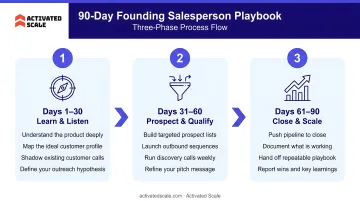
This is version one, not the final word. It gives the company something to iterate from and eventually hand to the next hire — which is part of your job. The goal isn't perfection; it's a starting point someone else can pick up and run with.
Working With Founders: How to Navigate the Relationship
The most common friction point is the founder who previously handled all sales and has strong opinions about what good looks like — sometimes based on experiences that don't transfer to a non-founder seller.
How to earn the right to push back:
- Close deals quickly in the first 60 days. Nothing establishes credibility faster
- Frame alternative approaches as "let me test this hypothesis for two weeks" rather than "that's not how sales works"
- Show your work — share call recordings, document what you're hearing from prospects, make your reasoning visible
Involving the Founder Strategically:
Use the founder as executive presence in targeted situations:
- Deals where technical depth is the key differentiator
- Strategic accounts where the founder relationship genuinely matters
- Late-stage negotiations where an extra credibility boost helps
Avoid leaning on the founder to close every deal. That pattern signals — to the team and to future investors — that the founding salesperson hasn't proved anything independently.
Negotiating Quota Expectations:
Founders consistently set unrealistic revenue targets for the first 60–90 days. Push to negotiate activity-based milestones instead: outbound touches per week, conversations booked, pipeline dollars generated. These give both sides a fair evaluation framework while the sales motion is still being established. Revenue quotas make sense once the process is proven; before that, they're just pressure applied to an incomplete equation.
Compensation and Career Growth
What the Numbers Look Like
Founding salesperson compensation typically involves a lower base than a comparable AE role at a mature company, offset by higher commission and equity participation.
For market context: the Bridge Group's 2024 SaaS AE benchmark report found median AE OTE across 170+ B2B SaaS companies at $190,000, with a median ACV quota of $800,000. Founding AE roles will generally sit below these figures on base, but commission structures are typically more aggressive.
Based on Activated Scale's placement data, founding AE positions at early-stage B2B SaaS companies commonly show:
- Base salary: $75,000–$100,000
- OTE: $150,000–$200,000 (higher-end roles at growth-stage companies can reach $260,000–$320,000)
On equity: Carta notes that startup option pools typically range from 13%–20%, and that sales roles generally require more cash and less equity than engineering or product positions. Precise equity ranges for first sales hires vary widely by stage and company — treat any number you hear as directional until you see the cap table.
The Career Accelerator Argument
The base salary isn't what makes a founding sales role compelling. Career trajectory is.
Founding salespeople who build the first revenue motion become the most natural internal candidates when the company needs to grow its sales leadership. They've already proven they can operate without structure — the hardest thing to demonstrate from inside a scaled organization. That track record opens doors:
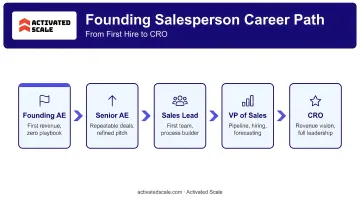
- First sales manager or team lead as headcount grows
- VP of Sales once a repeatable motion is established
- CRO at the company or as a credentialed candidate elsewhere
On a resume, building a sales process from zero — closing deals before there's a playbook, navigating genuine ambiguity — signals self-direction and commercial instincts that a mid-level AE stint at an enterprise company can't replicate. Hiring managers at growth-stage companies recognize the difference immediately.
Frequently Asked Questions
What does founding sales mean?
Founding sales refers to the practice of driving revenue at an early-stage startup before a formal sales team or process exists. The founding salesperson — or a founder doing sales — validates the go-to-market approach, closes initial customers, and builds the sales infrastructure that future hires will eventually follow.
What is the difference between a founding salesperson and a regular sales rep?
A founding salesperson operates without a playbook, inbound leads, or sales support, and is responsible for building the process — not just executing it. A regular AE at a mature company inherits an established motion with defined territory, SDR support, and marketing-generated pipeline.
What skills do you need to be a founding salesperson at a startup?
The role demands a specific mix of skills most AEs never develop at larger companies:
- Full-cycle B2B sales experience across prospecting, discovery, and close
- Ability to generate pipeline independently without SDR or marketing support
- Strong discovery and qualification instincts to identify real buyers fast
- Comfort with ambiguity and a builder's mindset — you're creating the process, not following one
How much does a founding salesperson make?
Compensation typically includes a base of $75,000–$100,000 and OTE of $150,000–$200,000, plus equity. Earning potential runs well above a standard AE role if the company scales — the equity component is where the real upside comes from.
When should a startup hire their first salesperson?
After the founder has manually closed at least 10–20 customers and has a working understanding of who the ICP is, what the value proposition is, and how a deal progresses. Hiring before that validation means the first salesperson walks into a role with no proven foundation to build from.
How do you build a sales process from scratch at a startup?
Start with three priorities:
- Set up a CRM on day one and log every interaction, objection, and outcome
- Define your ICP from early wins, then build outreach sequences around that profile
- Treat every conversation as data — the playbook you'll hand future reps is being written right now