
Introduction
You've built a product people want. Now you need someone to sell it — and hiring the wrong person will cost you far more than just their salary. A misaligned sales hire at the early stage can burn prospect relationships, drain runway, and set your entire go-to-market back by months.
The challenge is real: experienced SaaS reps are rarely job hunting, early-stage startups can't always compete on brand or resources, and the skills that made your founder-led sales work don't translate into a job description.
This guide covers the full hiring framework:
- When to make your first sales hire
- Which role to prioritize first
- Where to find qualified candidates
- What to screen for in interviews
- How to structure compensation
Whether you're making your first sales hire or building out a small team, use this as your practical playbook.
Key Takeaways
- Wait until you've closed 10–20 customers yourself before delegating sales to a rep
- Your first hire should be a full-cycle seller who can both prospect and close
- Top SaaS reps don't browse job boards — source them directly through outreach and referrals
- Screen for stage fit and ACV match above everything else
- Consider fractional sales reps to reduce hiring risk while still validating your playbook
What Makes SaaS Sales Different (and Why Hiring Gets Tricky)
SaaS sales isn't just selling software. Reps must sell subscriptions, manage multi-month buying cycles, demonstrate ongoing value post-sale, and build relationships that prevent churn. According to Bridge Group's 2024 SaaS AE research across 172 B2B companies, the median sales cycle is 5.0 months, the median win rate is 19%, and only 51% of AEs hit annual quota. Those close rates only tell part of the story.
Win rates mean little if customers churn — so retention is just as critical as the close. ChartMogul's 2024 analysis of 2,500+ SaaS businesses found that companies achieving 100%+ net revenue retention grew 48% year-over-year in H1 2024. That growth comes from reps who sell well-fit customers and support expansion — not just reps who close logos.
Why Finding the Right Rep Is Harder Than It Sounds
The market is competitive. Most experienced SaaS reps are already employed, and early-stage startups rarely offer the brand recognition or inbound pipeline that established companies can.
That gap matters more than most founders expect. A rep who thrived at Salesforce — with a full SDR team, marketing support, and a name prospects already recognize — will struggle in an environment where they have to generate their own leads, build the playbook, and close without social proof behind them.
The stakes of a bad hire are also high. Beyond the missed quota, a misaligned rep can:
- Burn relationships with your best-fit prospects
- Create a false negative about your sales playbook's viability
- Deplete runway through ramp time with no return
- Demoralize early momentum if the team is small
When Is Your Startup Ready to Hire a SaaS Sales Rep?
The readiness question is a repeatability question, not just a revenue question.
SaaStr recommends that founders close 10–20 customers themselves before handing off to a sales rep. That threshold isn't arbitrary — it's the minimum needed to know which customer profiles convert, what objections kill deals, and which messages actually work. A rep walking into an unproven playbook is set up to fail.
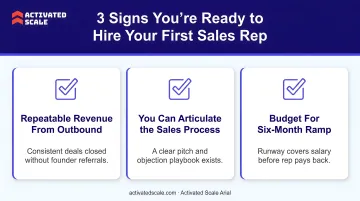
Three Signals That You're Ready
Once you've closed those first customers yourself, look for these three signals before bringing in a rep:
- You can describe your ICP precisely — 10+ closed customers and documented lessons from 20–30 lost deals, not a general target profile
- You have real pipeline to hand off — consistent inbound interest or a defined outbound target list, not a blank slate for a rep to build from scratch
- Sales is crowding out everything else — when calls are consuming enough founder time that product, hiring, or fundraising are suffering, the cost of not hiring exceeds the risk of hiring
The $10K MRR threshold cited in founder communities is a useful heuristic — treat it as a secondary signal, not a trigger.
Types of SaaS Sales Roles and Which One to Hire First
Not every startup needs all four core sales roles from day one. Here's how they break down:
| Role | Primary Focus |
|---|---|
| SDR/BDR | Outbound prospecting and qualifying leads |
| Account Executive (AE) | Running demos, negotiating, and closing |
| Account Manager | Renewals, upsells, and expansion |
| Sales Engineer | Technical support for complex deals |
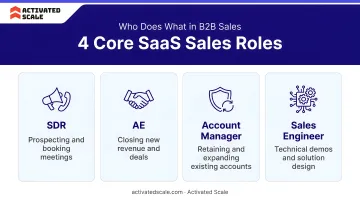
For most Seed to Series A companies, the only role that matters at first is an AE — and ideally a full-cycle one.
Choosing the Right First Hire
Hire a hybrid SDR/AE first. Splitting prospecting and closing into separate roles is premature when you don't yet have enough pipeline volume to keep two people busy. As a16z describes it, this is a "renaissance" seller — someone who learns, iterates, and feeds product feedback while generating their own pipeline.
Consider hiring two at once. SaaStr makes this case clearly: with only one rep, you can't distinguish between a product problem, a playbook problem, and a people problem. Two reps give you a real benchmark.
Or start fractional. If budget doesn't support two full-time hires yet, fractional sales reps are a practical alternative. They generate immediate pipeline activity and validate your sales motion before you commit to permanent headcount.
Activated Scale places vetted fractional SDRs, AEs, and VP-level sales talent with B2B SaaS startups — often within 7 days. Professionals are matched by buyer persona and deal size, covering ACV ranges from $10K to $100K+.
What to Look for When Hiring a SaaS Sales Rep
Stage Fit Beats Logo Fit
The biggest hiring mistake early-stage founders make is prioritizing a candidate's last employer over their last environment.
A rep who closed $2M at HubSpot — with strong inbound flow, an SDR team, and a recognized brand behind them — hasn't proven they can sell into a cold market with none of those advantages.
What you want is someone who has sold at a similar stage: limited resources, no brand recognition, no established pipeline. That background is harder to find, but it's the one that actually translates.
ACV Match Matters More Than Vertical Match
A rep experienced closing $5K deals will struggle with $80K enterprise cycles — different stakeholders, different timelines, different objections. Look for candidates who've consistently closed at a similar average contract value to yours. A quick screen: ask them to walk through their last three deals — deal size, cycle length, and number of decision-makers involved.
Skills to Screen For
- Asks sharp discovery questions to surface real pain — and qualifies out quickly when there's no fit
- Builds pipeline independently, without an SDR team feeding them leads
- Runs product demos without heavy pre-sales support
- Maintains focus and accountability through long sales cycles (think 4-6 months)
Red Flags to Watch For
- Can only sell with strong inbound lead flow
- Never sold without a recognized brand behind them
- Can't clearly explain why a specific deal was lost
- Avoids accountability metrics or gets vague about past quota attainment
- Rigid habits with no interest in iterating on messaging
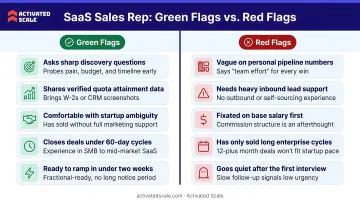
That last flag — rigidity — is often the most costly. At the early stage, coachability matters as much as past results. A rep who adjusts quickly based on customer feedback will outperform a stronger resume that can't adapt.
Where to Find and Source SaaS Sales Rep Candidates
The honest reality: top-performing SaaS reps are rarely applying to job boards. Treat sourcing like an outbound sales motion.
DIY Sourcing Approach
Use LinkedIn to identify sales reps at recently-funded Series A/B SaaS companies who joined at the seed stage. These reps have proven they can sell in scrappy environments — and may be ready for their next early-stage challenge.
Reach out at inflection moments: right after a funding round or acquisition at their current company. That's when people naturally reassess where they want to be.
Other Sourcing Channels
- Investor referrals — Your existing investors have networks of vetted operators. Ask directly.
- Wellfound (formerly AngelList) — Active startup-focused job marketplace with thousands of sales listings
- GTMnow — The community successor to Sales Hacker, with 60K+ members across software and AI, spanning all 50 US states
- Word of mouth — LinkedIn's talent research found 50% of professionals discover opportunities through word of mouth
The Shortcut Option
For founders who'd rather spend time closing deals than screening candidates, Activated Scale provides immediate access to a pre-vetted network of US-based fractional and full-time SaaS sales professionals. Their 3-step vetting process covers application review, pitch video assessment, and an expert interview — only the top candidates make it through.
The result: founders skip 20+ hours of interviewing, and placements happen in under 7 days. The contract-to-hire model lets you evaluate a rep's actual performance before committing to a full-time offer.
How to Structure Compensation for SaaS Sales Reps
Base + Variable Pay (OTE) Model
Most SaaS sales roles use a base salary plus variable performance pay, expressed as an on-target earnings (OTE) figure. Current benchmarks based on RepVue's 2024 self-reported data and Bridge Group's 2024 SaaS AE report:
| Role | Base Salary | OTE |
|---|---|---|
| SDR | ~$55K | ~$83K |
| SMB AE | ~$68K | ~$130K |
| Mid-Market AE | ~$85K | ~$160K |
| SaaS AE (overall median) | ~$100K | ~$190K |
| Enterprise AE | ~$130K | ~$255K |
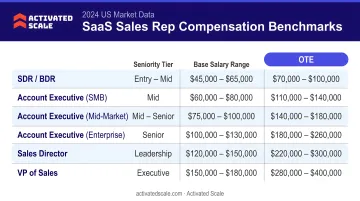
Bridge Group reports a 53:47 base-to-variable split as the median across SaaS AEs.
Variable Pay Structure
Saastr puts typical SaaS AE incentive at 8–10% of first-year ACV. Bridge Group's data shows an 11.5% median performance pay rate at 100% quota attainment, with the 25th–75th percentile range sitting at 11–14%. The commonly cited 8–15% range is reasonable depending on deal size and unit economics.
Common structures include:
- Flat percentage of ARR closed
- Tiered rates that increase as the rep exceeds quota
- Accelerators for overperformance above 100%
Early-stage reps are taking on real risk: no brand, no mature product, often no existing pipeline. They know it. Expect them to negotiate above-market base compensation or ask about equity.
Equity Considerations
First sales reps who join pre-traction often ask about equity. Come prepared for that conversation. The revenue upside an early rep unlocks can be significant; the equity cost, modeled against that upside, is worth it.
If the full-time cost and equity conversation feels premature, fractional arrangements offer a leaner alternative. Activated Scale's fractional AEs are $6,500/month plus performance pay, compared to $80K–$150K base salary plus benefits for a full-time hire — a difference of $50K–$100K+ annually before factoring in onboarding and ramp time. For a startup still validating its sales motion, that gap matters.
Frequently Asked Questions
How much incentive do SaaS sales reps make?
Incentive in SaaS typically ranges from 8–15% of first-year ACV, depending on deal size and seniority. Bridge Group reports an 11.5% median at 100% quota attainment for SaaS AEs. Accelerators kick in above quota, often at a higher rate.
When should a SaaS startup hire its first sales rep?
Most operators recommend waiting until you've closed 10–20 customers through founder-led sales and can describe a repeatable process. $10K MRR is a commonly cited benchmark, but a documented, repeatable process matters more than any revenue threshold.
What's the difference between an SDR and an AE in SaaS sales?
An SDR focuses on outbound prospecting and qualifying leads; an AE handles demos, negotiation, and closing. Early-stage startups usually need one person capable of doing both before the pipeline volume justifies splitting the roles.
Should I hire a full-time or fractional SaaS sales rep?
Fractional is the lower-risk option when you're still validating your sales playbook. It provides immediate pipeline activity without the cost and commitment of a full-time hire. About 85% of Activated Scale clients convert their fractional reps to full-time after seeing results.
What interview questions should I ask a SaaS sales rep candidate?
Strong questions include: "Walk me through a deal you lost and what you learned," "What does your prospecting process look like with no inbound support?" and "How do you handle a prospect who goes dark after a demo?" How a candidate answers the first question tells you more about their self-awareness than any win story will.
How long does it take to hire a SaaS sales rep?
SHRM's 2025 data puts average time-to-fill at roughly six weeks for traditional recruiting. Platforms like Activated Scale can connect founders with pre-vetted SaaS sales talent in 7 days or less, sometimes within 48 hours.