
Introduction
At some point, most B2B SaaS founders hit a wall. You're managing product, customers, investor updates, and somehow still personally sending cold emails at 10pm. Hiring an SDR feels like the obvious fix.
But rushing this hire is one of the costliest mistakes early-stage startups make. A bad SDR hire doesn't just waste salary: Gallup estimates employee replacement costs run 0.5x–2x annual salary, and for a junior role managing your most precious asset (pipeline), the damage compounds fast.
Some advisors say hire an AE first; others say SDR. The right answer depends on where you are in your sales motion. This guide covers when to hire, what to look for, how to structure compensation, and how to set your first SDR up to succeed from day one.
Key Takeaways
- Not ready yet? If you lack a defined ICP, paying customers, and a basic sales playbook, don't hire — you'll waste both money and momentum.
- Screen for startup fit, not pedigree: drive, coachability, and comfort with ambiguity matter more than a recognizable company logo.
- Comp structure: aim for 60–70% base / 30–40% variable, tied to qualified meetings held, not raw activity.
- Onboard before they prospect: product immersion, customer call shadowing, and messaging alignment should come first.
- Manage with milestones: track input activity, pipeline pacing, and meeting quality weekly — and act fast if improvement stalls.
Are You Ready to Hire Your First SDR?
Here's the blunt version: an SDR amplifies a working sales motion. They don't create one from scratch.
If you haven't personally closed at least a handful of paying customers and can't explain why those deals were won, there's nothing concrete to hand off. You'd be paying someone to run experiments you haven't finished running yourself.
The Readiness Checklist
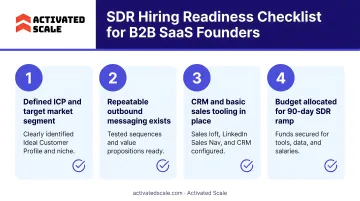
Before posting that job description, confirm you have all four:
- A defined ICP — not just "SMBs" or "tech companies," but a specific profile with title, company size, and trigger event
- A value proposition that resonates — meaning customers have told you why they bought, not just that they bought
- At least a handful of paying customers — SaaStr recommends closing 10–20 customers before making a first sales hire
- A repeatable lead source — some outbound motion or inbound channel the SDR can actually execute against, outside your personal network
If you've closed 5–10 paying customers and can articulate the pattern behind those wins, outreach will land. Short of that, you're paying someone to confirm a positioning problem — and that's not a staffing fix.
The Most Common Premature Hire Trigger
Founders often think: "If I just had someone doing outbound, we'd grow faster."
That logic only holds if inbound or founder-led outbound is already generating some traction. If neither is working, adding an SDR won't change the underlying dynamic. It'll just make the failure more expensive and take longer to diagnose.
Full-Time vs. Fractional: A Lower-Risk Alternative
If you have the readiness signals but aren't sure you can sustain a full-time salary — or aren't confident in your ability to manage the hire — consider a fractional or contract-to-hire SDR first.
Activated Scale matches pre-vetted fractional SDRs with early-stage B2B SaaS startups — typically within 7 days. Key details:
- Cost: $4,500/month plus performance pay
- Flexibility: Cancel or convert at any time — no long-term commitment required
- Conversion rate: ~65% of clients eventually bring their fractional SDR on full-time after validating the motion
What to Look for in a Startup SDR
Someone who thrived at Salesforce with a dedicated enablement team, brand recognition, and a pre-built tech stack will often struggle at an early-stage startup where the tools are minimal and the playbook doesn't exist yet. Enterprise and startup sales are genuinely different operating environments.
SaaStr specifically warns that large-company sales hires often fail at startups without the infrastructure they're used to. Prioritize candidates from other startups or high-velocity environments where they had to figure things out on their own.
Core Traits to Screen For
| Trait | What to Look For |
|---|---|
| Drive and self-direction | Can they work without daily supervision? |
| Coachability | Do they absorb feedback and adjust, or defend their approach? |
| Resilience | Evidence of performing in high-rejection environments |
| Intellectual curiosity | Do they ask smart questions about your product and customer? |
| Writing ability | Strong email and LinkedIn outreach is table stakes |
| Comfort with ambiguity | Are they energized by building, or do they need a defined playbook? |
Experience Level: The Real Tradeoff
SDR roles are typically early-career, but for a startup's first SDR hire, some prior experience matters more than usual. Candidates with 6–12 months of prior SDR experience ramp faster and require significantly less coaching — and your time is the real cost here.
A zero-experience hire might save $5,000–$10,000 in base salary. But if ramp takes six months instead of three, you've lost far more in pipeline than you saved.
The Case for Hiring in Pairs
When budget allows, consider hiring two SDRs at the same time. It sounds counterintuitive, but it's one of the most useful diagnostic tools available. If both struggle, you likely have a messaging problem. If one excels and the other doesn't, you have a performance problem. With a single hire, you can't tell the difference.
What NOT to Optimize For
- Polished LinkedIn profiles with prestigious company names
- High GPAs or educational credentials
- Interview polish without demonstrated outbound activity
The traits that actually predict SDR success don't show up on a resume. Surface them through work samples: ask candidates to write a cold email to your ICP or walk through how they'd build a prospect list from scratch.
How to Run the SDR Hiring Process
Keep this lean. An SDR role doesn't need a five-round executive search process.
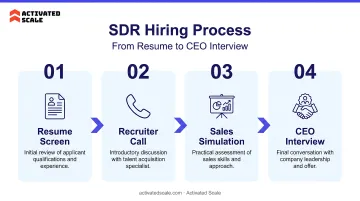
A Four-Stage Structure That Works
Resume screen — Look for prior outbound activity and startup or fast-paced environment experience. Skip polished resumes that show no evidence of actual prospecting.
30-minute phone screen — Assess communication clarity, energy, and basic familiarity with the outbound sales process. Can they articulate why they want this role at a startup?
Work sample exercise — This is the most important stage. Give candidates a prospect persona and ask them to draft a cold email and conduct a brief mock cold call. Research on hiring validity consistently shows structured interviews combined with work samples outperform unstructured conversations.
Hiring manager or CEO interview — 30 minutes. Assess coachability, startup mentality, and cultural fit. Listen for candidates who push back intelligently on feedback rather than just agreeing with everything.
What the Work Sample Actually Reveals
The point isn't to see perfect technique. You want to know: can this person research a prospect, craft a concise value hook without a script, and then make the case for why someone should take a meeting? That's the core SDR competency. Behavioral questions alone won't tell you as much as watching someone actually do it.
Reference Checks That Actually Help
Don't ask if the candidate "was a pleasure to work with." Ask:
- How did they respond to rejection and a losing streak?
- Were they consistently hitting daily outreach targets?
- Would you rehire them, and if not — why?
The First Round Capital framework suggests asking references to rate the candidate on a 1–100 scale, then asking what would make them a 100. The gap is usually more revealing than the number.
Compensation, Onboarding, and Ramping Your SDR
Compensation Structure
The old 50/50 base-to-variable split is largely outdated for early-stage startup SDRs. The current norm sits closer to 60–70% base and 30–40% variable, which reflects the reality that startup SDRs often wear multiple hats and need income stability while building from scratch.
Current US market benchmarks (per Betts Recruiting's 2025 SDR Compensation Report and RepVue's 2026 data):
| Experience Level | Base Salary | OTE |
|---|---|---|
| Entry-level | $55,000–$70,000 | $75,000–$90,000 |
| 6+ months experience | $60,000–$75,000 | $80,000–$100,000 |
| Major metro market | $60,000–$80,000 | $80,000–$100,000 |
Note: These are broad tech-market benchmarks, not startup-specific. Early-stage startups often land at the lower end of these ranges.
Tie the variable to quality, not volume. Compensating on qualified meetings held (not just scheduled) or on opportunities accepted by the founder keeps incentives aligned. When the founder is personally taking every demo, a wasted meeting is genuinely costly. Don't incentivize them.
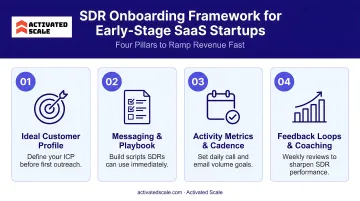
Onboarding: The Four Pillars
Most startup SDRs fail not because they're bad at sales, but because they were sent to prospect before they understood what they were selling or who they were selling to. Build four weeks of onboarding around:
- Product and competitive landscape — What it does, who it beats, and the honest reasons why customers choose it
- ICP and messaging — Who to target, what pain to lead with, and what actually resonates (pull from real customer conversations)
- Sales operations — CRM hygiene, what counts as a qualified lead, and how handoffs to the founder/AE work
- Tools and tech stack — Whatever sequencing, email, and prospecting tools are in place
Make the SDR a co-owner of their own onboarding. Have them document what they learn during ramp. This improves the process for future hires and quickly reveals how much initiative they take on their own.
Ramp Timeline
Forum Ventures' first SDR framework provides a useful benchmark for quota expectations:
- Day 30: 25% of quota
- Day 60: 50% of quota
- Day 90: 100%+
During month one, prioritize shadowing real sales calls and listening to customer conversations over solo prospecting volume. The Bridge Group's 2024 SDR data puts average SDR ramp time at roughly three months, which aligns with this plan.
Because the ramp window is genuinely pre-quota, a nonrecoverable draw or MBO-based compensation plan is reasonable during this period before holding the SDR to full expectations.
Managing and Measuring Your SDR's Performance
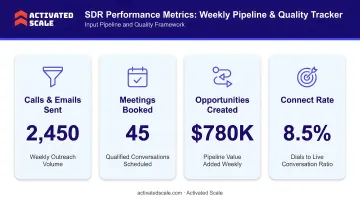
Three Categories to Track Weekly
Structure your weekly 1:1s around these three buckets:
Input metrics — Are they doing enough outbound activity across channels (calls, emails, LinkedIn)? Track volume, but don't worship it. Activity without quality is noise.
Pipeline pacing — Are they on track to hit their qualified meeting or opportunity goal for the month? If not, is it a volume problem or a conversion problem?
Quality feedback — Are the meetings they're booking actually converting downstream? A calendar full of meetings that waste the founder's time is worse than fewer, better-qualified ones. Monthly sales-qualified leads are the primary KPI most early-stage teams anchor to.
For context on what "good" looks like: Bridge Group's SDR planning model shows a fully ramped SDR generating approximately 5 Stage 1 opportunities per month, or roughly $3M in annual pipeline at a $50K ACV — adjust these benchmarks for your deal size and ICP.
Course-Correcting vs. Letting Go
Tracking these metrics is only useful if you act on what they tell you. That means recognizing which type of underperformance you're actually dealing with:
- Fix the program, not the person: If targets are unrealistic, messaging is unclear, or enablement is thin, the SDR isn't the problem. Address the environment first.
- Act on persistent underperformance: If the SDR is consistently below input metrics with no improvement after coaching and clear expectations, that's a performance issue — not a program issue.
Most startup founders wait too long to act on the second scenario.
The standard framework: run one structured 30-day improvement cycle with explicit targets, regular check-ins, and documented feedback. If there's no measurable improvement in both activity and results by the end of it, move quickly. A slow backfill is almost always less costly than carrying an underperforming SDR for another quarter.
Frequently Asked Questions
What does hiring SDRs mean?
SDRs (Sales Development Representatives) handle outbound prospecting and lead qualification — they focus entirely on top-of-funnel activity. Their job is to book qualified meetings and pass interested prospects to a founder or AE to close. They don't handle the full sales cycle.
Is SDR an entry-level role?
Yes — SDR is typically an early-career position. For a startup's first SDR hire, though, candidates with 6–12 months of prior experience tend to ramp significantly faster and require less day-to-day coaching, which matters when founder time is the real constraint.
Are SDRs worth it?
SDRs are worth it when there's already a working sales motion to scale. Bridge Group's data shows a fully ramped SDR can generate roughly 5 qualified opportunities per month — around $3M in annual pipeline at a $50K ACV. Without a proven motion, the math doesn't work.
Do SDRs make a lot of money?
US SDR median base is around $60,000 with an $85,000 OTE (per RepVue's 2026 data). Startup SDRs often earn slightly less base than enterprise peers, but typically have faster promotion timelines and more variable upside as the company grows.
How long is too long as an SDR?
Most high-performing SDRs move into an AE or senior SDR role within 12–24 months — but SaaStr data shows average tenure is just 14 months, with 52% not lasting a year. Acknowledge the career path upfront and set a clear promotion timeline to retain your best people.
What is the 70% rule of hiring?
The 70% rule means hiring someone who meets roughly 70% of your requirements rather than holding out for a perfect fit. For SDR hires, prioritize coachability and drive over a complete checklist — the missing 30% is usually trainable; the wrong attitude isn't.