
Introduction
Closing a Series B round creates immediate pressure. Investors expect 2–3x ARR growth, your AEs need a steady pipeline, and founder-led prospecting is no longer sustainable at scale.
Recruiting your first SDR is also one of the most commonly mishandled decisions at this stage. Series B conditions differ from Series A: you need someone who ramps fast, works from an existing playbook, and delivers qualified pipeline within 60–90 days. A bad hire here typically costs 6+ months of lost ramp time on top of a $60,000–$80,000 base salary sunk cost.
This article walks founders and sales leaders through the complete SDR recruitment process, from defining the role internally to closing the offer, with guidance specific to the Series B stage.
Key Takeaways
- Define SDR success metrics — meetings booked, pipeline sourced — before drafting the job description
- Referrals convert far better than job boards — 1 in 10 referrals results in a hire vs. 50–60 applicants per hire on job boards
- Series B SDR compensation runs $60K–$80K base and $85K–$100K OTE for experienced candidates
- A live cold call roleplay or prospecting exercise is required in the interview process
- No documented playbook yet? A fractional SDR lets you test before committing to a full-time hire
What Is SDR Recruitment and Why Series B Changes Everything
SDR recruitment is the structured process of identifying, evaluating, and hiring a Sales Development Representative whose job is to generate qualified pipeline through outbound prospecting and inbound qualification.
At Series B, this hire carries more weight than at any prior stage. The company now has proof of product-market fit, a repeatable ICP, and investor expectations baked into the cap table.
According to SaaS Capital's 2024 benchmarks, median growth for private SaaS companies sat at 30% in 2023. Investors funding Series B rounds expect trajectories well above that median, which puts direct pressure on every sales hire you make.
How Series B SDR Hiring Differs From Earlier Stages
Seed and Series A SDRs can be generalists — learning the motion while building it. At Series B, you're no longer building the motion. You're running it. The hire you make now needs to step into a defined playbook and execute from day one.
| Stage | What SDR Needs | Tolerance for Ambiguity |
|---|---|---|
| Seed | Grit + curiosity | High |
| Series A | Process + coachability | Medium |
| Series B | Playbook execution + fast ramp | Low |
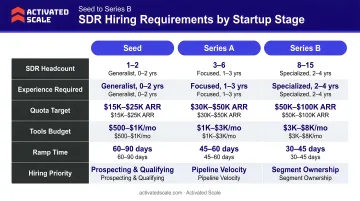
A Series B SDR must hit reduced quota targets by day 30, full quota by day 90, and be evaluated against defined KPIs from week one. Carta's H2 2025 data shows average Series B headcount has dropped to 45 employees. On a lean team, there's no runway for a slow ramp.
Steps to Recruit an SDR for Your Series B Startup
The recruitment process has five distinct steps. Skipping or rushing Step 1 is the most common cause of SDR mis-hires at the startup stage — everything downstream depends on clarity defined before the job post goes live.
Step 1: Define the Role Before You Write the Job Description
This step is internal, not external. Before touching a job description, document:
- Scope: Outbound-only, inbound qualification, or both?
- ICP and ACV: What company profile and deal size will this SDR work against?
- Handoff process: What does a qualified meeting look like, and how does it transfer to an AE?
- Ramp quota: What does success look like at 30, 60, and 90 days?
Without this clarity, the job description attracts generalists. A Series B SDR needs defined targets from day one — ambiguity tolerance is not a hiring virtue at this stage.
Step 2: Write a Job Description That Filters for Fit
A strong Series B SDR job description includes:
- A specific mission statement for the role (not "join a fast-growing team")
- The tools they'll use — CRM, sequencing platform, data enrichment
- The metrics they'll be held to (meetings booked per week, pipeline sourced per quarter)
- Realistic base + OTE clearly stated
Including OTE in the listing matters. Quota-driven SDR candidates evaluate opportunities on earning potential first. Candidates who aren't performance-motivated will self-select out when they see variable compensation attached to specific targets.
Step 3: Build a Targeted Sourcing Strategy
Job boards alone produce volume, not quality. iHire's 2025 State of Online Recruiting found that 59.7% of employers cite too many unqualified applicants as their primary job-board challenge.
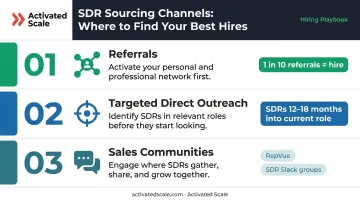
An effective Series B sourcing strategy layers three channels:
- Referrals first: tap founder, investor, and customer networks. SHRM data shows 80% of referred candidates respond and 40% get interviewed, compared to 50–60 applicants per job-board hire
- Targeted direct outreach: identify SDRs at comparable-stage B2B SaaS companies who are 12–18 months into their current role and ready to move
- Sales-specific communities: platforms like RepVue, SDR-focused Slack groups, and sales forums produce more qualified candidates than general job aggregators
Step 4: Run a Structured Interview and Skills Evaluation
A Series B SDR interview process should include three components:
- Phone screen — assess baseline communication clarity and motivation; ask directly what their quota was and whether they hit it
- Behavioral interview — focus on pipeline metrics, objection handling, and how they've handled extended cold streaks
- Live skills exercise — a cold call roleplay or a 10-minute prospecting brief using your actual ICP
The live exercise is non-negotiable. SDR performance is behavioral, not credential-based. Someone who interviewed well but freezes on a cold call roleplay will behave the same way on the phone with prospects.
Step 5: Close the Candidate and Set Up for a Fast Ramp
Closing an SDR at Series B is not just about the offer number. Strong SDR candidates evaluate four things:
- Compensation: Competitive base + OTE + equity
- Playbook: Does a documented outbound process actually exist?
- Management access: Will they have a real manager, or be left to figure it out alone?
- Career path: Is AE promotion realistic and on a defined timeline?
A strong offer package includes base salary, OTE, equity with a 4-year vest/1-year cliff, and ramp protection: paying at or near full OTE while the SDR hits reduced targets in months one and two.
The 30-60-90 day onboarding plan should have one concrete output: the SDR sources their first qualified meeting within 30 days. Forum Ventures' guidance targets 25% quota at 30 days, 50% at 60 days, and 100% by 90 days — a practical benchmark for setting mutual expectations before day one.
How to Define the SDR Profile and Compensation Package
Experience Profile
The right Series B SDR hire typically has:
- 1–3 years of outbound SDR experience at a B2B SaaS company
- Demonstrated quota attainment — ask for specific percentages, not approximations
- Familiarity with at least one CRM and one sequencing tool
- Comfort operating in an environment that's still refining its process
The traits that separate high performers don't show up on a resume. They show up in the interview: how a candidate handles rejection mid-conversation, whether their cold call opener is sharp or scripted, and how clearly they write under pressure. Those signals matter more than tool familiarity.
2025 SDR Compensation Benchmarks
According to Betts Recruiting's 2025 compensation data, SDR compensation varies by experience level and region:
| SDR Level | Base Salary | OTE |
|---|---|---|
| Entry-level (most markets) | $55K–$70K | $70K–$90K |
| Entry-level (top metros) | $50K–$70K | $80K–$90K |
| 6+ months experience | $60K–$80K | $85K–$100K |
| Remote | $60K–$80K | $85K–$100K |
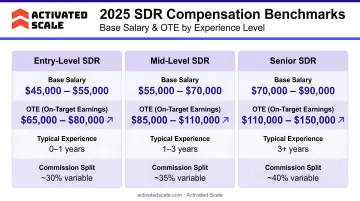
Betts also projected SDR salaries would rise 5–10% from 2024 levels. Underpaying relative to market is the fastest way to lose strong candidates to better-funded competitors.
Equity at Series B
Most Series B companies offer stock options with a standard 4-year vesting schedule and 1-year cliff — Carta confirms at least 95% of VC-backed cliffs are set at one year. For an SDR evaluating a startup versus a late-stage company or agency, equity is a genuine differentiator. Be specific: share the current strike price, the last valuation round, and what their grant could be worth under realistic growth scenarios. Vague "upside potential" talk doesn't move candidates — concrete numbers do.
Ramp Protection
A 60–90 day ramp guarantee — where the SDR earns at or near full OTE while hitting reduced targets — is standard at funded B2B SaaS startups. Candidates comparing offers notice when it's missing, and they'll choose the company that includes it.
Common Mistakes Series B Founders Make When Hiring SDRs
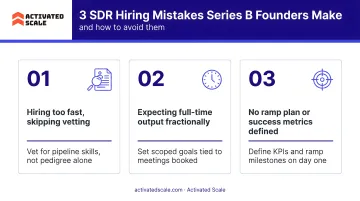
Three patterns consistently derail SDR hires at the Series B stage:
Hiring before the playbook exists. An SDR who joins with no documented ICP, outbound sequences, or objection-handling framework will either flounder or reverse-engineer the process themselves. Neither outcome is efficient — write down the sales motion before the SDR's first day.
Optimizing for pedigree over performance. A well-known logo on a resume is not a proxy for quota attainment. Harvard Business Review's review of 81 studies found prior work experience has little predictive validity for future job performance. Ask for specific quota percentages and pipeline numbers instead.
Setting unrealistic ramp expectations. Expecting qualified meetings in week two — before the SDR has finished product training, ICP education, and messaging calibration — inflates early turnover. A realistic ramp builds to full productivity over 90 days. Rushing it typically means losing the hire within six months and starting over.
When a Full-Time SDR Hire Isn't the Right Move Yet
A full-time SDR hire is premature at Series B when:
- The ICP is still being refined
- There is no AE available to receive and close qualified meetings
- The founder hasn't yet validated a repeatable outbound sequence
Hiring a full-time SDR into this environment is expensive and almost always ends in a mis-hire. CareerBuilder estimates a bad hire costs at least 30% of the role's total annual salary — before accounting for lost pipeline and the time cost of restarting the search.
The Fractional Alternative
A fractional or contract-to-hire SDR arrangement lets a startup test messaging, refine the ICP, and validate quota assumptions before committing to a full-time salary and equity package.
Activated Scale connects B2B SaaS startups with vetted, US-based fractional SDRs in 7 days or less, with a contract-to-hire option that lets founders convert strong performers to full-time employees once the role is validated. Only 7% of applicants pass their vetting process, which screens for outbound experience, pitch quality, and buyer persona match.
The fractional model also accelerates ramp. Because these SDRs have already sold to similar buyer personas, the effective ramp time compresses to roughly two weeks compared to 90 days for a cold full-time hire. That shorter ramp means you'll know faster whether the model is working — and when it is, the conversion decision becomes straightforward.
When to Move From Fractional to Full-Time
The trigger is operational, not calendar-based. Consider converting when:
- The SDR is consistently booking 8–12 qualified meetings per month
- AE pipeline coverage is above 3x quota
- The outbound playbook is documented, repeatable, and not dependent on the SDR's memory
Frequently Asked Questions
Frequently Asked Questions
What is the salary of a Series B startup SDR?
Experienced SDRs at Series B B2B SaaS companies typically earn $60K–$80K base and $85K–$100K OTE in most US markets, with higher ranges in top-tier metro markets. Entry-level SDRs run slightly lower at $55K–$70K base. Compensation varies by whether the role is outbound-focused or mixed inbound/outbound.
Do employees at Series B startups get equity?
Yes. Most Series B startups offer stock options with a 4-year vesting schedule and a 1-year cliff — meaning 25% vests after year one, then monthly thereafter. Even at the SDR level, equity is real ownership — and Series B is still early enough that it can be worth something meaningful at exit.
Is a Series B company still considered a startup?
Yes. Series B companies typically operate at around 45–50 employees (per Carta's 2025 data) with strong growth but no guarantee of scale. SDR candidates should understand they're joining a company still building its systems, not executing a mature playbook.
What is the 50/100/500 rule for startups?
The 50/100/500 rule is an informal benchmark in startup circles — 50 customers, 100 data points, 500 conversations as signals of GTM readiness — not a formally documented framework. The core idea applies: the more ICP and outbound signal you have before hiring an SDR, the better that hire will perform.
How long does it take to recruit an SDR for a startup?
A traditional full-time SDR search typically runs 4–8 weeks from job description to start date. Fractional or contract-to-hire arrangements can compress that timeline significantly — Activated Scale places vetted fractional SDRs in 7 days or less, sometimes within 48 hours of the initial consultation.
How many SDRs should a Series B startup hire first?
Start with one. Validate the playbook and quota model before scaling to two or three. Hiring in parallel before the process is proven multiplies the cost of any mis-hire and strains a sales leader who's still defining what good looks like.